We use cookies to improve your experience on our site, analyze site traffic, and assist in our marketing efforts. By clicking "Accept all," you agree to the storing of cookies on your device. You can choose to "Reject all" non-essential cookies. For more information, please read our Cookie Policy.
A 2026 UK guide to penetrating damp: how to tell it from rising damp and condensation, the external defects that cause it, how an accredited surveyor traces the source, typical repair costs and the latest legal duties.
Penetrating damp is the damp problem UK surveyors see most often after condensation, and it is the one most likely to be misdiagnosed – and mistreated – by anyone selling a product rather than a diagnosis. If a wall stains after heavy rain, a ceiling blooms with brown rings, or a bay window reveal never quite dries, water is almost certainly getting in through the fabric of the building. This 2026 guide explains what penetrating damp is, the tell-tale signs, the defects that cause it, how an accredited surveyor pins down the source, what repairs cost this year, and what the latest law says if you rent your home.
Key takeaways
Penetrating damp is rainwater (or a leak) entering through walls, roofs, windows or joints – it is a building-maintenance defect, not a mysterious condition of the wall itself.
The clues are in the pattern: patches that spread or darken after rain, staining at any height (not a 1-metre tide line), and an external defect directly above or outside the mark.
Fix the outside first. Repointing, gutters, flashings, render and sealants cure the problem; internal tanking or damp-proof paint alone just hides it.
Typical 2026 costs run from about £150 for a gutter repair to £5,000+ where scaffolding, re-rendering or re-roofing are needed (see the table below).
Penetrating damp affected around 2% of English homes in 2024 according to the Government’s English Housing Survey, rising to its highest in the private rented sector.
Get an independent diagnosis from a suitably qualified, accredited surveyor (RICS, CIOB or RPSA) before paying for any treatment – especially if you are buying.
What is penetrating damp?
Penetrating damp (sometimes called lateral damp) is moisture that enters a building horizontally or from above through the external envelope – walls, roof coverings, chimneys, window and door surrounds, parapets and junctions. It shows as localised staining that worsens in wet weather, can occur at any level of the building, and is nearly always traceable to a specific external defect such as failed pointing, a blocked gutter or a cracked render coat.
That definition matters because it separates penetrating damp from the two other types of dampness a surveyor looks for. Rising damp draws ground moisture up through masonry by capillary action and stops at roughly a metre above floor level. Condensation forms when warm, humid indoor air meets a cold surface and is driven by heating, ventilation and lifestyle rather than by a hole in the building. Our guide to the three types of damp in a house covers the distinctions in more depth; the rest of this article focuses on water that is physically getting through.
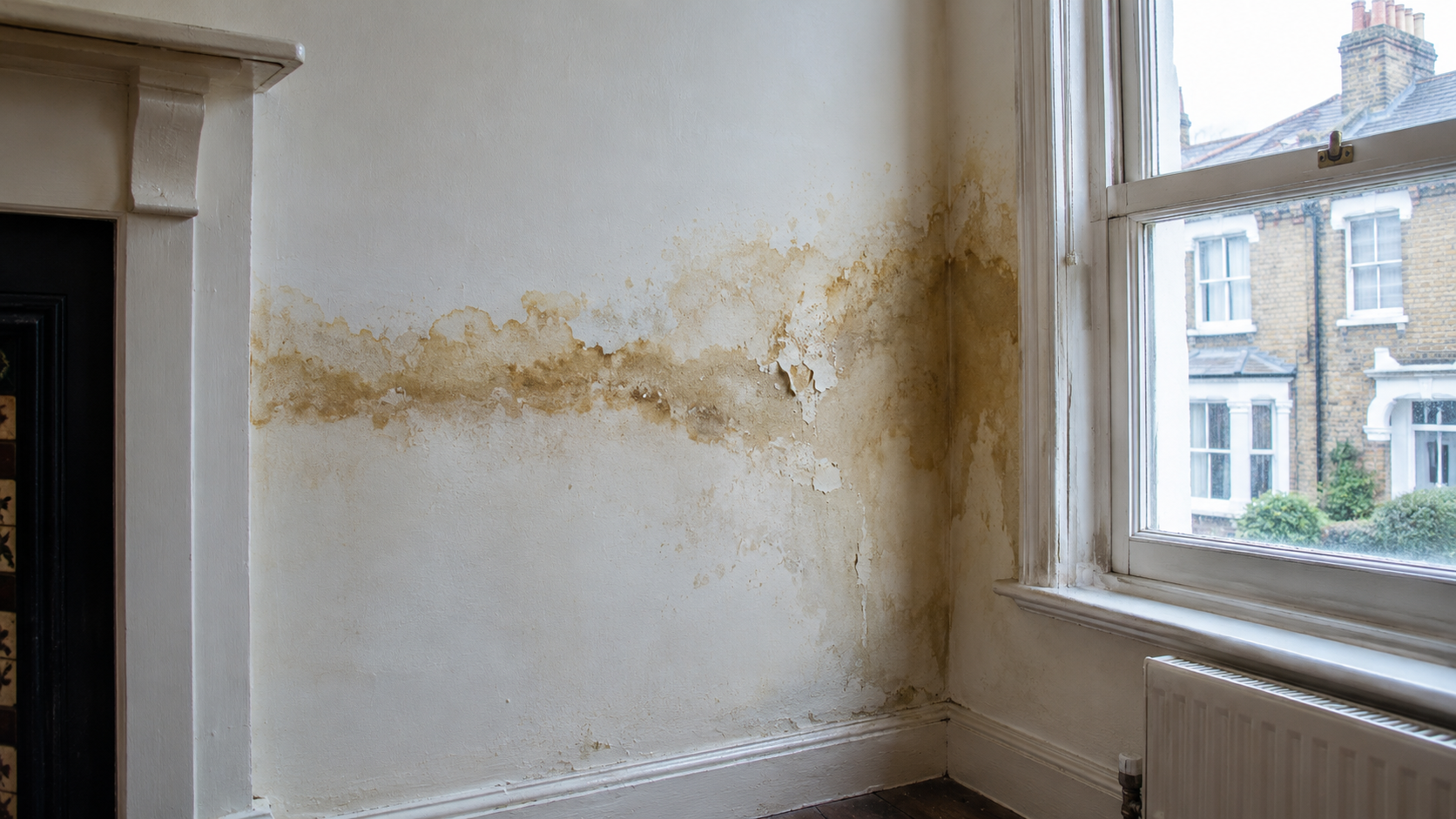
Irregular brown staining at mid-height next to a window is a classic penetrating damp pattern – the source is usually the sill, reveal or wall directly outside.
Signs of penetrating damp: how to recognise it
Because penetrating damp follows the water, the symptoms are rarely uniform. Look for the following, and note where and when they appear:
Damp patches that grow or darken after rain and fade (but never fully disappear) in dry spells. If a patch is worst a day or two after a storm on the exposed, usually south-west-facing wall, you are looking at penetrating damp.
Staining at any height – below a window, around a chimney breast, at ceiling-to-wall junctions, or on the top floor. Rising damp cannot get to the first floor; penetrating damp can.
Irregular brown or yellow tide marks rather than a straight horizontal band, often with blistering or flaking paint and soft, crumbly plaster.
Black mould in the stain itself, particularly in corners and behind furniture where the damp wall stays cold.
Musty smells and wet timber – skirting boards, joist ends or window frames that are soft when probed, which can lead to wet rot or, more seriously, dry rot.
A visible external defect directly outside the mark: a dripping gutter, a split downpipe, crumbling mortar, a cracked sill, spalled bricks or vegetation growing from the brickwork.
An absence of white salt deposits. Hygroscopic salts are a signature of ground moisture; their absence (or a very light dusting) points away from rising damp.
Penetrating damp vs rising damp vs condensation
Misdiagnosis is expensive. Chemical damp-proof course injection is routinely sold for walls that are actually suffering penetrating damp or condensation, and RICS’ own consumer guidance warns that rising damp is “often misdiagnosed”. The table below summarises how a surveyor separates the three.
Feature
Penetrating damp
Rising damp
Condensation
Where it appears
Any height; follows the external defect
Ground floor only, up to c. 1 m
Cold spots: corners, behind wardrobes, window reveals, north walls
Pattern
Localised, irregular patches or rings
Horizontal tide mark with salt band
Speckled black mould, beads of water on glass
Timing
Worse after rain or during leaks
Fairly constant year-round
Worse in winter, mornings and poorly ventilated rooms
Address bridging/ground level; DPC only if truly needed
Ventilation, heating pattern, insulation
For condensation-driven problems, which account for the largest share of damp complaints, see our guide to tackling condensation and mould.
What causes penetrating damp?
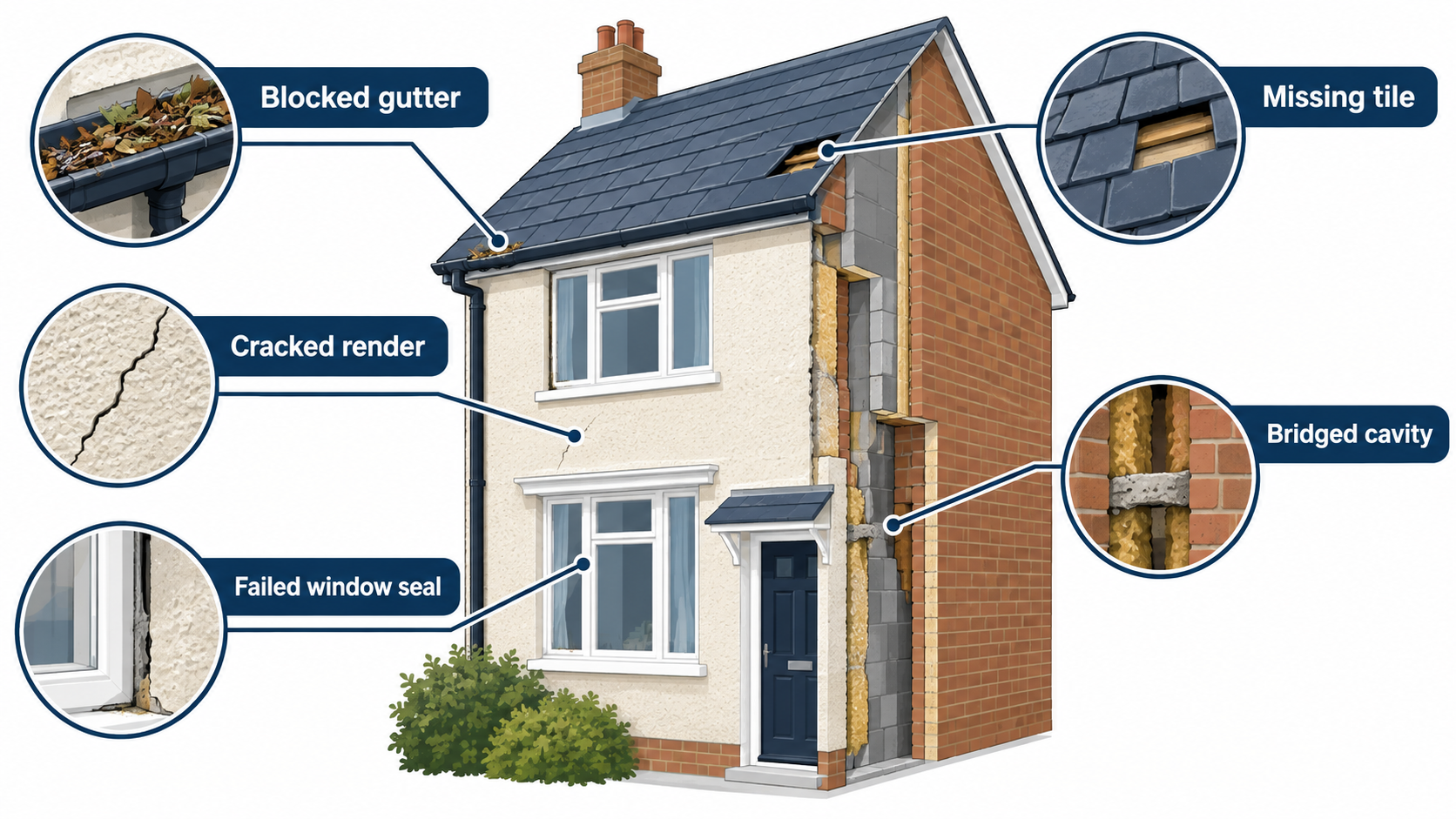
Almost every case comes down to one of a short list of maintenance or construction defects. In our surveyors’ experience the most common culprits in UK housing are:
Rainwater goods
Blocked, sagging, cracked or undersized gutters and downpipes discharge water straight onto the wall below. A single overflowing joint can saturate a 2 m strip of brickwork every time it rains, and the internal stain will usually be just below the leak.
Defective pointing and porous masonry
Weathered lime mortar on older houses, or hard cement repointing that has cracked away from soft brick, lets wind-driven rain into the wall. Soft or underfired bricks and stone can themselves become saturated on exposed elevations.
Cracked or debonded render
Hairline cracks in cement render act as funnels: water gets behind the render, cannot evaporate back out, and travels inwards. Hollow-sounding render is a reliable warning sign.
Roof, flashing and chimney defects
Slipped tiles, perished lead flashings, open valleys, cracked chimney flaunching and failed parapet copings all admit water from above – which is why top-floor ceilings and chimney breasts are such frequent locations. Our roof leak detection guide explains how to trace these.
Windows, doors and sills
Perished mastic, missing drip grooves under sills, and cracked or back-falling concrete sills channel water into the reveal. This is the usual explanation for a damp patch under a window.
Bridged or filled cavities
Mortar droppings on wall ties, debris at the base of the cavity, or saturated cavity wall insulation on an exposed wall can carry water across to the inner leaf. See our guides to wall ties and cavity wall insulation problems.
Plumbing leaks and raised ground levels
A weeping bath seal, shower tray or radiator pipe can mimic penetrating damp on the floor below, while paths, patios or flower beds built up above the damp-proof course push water into the wall above it.
The usual suspects: most penetrating damp traces back to one of these five external defects.
How does a surveyor diagnose penetrating damp?
A proper diagnosis follows the water from outside in rather than reading a single meter on a single day. A suitably qualified, accredited surveyor will typically:
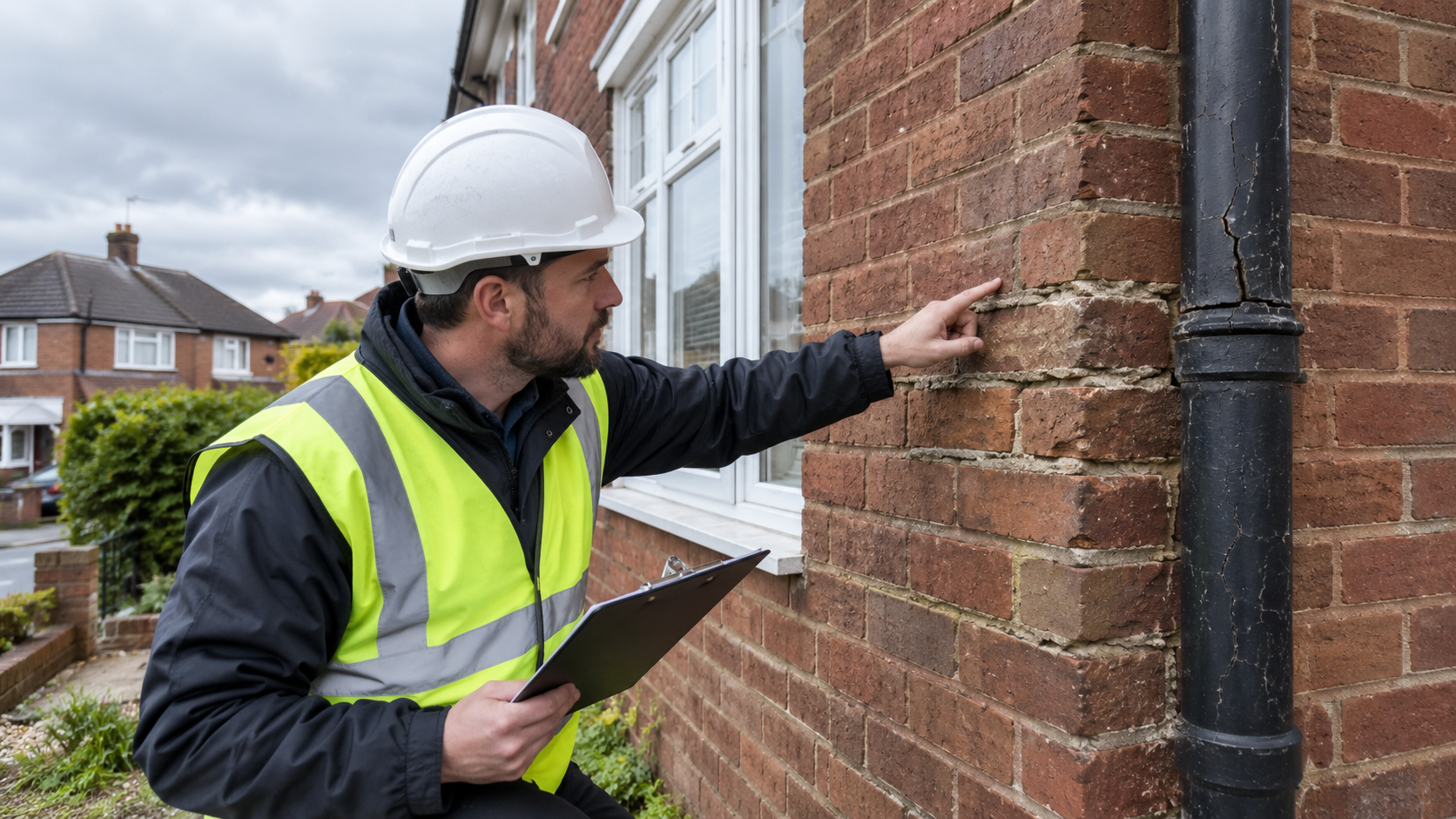
Inspect the external envelope first – gutters, downpipes, pointing, render, sills, flashings, copings and ground levels – and map every defect against the internal staining.
Profile moisture across the wall with an electrical moisture meter, taking readings in a grid at several heights and comparing affected with unaffected areas. High readings at the top of a wall rule out rising damp.
Check surface and air conditions with a thermo-hygrometer to establish whether the room is condensation-prone, in line with the moisture-management principles of BS 5250:2021.
Use thermal imaging or deep-wall probes where the entry point is hidden, and take drilled samples for laboratory analysis in disputed or complex cases.
Record the pattern over time where possible – a return visit after rain is often more informative than any instrument.
RICS, the Property Care Association and Historic England jointly published a position statement on investigating moisture in traditional buildings, and RICS advises homeowners to choose surveyors who follow it and who have no commercial interest in selling remedial products. That independence is the whole point of a damp and timber report from a surveyor rather than a free “survey” from a contractor. Our article on how surveyors assess damp walks through a typical inspection.
Diagnosis starts outside: eroded joints and a split downpipe will explain most internal stains.
How to fix penetrating damp
The cardinal rule is simple: stop the water getting in, let the wall dry, then repair the finishes. In that order. Internal “damp-proof” paints, foil-backed plasterboard or tanking slurries applied before the external defect is fixed simply trap moisture in the wall, where it finds another way out or quietly rots the timber.
Repair the external defect. Clear and realign gutters, replace split downpipes, repoint eroded joints in a mortar that matches the brick (lime for pre-1920s solid walls), cut out and re-render cracked areas, renew flashings and flaunching, reseal or replace sills, and reduce raised ground levels to at least 150 mm below the damp-proof course.
Deal with the cavity. Where a bridged cavity or saturated insulation is the cause, the bridge needs clearing or the insulation extracting from the affected elevation.
Allow drying. A solid brick wall dries at roughly 25 mm of thickness per month in good conditions, so a 225 mm wall can take four to eight weeks or more. Ventilate, heat gently and resist redecorating early.
Repair internally. Hack off blown or salt-contaminated plaster, replace rotten timber, treat any residual mould and only then replaster and redecorate – ideally with breathable materials on older walls.
Consider breathable protection on exposed elevations. On very exposed solid walls a silane-siloxane water repellent or a lime-based render can reduce rain absorption while still letting the wall breathe. Avoid impermeable masonry paints and cement renders on traditional construction.
Penetrating damp treatment costs in 2026
Costs depend almost entirely on what is letting the water in and whether access needs scaffolding. The figures below are typical 2026 UK ranges drawn from current trade cost guides and our own panel’s experience; London and the South East usually sit at the upper end, and VAT may be added for contractor work.
Repair
Typical 2026 cost
Notes
Independent damp survey / specific defect report
£200–£450
Often included within a Level 3 building survey when buying
Gutter clearing, realignment or replacement
£150–£600
Full replacement of a terrace run can exceed £1,000
Localised repointing
£25–£50 per m² (£500–£2,500 per elevation)
Lime mortar and heritage work cost more
Render patch repair / full re-render of one elevation
£300–£1,200 / £3,000–£8,000
Whole-house rendering £8,000–£15,000
Lead flashing or chimney flaunching renewal
£400–£900
Plus scaffold or tower access
Window sill repair or resealing
£100–£400 per window
Replacement concrete sills cost more
Cavity wall insulation extraction (one elevation)
£1,000–£3,000
Check whether a CIGA guarantee applies
Internal replastering (affected area / full room)
£400–£1,500
Add £300–£600 for skirting replacement
Scaffolding
£800–£1,500+
Often the single biggest line on high-level repairs
Overall: minor single-wall case
£300–£1,500
Gutter or sill fix plus local redecoration
Overall: extensive, with external works and access
£2,000–£5,000+
Multiple elevations, re-render or re-roofing push this higher
If you are buying, these numbers are negotiating material. A clearly diagnosed defect with a costed repair is exactly the kind of evidence that supports a price reduction – our guide to negotiating after a survey explains how to use it.
Penetrating damp and the law in 2026
Penetrating damp is not only a maintenance issue; for rented homes it is increasingly a legal one, and 2026 has brought significant changes.
English Housing Survey (published 29 January 2026): 5%, or about 1.4 million dwellings, had a damp problem in 2024, up from 4% in 2021 and 2022. Penetrating damp affected 2% of homes, serious condensation 3% and rising damp 1%, with the private rented sector worst affected at 10% for any damp. Source: GOV.UK.
Awaab’s Law: since 27 October 2025, social landlords in England must investigate potential significant damp and mould hazards within 10 working days, complete safety works within 5 working days of the investigation concluding, act on emergencies within 24 hours and give tenants a written summary within 3 working days. Government guidance updated on 31 July 2026 confirms that from 30 November 2026 the law extends to excess cold and heat, falls, structural collapse, fire, electrical and hygiene hazards. Penetrating damp through a defective roof or wall is squarely within the existing damp and mould duty.
Private tenants: the Renters’ Rights Act 2025 (Royal Assent 27 October 2025) gives government the power to extend Awaab’s Law to private landlords after consultation; as of autumn 2026 no commencement date has been set. In the meantime the Homes (Fitness for Human Habitation) Act 2018 already allows private tenants in England to take action over damp that makes a home unfit.
Home sellers and buyers: damp must be disclosed honestly on the TA6 property information form, and a surveyor’s report that identifies penetrating damp gives a buyer firm grounds to require repairs or renegotiate.
Penetrating damp when buying a house
Penetrating damp is one of the most common findings in pre-purchase surveys, particularly on Victorian and Edwardian solid-wall houses, 1930s semis with original rainwater goods, and rendered properties of any age. A RICS Home Survey Level 3 (building survey) is the right tool for older or altered homes because the surveyor will inspect the external envelope in detail, take moisture readings throughout and explain the likely cause and repair. A Level 2 survey will flag damp but is less likely to trace the source.
Whatever the level, make sure the person inspecting is independent, suitably qualified and accredited – Survey Merchant’s panel includes chartered building surveyors and residential surveyors regulated by RICS, CIOB and RPSA among other recognised bodies – and ask specifically for a moisture profile and an external defects schedule rather than a one-line “damp noted, specialist report recommended”.
Can I treat penetrating damp myself?
Some causes are genuinely DIY-friendly: clearing gutters, resealing a window with exterior-grade sealant, removing a flower bed that bridges the damp-proof course, or repointing a few joints at ground level. Anything at height, anything involving the roof, chimney or render, and anything where the cause is not obvious should go to a competent contractor – and where the diagnosis is uncertain, to a surveyor first. The most expensive mistake homeowners make is paying for a remedy before anyone has proved the cause.
Why choose Survey Merchant for your penetrating damp survey?
Survey Merchant exists to give homeowners, buyers and landlords an impartial answer to the question “where is this water coming from and what will it cost to stop?”. We recommend using our service for penetrating damp because:
An accredited panel matched to the job: suitably qualified surveyors regulated or accredited by RICS, CIOB, RPSA and other recognised UK bodies, selected for experience with the construction type and age of your property.
Independence: our surveyors diagnose; they do not sell damp-proofing products or treatments, so their advice is not shaped by a sales target.
Nationwide UK coverage with local knowledge of regional construction, exposure and typical defects.
Fast turnaround on inspections and reports, which matters when a purchase or a tenant complaint is waiting on the answer.
Transparent, competitive fixed fees agreed up front – whether you need a specific damp report, a Level 3 building survey, or a damp and timber report for a lender.
End-to-end support: clear, costed recommendations you can hand to a contractor, use in a price negotiation, or rely on in a landlord-tenant dispute.
Localised damp patches or brown staining that get worse after rain, flaking paint or soft plaster at any height of the building, black mould within the stain, and a visible external defect - such as a leaking gutter, eroded pointing or a cracked sill - directly outside the mark.
How do I know if damp is penetrating or rising?
Rising damp only occurs on ground-floor walls, stops at roughly one metre above floor level and leaves a horizontal tide mark with white salt deposits. Penetrating damp can appear anywhere, forms irregular patches that respond to the weather and usually has few or no salts. A moisture profile taken by a surveyor settles it.
How serious is penetrating damp?
Left untreated it damages plaster and decorations, encourages black mould that can affect health, and keeps timber wet enough for wet rot or dry rot to develop. Caught early, most cases are cured by a straightforward external repair and a period of drying out.
How much does it cost to fix penetrating damp in 2026?
Minor cases involving a gutter, sill or small area of pointing typically cost £300 to £1,500 including redecoration. Extensive repairs that need scaffolding, re-rendering, flashing renewal or cavity insulation extraction commonly run from £2,000 to £5,000 or more. An independent survey to pin down the cause costs around £200 to £450.
Will penetrating damp dry out on its own?
Not while the defect remains. Once the external cause is repaired, a solid wall dries at roughly 25 mm of thickness per month, so a 225 mm brick wall usually needs four to eight weeks of ventilation and gentle heating before it is ready to replaster and redecorate.
Does Awaab's Law cover penetrating damp?
Yes. Since 27 October 2025 social landlords in England must investigate significant damp and mould hazards within 10 working days and complete safety works within 5 working days of the investigation concluding, with emergencies acted on within 24 hours. From 30 November 2026 the law also covers hazards such as excess cold, fire and electrical risks. It does not yet apply to private landlords.