Building Surveying
Jul 16, 2026
Wet Rot vs Dry Rot: A Homeowner's Guide to the Signs
Confused about wet rot vs dry rot? Learn the key signs, causes, and risks. Understand when to DIY and when you must call a surveyor for your UK property.

Wet rot is usually a localised timber problem linked to very high moisture, typically about 50% or more, and it's often put right by stopping the leak and repairing the affected wood. Dry rot can start at around 20% moisture content and remain active at roughly 20%, which is why it's treated as the more serious threat when it spreads beyond the obvious damp area.
If you're reading this after finding a musty smell under the stairs, a soft skirting board, or paint lifting near a window, your main concern is probably simple: is this a straightforward repair or the start of something expensive? That's the right question to ask, because the practical difference between wet rot and dry rot isn't academic. It affects how far the damage may have travelled, how intrusive the investigation needs to be, and whether you're facing a targeted repair or a much broader programme of remedial work.
Many homeowners try to tell the difference by colour, smell, or surface appearance alone. That's understandable, but it's where costly mistakes happen. Wet rot often stays where the moisture is. Dry rot is the one surveyors worry about because it may extend into concealed timbers and adjacent areas that don't look obviously wet.
A common sequence goes like this. A homeowner notices a stale smell in the front room, then finds a skirting board that gives slightly under thumb pressure. A week later, they spot old staining near the chimney breast or bubbling paint around a window reveal and start wondering whether it's just damp, or something more serious.
That's where timber decay enters the conversation. In UK homes, the two terms people hear most often are wet rot and dry rot. Both are fungal decay in timber. Both need moisture to begin. But they behave very differently once conditions suit them, and that difference is what drives the repair strategy.
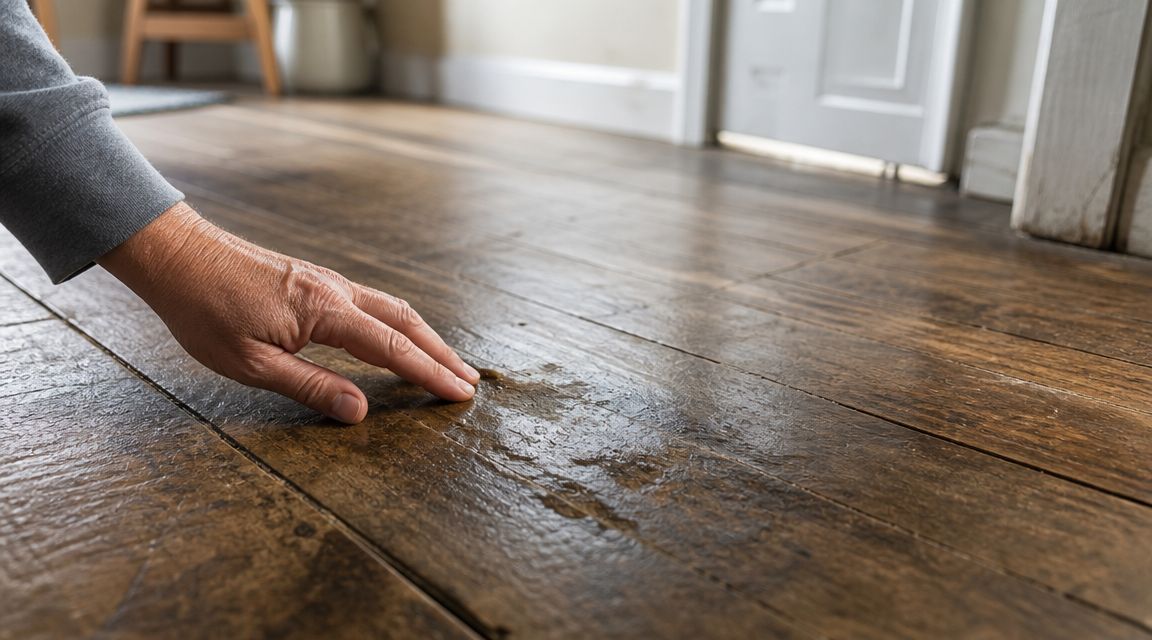
The first clue is rarely a fungus fruiting body. More often, it's one of these practical signs:
Wet rot is usually tied to an active and fairly obvious moisture source such as a plumbing leak, overflowing gutter, failed seal around joinery, or prolonged rain penetration. Dry rot concerns surveyors more because the visible defect may only be a small part of the story.
Wet rot tends to be a containment problem. Dry rot can become an investigation problem.
That's why homeowners, buyers, and sellers need more than a visual guess. If you misread localised wet rot as harmless cosmetic damage, timber keeps decaying. If you mistake early dry rot for simple damp-related softness, the fungus may keep moving through concealed parts of the building while you're only repairing the surface.
Wet rot is the more straightforward of the two, not because it's harmless, but because its behaviour is usually easier to track. It develops where timber stays persistently wet. In practice, that means there is normally a direct moisture source nearby.
When I inspect suspected wet rot, the pattern is often tight and local. The timber may look darkened, soft, or spongy, and it can feel damp under the surface. Paint over the affected area may peel or blister because the moisture below has nowhere to go.
You may also see cracking in the timber, though the key point is that the damage is typically centred on the wettest part of the defect. Think of a leaking window sill, the base of a door frame exposed to repeated rainwater, or floor timbers near a plumbing leak.
Wet rot usually appears where water has a clear route in and poor conditions for drying out. Typical locations include:
A leaking balcony detail can also create the kind of persistent moisture that damages adjacent timbers and finishes. If that sounds familiar, these pro tips for balcony waterproofing are useful for understanding how water gets through failed coverings and junctions.
A careful homeowner can carry out a simple first check. Press a blunt tool or screwdriver gently into suspect wood. If it sinks in easily and the timber compresses with a soft, damp feel, that supports the case for wet rot. Don't gouge into structural timber, and don't treat this as a final diagnosis.
Practical rule: If the timber defect sits right beside an obvious leak or rainwater defect, wet rot moves higher up the list.
What doesn't work is painting over it, filling the surface, or replacing a small timber section before dealing with the moisture source. Wet rot is a moisture problem first and a carpentry problem second. If the leak remains, the repair won't last.
Dry rot worries homeowners because the visible symptom may be the least important part of the defect. Of greater concern is its ability to move beyond the original damp source and reach new timber in concealed parts of the building.
In building-survey practice, dry rot is the more aggressive decay mechanism because it can move beyond the visibly damp source area, while wet rot is usually confined to timber that remains chronically wet. One practical benchmark used by UK timber specialists is that wet rot is associated with timber moisture content around 50%, while dry rot can develop at roughly 20% moisture content, so surveyors assess both the extent of spread and the moisture regime rather than appearance alone, as noted by Timberwise on identifying the differences between wet rot and dry rot.
Dry rot often leaves timber brittle rather than soft. Wood may crack into deeper cuboidal patterns and break rather than compress. In concealed voids, you may find white cotton wool-like growth, sometimes with a yellowish tinge, and grey root-like strands that indicate the fungus has been travelling.
A strong musty or mushroom-like smell is another clue. In more advanced cases, there may be a fruiting body and rust-red spore dust nearby. By the time those signs appear, the defect usually needs careful tracing rather than surface repair.
Dry rot often turns up in places homeowners don't inspect routinely:
This is why people get caught out. The front room floor may only feel slightly springy, but the decay can extend to joists, wall plates, or hidden timber abutting masonry.
A dry-looking surface doesn't rule out dry rot. The fungus needs moisture to begin, but once established it may be found beyond the place where the original water entered. That's the dangerous part for buyers and owners alike. They see one patch of damage and assume one patch of repair.
If timber looks dry but breaks with a brittle, cuboidal fracture, don't assume the problem has already stopped.
Dry rot demands a more sceptical inspection. You're not just asking what's visible. You're asking where the moisture came from, where it went, which timbers are connected to the affected zone, and whether the fungus has crossed into adjacent concealed areas.
The simplest way to understand wet rot vs dry rot is this: one usually stays near the moisture source, the other may not. That difference changes the inspection method, the risk to hidden structural timbers, and the likely scale of repairs.
A widely used benchmark in UK building practice is that wet rot is typically associated with timber moisture content of about 50% or more, whereas dry rot can start at around 20% moisture content and remain active at roughly 20%, making dry rot viable at substantially lower moisture levels once conditions are right, according to this UK rot guidance.
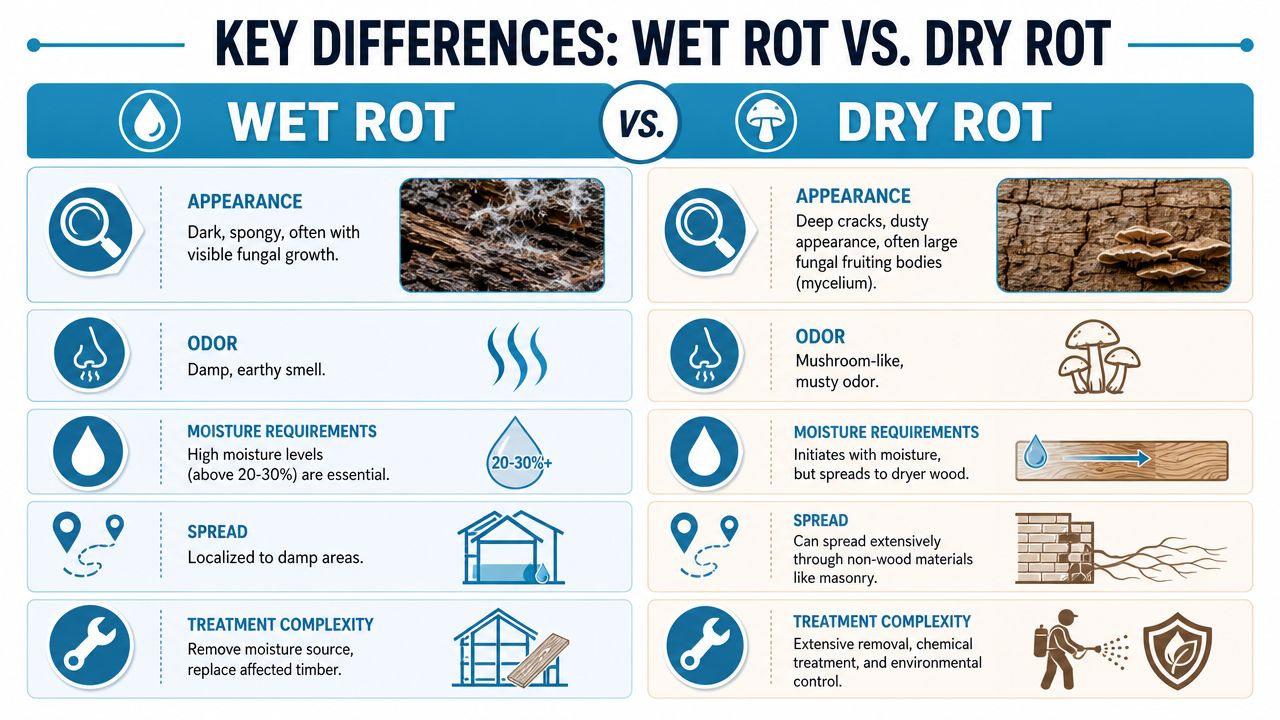
| Feature | Wet Rot | Dry Rot |
|---|---|---|
| Moisture pattern | Usually linked to a clear, ongoing source of significant wetting | Can establish at lower moisture levels once conditions suit it |
| Typical timber feel | Soft, spongy, damp | Brittle, dry-looking, prone to fracture |
| Spread behaviour | Usually confined to timber that remains wet | Can move beyond the visibly damp area |
| Common locations | Window frames, leaking roof timbers, plumbing zones, external joinery | Under floors, enclosed voids, joist ends, hidden structural areas |
| Visual clues | Darkened timber, localised decay, peeling paint | Cuboidal cracking, mycelium, strands, possible spore dust |
| Repair scope | Often targeted once the leak is fixed | Often broader, with opening up and tracing required |
| Risk of hidden damage | Moderate and usually linked to the same local defect | Higher because spread may outstrip what's visible |
Wet rot is usually a contained moisture defect. Dry rot is a spreading timber defect with a moisture cause.
That's the point many articles miss. Homeowners often compare colour, smell, or fungus shape as if that alone settles the diagnosis. In practice, surveyors weigh three things together: moisture readings, the physical condition of the timber, and whether the pattern suggests spread beyond the source area.
Here's a useful technical crossover. A UK-relevant treatment threshold often cited is that dry rot typically requires sustained moisture content above about 28–30% in the wood and very high surrounding humidity, while wet rot is commonly linked to sustained moisture contact above roughly 23–25%. The practical implication is that keeping timber below those levels is the key control measure for preventing recurrence, as outlined in this technical timber decay reference.
The video below gives a helpful visual overview before you assess your own property.
Treatment always starts in the same place. You find and fix the moisture source. Everything else comes after that. If the building stays damp, timber decay treatment becomes temporary at best.
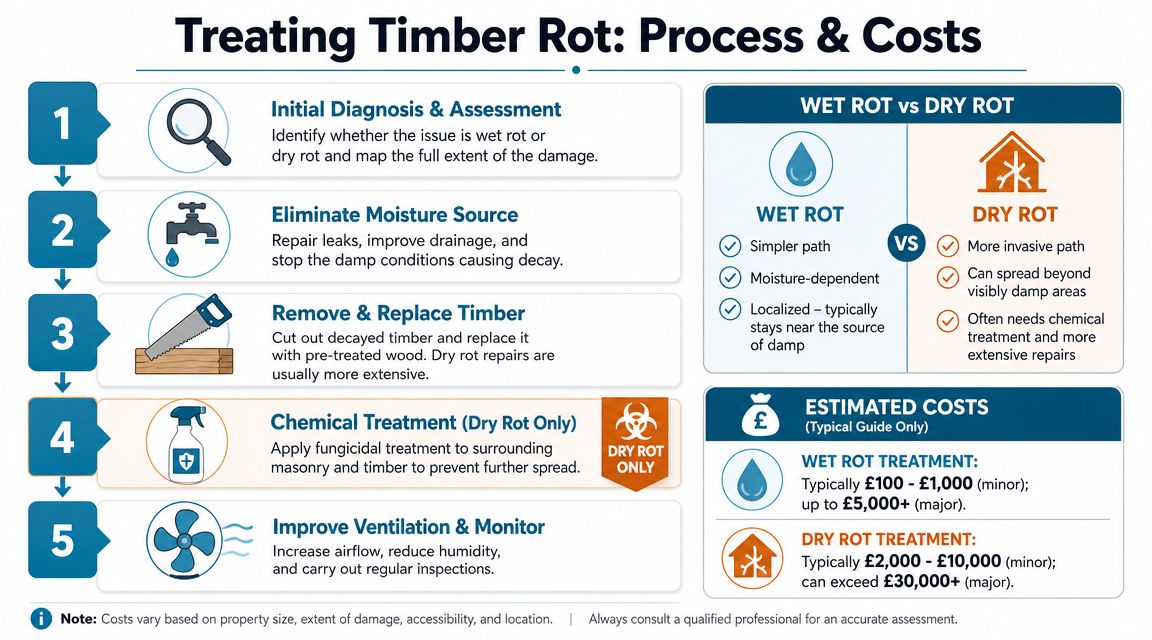
Wet rot repairs are usually more linear. You identify the source of water ingress, stop it, allow the area to dry, and then decide whether the timber can be retained, repaired, or needs replacing.
In practical terms, that often means:
For localised wet rot, the cost and disruption are often moderate because the work is limited to the damaged zone and its direct cause. The complication comes when “wet rot” has been present for a long time and joist ends, floor finishes, plaster, or embedded wall timbers have all been affected.
Dry rot is different because the repair isn't limited to what you can see. The affected area often has to be opened up to establish the full spread. That can involve lifting floorboards, removing skirtings, opening wall linings, and exposing hidden timber abutments.
A typical dry rot approach includes:
Dry rot treatment fails when contractors only replace the visibly damaged timber and leave the hidden environment unchanged.
Costs vary widely because the bill is usually driven by access, extent, and the structural role of the affected timber. A small localised window repair is one thing. Opening up suspended floors, replacing joists, treating concealed areas, and reinstating finishes is another.
What matters financially is the difference between targeted repair and investigative repair. Wet rot more often falls into the first category. Dry rot frequently falls into the second. That's why an accurate diagnosis early on can save a homeowner from wasting money on the wrong trade at the wrong stage.
When budgeting, think in layers rather than one headline number:
If you're buying a property, ask not just “what will the timber treatment cost?” but “what else must be opened, removed, dried, and reinstated to complete the repair properly?” That's the question that protects your budget.
The most common homeowner question is whether they can tell wet rot from dry rot themselves. Sometimes you can form a sensible first impression. You can notice the smell, prod the timber, look for a leak, and decide whether the defect appears tightly localised. But that's not the same as diagnosis.
UK-focused guidance consistently points to the same problem. Visible symptoms can be misleading, and fungal decay is driven by moisture. The UK Health and Safety Executive is noted in this practical rot guide as recognising that dry rot can spread beyond the obvious damp area, which is exactly why a decision tree matters for homeowners and buyers.

There are situations where a defect may prove relatively contained, especially if:
Even then, caution matters. Monitoring isn't the same as ignoring.
Arrange a proper inspection if any of these apply:
For anyone navigating a purchase or trying to separate cosmetic damp issues from structural timber decay, it helps to start by understanding damp and timber surveys.
A wrong diagnosis doesn't just delay repair. It changes the scope of work, the budget, and the risk to the structure.
A surveyor's value is not merely naming the fungus. It's determining the likely cause, likely extent, what needs opening up, what can remain, and which repairs are proportionate. That protects both the building and your money.
No. Paint hides evidence and can trap moisture in the timber. If the substrate is already decayed, decoration only delays proper repair and makes later diagnosis harder.
Not always. Some timber can be retained if decay is slight, the moisture source has been removed, and the remaining section is still sound. Severely weakened timber, especially structural timber, usually needs cutting out and replacing or repairing properly.
Sometimes the active conditions are removed, but that doesn't mean the timber has regained strength or that concealed spread wasn't already established. Drying out is essential, but it isn't the same as certifying the structure as sound.
No. A musty smell tells you moisture and poor ventilation may be present, not which form of decay you have. Smell is a clue, not a conclusion.
Many policies treat rot as a maintenance-related issue rather than a sudden insured event, though cover depends on the policy wording and the cause of the moisture. Don't assume cover. Check the policy and the insurer's approach to escape of water, storm damage, and gradual deterioration.
Good prevention is mostly ordinary building maintenance carried out consistently:
It could be, or both defects may exist together in older timber. If you're seeing flight holes, frass, or suspect insect damage as well as damp-related weakness, it's worth learning more about property protection from woodworm.
If you've found soft timber, a musty smell, or signs of spreading decay, the safest next step is to get an impartial assessment from a qualified surveyor. Survey Merchant connects homeowners, buyers, and property professionals with experienced UK surveyors who can identify the cause, assess the extent, and give clear advice on the right remedial work before costs escalate.
Survey Merchant provides vetted RICS surveyors across 100+ UK locations at fixed fees:
→ Level 2 Home Survey (HomeBuyer Report)
→ Level 3 Building Survey (full structural survey)
→ RICS Red Book property valuations
→ Party wall surveyors — notices, awards & schedules of condition
→ Expert witness surveyors — CPR Part 35 reports for property disputes