Building Surveying
Jul 16, 2026
How surveyors assess damp: a homeowner's guide
Discover how surveyors assess damp in homes. Learn about tools, methods, and what to expect during your damp survey. Get informed today!

A damp survey is a structured diagnostic process in which a qualified surveyor uses calibrated instruments, visual inspection protocols, and thermal imaging to identify the presence, type, and source of moisture in a property. Understanding how surveyors assess damp matters whether you are buying a house, managing a rental, or dealing with a persistent stain on a wall. The process is far more systematic than most homeowners expect, and the findings carry real weight in negotiations, insurance claims, and treatment decisions. Recognised bodies such as the Royal Institution of Chartered Surveyors (RICS) and the Property Care Association set the standards that qualified surveyors follow.
Surveyors rely on a defined set of instruments to detect dampness accurately. The choice of tool depends on the material being tested and the type of damp suspected.
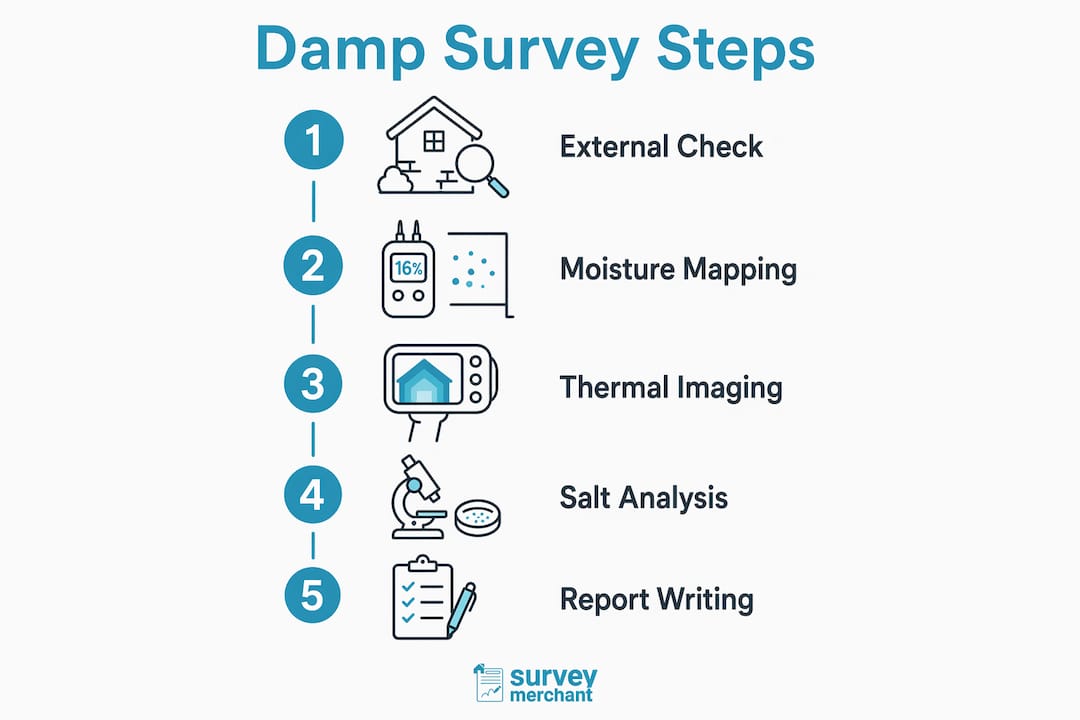
The moisture meter is the surveyor’s primary instrument. Pin meters measure electrical conductance between two metal probes inserted into a surface, while pinless meters use radio frequency scanning to detect moisture without breaking the surface. Each type has strengths. Pin meters give precise localised readings; pinless meters cover larger areas quickly and suit delicate finishes. Surveyors record readings on two scales: Wood Moisture Equivalent (WME) for timber, and a relative scale for masonry and plaster.

Thermal imaging reveals concealed moisture patterns behind plasterwork, under floors, and within wall cavities. The camera detects temperature differences caused by evaporative cooling where moisture is present. Cold bridging, which occurs where insulation is absent or defective, also shows up clearly. Thermal imaging catches what the naked eye cannot, making it an integral part of any thorough damp inspection.
A hygrometer measures relative humidity in the air. Surveyors use it to assess whether condensation is a likely cause of dampness. High indoor humidity combined with cold surfaces creates the conditions for surface condensation, which is the most common form of damp in UK homes. Recording environmental conditions at the time of inspection gives context to every meter reading taken.
Standard methodology starts externally, with the surveyor checking gutters, downpipes, pointing, render, window sills, and roof coverings for defects that could allow water ingress. The internal inspection then follows a systematic pattern: walls are read at specific height bands (typically 0–300mm, 300–600mm, and 600–1,200mm from floor level), floors are checked for sub-floor ventilation, and roof spaces are inspected for condensation or leaks. This height profiling is not arbitrary. Rising damp, penetrating damp, and condensation each produce distinct moisture patterns at different heights.
Pro Tip: Ask your surveyor to show you the moisture meter readings in real time during the inspection. Seeing the numbers change as the probe moves up the wall gives you an immediate sense of where the problem is concentrated.
A moisture meter reading alone is not a diagnosis. Moisture meters measure electrical response, not direct water content. The same reading can result from genuine dampness, hygroscopic salts attracting atmospheric moisture, or a dense material with naturally high conductance. Interpretation requires context, baseline comparisons, and professional judgement.
Industry thresholds for concern start at moisture levels over 17% WME in timber and above 1,000 units on the relative scale in plaster. These figures are screening guidelines, not absolute verdicts. A reading of 950 in a wall adjacent to a leaking gutter is more significant than a reading of 1,050 in a wall with a history of hygroscopic salt contamination. The threshold tells you where to look harder, not what the problem is.
The spatial pattern of readings matters as much as the figures themselves. Rising damp typically produces a band of elevated readings that decreases with height, rarely exceeding 1.2 metres. Penetrating damp concentrates around a specific defect: a failed window seal, a cracked lintel, or a blocked cavity. Condensation produces widespread elevated humidity readings across cold surfaces, often with no clear external source. A surveyor who maps readings across the whole wall, rather than taking a single spot check, can distinguish between these types reliably.
In complex cases, professional diagnosis aligns with Property Care Association Code of Practice and may include gravimetric testing or salt analysis. Salt analysis involves taking a small sample of plaster or masonry and testing it for chlorides, nitrates, and sulphates. Chlorides and nitrates indicate active rising damp or contamination from ground salts. Sulphates often point to historic damp or building material chemistry. This distinction matters enormously. A wall contaminated with hygroscopic salts will give elevated meter readings even after the original damp source has been fixed, and treating it with a chemical damp-proof course would be both unnecessary and expensive.
| Reading type | Likely cause | Recommended next step |
|---|---|---|
| High WME in timber at low level | Rising damp or sub-floor condensation | Check sub-floor ventilation and DPC condition |
| Elevated relative scale in plaster, decreasing with height | Rising damp pattern | Salt analysis to confirm active versus historic |
| Localised high readings near window or roof junction | Penetrating damp from defect | External inspection of the specific junction |
| Widespread elevated humidity, no external source | Condensation | Hygrometer readings and ventilation assessment |
Pro Tip: Always ask for a control reading taken from an unaffected internal wall. Without a baseline, elevated readings in a suspect area have no reference point and can be misread.
A specialist damp survey report is a written, evidence-based document. Verbal-only reports lacking mapped moisture readings, photographic evidence, and clear cause statements should be avoided. They offer no protection in a dispute and no reliable basis for treatment decisions.
A thorough written report contains:
Specialist damp survey reports provide objective evidence that is vital for property negotiations and insurance purposes. If a survey reveals active penetrating damp caused by a failed roof, that documented finding gives a buyer a concrete basis to renegotiate the purchase price or require remediation before exchange. Insurers also require written evidence of cause and extent before they will consider a claim related to damp damage.
The difference between a specialist damp report and a standard RICS Level 2 or Level 3 survey is significant. RICS HomeBuyer and Building Surveys are primarily visual and carry only basic spot checks. They flag damp as a concern and recommend further investigation. They do not provide the systematic moisture mapping, thermal imaging, or salt analysis that a specialist report delivers. For a full picture of damp and timber findings, a dedicated specialist survey is the only reliable option.
Most homeowners commission a specialist damp survey after a standard building survey flags a concern. That is a reasonable trigger, but it is not the only one.
Situations that warrant a specialist survey include:
On cost, a specialist damp survey typically costs between £300 and £600 for a standard residential property. That figure is modest relative to the cost of unnecessary chemical treatments, which can run into thousands of pounds when based on a misdiagnosis. Commissioning a survey early, before making an offer or before instructing a contractor, gives you the clearest picture at the lowest financial risk.
Surveyors accredited by the British Damp and Mould Association (BDMA) or operating under the Property Care Association Code of Practice carry the professional standards that protect you from poor diagnosis. Always check accreditation before booking. Surveymerchant connects property owners with qualified damp surveyors across the UK, matching clients to the right specialist for their property type and location.
A surveyor’s damp assessment combines systematic moisture mapping, thermal imaging, and salt analysis to produce a diagnosis that a meter reading alone cannot deliver.
| Point | Details |
|---|---|
| Moisture meters need context | Readings above 17% WME in timber or 1,000 units in plaster signal concern, but require pattern analysis and baseline comparisons to mean anything. |
| Thermal imaging finds hidden damp | Cameras detect moisture behind surfaces and cold bridging that visual inspection misses entirely. |
| Salt analysis confirms the cause | Gravimetric and salt testing distinguishes active rising damp from hygroscopic salts, preventing unnecessary chemical treatments. |
| Written reports are non-negotiable | A mapped, photographic, evidence-based report is the only reliable basis for negotiation, insurance, and treatment planning. |
| Standard surveys are not enough | RICS Level 2 and Level 3 surveys flag damp visually but do not replace a specialist diagnostic investigation. |
The most expensive mistakes I have seen in property transactions do not come from surveyors missing damp. They come from surveyors misidentifying it. A wall with hygroscopic salt contamination will read high on a moisture meter for years after the original leak has been fixed. Without salt analysis, that reading looks like active rising damp. The homeowner gets quoted for a chemical damp-proof course, pays several thousand pounds, and the readings stay elevated because the salts are still there. The damp was never active. The treatment was never needed.
The second pattern I see repeatedly is the verbal-only report. A surveyor visits, takes some readings, and tells the homeowner verbally that they need a new DPC. No map, no photographs, no written cause statement. That is not a diagnosis. It is a sales pitch dressed as professional advice. Experts are clear that verbal-only damp reports recommending costly treatments without evidence-based analysis risk unnecessary and ineffective work.
What actually works is methodical. External fabric first, then internal mapping at defined height bands, then environmental readings, then a written report with photographs and a clear cause statement. When a surveyor follows that sequence, the diagnosis is defensible. When they skip steps, the homeowner pays for it later. If your surveyor cannot show you a moisture map and a written cause diagnosis, ask why not.
— Surveymerchant
Damp problems rarely resolve themselves, and a misdiagnosis costs far more than the survey itself.

Surveymerchant connects homeowners and property buyers with RICS-qualified and BDMA-aligned surveyors who carry out thorough damp assessments across the UK. Every surveyor on the panel follows a systematic methodology: external inspection, calibrated moisture mapping, thermal imaging, and a full written report with cause diagnosis and treatment recommendations. Whether you need a Level 3 building survey with specialist damp investigation or a standalone moisture assessment for a specific concern, Surveymerchant matches you to the right professional for your property. Book a consultation and get the evidence you need before you commit.
A damp survey is a specialist diagnostic inspection that uses calibrated moisture meters, thermal imaging, and environmental readings to identify the type, cause, and extent of dampness in a property. It produces a written report with mapped readings, photographs, and treatment recommendations.
A thorough damp survey of a standard residential property typically takes two to four hours, depending on the size of the property and the number of affected areas requiring detailed investigation.
No. RICS Level 2 and Level 3 building surveys are primarily visual and include only basic spot checks for damp. They flag concerns and recommend further investigation but do not provide systematic moisture mapping or thermal imaging.
Hygroscopic salts left in masonry from historic damp attract atmospheric moisture and produce elevated meter readings even when no active water ingress is present. Salt analysis is the only reliable way to distinguish this from genuine active damp.
A specialist damp survey for a standard residential property costs between £300 and £600. That cost is substantially lower than the expense of unnecessary treatments based on a misdiagnosis.
Survey Merchant provides vetted RICS surveyors across 100+ UK locations at fixed fees:
→ Level 2 Home Survey (HomeBuyer Report)
→ Level 3 Building Survey (full structural survey)
→ RICS Red Book property valuations
→ Party wall surveyors — notices, awards & schedules of condition
→ Expert witness surveyors — CPR Part 35 reports for property disputes