We use cookies to improve your experience on our site, analyze site traffic, and assist in our marketing efforts. By clicking "Accept all," you agree to the storing of cookies on your device. You can choose to "Reject all" non-essential cookies. For more information, please read our Cookie Policy.
A complete 2026 guide to the damp proof course in UK homes, covering how a DPC works, physical and chemical types, replacement costs, signs of failure or bridging, and 2026 legal changes on damp.
A damp proof course is one of the least glamorous parts of a house and one of the most misunderstood. Every year UK homeowners spend thousands on chemical injection to cure “rising damp” that turns out to be a blocked gutter or a raised patio. This 2026 guide explains what a damp proof course is, how to tell whether yours has failed or simply been bridged, what a replacement really costs, and when you should call an independent surveyor before a damp-proofing contractor.
Key takeaways
A damp proof course (DPC) is a horizontal moisture barrier built into a wall, usually about 150mm above outside ground level, to stop groundwater rising through masonry by capillary action.
Most UK homes built after the late 1800s have an original DPC of slate, bitumen or, since the 1970s, polythene. RICS notes that genuine failure of an original DPC is extremely rare; “rising damp” is far more often caused by a bridged DPC, raised ground levels, leaks or condensation.
A retrofit chemical DPC (injected cream) typically costs £60–£90 per linear metre in 2026, or roughly £350–£2,200 per property before replastering (MyJobQuote, September 2026). The FMB quotes around £240 per metre where plaster and finishes are included.
Get an impartial diagnosis first. Damp-proofing contractors have a commercial interest in selling a DPC; an independent, accredited surveyor does not.
Awaab’s Law has required social landlords to investigate damp and mould within 10 working days since 27 October 2025, and the Renters’ Rights Act 2025 paves the way to extend it to private rentals.
Survey Merchant matches you with a suitably qualified, accredited damp or building surveyor (RICS, CIOB, RPSA and others) anywhere in the UK, with transparent fixed fees.
What is a damp proof course?
A damp proof course is a continuous, impermeable layer built into a masonry wall to stop moisture rising from the ground through the bricks or blocks. It is normally installed at least 150mm above external ground level and is linked to the damp proof membrane beneath a solid floor, forming a sealed barrier around the base of the building.
The physics are simple. Brick, stone and mortar are porous, and porous materials draw water upwards by capillary action, much as a paper towel dipped in water becomes wet above the waterline. Without a barrier, ground moisture can climb the lower part of a wall, carrying with it dissolved salts that stain and damage plaster. The damp proof course interrupts that capillary path.
You will often see the abbreviation DPC, and occasionally “damp course” or “dampcourse”. They all mean the same thing. A damp proof membrane (DPM) is the related sheet laid under a concrete floor slab; the two should lap together so there is no gap through which moisture can pass.
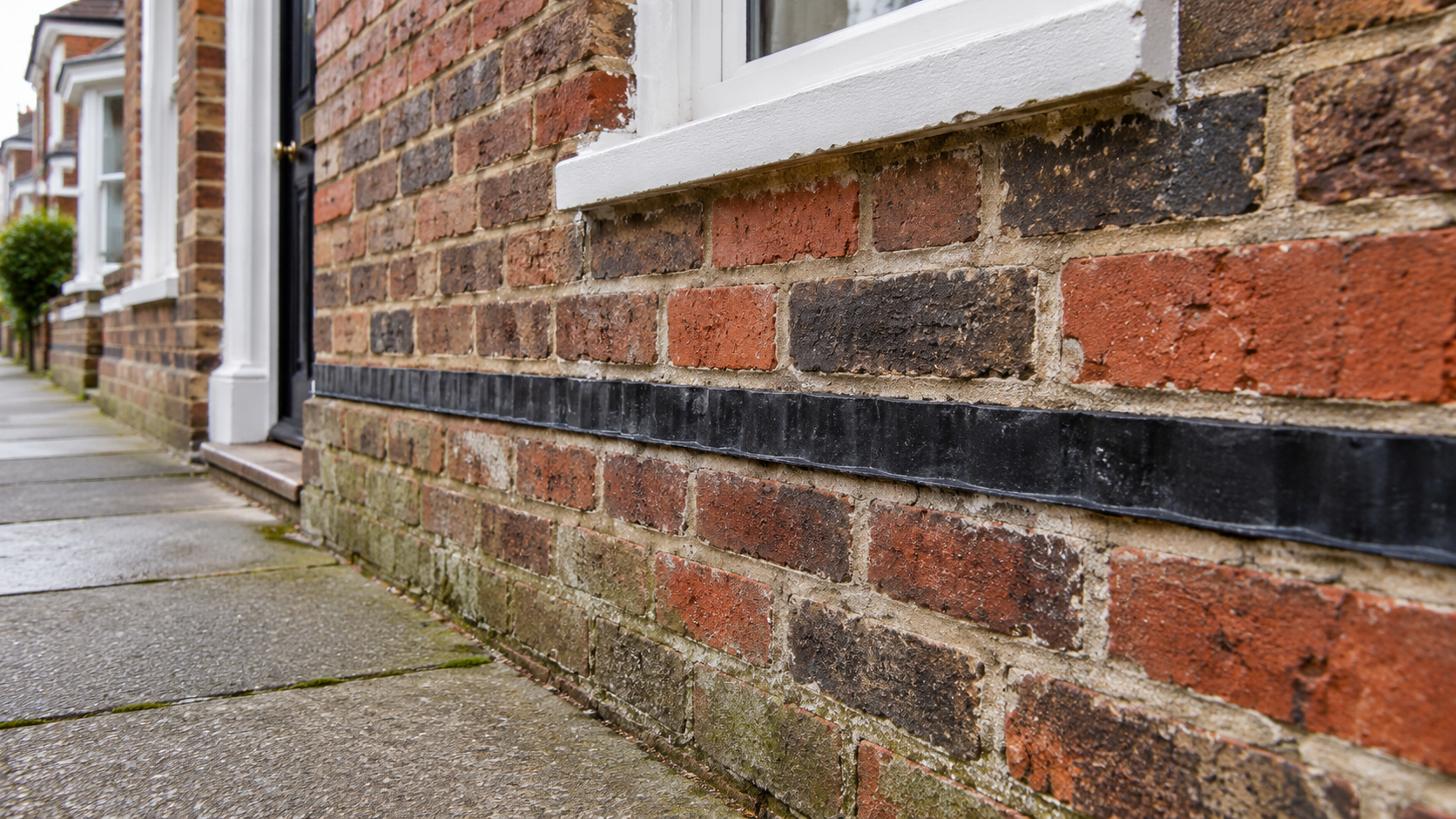
A polythene DPC sits in a mortar joint at least 150mm above ground level. On older homes, look for a line of slate or bitumen instead.
A short history of the DPC in UK homes
Damp proof courses became a requirement in England and Wales with the model building by-laws that followed the Public Health Act 1875, although careful builders had used slate or engineering-brick courses for decades before that. If your house dates from roughly 1880 onwards it almost certainly has an original DPC; many Victorian and Edwardian terraces have two or three courses of slate bedded in mortar. Bitumen felt and lead were common in the early 20th century, and from the 1970s flexible polythene became the norm.
Genuinely pre-1875 cottages, and some rural or stone-built properties, may have no DPC at all. These buildings were designed to breathe: lime mortar, lime plaster and permeable finishes let moisture evaporate as fast as it arrived. That matters when you are deciding how, or whether, to treat damp in an older home, as we explain below. For more on the defects surveyors look for in period housing, see our guide to surveying a Victorian house.
Types of damp proof course
There are two broad families: physical DPCs built in during construction, and remedial systems installed afterwards.
Physical (original) damp proof courses
Slate — two or three courses of overlapping slate. Very durable; failures are usually down to cracking from structural movement rather than the slate itself.
Engineering brick — dense, low-absorption bricks laid in a band near the base of the wall.
Bitumen or bituminous felt — common from the early 1900s. Can become brittle with age but rarely fails outright.
Polythene / plastic — the black strip you can see in the mortar joint of most homes built since the 1970s. Required under Approved Document C of the Building Regulations for new masonry walls.
Remedial (retrofit) damp proof courses
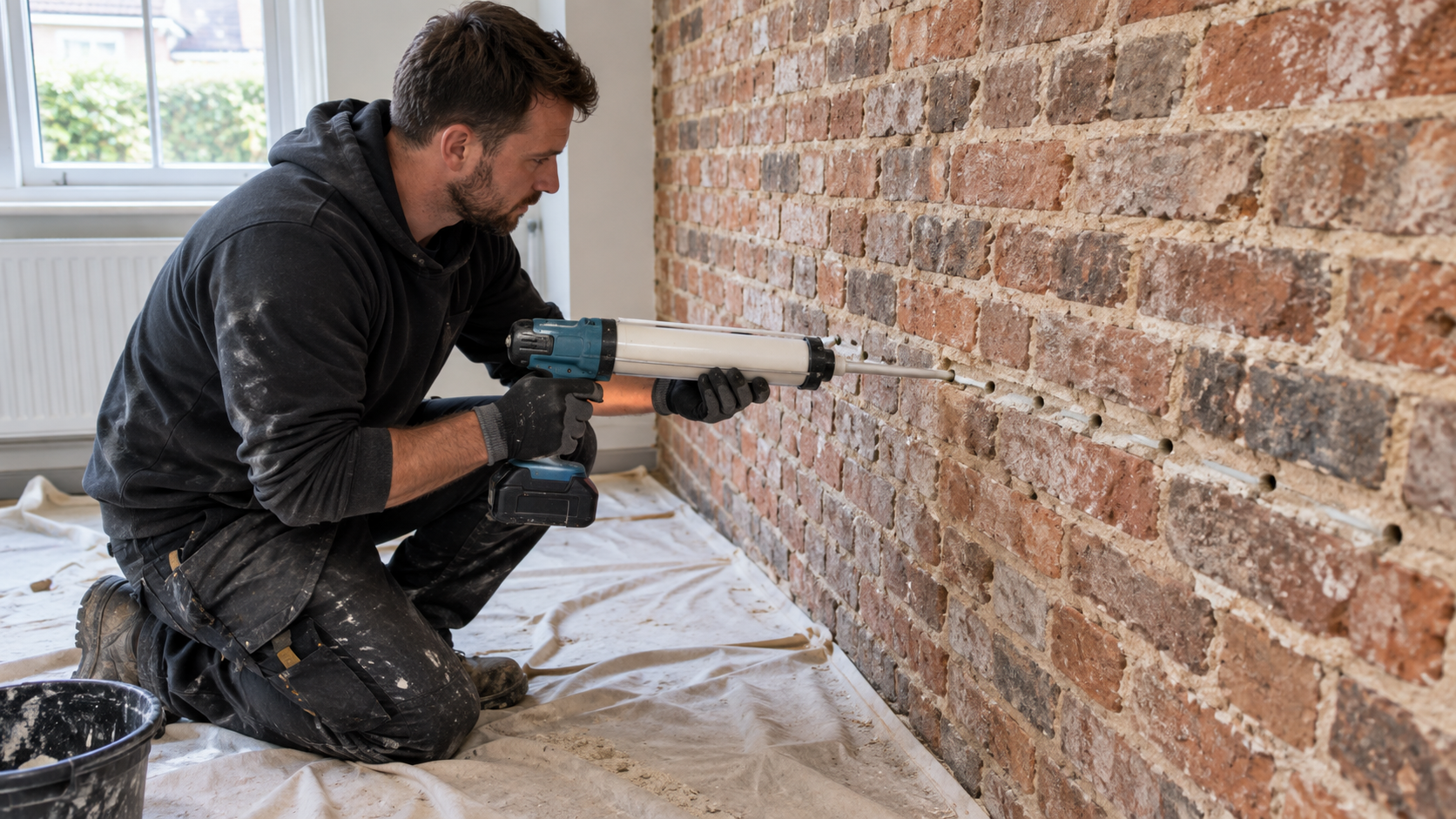
Chemical injection DPC — a silicone-based cream or fluid injected into holes drilled along a mortar joint. It lines the pores of the masonry with a water-repellent barrier. The Property Care Association (PCA) describes it as economically the most viable retrofit option.
Physical insertion — cutting out a mortar bed and inserting a new sheet DPC. Highly effective but slow, expensive and unsuitable for flint, rubble-filled or very thick walls.
Electro-osmotic systems — low-voltage wiring intended to repel moisture. The PCA notes these currently lack British third-party accreditation, so many surveyors and lenders are cautious about them.
Membranes and tanking — studded cavity drainage membranes or cementitious tanking slurries applied to walls. Strictly these manage water rather than stopping rise, and they are usually reserved for basements and below-ground rooms.
How high should a damp proof course be?
Building Regulations guidance (Approved Document C, requirement C2) expects the DPC to sit at least 150mm above the finished external ground level. That gap stops rain splashing back above the barrier and keeps soil, paving and planting from bridging it. If a patio, path, flower bed or render has been built up so that the outside ground is level with or above the DPC, moisture can simply bypass it. This “bridging” is one of the most common causes of damp at low level in British homes, and it is far cheaper to fix than injecting a new DPC.
Signs your damp proof course has failed or been bridged
Typical symptoms of moisture rising above a defective or bridged DPC include:
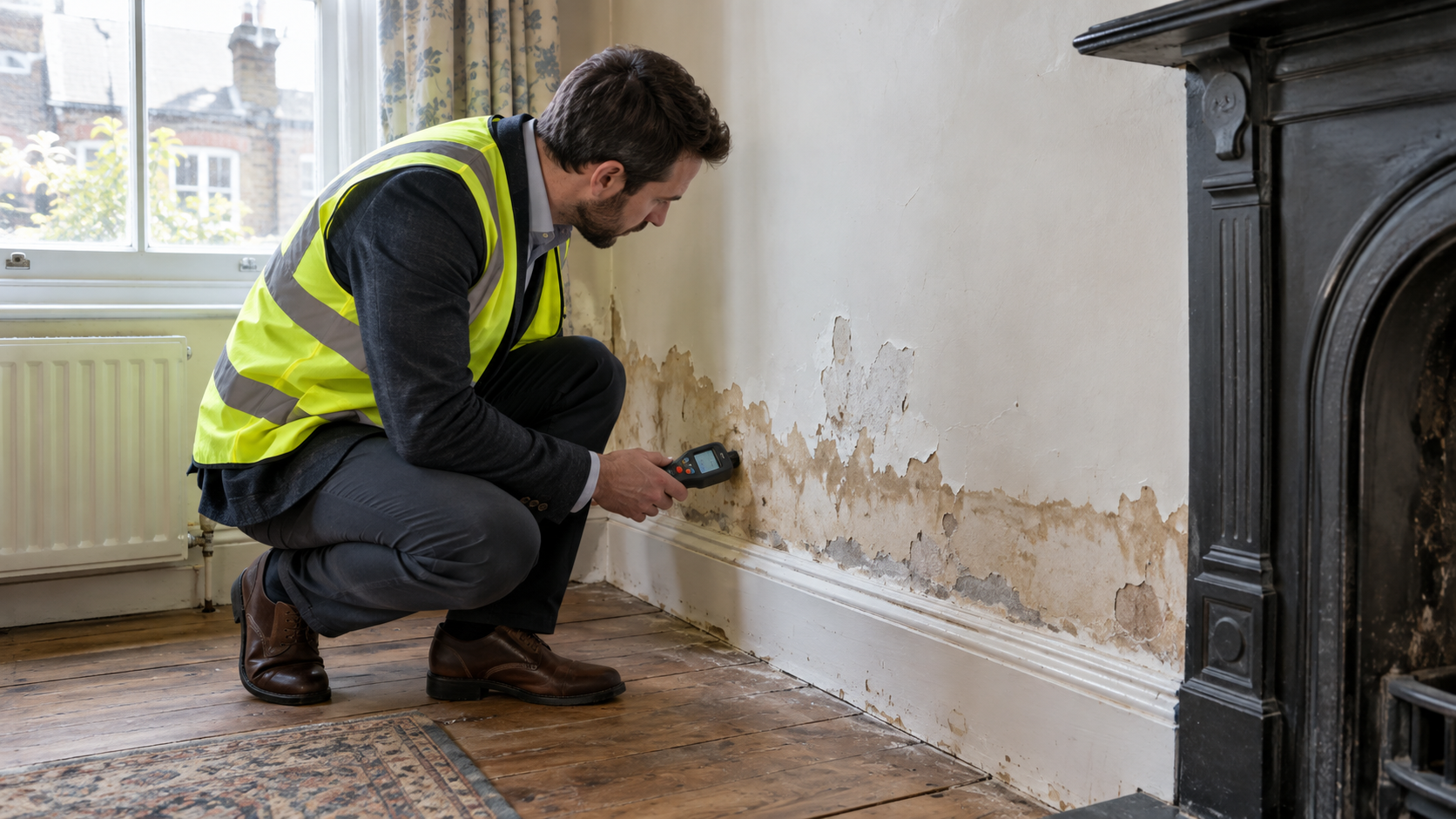
A horizontal “tide mark” of staining on internal walls, usually no more than a metre above floor level.
Blistering or bubbling paint, and plaster that feels soft, crumbly or salty to the touch.
White, fluffy salt deposits (efflorescence) on plaster or brickwork.
Rotting or loose skirting boards and damp floor timbers.
Peeling wallpaper concentrated at the bottom of the wall.
A musty smell in ground-floor rooms even when the weather is dry.
Be cautious, though. Every one of these signs can also be produced by penetrating damp from a leaking gutter, a plumbing leak, condensation, or simply high external ground levels. RICS consumer guidance is blunt on the point: “rising damp” describes a symptom, not a diagnosis, and failure of an original damp proof course is extremely rare. Our article on what causes damp in a house explains how the three types of damp differ.
An impartial damp inspection should look at ground levels, drainage, ventilation and construction, not just meter readings.
Why an impartial diagnosis matters before you buy a new DPC
Damp-proofing companies inspect for free because they sell treatments. That does not make them dishonest, but it does create an obvious incentive to recommend chemical injection where a simpler repair would do. The RICS consumer guide on damp and mould advises homeowners not to install expensive damp-proofing measures without first carrying out routine maintenance, and warns that relying solely on an electrical damp meter can produce misleading readings on masonry and plaster.
A suitably qualified, accredited building or damp surveyor will instead work through the building pathology: where is the water coming from, how is it moving, and what is stopping it from evaporating? RICS, Historic England and the PCA jointly published the Joint Position Statement on the Investigation of Moisture and its Effects on Traditional Buildings (JPS22), and asking for a JPS22-compliant inspection is a good way to get an unbiased opinion. For a fuller picture of what an inspection involves, read how surveyors assess damp, or arrange a damp and timber report if timber decay is suspected.
Damp proof course cost in 2026
Prices vary with wall length, wall thickness, access and, above all, how much replastering is needed afterwards. The figures below are drawn from published 2026 cost guides and are indicative only; always obtain written quotes.
Work
Typical 2026 cost (UK)
Notes
Chemical DPC injection (materials and labour)
£60–£90 per linear metre
MyJobQuote, updated September 2026
Injection including replastering and finishes
Around £240 per metre; a 5m wall from about £1,200
Federation of Master Builders, May 2026
Terraced house, injection only
£350–£450
Small footprint, party walls excluded
Semi-detached house, injection only
£650–£950
Three exposed elevations
Detached house, injection only
£1,700–£2,200
All elevations
Three-bedroom terrace, full treatment with plastering
£2,000–£4,000
FMB benchmark
Replastering after treatment
£450–£800 per room
Salt-resistant renovating plaster
Cavity drainage membrane or tanking
£2,000–£6,000 per property
Mainly basements; Checkatrade 2025/26 guide
Independent damp survey
£100–£600
Depends on property size and report depth
The lesson from the table is that plaster, not chemicals, drives the bill. Salt-contaminated plaster usually has to be hacked off to about a metre and replaced, and that is where the cost of a “cheap” DPC quietly doubles. Our surveyor tips for damp cost estimates explain how to compare quotes fairly.
Chemical injection is the most common retrofit DPC, but it only works if the real moisture source has been identified first.
How long does a damp proof course last?
An original slate, engineering-brick or polythene DPC should last the life of the building unless it is cracked by movement or bridged. Chemical DPCs are generally guaranteed for 20 to 30 years by the installer, and reputable contractors offer insurance-backed guarantees that survive if the firm ceases trading. Ask to see the guarantee wording, and check whether it covers replastering as well as the injection itself.
Old houses, lime and the case against a chemical DPC
Traditional solid-walled homes were built to manage moisture by evaporation, not exclusion. Historic England, together with RICS and the PCA, cautions that cement renders, gypsum plasters and impermeable coatings can trap moisture in old walls and make damp worse. In a pre-1919 property the better approach is often to lower external ground levels, clear drains and gutters, reinstate lime-based finishes and improve ventilation, then reassess before considering any injected DPC. For listed buildings, remedial works may also need consent; our guide to Grade II listed buildings covers the basics.
Damp proof courses, lenders and home surveys
If you are buying, damp at low level will usually be flagged in a RICS Home Survey Level 2 or Level 3 report, often with a recommendation for a specialist damp and timber inspection before exchange. Lenders sometimes impose a mortgage retention until that report is produced. A Level 3 building survey goes furthest in explaining the likely cause and repair options, which is why we recommend it for period homes; see our Level 2 vs Level 3 survey comparison and current house survey costs.
What’s new in 2026: damp, mould and the law
Damp has moved up the political agenda. Awaab’s Law came into force for the social rented sector in England on 27 October 2025. Social landlords must now investigate significant damp and mould hazards within 10 working days of becoming aware of them, complete safety work within 5 working days of the investigation concluding, and act on emergency hazards within 24 hours (GOV.UK guidance for social landlords). The government has said phase two, covering excess cold and heat, falls, structural collapse and electrical hazards, follows in 2026, with all remaining HHSRS hazards from 2027.
For private landlords, the Renters’ Rights Act 2025 provides the mechanism to extend Awaab’s Law to the private rented sector, with commencement dates still to be set by regulations as of September 2026. In practice, that means landlords with damp at low level should be commissioning independent inspections now rather than waiting for a tenant complaint. The RICS consumer guide on damp and mould was also refreshed in June 2025 and now explicitly discourages unnecessary damp-proofing works in favour of proper investigation.
Frequently asked questions about damp proof courses
Do I need a damp proof course?
If your home was built after about 1880 it almost certainly has one. Rather than asking whether you need a new DPC, ask why the existing one appears not to be working. Bridging by raised paths, render or internal plaster is the usual culprit, and a surveyor can confirm this quickly.
Can a damp proof course be installed from outside?
Yes. Chemical injection can be carried out from the external face of a wall, which avoids disturbing internal finishes. Internal replastering may still be needed if the plaster has absorbed salts.
Should the damp proof course be visible?
On most post-1970 homes you can see the black polythene strip in a mortar joint two or three brick courses above the ground. On older homes look for a course of slate or a line of dark bitumen. If you cannot see it, the ground may have been raised above it.
Why choose Survey Merchant for your damp proof course assessment?
Deciding whether you need a new damp proof course is a diagnostic question, and the answer is worth far more when it comes from someone with no product to sell. Survey Merchant connects homeowners, buyers and landlords with independent surveyors who investigate first and recommend second. Here is why clients across the UK use us:
An accredited panel matched to the job. Our surveyors are suitably qualified and accredited by recognised bodies including RICS, CIOB and RPSA, and we match you with a specialist in damp and building pathology rather than a generalist.
Nationwide coverage with local knowledge. From London terraces to stone cottages in the Dales, we have surveyors who understand regional construction types and the damp problems that come with them.
Impartial advice. We do not sell damp proofing, so our recommendations are driven by the evidence, not by a sales target.
Transparent, competitive fixed fees. You know the cost before you instruct, with no hidden extras.
Fast turnaround. Inspections are usually arranged within days, and reports are written in plain English so you can act on them, negotiate a purchase price or brief a contractor.
End-to-end support. From a standalone damp inspection to a full Level 3 building survey or a RICS valuation, we support you through the whole process.
Ready to find out whether your damp problem really needs a new DPC? Book a building or damp survey with an accredited Survey Merchant surveyor, or contact our team for a free, no-obligation quote today.
A damp proof course (DPC) is a horizontal barrier of slate, engineering brick, bitumen, polythene or injected chemical built into a masonry wall, usually at least 150mm above external ground level, to stop ground moisture rising through the bricks by capillary action.
How much is a damp proof course?
In 2026 a retrofit chemical DPC injection typically costs £60 to £90 per linear metre, or roughly £350 to £2,200 per property before replastering. With plaster and finishes included, the Federation of Master Builders quotes around £240 per metre and £2,000 to £4,000 for a three-bedroom terrace.
How long does a damp proof course last?
An original slate, engineering-brick or polythene DPC should last the life of the building unless it is cracked by movement or bridged. Chemical injection DPCs are usually guaranteed for 20 to 30 years, ideally with an insurance-backed guarantee.
Can a damp proof course fail?
It is possible but, according to RICS, extremely rare. Most low-level damp blamed on a failed DPC is actually caused by bridging (raised paths, render or plaster crossing the DPC line), leaking gutters or pipes, or condensation. An independent surveyor can identify the real cause.
Do Victorian houses have a damp proof course?
Most do. Damp proof courses were required under the model by-laws that followed the Public Health Act 1875, so homes built from about 1880 usually have two or three courses of slate or a layer of bitumen. Genuinely pre-1875 cottages may have none and rely on breathable lime construction instead.
Should I get a survey before installing a new DPC?
Yes. Damp-proofing contractors have a commercial interest in selling injection treatments. A suitably qualified, accredited surveyor (RICS, CIOB, RPSA or similar) will diagnose the moisture source first and may find a far cheaper fix, such as lowering external ground levels or repairing gutters.