We use cookies to improve your experience on our site, analyze site traffic, and assist in our marketing efforts. By clicking "Accept all," you agree to the storing of cookies on your device. You can choose to "Reject all" non-essential cookies. For more information, please read our Cookie Policy.
Full house rewire costs in the UK in 2026 typically run from £3,500 to £12,000. Learn prices by property size, warning signs, Part P rules and how a survey protects you.
Wondering how much it costs to rewire a house in the UK? In 2026, a full rewire typically costs between £3,500 and £12,000, with most three-bedroom homes landing somewhere around £5,500 to £8,000. The cost to rewire a house depends on size, age, location and whether you are living in it while the work happens. Rewiring is also one of the most common “big ticket” items flagged in a Level 3 building survey, so if you are buying an older property it pays to understand the numbers before you exchange contracts. This guide sets out current prices, the warning signs, the regulations and how a suitably qualified, accredited surveyor can help you budget and negotiate.
Key takeaways
A full house rewire in the UK costs roughly £3,500–£12,000 in 2026; expect £5,500–£8,000 for a typical three-bedroom semi outside London.
London and the South East usually add 15–25%, and listed or pre-1900 homes can cost considerably more because of access and making good.
An Electrical Installation Condition Report (EICR) costing around £150–£300 tells you whether you actually need a full rewire or just targeted repairs.
Rewiring is notifiable work under Part P of the Building Regulations in England; always obtain an Electrical Installation Certificate and building control compliance certificate.
BS 7671 Amendment 4:2026 was published in April 2026, so quotes should reference the current edition of the Wiring Regulations.
A building survey from Survey Merchant’s accredited panel can identify outdated wiring before you buy, giving you grounds to renegotiate the price.
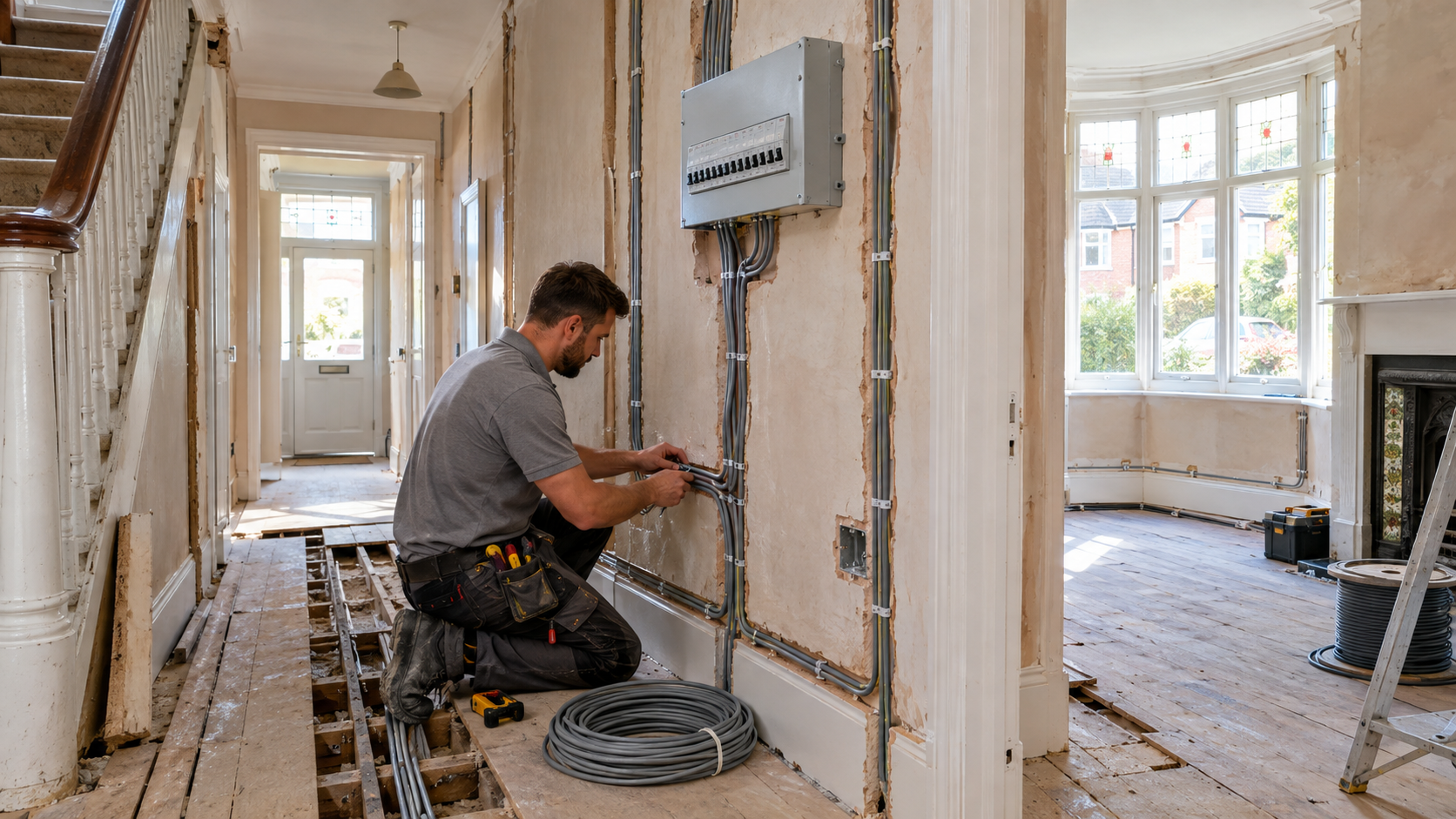
A full rewire involves chasing walls, lifting floors and installing a new consumer unit – which is why labour, not cable, drives the cost.
How much does it cost to rewire a house in the UK in 2026?
The cost to rewire a house in the UK in 2026 is typically £3,500 to £12,000 for a full rewire, including a new consumer unit, all circuits, sockets, switches and certification. A one-bedroom flat starts from around £2,500, a three-bedroom house averages £5,500–£8,000, and large or period homes can exceed £15,000.
Those ranges are drawn from several UK trade price guides updated during 2026, and they broadly agree with each other. Where they differ is at the margins: an empty property is usually 15–25% cheaper than an occupied one because electricians can work faster without furniture and family in the way, while a Victorian terrace with lath-and-plaster walls and solid floors will push towards the top of its band.
Rewiring cost by property size
Property type
Typical full rewire cost (outside London)
London & South East
Time on site
Studio or 1-bed flat
£2,500–£4,500
£3,000–£5,000
3–5 days
2-bed flat or small house
£3,500–£5,500
£4,200–£6,800
4–7 days
3-bed semi-detached
£5,500–£8,000
£6,500–£10,000
6–10 days
4-bed detached
£8,000–£12,000
£10,000–£15,000
8–14 days
5+ bed, listed or pre-1900
£11,000–£18,000+
£14,000–£22,000+
10–18+ days
Figures are indicative 2026 ranges compiled from published UK trade cost guides and assume a standard specification. Always obtain at least three itemised quotes.
Other electrical costs you may be quoted
Partial rewire (for example, replacing one or two circuits, or rewiring a kitchen and bathroom): typically £1,500–£6,000 depending on how many circuits are involved.
Consumer unit (fuse board) replacement only: usually £400–£900 installed, including RCD or RCBO protection and a surge protection device.
Making good: replastering chases, redecorating and refitting flooring can add £600–£1,800 and is often excluded from the electrician’s quote.
Extras: arc fault detection devices (AFDDs) at roughly £30–£50 per circuit, USB sockets, outdoor power, EV charger supplies and data cabling all add to the total.
What affects the cost to rewire a house?
Cable itself is cheap. What you are paying for is skilled labour, the time it takes to route cables through an existing building, and the disruption that follows. The main variables are:
Size and layout – more rooms mean more circuits, more points and more cable runs. Electricians often price by the “point” (each socket, switch or light), so a home with generous socket provision will cost more than a minimalist one.
Age and construction – solid concrete floors, lath-and-plaster walls and ornate cornicing all slow the first fix. Pre-1970 homes may also hide asbestos in old fuse board backings or ceiling finishes, which must be dealt with safely before work can proceed; see our asbestos survey guide.
Occupied or empty – working around furniture and keeping the power on for a family costs time. If you can schedule the rewire between completion and moving in, you will usually save money.
Specification – a basic like-for-like replacement is cheaper than a full redesign with kitchen island sockets, garden power, smart lighting and an EV charger circuit.
Location – labour rates in London and the South East are higher, and parking or congestion charges are often passed on.
Condition of what is already there – an EICR that reveals multiple C2 (potentially dangerous) observations usually points to a full rewire, whereas isolated faults may only need a partial rewire.
Signs a house needs rewiring
Age alone does not prove a rewire is needed, but the following warning signs should prompt a professional inspection:
An old-style fuse box with a wooden back, Bakelite casing, cast-iron switches or rewirable ceramic fuses rather than a modern consumer unit with RCD protection.
Black rubber, fabric or lead-sheathed cables, which generally date from before the mid-1960s and perish over time.
Round-pin sockets, braided flex to light fittings, or sockets mounted on skirting boards.
Frequent tripping, flickering lights, buzzing or warm sockets and switches, or scorch marks and discolouration around outlets.
A shortage of sockets leading to a tangle of extension leads and adaptors.
Evidence of undocumented DIY alterations or a mixture of cable types and colours.
An unsatisfactory EICR with C1 or C2 codes, or several “FI” (further investigation) items.
Many of these issues are exactly what a surveyor looks for during a property inspection. Our article on common electrical issues in older homes explains them in more depth, and if you are buying a 1930s semi or a Victorian terrace our dedicated guides to a survey on a 1930s house and a survey on a Victorian house cover the typical electrical findings for each era.
A wooden-backed fuse box with rewirable fuses (left) is one of the clearest signs that a full rewire may be due; a modern consumer unit (right) provides RCD and surge protection.
How often does a house need rewiring?
Modern PVC twin-and-earth cable installed to current standards can last 25–40 years or more, while consumer units typically need replacing every 15–25 years as protection standards improve. Older rubber or VIR cable often fails at 50–60 years. Rather than working to a fixed interval, industry bodies recommend a periodic inspection: an EICR every ten years for owner-occupied homes, every five years for rented homes, and whenever you buy a property.
What does a full rewire include?
A complete rewire is carried out in two stages. The first fix involves lifting floorboards, chasing walls, running new cables for every circuit and fitting back boxes. The second fix follows plastering and includes fitting sockets, switches, light fittings and the new consumer unit, then inspecting and testing every circuit. A proper quote should cover:
New cabling for lighting, power, cooker, shower and any dedicated circuits.
A new metal consumer unit with RCD or RCBO protection and surge protection.
Main protective bonding to gas and water services.
New sockets, switches and ceiling roses or fittings to an agreed specification.
Mains-wired, interlinked smoke and heat alarms.
Full inspection and testing, an Electrical Installation Certificate (EIC) and notification to building control.
Regulations, Part P and certification
In England, a full rewire is notifiable work under Approved Document P (Electrical safety) of the Building Regulations. Work must either be carried out by an electrician registered with a competent person scheme, who can self-certify and notify on your behalf, or be notified to your local authority building control before it starts. On completion you should receive an Electrical Installation Certificate and, within around 30 days, a Building Regulations compliance certificate. Keep both: a buyer’s conveyancer will ask for them, and without them you may later need a regularisation certificate or indemnity policy to sell.
All electrical work must comply with BS 7671, the IET Wiring Regulations. According to awarding body EAL, BS 7671:2018+A4:2026 (Amendment 4) was published on 15 April 2026, with the previous version (A3:2024) withdrawn six months later. Amendment 4 adds new requirements covering battery energy storage, functional earthing for ICT systems and Power over Ethernet, among other changes. Any quote you accept in late 2026 should reference the current edition, and your certificate should confirm the installation complies with it. The IET publishes the official Amendment 4 updates and free model forms.
Rules for landlords in 2026
If you let property in England, The Electrical Safety Standards in the Private Rented Sector (England) Regulations 2020 require an EICR at least every five years, with any C1, C2 or FI items remedied within 28 days and copies supplied to tenants and, on request, the local authority. Councils can impose financial penalties of up to £30,000 for breaches. In a significant 2025 development, the government confirmed these standards were extended to the social rented sector by the 2025 amendment regulations, and published updated GOV.UK guidance for private and social landlords on 1 November 2025. For buy-to-let investors, a rewire is therefore not just a comfort issue but a compliance one; our landlord property inspection checklist covers the wider picture.
Rewiring and your property survey
Few buyers can see behind the plaster, which is why an independent survey matters. A Level 2 (HomeBuyer) survey will note visible indicators such as an old fuse board or outdated sockets and recommend a specialist test. A Level 3 building survey goes further, with the surveyor inspecting accessible wiring in the loft, under floors and at the consumer unit, commenting on the likely age and condition of the installation and advising whether an EICR or rewire should be budgeted for. If you are unsure which level you need, our comparison of Level 2 vs Level 3 surveys will help.
Because a rewire can run to five figures, the survey findings are a legitimate basis for renegotiation. Our guide on how to negotiate the house price after your survey explains how to present quotes to the seller. Survey Merchant matches you with a suitably qualified, accredited surveyor from a panel regulated or accredited by bodies such as RICS, CIOB and RPSA, so the report carries weight with sellers, lenders and solicitors alike.
Scorched or discoloured sockets are a classic survey finding that points towards an ageing installation.
How to keep rewiring costs down without cutting corners
Start with an EICR. For a few hundred pounds you will learn whether a full rewire is genuinely needed or whether targeted remedial work will make the installation safe.
Rewire before you decorate. Coordinate the rewire with plastering, new kitchens and bathrooms so walls are only opened once. Our home renovation budget planner helps you sequence the work.
Do it while the property is empty. An unoccupied house is quicker and cheaper to rewire.
Agree the specification in writing. List every socket, switch and fitting so quotes are comparable and extras do not creep in.
Get three itemised quotes from electricians registered with a competent person scheme, and check whether VAT and making good are included.
Add a 10–15% contingency for the unexpected, particularly in homes built before 1970.
Can you live in a house while it is being rewired?
You can, but it is disruptive. Expect dust, lifted floorboards, carpets rolled back and periods without power or lighting in parts of the home. Electricians often work room by room in occupied properties, which extends the programme and increases the cost. Where possible, move out for the first fix, or at least clear the rooms being worked on.
Does rewiring add value to a house?
A rewire rarely adds more to the sale price than it costs, but it removes a significant negotiating lever from buyers, satisfies lenders and insurers, and makes the home safer and more practical. Crucially, a property with a recent EIC and compliance certificate is far easier to sell than one where the survey flags “rewiring likely required”. If a survey has already identified problems, see our advice on what to do when a survey finds problems.
Why choose Survey Merchant for your pre-purchase survey?
Electrical defects are among the costliest surprises a buyer can face, and they are often invisible until an expert looks. Survey Merchant helps you find out before you commit:
Accredited panel matched to the job – suitably qualified surveyors regulated or accredited by bodies such as RICS, CIOB and RPSA, selected for the property type and age.
Nationwide UK coverage with local surveyors who understand regional housing stock, from Victorian terraces to 1960s estates.
Fast turnaround so your survey does not hold up the purchase.
Transparent, competitive fixed fees agreed up front with no hidden extras.
Impartial advice – our surveyors work for you, not the seller or the lender.
End-to-end support from choosing the right survey level to understanding the report and planning next steps.
How much does it cost to rewire a 3-bedroom house in the UK?
In 2026 a full rewire of a three-bedroom house typically costs £5,500 to £8,000 outside London, or £6,500 to £10,000 in London and the South East, including a new consumer unit and certification. Making good plaster and decoration is usually extra.
How long does it take to rewire a house?
A one-bedroom flat takes around 3–5 days, a three-bedroom house 6–10 days and a large detached home two weeks or more. Occupied properties take longer because electricians work room by room; empty homes are quicker and cheaper.
Do I need to rewire a house that is 30 years old?
Not necessarily. Modern PVC cabling can last 25–40 years or more, so the right first step is an Electrical Installation Condition Report (EICR). If it returns C1 or multiple C2 codes a rewire is likely; isolated faults may only need remedial work or a new consumer unit.
Does a house survey check the electrics?
A surveyor will not test the circuits, but a Level 3 building survey inspects the visible installation – consumer unit, cable types, sockets and loft wiring – and flags whether an EICR or rewire should be budgeted for. That evidence can support a price renegotiation.
Is rewiring notifiable under Building Regulations?
Yes. In England a full rewire is notifiable under Part P. Use an electrician registered with a competent person scheme who can self-certify, or notify building control before work starts. You should receive an Electrical Installation Certificate and a compliance certificate.
Can I get my house rewired for free?
Generally no. Government energy-efficiency grants do not cover rewiring, although some councils offer home improvement loans or grants for vulnerable homeowners. Landlords in England must fund any remedial work identified by a five-yearly EICR within 28 days.