Building Surveying
Oct 15, 2026
Asbestos Survey Guide 2026: UK Regulations & Experts
Our complete asbestos survey guide explains UK regulations, types, costs, & legal duties. Learn when to get one & how to pick a pro.

You're often told you need an asbestos survey at the worst possible moment. A solicitor raises it just as you're trying to exchange. A contractor asks for it the day before pricing a refurbishment. A managing agent mentions it in passing, and suddenly you're reading unfamiliar terms and wondering whether you've missed a legal duty.
That reaction is normal. Most clients don't spend their time reading Health and Safety Executive guidance, and the phrase “asbestos survey” can sound more alarming than it needs to. In practice, this is a property risk-management exercise. It's about finding out what is present, where it is, what condition it is in, and what that means for occupation, maintenance or building work.
A good asbestos survey guide should do more than repeat the familiar rule about buildings built before 2000. That cut-off matters in UK practice, but it doesn't tell you where asbestos is most likely to be missed, or why one survey report is useful and another is little more than paperwork. Its value lies in understanding hidden risk areas, matching the survey type to the job, and making sure the report is documented well enough to support legal compliance and practical decisions.
When checking a roof, knowing the building's age is useful, but it won't tell you whether the leak starts at the valley, the flashing or the hidden gutter behind a parapet. Asbestos works much the same way. The age rule helps you know when to look. A proper survey tells you where to look properly.
If you own, buy, manage or plan works to a UK property, asbestos sits in the same category as structure, fire safety and drainage. It's one of those issues that doesn't disappear because it's inconvenient. It needs to be identified and managed properly.
The official framework for surveys is anchored in HSG264, “Asbestos: The survey guide,” which the Health and Safety Executive describes as the publication for people carrying out asbestos surveys and those responsible for managing asbestos. In practical terms, HSG264 centres the survey on locating and recording the location, extent and product type of any presumed or known asbestos-containing materials, while also recording accessibility and condition. It also sits against the long UK timeline in which blue and brown asbestos were banned in 1985, followed by a complete prohibition on all asbestos types in 1999, including white chrysotile, as set out by the HSE's HSG264 guidance.
That timeline explains why so many current instructions still involve older stock. Offices, shops, schools, industrial buildings, converted blocks and houses altered over decades can all contain legacy materials. The survey isn't there to create fear. It's there to replace guesswork with evidence.
A sensible asbestos survey does the same job as a measured survey before design work. It gives everyone the same factual starting point.
Where clients often get caught out is assuming the age rule answers everything. It doesn't. Many of the problems I see arise in concealed service routes, layered finishes, boxed-in pipework, ceiling voids and areas altered by previous contractors. If the survey scope is vague, those places can be missed. If the documentation is poor, the report may exist but still be difficult to use when works start or when responsibility changes hands.
A common failure point is simple. A landlord books minor repair works, the contractor opens a boxed-in pipe run, and asbestos insulation board is found where nobody expected it. The legal problem is not just that asbestos was present. It is that nobody had arranged suitable information, recorded the risk properly, or passed clear instructions to the people doing the work.
In UK law, that responsibility usually sits with the dutyholder.
The dutyholder is the person or organisation responsible for maintenance and repair in non-domestic premises, or in the shared parts of domestic buildings. That may be the owner, landlord, managing agent, employer, facilities manager, or another party named in a lease or contract. Ownership matters less than control. If you control what is repaired, accessed, or altered, the law is likely to look to you.
For homeowners, the position is different under the formal duty to manage rules, but the practical risk remains the same. If planned work could disturb hidden materials, suitable asbestos information is still needed before the building fabric is opened up.
This is why paperwork alone is not enough. A survey only helps if it is scoped properly, understood by the people commissioning work, and available to contractors before they start. In practice, the dutyholder is expected to keep asbestos risk under control in the same way a building manager keeps the fire logbook current. The record must exist, but it also has to be usable.
If you oversee contractors regularly, it also helps to understand related liabilities, including this guide to protecting contractors from pollution risks, because asbestos issues often lead to wider contractual, insurance and delay costs.
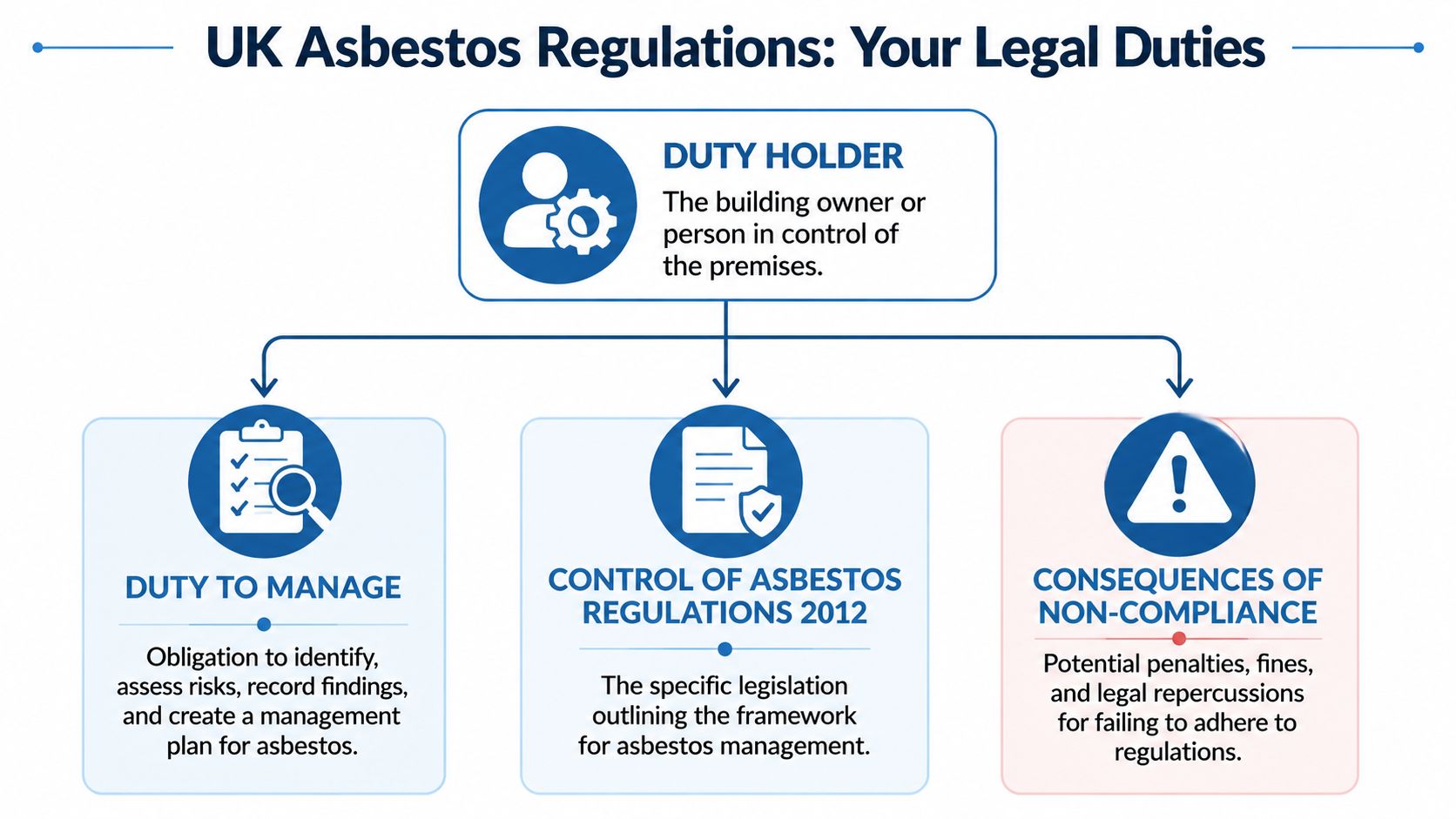
The legal duty under the Control of Asbestos Regulations 2012 is often described as a duty to manage. In plain English, that means finding out whether asbestos is present or likely to be present, judging the risk of disturbance, keeping an up-to-date record, and making sure that information reaches anyone who might disturb it, as set out by the HSE's summary of the duty to manage asbestos.
That process works best as a documented plan, not a one-off report filed away after purchase or handover. Buildings change. Ceiling voids get reopened, risers are altered, old finishes are covered, and maintenance teams change. The places that cause trouble are often the ones no one included clearly in the original instruction, such as service ducts, lift motor rooms, back-of-house storerooms, undercroft areas, soffits, toilet boxing, and lined plant enclosures.
The age of the building is only the starting clue. Missed asbestos is often a scope problem.
A defensible asbestos record should let a contractor answer three basic questions before touching the fabric of the building. What is here. Where is it. What controls apply.
If those answers are unclear, the cost usually appears later as delay, emergency sampling, work stoppages, redesign, or a second survey under pressure. That is why cheaper instructions can become more expensive overall. The first saving is often small. The later disruption rarely is.
The material type also affects how risk is judged and managed. If you need a plain-English explanation of chrysotile, amosite and crocidolite risks, it helps when reviewing reports and deciding what work can proceed safely.
A practical way to check whether you are meeting your duty is to test the quality of the information you hold:
Practical rule: if a maintenance contractor has to rely on guesswork, the dutyholder has not been given a safe working basis.
Legal compliance and practical compliance should match. The survey, register, and communication process need to work together. If one part is weak, the building can look compliant on paper while still exposing you to enforcement issues, contractor claims, and avoidable project costs.
These two survey types serve different jobs, and the wrong choice usually shows up later as delay, extra opening-up works, contractor disputes, or a second survey ordered at short notice.
A management survey is for a building in normal use. Its purpose is to identify asbestos-containing materials, or materials presumed to contain asbestos, that could be damaged or disturbed during everyday occupation, cleaning, and routine maintenance. It supports the asbestos register and the day-to-day decisions that flow from it.
That sounds straightforward until hidden areas are involved.
A good management survey does not stop at obvious room surfaces. It should follow a documented plan that includes the places asbestos is often missed but still encountered during ordinary maintenance, such as ceiling void edges, service risers, understairs cupboards, lift motor rooms, old fuse backing boards, boxing around pipework, the back of access panels, and store rooms that no one has opened for years. If those areas are left out of the brief, the report can look tidy while still leaving contractors to guess.
A refurbishment / demolition survey is different because the question is different. Instead of asking, "What must we manage while the building is in use?", it asks, "What will the planned works disturb once we start opening the fabric?" That is why it is more intrusive and often involves breaking through finishes, lifting floors, opening voids, and tracing services into hidden spaces.
The practical distinction is simple. A management survey helps you manage risk in an occupied building. A refurbishment or demolition survey helps you remove uncertainty before the work starts.
If a contractor is repainting a wall and replacing a like-for-like light fitting, management information may be enough, provided it is current and relevant to that area. If the same contractor is removing partition walls, replacing ceilings, rerouting cables, or opening service ducts, you need a refurbishment survey for the affected area before work begins.
Costs often rise unnecessarily when clients sometimes rely on an existing management survey because they already have one on file. But a management survey is not designed to clear intrusive works. Using it that way is like pricing a structural alteration from an estate agent's floor plan. It gives an outline, not the opening-up detail needed to work safely and lawfully.
Material type also affects what follows after identification. Understanding chrysotile, amosite and crocidolite risks helps explain why one item may stay in place under management while another leads to tighter controls, licensed removal, or changes to the work sequence.
FeatureManagement SurveyRefurbishment / Demolition SurveyMain purposeSupport safe normal occupation and routine maintenanceIdentify ACMs before intrusive works or demolitionLevel of intrusionUsually limited and geared to accessible areasMore intrusive, and may involve destructive inspectionTypical settingOccupied building in day-to-day useArea due to refurbishment, strip-out or demolitionFocus of riskMaterials that could be disturbed during normal useHidden materials that works may uncover or damageOutcomeInformation for an asbestos register and management decisionsInformation contractors need before works begin
The right survey is the one that matches the task, the access available, and the likely disturbance to the building fabric.
Clients also ask whether a refurbishment survey has to cover the whole building. Usually, no. It should cover the specific area affected by the works, plus any linked routes, voids, plant, and service runs the project may disturb. That scope needs to be recorded clearly. A vague instruction such as "survey the office" often misses the riser, ceiling void, or redundant plant room that later stops the job.
If you manage asbestos alongside wider property compliance, a commercial building inspection checklist can help teams see how survey information needs to line up with permits to work, contractor control, maintenance planning, and building records.
A useful rule for clients is this. If people are only occupying the building, you need information for management. If the project will disturb the fabric, you need information for the works.
There's no need for an asbestos lecture. You need to know whether you need a survey now, and if so, why.
For UK property practice, 2000 is the key threshold. Buildings built before that year are widely treated as potentially containing asbestos. A management asbestos survey is expected for non-domestic premises and shared parts of domestic buildings during normal occupation, and before refurbishment or demolition a more intrusive survey is required for buildings built before 2000 unless there is strong evidence asbestos has already been fully removed. Management surveys should be reviewed and updated at least annually, with reinspection intervals often shortening to around 6 months where materials are damaged or higher risk, as summarised in this UK asbestos survey types guide.
That gives you the legal trigger points. Day-to-day occupation of relevant premises needs current asbestos information. Planned intrusive work needs a different level of investigation before work starts.
If you manage a wider compliance file, it can help to look at asbestos in the context of other routine building checks. A practical example is this commercial building inspection checklist, which shows how asbestos often sits alongside access, services, condition and maintenance planning rather than as a standalone issue.
Use these as quick filters:
A lot of readers want a neat rule that covers every case. There isn't one. The legal need depends on building type, who controls it, and whether the premises are occupied or being altered.
If you want a more scenario-based explanation, this advice from Survey Merchant on asbestos surveys is a useful companion for deciding when a formal instruction is sensible.
The financial angle is straightforward. Ordering too little survey work can stop a project once hidden materials are found. Ordering the wrong survey can mean paying twice. In both cases, delay tends to be more expensive than clarity.
A week before a strip-out starts, a contractor lifts one access panel and finds insulating board where everyone expected plain plasterboard. Work stops, labour waits, and the budget shifts in a single morning. That is usually how asbestos becomes expensive. Not because the material was impossible to find, but because nobody had agreed a clear survey plan for the areas most likely to hide it.
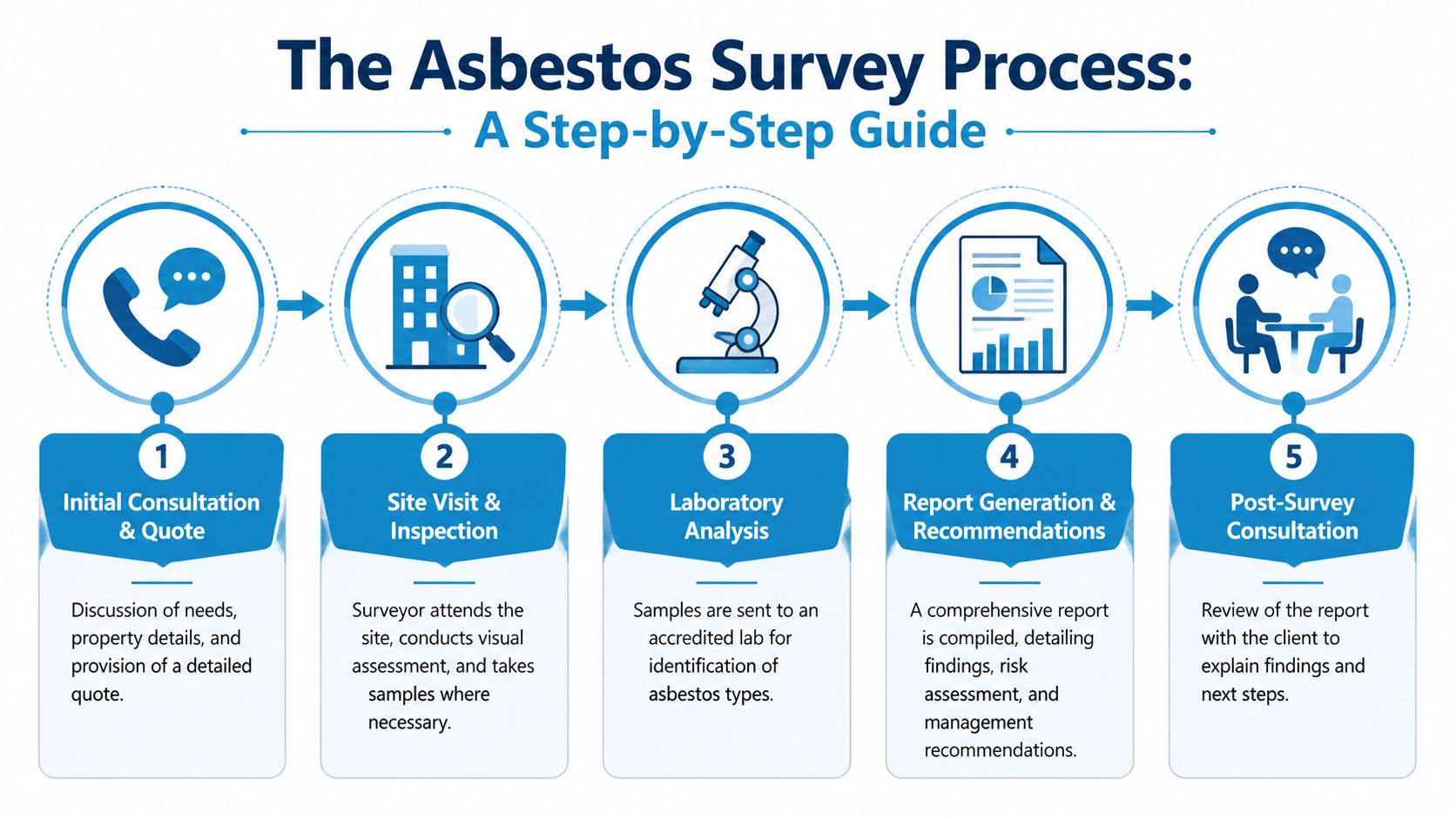
A well-run survey follows a sequence. The surveyor first defines the scope, then checks access, then inspects and samples where needed, and finally produces a report that the dutyholder, designer, contractor, or buyer can act on. It works like a measured inspection before structural work. If the brief is vague, the result is vague.
The first stage is desk-based and practical. The surveyor will ask what the building is used for, why the survey is needed, which areas are included, and what level of access can be arranged. They should also ask about previous alterations, available drawings, and any known problem areas such as risers, lofts, plant rooms, service ducts, or locked cupboards.
That planning stage matters because asbestos is often missed in the places people do not routinely open. Ceiling voids, boxed-in columns, old floor build-ups, behind bath panels, around service penetrations, and within earlier refurbishments are common examples. The pre-2000 rule is only a starting filter. The key question is where disturbance is likely and where hidden materials may sit behind finished surfaces.
A good brief should leave little room for guesswork. It should state the survey type, the parts of the premises in scope, any exclusions, who will provide access, and whether opening up is permitted. Without that, a client can end up paying for a report that is technically neat but operationally weak.
On site, the surveyor carries out a visual inspection and, where appropriate, takes samples of suspect materials for analysis. The depth of inspection depends on the survey type and the access agreed beforehand. A management survey usually focuses on materials that can be reached during normal occupation and maintenance. A refurbishment survey goes further because hidden asbestos has to be identified in the work area before trades start disturbing fabric.
Clients often get caught out. A room can look modern and still contain asbestos above the suspended ceiling, behind wall linings, under vinyl, or around old service routes left in place during earlier upgrades. Refurbished buildings are not automatically lower risk. In some cases they are harder to read because newer finishes conceal older materials.
Typical inspection points include:
This video gives a practical view of how the process is approached in the field.
After the visit, any samples go to a laboratory and the surveyor compiles the report. The finished document should do more than list materials. It should show what was found or presumed, where it is, what could not be accessed, and what action is required. Plans, photographs, sample results, and clear recommendations are what make the report usable in practice.
The report should read like a working document for a property team, not like a technical diary that only the surveyor understands.
One point often causes confusion. A management survey does not promise that every hidden cavity has been opened. If hidden areas matter to the decision you are making, the instruction and access arrangements must reflect that from the start. That is how you avoid the familiar pattern of survey first, discovery later, and cost climbing at the point work should have begun.
A common and expensive pattern goes like this. A client accepts the lowest quote, assumes all the awkward areas will be checked, then discovers during works that risers, boxed-in services, ceiling voids or older layers behind newer finishes were outside scope or only presumed. The survey has not failed on price. It has failed on planning.
That is why competence matters as much as cost. You need a surveyor who can set out a clear, documented plan for what will be inspected, what may be hidden, what access is needed, and how any gaps will be recorded. In practice, that plan works like a map before a journey. Without it, you may still arrive, but usually with delays, arguments and extra cost.
A competent surveyor should be able to explain the instruction in plain English and turn it into a report your property team, contractor, or buyer can use. The standard is not just technical knowledge. It is the ability to connect findings to decisions about occupation, maintenance, refurbishment, purchase, or budgeting.
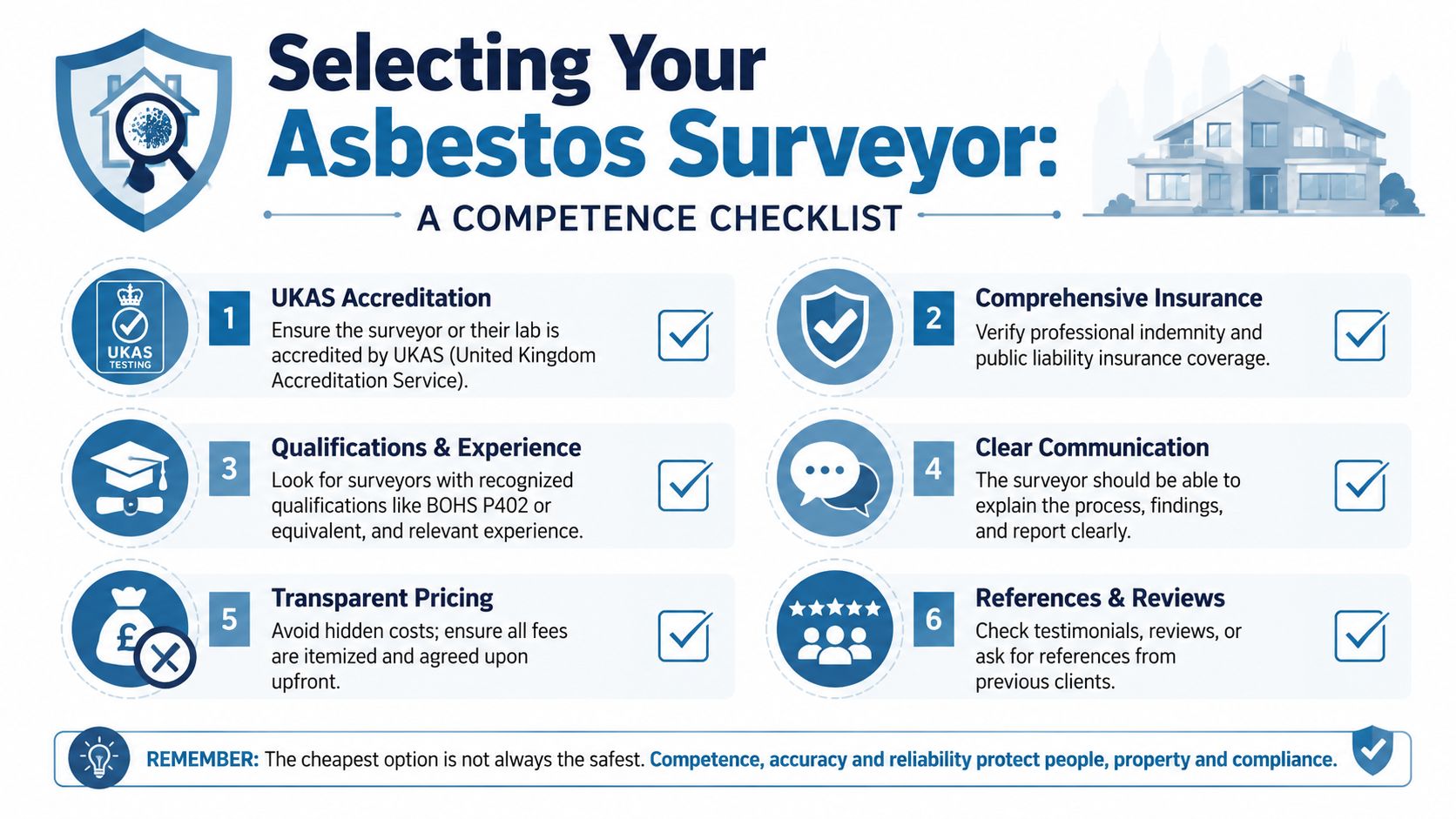
Ask the firm to explain five things clearly:
One simple test helps. If the surveyor cannot explain how they will deal with hidden high-risk areas before they attend site, they are unlikely to deal with them well once they are there.
A quote should read like a work plan, not a placeholder. Short, vague quotes often leave too much unsaid. That matters because asbestos costs are rarely driven by the inspection alone. They are driven by what was missed, what was inaccessible, and what has to be revisited once contractors are already booked.
Read the quote for detail, not just the total. Check whether it identifies the building, the survey type, the intended use of the report, access assumptions, laboratory analysis, and likely limitations. If those points are missing, the price may only cover a narrow slice of what you thought you were buying.
Useful questions include:
This matters for residential transactions too. If you are weighing up survey advice during a purchase, this homebuyer guide on asbestos in surveys shows how technical findings affect decisions in practice.
Survey costs vary because buildings vary. Size matters, but layout, occupancy, access restrictions, number of suspect materials, extent of opening up, and the quality of the final reporting all affect the fee. A straightforward, vacant unit is one thing. A live building with locked areas, service runs above ceilings, and a patchwork of old alterations is another.
The cheapest fee can become the highest total spend if it leads to reinspection, delays to works, contractor downtime, or a second survey to cover omitted areas. A better way to judge value is to ask whether the survey will stand up when a contractor starts asking practical questions on site. If the answer is yes, the fee is usually being spent in the right place.
Pay for a survey that matches the decision you need to make. That is how you control legal risk and avoid paying twice.
Once the report lands in your inbox, the key is not to overreact and not to shelve it. A survey report is only useful if it changes what happens next.
Start with the scope. Confirm what the survey covered and what it did not. Many misunderstandings begin here. A client assumes the entire building has been cleared, when in fact the report only relates to accessible areas or a defined work zone.
Then move to the findings. In broad terms, there are usually a few possible outcomes:
The practical question is always the same. What does this finding mean for the way the building will be occupied, maintained or altered?
If you're dealing with a residential purchase or a survey flag during conveyancing, this homebuyer guide on asbestos in surveys is helpful for turning technical findings into sensible next steps.
The standard “pre-2000” rule becomes too blunt to be enough on its own. More modern guidance places real emphasis on where asbestos can be missed: service voids, risers, layered finishes, and residual contamination from past removals, along with the need for systematic survey planning, photo records and detailed location plans, as highlighted in the National Guide for Asbestos Surveys 2025.
That point has practical consequences. A clean-looking room can still conceal risk above the ceiling, behind boxing, under later floor coverings or around old service penetrations. Previous refurbishment doesn't automatically mean all asbestos was removed. Sometimes it means the obvious parts were removed and awkward residual material was left behind.
A well-documented report protects you in several ways:
The best asbestos reports don't just identify risk. They make future decisions easier.
If asbestos is present but in good condition, management may be the correct response. If work will disturb it, removal or specialist controls may be necessary. If the report is unclear, ask for clarification before contractors proceed. That pause is usually cheaper than dealing with a stopped site.
The broad lesson is reassuring rather than alarming. Asbestos risk becomes manageable when information is specific, current and tied to the actual building. The problem is not always the material itself. The problem is often missing information, poor scope, or hidden areas that nobody thought to inspect properly.
If you need help finding the right surveyor for a purchase, a managed property or planned works, Survey Merchant can connect you with suitably matched UK professionals who understand both the technical survey requirements and the practical decisions that follow.
Survey Merchant provides vetted RICS surveyors across 100+ UK locations at fixed fees:
→ Level 2 Home Survey (HomeBuyer Report)
→ Level 3 Building Survey (full structural survey)
→ RICS Red Book property valuations
→ Party wall surveyors — notices, awards & schedules of condition
→ Expert witness surveyors — CPR Part 35 reports for property disputes