Building Surveying
Aug 2, 2026
Expert Guide to Lath and Plaster Walls
Buying a UK home with lath and plaster walls? Our guide covers identification, common issues, repair costs, and surveyor checks.

You’re standing in a Victorian terrace or Georgian flat, looking at walls that don’t behave like modern plasterboard. They aren’t perfectly flat. The corners may have softened slightly with age. A few cracks might run above a door head or across a ceiling line. Estate agents often call this “character”. Buyers usually wonder whether it means trouble.
That’s a sensible question.
In older UK homes, lath and plaster walls can be either a perfectly serviceable original feature or a sign of expensive remedial work ahead. The difference isn’t the age of the wall alone. It’s the wall’s present condition, the cause of any defects, and whether the property has been altered badly over time.
From a surveyor’s point of view, the key issue isn’t just “Does this house have lath and plaster?” It’s “Are the plaster keys still holding, is there damp or movement behind the finish, and what does that mean for value, repairs, insurance and planned works?” That’s where buyers, sellers and owners usually need clearer guidance than the usual short definition.
Most buyers first notice lath and plaster walls indirectly. A wall feels denser when tapped. A ceiling line isn’t machine-straight. A chimney breast has crisp old mouldings, but the adjacent wall has a shallow ripple or two. In a period house, those details are common.
That doesn’t automatically make them defects.
In many older properties, the original wall finish is part of the building’s fabric and character. It can also be more forgiving visually than modern plasterboard. Small undulations often reflect age, hand-applied workmanship and long settlement rather than imminent failure.
The problem starts when buyers treat every crack as harmless, or every old wall as doomed.
A practical approach is better. Look at the wall as a system. Ask whether the surface damage is local or widespread. Consider whether there’s evidence of damp, previous patching, movement around openings, loose areas, or ceilings that appear to have dropped. The answer often sits in the pattern, not in one isolated mark.
Practical rule: Old plaster isn’t a defect by default. Hidden damp, failed keys, and poor previous repairs are what usually turn an old wall into a cost issue.
For homebuyers, the stakes are obvious. If the walls are broadly sound, you may be buying a house with original materials and a maintenance burden typical of its age. If they’re failing, you may be taking on opening-up works, specialist plaster repairs, redecoration and disruption soon after completion.
For sellers, these walls matter too. Poorly handled cosmetic touch-ups can worry a careful buyer more than honest, visible age-related wear.
For owners planning renovation, the issue widens again. Once you start chasing cables, moving openings, replacing ceilings or dealing with damp, lath and plaster walls quickly become a decision point. Preserve them, stabilise them, or replace sections with modern systems. Each route has consequences for cost, finish, breathability and heritage value.
Lath and plaster walls became widespread in the UK from the 15th century, were used extensively until the 1930s, and may still be present in over 20 million pre-1940 homes. Their fire-resistant role was recognised early, with a 1212 decree endorsed by King John requiring houses near the Thames to be plastered to reduce fire risk, as outlined in this history of lath and plaster in 15th century England.

At its simplest, think of it as a timber backing with plaster locked through it.
Traditional softwood laths are typically 25 mm wide by 6 mm thick, fixed horizontally to timber studs or joists with about 6 mm spacing between them. Wet plaster is then applied in coats. The first coat pushes through the gaps and forms hardened nibs behind the laths. Those nibs are called keys.
Those keys matter more than anything else. They’re what physically lock the plaster face to the wall or ceiling structure.
A useful way to picture it is a plaster sandwich. The visible face is on one side. The keys harden on the back side. The lath sits in the middle and gives the whole assembly its grip.
Where buyers get caught out is assuming all solid walls in old houses are masonry. Many internal partitions in period homes are timber-framed with lath and plaster fixed over them. If you’re planning to alter rooms, it helps to understand what constitutes a load-bearing wall before making assumptions based on thickness or sound alone.
This system survived for centuries because it did several jobs well when properly maintained.
Lime-based plaster could remain serviceable for long periods. Historical records cited in the same source note durability often exceeding 100 years before repairs were needed. It also suited decorative work, which is why older homes often have better cornices, fireplace details and ceiling enrichment than later mass-built properties.
It also had a practical safety role. In towns vulnerable to fire, plastered internal surfaces offered a clear advantage over more combustible finishes.
Good traditional plaster often fails because of what happens behind it, not because plaster as a material is inherently short-lived.
That distinction matters. When people say “old plaster is failing”, the root cause is often damp, movement, vibration, timber decay or poor later interventions. The original build-up can remain remarkably durable where those stresses haven’t developed.
You don’t need to open walls during a viewing to make an informed first judgement. A careful buyer can usually gather enough clues to know whether lath and plaster walls are likely.
Start with the age of the property. If the house or flat is pre-war, especially Victorian, Edwardian, Georgian or earlier, lath and plaster is a realistic possibility for internal walls and ceilings.
Then look for a combination of signs rather than relying on one.
Touch also helps. Modern plasterboard partitions often feel more uniform and predictable. Older plaster can feel harder, colder and less forgiving under the hand.
Don’t assume every crack means lath and plaster. Don’t assume every solid-feeling partition is masonry. Don’t assume a flat wall is modern either. Many homes have a mix of retained original walls, overboarded sections and later replacement ceilings.
That mixed history is common.
One room may still have original lath and plaster. The next may have plasterboard fixed during a past rewire or refurbishment. Ceilings often tell a different story from walls because damaged ceilings are commonly replaced earlier.
If the house has been altered several times, expect a hybrid rather than a pure original scheme.
The right next step isn’t to diagnose the whole property during a viewing. It’s to ask sharper questions. Which rooms have been replastered? Were ceilings replaced? Was any damp treatment carried out? Have cracks changed over time? Those answers are far more useful than an estate agent’s broad reassurance that “it’s just an old house”.
The most common failure in lath and plaster walls is simple in principle. The plaster loses its grip on the laths.
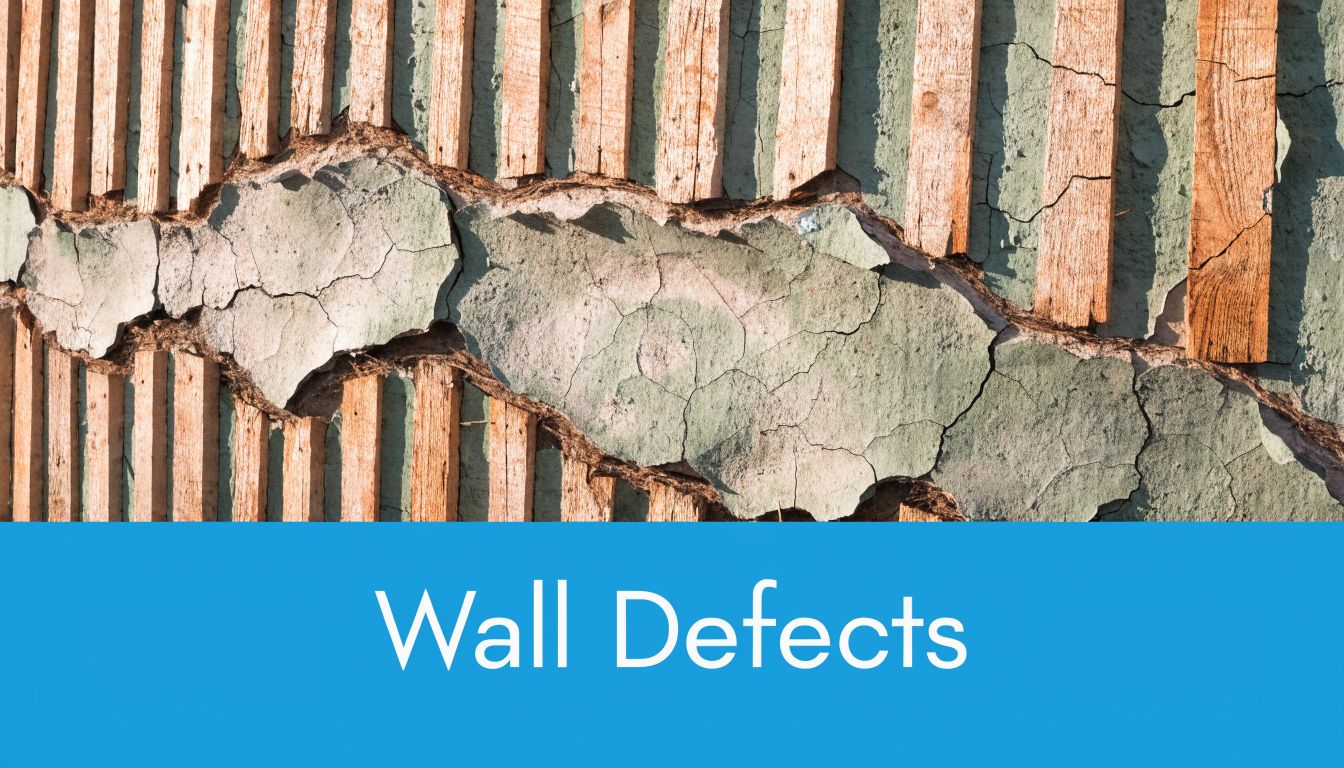
Traditional laths are fixed with narrow gaps so plaster keys can form. Where the keys break away, the face coat starts to detach. According to the technical overview on Designing Buildings Wiki, this is a primary cause of failure, often linked to damp-related decay or vibration. The same source notes that over 40% of pre-1940 UK properties in RICS Home Surveys show lath and plaster defects, and remedial works average £50-£100 per m² where lath renewal and replastering are required.
Ceilings are often the first place where real concern arises, because gravity is involved. Once keys fail over a large enough area, the plaster can sag or loosen.
Walls usually give warning earlier.
You may see:
If you’re also seeing staining, salt deposits, blown decorations or soft skirting ends, check the wider moisture picture. Damp is often the issue behind the plaster issue, not a separate problem. This guide to wall damp guidance is useful background because treating the finish without curing the moisture source rarely lasts.
Not all cracks carry the same weight.
A fine, stable crack at a wall-to-ceiling junction may reflect ordinary building movement. A broader irregular crack that coincides with bulging, distortion around a reveal, or loose plaster under hand pressure deserves more scrutiny.
Bulging matters because it suggests the face is no longer tight to the background. Once detachment has progressed, local filling won’t solve it.
The other concern is timber condition. The laths themselves can decay if ventilation has been poor or moisture has been persistent. Rising damp, leaks and condensation-prone cold spots all contribute to that risk. When timber laths weaken, the plaster loses the mechanical support it depends on.
This short visual example shows the sort of hidden deterioration that can sit behind a seemingly modest surface defect:
A surveyor doesn’t stop at the crack itself. The job is to read the pattern and test the likelihood of failure.
That usually includes:
A neat filler line can be more misleading than an untidy honest crack, because it tells you someone treated the symptom already.
There’s also a balanced side to this. Traditional plaster can offer useful fire resistance and contributes to the solidity of older interiors. That doesn’t remove the need for repair where failure exists, but it does mean wholesale replacement isn’t always the best answer. Good survey advice distinguishes between plaster that is old, plaster that is damaged, and plaster that is unsafe or uneconomic to retain.
Once the cause is understood, the next decision is practical. Keep the original fabric where possible, or replace it with a modern system.
That choice shouldn’t be made on sentiment alone.
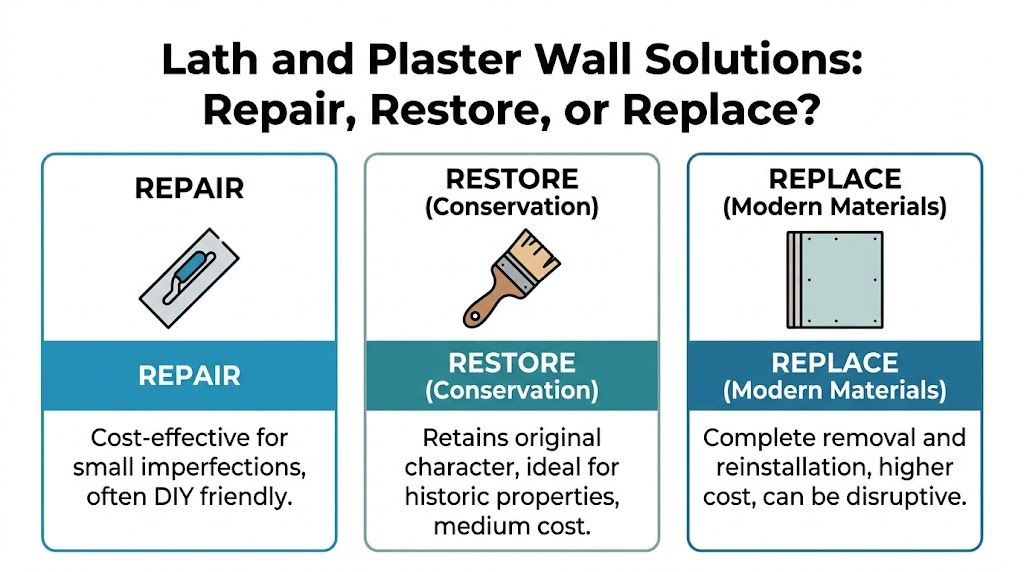
Specialist repair suits walls that are broadly sound but have local defects.
That might mean isolated cracks, limited areas of failed keying, or patches damaged during earlier work. In a historic or listed context, repair is often preferable because it preserves original material and avoids changing the feel of the room.
Typical approaches include careful opening-up, local re-fixing where appropriate, renewal of damaged sections, and compatible lime-based patching. If you want a trade-focused overview of practical methods, this guide on How to Repair Plaster is a useful companion to professional survey advice.
Repair also makes sense where breathability matters. Older solid-wall buildings often perform better when moisture can move through traditional finishes rather than being trapped by dense impermeable replacements.
Full or substantial replacement is usually justified when defects are extensive, access is already open for wider renovation, or the laths themselves are in poor condition.
That route can also be sensible where ceilings have widespread detachment or where repeated patching has created a patchwork of hard and soft materials with no coherent long-term performance.
Replacement is often more disruptive. It can affect cornices, skirtings, joinery junctions and the proportions of reveals. In heritage properties, it may also create consent issues or loss of value through over-modernisation.
Where the defect pattern is uncertain, a focused inspection often saves money before any contractor starts stripping out. A specific defect report is often the right level of instruction when the main question is whether the plaster can be retained and what the proper repair scope looks like.
Costs depend on extent, access, finish quality and whether specialist lime-compatible work is required. Where remedial works include lath renewal and three-coat replastering, the benchmark figure already noted is £50-£100 per m² in the technical source cited earlier.
The bigger decision is often about what you keep, not just what you spend.
| Factor | Specialist Repair (e.g., Lime Plaster) | Full Replacement (e.g., Plasterboard) |
|---|---|---|
| Best use case | Localised defects, heritage retention, breathable construction | Widespread failure, major refurbishment, heavily altered rooms |
| Disruption | Usually more targeted | Usually more invasive and messier |
| Character | Preserves original undulation and detailing | Gives a more uniform modern finish |
| Compatibility | Better suited to older fabric where traditional materials matter | Can work well, but details and junctions need care |
| Risk if mis-specified | Repairs can fail if the damp or movement cause isn’t resolved | Replacement can mask underlying defects or trap moisture if done badly |
| Cost basis | Can be efficient for isolated areas | Can become better value where failure is extensive |
A common mistake is choosing the cheapest surface fix. If the keys have failed or the laths are decayed, skimming over the top won’t solve the problem. Equally, ripping everything out because one room has minor cracking is often needless.
The right answer usually sits in the middle. Retain what is sound. Repair what is salvageable. Replace what has reached the absolute end of its serviceable life.
The condition of lath and plaster walls affects far more than decoration. It can alter negotiation, valuation, insurance conversations and the scope of legal obligations once works begin.
Where original plaster is intact and suits the character of a period property, it can support buyer appeal. The valuation issue changes quickly when the condition is uncertain.
According to the property discussion at The Craftsman Blog, retaining original features may add a 5-10% resale premium in heritage areas, while buyers may seek up to a 7% purchase price discount where plaster integrity hasn’t been confirmed. The same discussion aligns with surveyor concern over repair liabilities in the £50-£100 per m² range.
In practical terms, buyers don’t usually reduce their offer because a house has lath and plaster walls. They reduce it because no one has established whether the visible defects are superficial or expensive.
That’s why the survey wording matters. A report that identifies isolated cracking with no broad evidence of detachment reads very differently from one that notes widespread hollow areas, damp-related decay and a likelihood of opening-up works.
Sellers should take note of that distinction too. If a property has already had sensible repairs, invoices and a clear description of the work help. If no one knows the extent of the issue, uncertainty itself becomes a bargaining tool for the buyer.
Buyers usually price risk more aggressively than they price known repair work.
Insurance concerns tend to arise when defects suggest neglect, active water ingress, or unsafe ceilings. An insurer may not be interested in old plaster based solely on its age, but they can become interested if there is evidence of ongoing damage, previous collapse, or poor maintenance.
Listed buildings raise the stakes further. Original plaster may be part of the significance of the property, particularly where historic mouldings, cornices or early fabric survive. Unauthorised replacement can create problems with conservation officers and can reduce heritage value even if the new finish looks neat.
For owners planning structural changes, there’s a separate point. Lath and plaster often masks the true form of partitions and junctions. Before removing walls or widening openings, establish whether the wall is structural, whether historic finishes should be protected, and whether adjoining owners could be affected.
Party Wall Act issues can also arise where works to walls between properties involve cutting in, vibration, or more extensive opening-up. The plaster itself may not trigger the issue in isolation, but the wider works often do. In terraced and converted buildings, that’s especially relevant.
Landlords should also think beyond the repair bill. Loose plaster in tenanted property can become a safety issue if ceilings or high wall areas are deteriorating. Routine inspections should record any bulging, cracking progression or signs of damp before the matter becomes urgent.
A proper survey goes beyond tapping a few walls and writing “old plaster present”.

In a higher-level survey of a period property, the surveyor looks at condition, pattern and likely cause.
That includes:
A useful general overview of survey scope is this article on what a surveyor checks during a house survey.
When you get the report, don’t just ask “Is it serious?”
Ask these instead:
That’s where specialist judgement earns its fee. A buyer can see a crack. A good surveyor can tell whether it’s a maintenance item, a hidden damp symptom, or the start of costly fabric loss.
If you’re buying, selling or renovating a property with lath and plaster walls, Survey Merchant can connect you with an experienced UK surveyor who understands period buildings, defect diagnosis and the practical implications for value, repairs and legal compliance.
Generated with Outrank app
Survey Merchant provides vetted RICS surveyors across 100+ UK locations at fixed fees:
→ Level 2 Home Survey (HomeBuyer Report)
→ Level 3 Building Survey (full structural survey)
→ RICS Red Book property valuations
→ Party wall surveyors — notices, awards & schedules of condition
→ Expert witness surveyors — CPR Part 35 reports for property disputes