We use cookies to improve your experience on our site, analyze site traffic, and assist in our marketing efforts. By clicking "Accept all," you agree to the storing of cookies on your device. You can choose to "Reject all" non-essential cookies. For more information, please read our Cookie Policy.
EICR Certificate 2026: Cost, Rules & How Long It Lasts
Everything you need to know about the EICR certificate in 2026: what the inspection covers, typical costs by property size, validity periods, C1/C2/C3/FI codes, the May 2026 social housing rules and why homebuyers should test electrics alongside a survey.
An EICR certificate – properly called an Electrical Installation Condition Report – is the document that tells you whether the fixed wiring in a property is safe. In 2026 it matters more than ever: landlords in every UK nation are legally required to hold one, social landlords in England joined the regime this year, and the wiring regulations it is tested against were updated in April. This guide explains what an EICR certificate is, what it costs, how long it lasts, what the codes mean and when homebuyers, homeowners and landlords should commission one.
Key takeaways
An EICR is a formal inspection and test of a property’s fixed electrical installation (consumer unit, circuits, sockets, lighting and earthing), producing a “satisfactory” or “unsatisfactory” result.
Landlords in England, Wales, Scotland and Northern Ireland must have a satisfactory EICR no more than five years old; in England, civil penalties can now reach £40,000 per breach.
From 1 May 2026, England’s rules extended to existing social housing tenancies, with a compliance deadline of 1 November 2026.
A typical domestic EICR costs around £120–£350 depending on property size and location, and takes two to four hours.
Codes C1, C2 and FI make a report unsatisfactory; C3 is advisory only. Remedial work in rented homes must be completed within 28 days.
A RICS Home Survey does not test the electrics, so buyers should budget for an EICR alongside their Level 2 or Level 3 survey.
What is an EICR certificate?
An EICR certificate is a report produced by a qualified electrician after inspecting and testing a building’s fixed electrical installation against BS 7671 (the IET Wiring Regulations). It records the condition of the consumer unit, wiring, sockets, switches, lighting and earthing, lists any defects using standard codes, and gives an overall assessment of “satisfactory” or “unsatisfactory”. It is not a pass certificate for new work – that is an Electrical Installation Certificate (EIC).
Strictly speaking, the EICR is a report rather than a certificate, but the terms “EICR certificate”, “electrical safety certificate” and “landlord electrical certificate” are used interchangeably by letting agents, conveyancers and councils. Whatever it is called, the inspection follows the model forms set out in BS 7671, and the current edition is BS 7671:2018+A4:2026, published on 15 April 2026 (the previous A3:2024 version was withdrawn six months later).
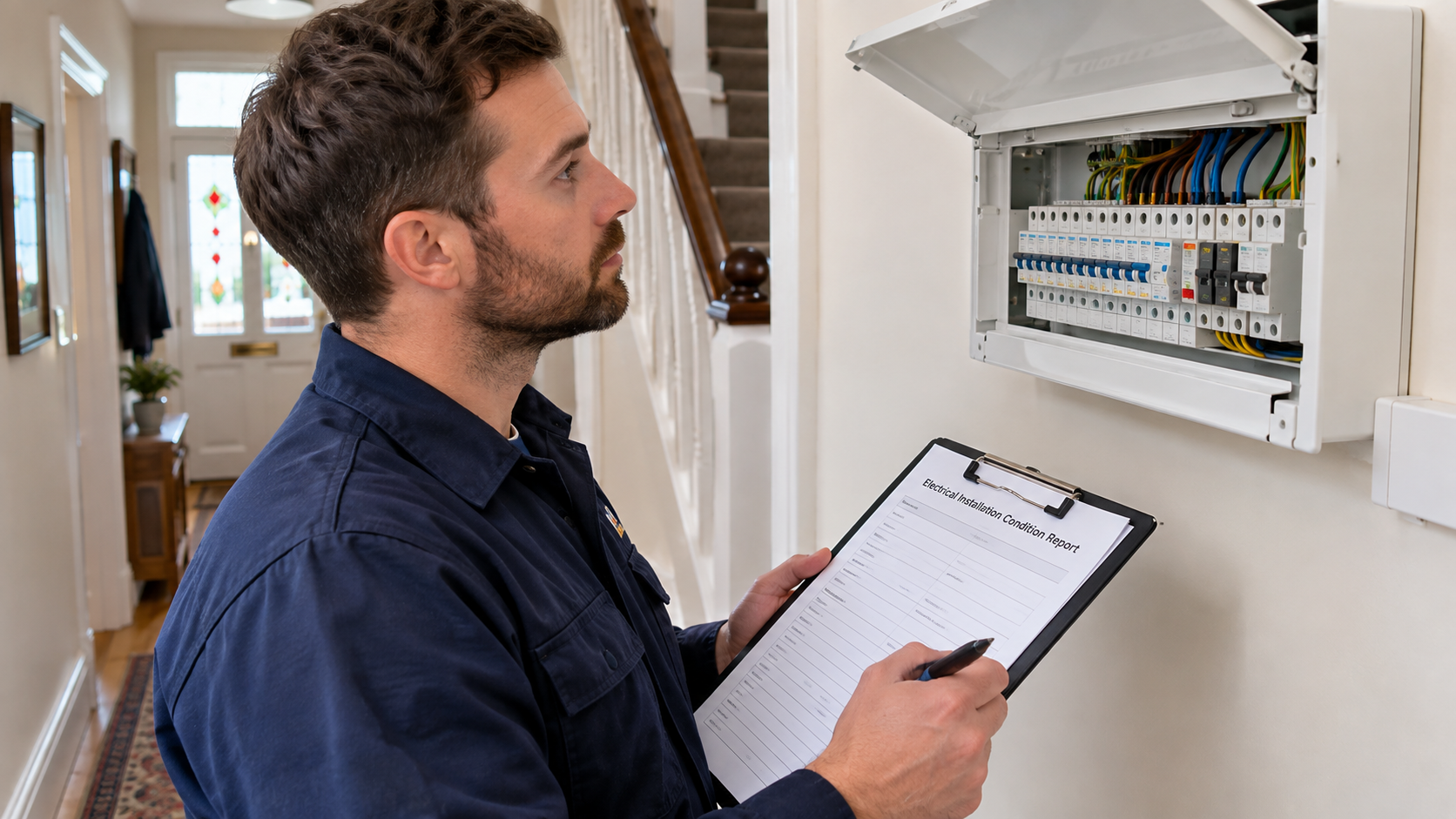
An EICR inspection covers the consumer unit, circuits, sockets, lighting and earthing – the parts of the installation a building survey can only look at visually.
EICR vs EIC vs Minor Works Certificate
EICR (Electrical Installation Condition Report): a periodic inspection of an existing installation. Confirms current condition at a point in time.
EIC (Electrical Installation Certificate): issued when a new installation, rewire or new circuit is completed. A new build should come with an EIC, not an EICR.
Minor Electrical Installation Works Certificate: issued for small alterations that do not add a new circuit, such as adding a socket to an existing ring.
Buyers frequently confuse these with Part P Building Regulations compliance certificates issued by competent-person schemes. If you are checking what paperwork a seller should hand over, ask for the EIC or Minor Works Certificate for any electrical work carried out since 2005, when Part P came into force.
What does an EICR inspection involve?
A competent electrician will carry out a visual inspection and a series of dead and live tests. Expect the power to be switched off for part of the visit. The inspection typically covers:
The consumer unit (fuse board): type, condition, labelling, presence of RCD or RCBO protection.
Earthing and main protective bonding to gas and water pipework.
Insulation resistance, continuity and polarity of every circuit tested.
Condition of accessories: sockets, switches, light fittings, cooker and shower circuits.
Signs of deterioration, overheating, DIY alterations, damage or wear, and whether the installation is suitable for continued use.
Outbuildings, garages and external supplies where they share the installation.
A sample of accessories is normally tested rather than every single point; a thorough contractor will state the extent and limitations of the inspection on the report. In older houses the inspection often uncovers the problems we describe in our article on common electrical issues in older homes, such as rubber-insulated cable, rewireable fuses and a lack of RCD protection.
EICR codes explained: C1, C2, C3 and FI
Every observation on an EICR is given a classification code. Understanding them is the key to reading the report and negotiating repairs.
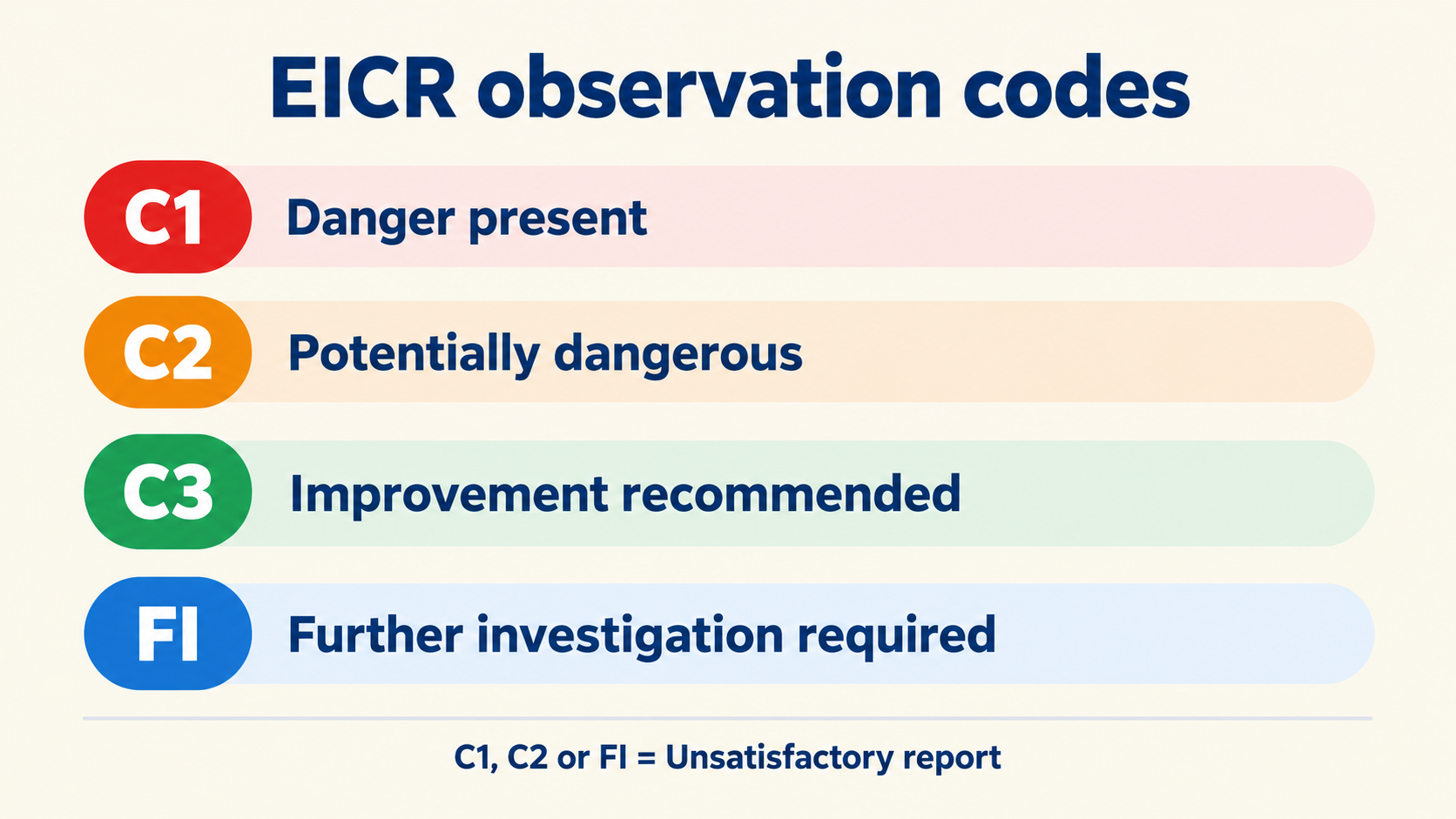
Only C1, C2 and FI observations result in an unsatisfactory EICR; C3 items are recommendations.
Code
Meaning
Effect on the report
Typical examples
C1
Danger present – risk of injury
Unsatisfactory; immediate action required (the electrician should make safe before leaving)
Exposed live conductors, badly damaged accessories
C2
Potentially dangerous
Unsatisfactory; urgent remedial action required
Missing main bonding, no RCD protection for bathroom or outdoor circuits, deteriorated cabling
C3
Improvement recommended
Report can still be satisfactory
Older consumer unit that is safe but not to current standards, missing circuit labels
FI
Further investigation required without delay
Unsatisfactory until investigated and resolved
Inaccessible junction boxes, unexplained test results
Coding is a matter of professional judgement, so two electricians can code the same observation differently. The Electrical Safety First Best Practice Guide 4, used widely across the industry, is the usual reference where there is disagreement. If a report seems unusually long on C2 items – particularly where the same contractor is quoting for the remedial work – it is reasonable to ask for a second opinion.
How long is an EICR certificate valid for?
The report itself states a recommended date for the next inspection, which the inspector sets according to the type of premises and the condition found. The usual intervals are:
Situation
Recommended or required interval
Owner-occupied home
Every 10 years (industry recommendation), or on change of occupancy
Private rented home (England)
At least every 5 years – legal requirement since 2020/2021
Social rented home (England)
At least every 5 years – legal requirement from 1 December 2025 (new tenancies) and 1 May 2026 (existing)
Private rented home (Wales)
At least every 5 years under the Renting Homes (Wales) Act 2016; copy to contract-holder within 14 days
Private rented home (Scotland)
At least every 5 years, plus PAT testing of landlord-supplied appliances
Private rented home (Northern Ireland)
Satisfactory EICR dated within 5 years for tenancies, phased in from April 2024
Houses in multiple occupation
5 years (and often a licensing condition)
Commercial premises and offices
Typically 5 years; shorter for industrial, swimming pools and caravan parks
In practice, lenders, insurers and buyers treat anything older than five years with suspicion, and a change of ownership is a sensible trigger for a fresh report regardless of the date on the last one.
EICR rules for landlords in 2026
In England, the Electrical Safety Standards in the Private Rented Sector (England) Regulations 2020 require landlords to have the installation inspected and tested by a qualified and competent person at least every five years. Under regulation 3 the landlord must give a copy of the report to existing tenants within 28 days, to new tenants before they move in, to prospective tenants within 28 days of a written request, and to the local housing authority within seven days of a request. Where the report shows C1, C2 or FI items, the remedial or investigative work must be completed within 28 days (or sooner if the report says so), with written confirmation supplied to the tenant and, if asked, the council.
Two developments this year change the picture:
Social housing is now covered. The Electrical Safety Standards in the Private Rented Sector (England) (Amendment) (Extension to the Social Rented Sector) Regulations 2025 brought social landlords into the regime for new tenancies from 1 December 2025 and for existing tenancies from 1 May 2026, with a six-month transition to 1 November 2026. Social landlords must also test the electrical appliances they supply. Electrical Safety First noted that more than half of accidental domestic fires in England have an electrical origin, which is why the extension was pressed for.
Penalties have increased. Councils can impose civil penalties of up to £40,000 per breach under the updated regime, up from the £30,000 maximum in the original 2020 regulations. Councils have already fined landlords £9,000–£10,000 for failing to produce a valid report, and the sums are expected to rise.
Landlords should also read our summary of the Renters’ Rights Act changes for landlords, because the new Decent Homes Standard and Awaab’s Law obligations make electrical safety records part of a much wider compliance file. A dated, satisfactory EICR belongs at the top of your landlord property inspection checklist.
How much does an EICR certificate cost in 2026?
Prices vary with the size of the property, the number of circuits, access and location. Current indicative figures published by MyJobQuote (August 2026) are:
Property type
Typical EICR cost (2026)
Typical time on site
Studio or 1-bedroom flat
£120–£180
1.5–2.5 hours
2–3 bedroom house
£150–£250
2–3 hours
4–5 bedroom house
£250–£350
3–4 hours
6+ bedrooms or HMO
£350–£450
Half a day or more
Small commercial unit
£200–£500
Varies by circuits
London uplift
£200–£400 for a standard home
–
Some contractors price per circuit (roughly £10–£30 each) rather than per property. Be wary of very cheap headline prices that are recouped through inflated remedial quotes; it is good practice to get the report from one firm and, if the work is substantial, remedial quotes from another.
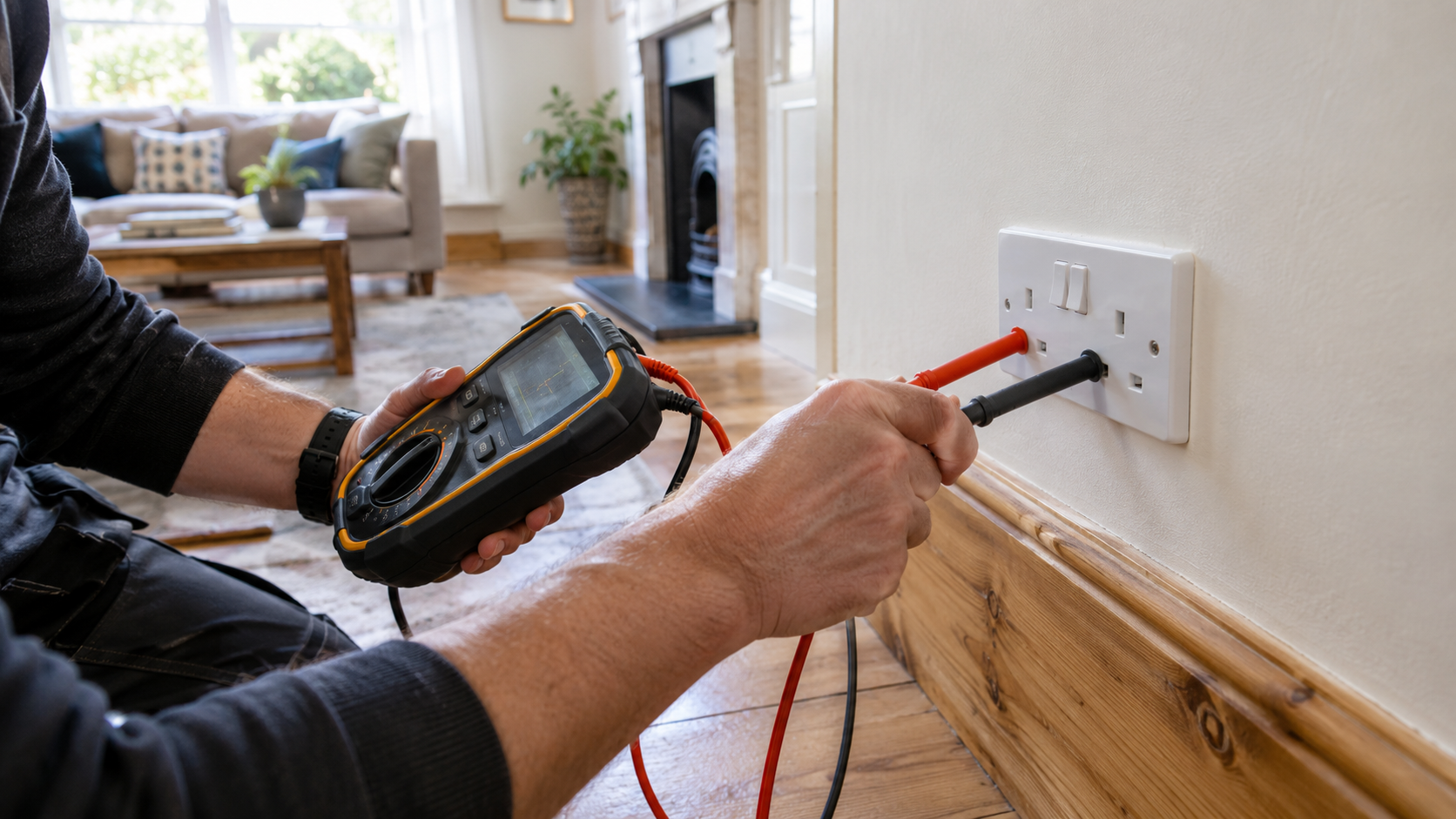
Dead and live tests on a sample of circuits and accessories are what distinguish an EICR from a visual check.
Do I need an EICR when buying a house?
There is no legal obligation for a seller to provide an EICR, and the vast majority of owner-occupied homes change hands without one. However, it is strongly advisable, for three reasons:
Surveyors do not test electrics. The RICS description of the Home Survey Level 3 states plainly that “the visual inspection cannot assess the efficiency or safety of electrical, gas or other energy sources”. A surveyor will note visible warning signs – an old fuse box, surface-mounted cable, scorched sockets – and recommend a test, but the test itself is a separate specialist job. See our comparison of Level 2 vs Level 3 surveys for what each report does and does not cover.
Rewiring is expensive. A full rewire of a three-bedroom house commonly runs to several thousand pounds plus redecoration. An EICR costing under £250 can give you the evidence to renegotiate the price or ask the seller to fix defects before exchange.
Insurance and mortgage conditions. Some insurers ask about the age of the wiring, and lenders occasionally impose a retention where a valuer flags obviously dangerous electrics.
Period properties deserve particular care. Our guides to surveying a 1930s house and what a house survey includes explain why pre-1970s wiring, lead-sheathed or rubber cables and fuse-wire boards almost always warrant an EICR before completion. For a new build, ask instead for the Electrical Installation Certificate and the Part P notification; if neither is forthcoming, raise it with the developer as a snagging item before completion.
Who can carry out an EICR?
The regulations require a “qualified and competent person”. In practice that means an electrician with a recognised inspection-and-testing qualification (such as City & Guilds 2391 or equivalent), current knowledge of BS 7671, calibrated test instruments and adequate insurance. Membership of a government-approved competent-person scheme such as NICEIC, NAPIT or ELECSA is the simplest way to demonstrate this, and GOV.UK’s landlord guidance recommends using it as a check. Ask to see the certificate of registration and make sure the report is issued on the BS 7671 model form with the inspector’s signature and scheme number.
What happens if an EICR is unsatisfactory?
An unsatisfactory result is not a disaster; it is a to-do list. The steps are:
Address any C1 items immediately – the inspector should have made them safe on the day.
Obtain quotes for C2 and FI items and have them completed within 28 days if the property is let (landlords in England must keep written confirmation from the electrician).
Decide whether to action C3 recommendations now or budget for them later; they do not affect the overall result.
Obtain a Minor Works Certificate or EIC for the remedial work. You do not usually need a brand-new EICR afterwards, provided the original report plus the certificates for the remedial work are kept together.
Buyers in the middle of a transaction can use an unsatisfactory report in exactly the same way they would use building survey findings – as a basis for a price reduction or a condition of the contract. Our article on negotiating the house price after your survey sets out how to present the evidence.
EICR and the wider 2026 compliance picture
Interest in electrical safety is rising sharply: Google Trends data for the United Kingdom shows searches for “EICR” reached their 12-month peak in the week of 20–26 September 2026, as social landlords worked towards the November deadline and private landlords prepared for the Renters’ Rights Act regime. At the same time, Amendment 4 to BS 7671 added new requirements for battery storage, Power over Ethernet and ICT earthing – relevant if a property has solar batteries or a home office network – and inspectors are now coding against that edition.
For homeowners the message is simple: an installation that was “satisfactory” in 2016 may still be safe, but it will attract more C3 observations against the 2026 standard. That is not a reason to panic, but it is a reason to plan upgrades (typically RCD protection and a modern consumer unit) rather than be surprised by them at the point of sale or letting.
Why choose Survey Merchant for your EICR and property survey?
Survey Merchant is a UK-wide surveying marketplace rather than an electrical contractor, and we think that independence is exactly why buyers and landlords use us. When you book a Level 2 or Level 3 survey, a valuation or a landlord condition report through us, you get:
An accredited panel matched to the job. Our surveyors are suitably qualified and regulated or accredited by recognised UK bodies including RICS, CIOB and RPSA, so the person inspecting your property is the right specialist for its age and type.
Impartial advice on what to test next. Because we do not sell remedial electrical work, our surveyors have no incentive to over-code or under-code. If the fuse board, cabling or bonding look suspect, the report will say so and recommend an EICR by a scheme-registered electrician – and we can help you sequence that alongside gas, damp and drainage checks.
Nationwide coverage and fast turnaround. From London to Edinburgh, we match you to a local surveyor who knows the housing stock, with reports typically delivered within days of inspection.
Transparent, competitive fixed fees. You see the price before you book, with no hidden extras.
End-to-end support. From choosing the right survey level to interpreting an unsatisfactory EICR and renegotiating, our team is on hand throughout the transaction.
If you are buying, letting or refinancing a property and want a clear, independent picture of its condition – including whether an EICR should be your next step – explore our building surveying services or contact Survey Merchant today for a fixed-fee quote.
An EICR (Electrical Installation Condition Report) is a formal report produced by a qualified electrician after inspecting and testing a property's fixed wiring, consumer unit, sockets, lighting and earthing against BS 7671. It records any defects using codes C1, C2, C3 and FI and gives an overall result of satisfactory or unsatisfactory.
How much does an EICR certificate cost in 2026?
Indicative 2026 prices are around £120–£180 for a one-bedroom flat, £150–£250 for a two- to three-bedroom house and £250–£350 for a four- to five-bedroom house, with London typically £200–£400. Some electricians charge £10–£30 per circuit instead. Remedial work is priced separately.
How long is an EICR valid for?
The inspector sets the next inspection date on the report. Rented homes across the UK legally need a satisfactory EICR at least every five years. For owner-occupied homes the industry recommendation is every ten years or on change of occupancy, and most buyers, lenders and insurers treat a report older than five years as out of date.
Is an EICR a legal requirement for landlords?
Yes. In England the 2020 regulations require private landlords to hold a satisfactory EICR no more than five years old, and from 1 December 2025 (new tenancies) and 1 May 2026 (existing tenancies) the same duty applies to social landlords. Wales, Scotland and Northern Ireland have equivalent five-year rules. Councils in England can impose civil penalties of up to £40,000.
What happens if my EICR is unsatisfactory?
C1 items must be made safe immediately and C2 or FI items must be investigated or repaired – within 28 days for rented property in England – by a qualified electrician who then issues a Minor Works Certificate or EIC. C3 items are recommendations only. You do not normally need a brand-new EICR afterwards if the original report and remedial certificates are kept together.
Does a RICS Level 2 or Level 3 survey include an electrical test?
No. RICS states that a Home Survey's visual inspection cannot assess the efficiency or safety of electrical, gas or other services. Your surveyor will flag visible warning signs such as an old fuse board and recommend a test, but the EICR itself is a separate specialist inspection by a scheme-registered electrician.