Leasehold
Jul 16, 2026
Level 2 vs Level 3 Survey: Complete Comparison Guide
Practical comparison of home survey depth, costs and when to choose a basic report versus a full structural survey for moder

When buying a property in the UK, choosing the right survey can save you time, money, and stress. The two most common options are Level 2 (HomeBuyer Report) and Level 3 (Building Survey). Here's a quick breakdown to help you decide:
Key Differences:
Quick Comparison:
| Feature | Level 2 (HomeBuyer Report) | Level 3 (Building Survey) |
|---|---|---|
| Best For | Modern, standard homes | Older, altered properties |
| Inspection Depth | Visual only | Detailed structural check |
| Report Length | 15–30 pages | 30–80 pages |
| Includes Valuation | Yes | Optional (£200–£400) |
| Cost Range | £400–£1,000 | £600–£1,500+ |
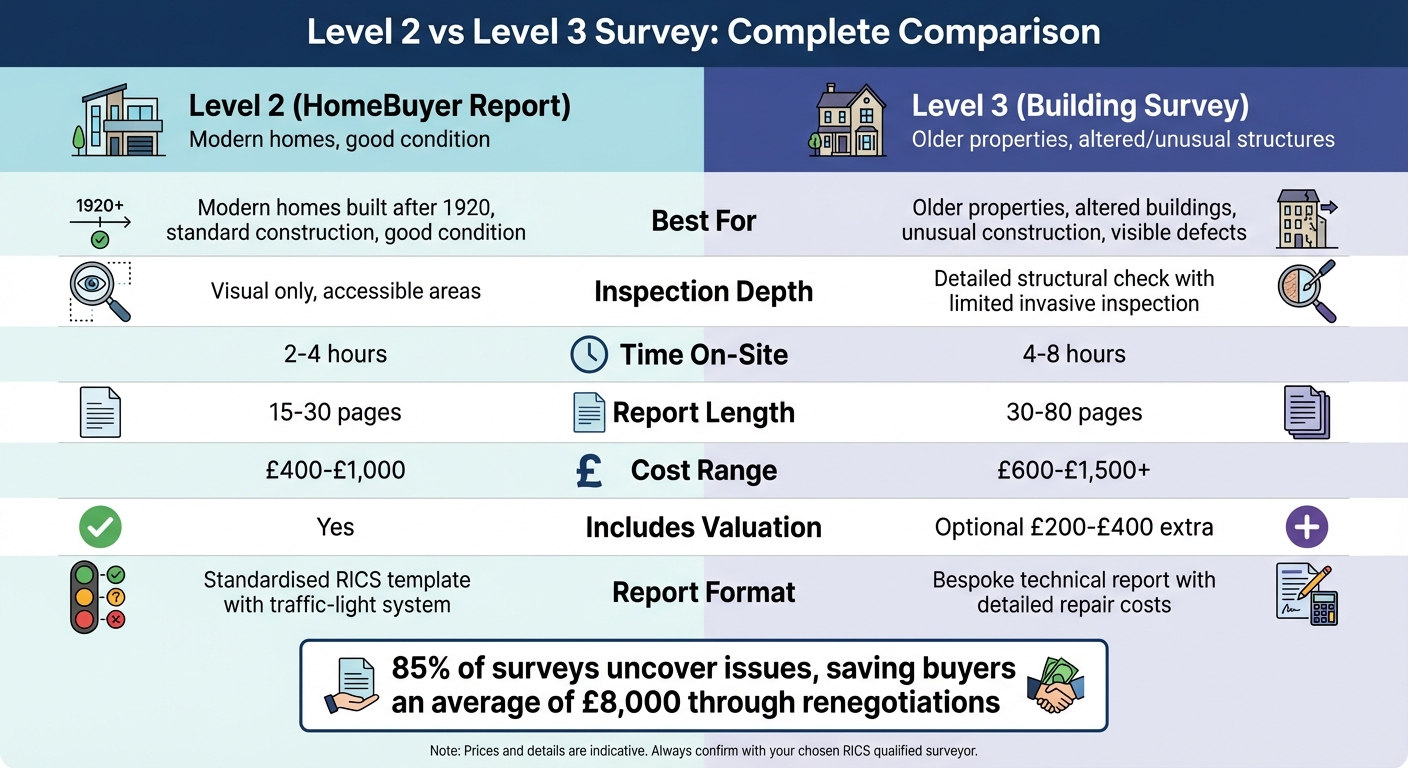
Choose Level 2 for straightforward properties and Level 3 for older or complex ones. A survey can uncover issues in 85% of cases, often leading to savings of up to £8,000 through renegotiations or repairs.
Level 2 vs Level 3 Property Survey Comparison: Cost, Depth, and Best Use Cases
The RICS Home Survey Level 2, previously called the HomeBuyer Report, is a professional visual inspection designed for conventional properties that are in good condition [1][2]. This survey focuses on areas that are visible and easy to access, covering the main building and any outbuildings. Key elements like roofs, walls, ceilings, floors, windows, and doors are all included in the assessment [2][4].
A Level 2 survey is non-invasive, meaning the surveyor won’t move heavy furniture, lift floorboards, or remove secured panels [2][5]. Instead, they perform a detailed visual inspection and may use tools like damp meters to check for moisture or signs of rot. The inspection usually takes 2 to 4 hours, and the final report - typically 15 to 30 pages long - is delivered within 5 to 7 working days [4][5].
The report uses a simple "traffic light" system to rate the condition of different elements:
Unlike the more detailed Level 3 survey, the Level 2 report generally includes a market valuation and an insurance reinstatement figure - an estimate of the cost to rebuild the property from scratch [6][7]. It also involves a visual check of basic services like electrical, plumbing, and heating systems, though no specialised testing is conducted [4][5]. Some modern Level 2 reports may even provide extra insights, such as broadband speed, mobile signal strength, and noise levels from traffic or aircraft [5].
Deciding whether a Level 2 survey is right for you depends on the property. This type of survey is best suited for homes built after 1920 that use standard construction methods like brick and tile and appear to be in generally good condition [6][4]. It’s a popular choice for buyers who want a professional assessment at a reasonable price but don’t require the in-depth structural analysis of a Level 3 survey [5].
However, if the property has seen major structural changes - such as large extensions or the removal of walls - it might be wise to opt for a Level 3 survey instead [4][5]. Choosing the right survey ensures you get the level of detail needed without spending more than necessary.
The RICS Home Survey Level 3 is the most thorough property inspection available in the UK, providing a detailed analysis of a property's structure, materials, and overall condition [8][9]. This tailored report goes beyond the Level 2 survey, with surveyors typically spending up to 8 hours on-site to carefully inspect areas such as roof spaces, cellars, chimneys, and grounds [9].
While the survey remains non-intrusive, it does involve a more hands-on approach where possible. Surveyors may lift accessible floorboards or move loose panels to examine concealed spaces, provided it is safe to do so [5]. The final report, which ranges from 30 to 80 pages, is usually delivered within 10 working days [3]. This extensive inspection naturally results in a more detailed breakdown of the property's condition.
A Level 3 survey is designed to identify major issues such as subsidence, structural movement, damp, timber decay (including rot and woodworm), and damage to masonry. It also flags potential legal concerns, such as whether previous alterations meet building regulations or planning permission requirements, and checks for hazardous materials like asbestos [8].
The report provides comprehensive repair advice, including specific repair options, estimated costs, and timelines. It also explains the potential consequences of neglecting these repairs and offers insights into how the building materials are likely to perform over time, helping you plan for future maintenance [5].
Unlike Level 2 surveys, Level 3 reports do not include market valuations or insurance reinstatement costs. If you require a valuation, this is typically offered as an additional service at an extra cost, usually between £200 and £400 [4].
A Level 3 survey is highly recommended for older or non-traditional properties. It is particularly important for homes over 50 years old, including those built before 1850, listed buildings, or properties constructed using methods like timber framing or thatching. It is also the best choice for properties that are unusually large, have complex designs, or have undergone significant alterations or extensions [9].
This survey is crucial if the property shows signs of wear or deterioration, as it can uncover hidden defects that might affect safety or value. It is especially valuable if you are planning major renovations or structural work, as it helps assess the building's limitations and how it might respond to modifications. The detailed repair cost estimates provided can also serve as a strong negotiation tool, allowing you to adjust the purchase price or request that the seller address critical repairs before the sale progresses [7]. This level of detail empowers buyers to make well-informed decisions, complementing the insights offered by Level 2 surveys.
When choosing between Level 2 and Level 3 surveys, the primary distinction lies in the depth of inspection. A Level 2 survey typically takes 2–4 hours and focuses on visible, easily accessible areas. It uses non-intrusive methods, such as inspecting one window per wall or performing a heel-drop test to check floor stability [4] [6] [10]. On the other hand, a Level 3 survey lasts 4–8 hours and includes limited invasive checks. Surveyors may lift accessible floorboards or look behind panels to uncover hidden issues [4] [6].
The reports also differ in scope and detail. Level 2 reports, generally 15–30 pages long, follow a standardised RICS format and provide a straightforward assessment of the property's condition. In contrast, Level 3 reports are more detailed, spanning 30–80 pages, and offer tailored technical analysis. These reports delve into defect origins, potential risks, and structural concerns, making them especially useful for understanding underlying problems or planning significant renovations. For a quick overview, refer to the comparison table below.
| Feature | Level 2 (HomeBuyer Report) | Level 3 (Building Survey) |
|---|---|---|
| Inspection Depth | Visual, accessible areas only [1] | Comprehensive with limited invasive checks [4] |
| Time On-Site | 2–4 hours [4] [6] | 4–8 hours [4] [6] |
| Report Length | 15–30 pages [4] [6] | 30–80 pages [4] [6] |
| Format | Standardised RICS template [2] | Bespoke technical report [2] |
| Structural Analysis | Basic condition assessment [4] | Detailed integrity and foundation analysis [4] |
| Repair Advice | General maintenance recommendations [4] | Detailed solutions with cost estimates [1] |
| Valuation Included | Usually standard [1] | Usually optional extra (£200–£400) [4] [5] |
| Best For | Post-1960, conventional construction [1] [4] | Pre-1920, unusual construction, or altered properties [1] [5] |
| Cost Indicator | ££ (£400–£1,000) [2] [4] [6] | £££ (£600–£1,500+) [4] [6] |
The age of the property often determines which survey is most suitable. For homes built after 1960 using standard brick-and-block methods and in good condition, a Level 2 survey is usually sufficient [1] [4]. However, older properties - especially those constructed before 1920 - benefit from the more in-depth analysis provided by a Level 3 survey [1] [6].
Construction type and current condition also influence the decision. Homes featuring non-standard materials like timber framing, thatched roofs, or steel structures require the specialist insights of a Level 3 survey [4] [5]. Similarly, if there are visible concerns such as cracks, damp patches, or uneven floors, a detailed investigation is essential. For those planning major renovations or extensions, the structural insights offered by a Level 3 report can help assess the building's capacity to handle changes [3] [1].
Finally, consider your budget for repairs. While Level 2 surveys provide a clear overview with traffic-light ratings to highlight urgent issues, Level 3 surveys go further by offering specific cost estimates. These detailed figures can strengthen your position during price negotiations [2] [4].
Survey costs can vary significantly, so it’s important to understand what you might pay before deciding on the right service for your property. A Level 2 survey generally falls between £400 and £1,000, with average prices ranging from £422 to £455 [12]. For properties valued up to £500,000, you’re likely to pay between £400 and £750, while homes priced between £500,000 and £1 million typically cost between £750 and £1,000 [4].
On the other hand, Level 3 surveys come with a higher price tag, ranging from £630 to £1,500 or more. The average cost is around £561 to £629 [12]. Larger or more complex properties often fall into the £1,000 to £1,500 range, and for mansions or estates, costs can exceed £3,000 [4]. It’s worth noting that Level 3 surveys usually don’t include market valuations, which, if required, can add an extra £200 to £400 [4][5].
Interestingly, 35% of homeowners who commissioned a survey used the findings to negotiate a lower purchase price, saving an average of £6,390 [13]. With 85% of surveys uncovering at least one issue [4], the investment in a detailed survey often pays off through potential price reductions.
Now, let’s explore what factors influence these costs.
The value of the property is one of the biggest factors affecting survey fees. Surveyors often use a sliding scale, meaning higher-value properties incur higher charges due to increased professional indemnity insurance requirements [4].
Location also has a significant impact. Surveyors in London and the South East typically charge £100 to £500 more than those in other parts of the UK [6].
The size and complexity of the property also play a role in costs. Level 3 surveys, for example, take between 4 and 8 hours, compared to 2 to 4 hours for Level 2 surveys [11]. Homes with non-standard features, such as timber framing, thatched roofs, or extensive alterations, can increase both the complexity and the cost of the survey [7].
When comparing quotes, make sure to check whether VAT is included. Additionally, it’s wise to avoid surveyors linked to estate agents or banks, as their fees may include commission markups [5].
Deciding on the right survey is a crucial step when purchasing a property. The choice depends largely on the property's age, construction, and condition, as well as your peace of mind.
A Level 2 survey is a good fit for homes built after 1920 - or sometimes after 1960, depending on the surveyor's criteria - that use standard brick and tile construction[6]. If you're considering a modern property or flat that seems well-maintained and free of visible issues, this type of survey provides the insights you need without the expense of a Level 3 inspection.
One added bonus of the Level 2 survey is that it typically includes a market valuation, unlike Level 3 surveys where this is an optional extra. For instance, a buyer purchasing a four-bedroom detached house built in 2015 for £450,000 chose a Level 2 survey priced at £650. The report revealed only minor maintenance concerns, with no significant structural problems, enabling the purchase to move forward quickly and confidently[6].
However, if the property has non-standard construction or visible defects, a more thorough investigation might be necessary.
For older properties or those with noticeable issues, a Level 3 survey is the better choice. This survey is tailored for homes built before 1920, listed buildings, or properties constructed with non-standard materials like timber, thatch, or stone[6]. It's also essential if the property has undergone - or will require - major renovations or structural changes.
Level 3 surveys are particularly valuable for homes with visible damage, such as large cracks, significant damp, or signs of subsidence. These issues require a detailed assessment to pinpoint the cause and recommend appropriate repairs[6]. For example, an 1890s cottage purchased for £320,000 prompted a Level 3 survey costing £1,200. The survey uncovered structural problems that led to a £15,000 price reduction. Similarly, a Grade II listed manor house priced at £800,000 required a Level 3 survey with heritage expertise, costing £2,500. This report identified conservation-related maintenance needs and included recommendations for specialist contractors, helping the buyer avoid future legal and preservation challenges[6].

Survey Merchant connects homeowners and buyers with RICS-qualified surveyors, including AssocRICS, MRICS, and FRICS professionals. The process is simple: enter your postcode or full address to receive instant quotes from local experts. These surveyors are well-versed in regional building practices and property characteristics, ensuring a tailored approach to your needs.
Every surveyor on the platform is covered by professional indemnity insurance, typically with a minimum of £1 million in coverage. This provides peace of mind, knowing you're protected if any issues arise. Once you've chosen a surveyor, they’ll coordinate directly with your estate agent or seller to arrange access to the property and schedule the inspection. Reports are delivered electronically - within 5 working days for Level 2 surveys and 7–14 days for Level 3 surveys.
The platform also offers impartial advice to help you choose between a Level 2 or Level 3 survey, factoring in the property's age, condition, and any renovation plans you might have. This guidance is a lifeline, especially since moving house is often considered one of the most stressful experiences in the UK.
By simplifying the process, Survey Merchant makes arranging property surveys straightforward while offering buyers a clear and efficient path to making informed decisions.
Survey Merchant isn’t just about convenience; it offers a range of benefits that make the process smoother and more effective. One of the standout features is the ability to compare surveyors based on not only price but also local expertise and turnaround times. This eliminates the hassle of researching individual surveyor credentials, as all professionals on the platform are pre-vetted.
For first-time buyers or anyone unfamiliar with property surveys, the service is particularly helpful. The detailed survey findings can be a powerful tool during price negotiations and can help you avoid costly mistakes down the line. Whether you're buying a modern flat or a period property, Survey Merchant ensures you're matched with a surveyor who understands the unique requirements of your home.
If you're buying a modern, conventional home - typically built after 1920 - a Level 2 survey is usually sufficient, with costs ranging between £400 and £1,000. However, for older, more complex, or altered properties, such as listed buildings or homes with visible defects, a Level 3 survey (costing £600 to £1,500 or more) is often a wise investment, as it can uncover hidden issues that might otherwise go unnoticed.
Statistics show that 85% of surveys identify at least one issue, potentially saving buyers an average of £8,000 through renegotiations or by avoiding a problematic purchase altogether [4]. Alarmingly, 16% of homeowners discover defects only after buying, with some repairs costing over £5,000 to fix [5]. A professional survey, therefore, offers not just peace of mind but also tangible financial protection.
As the Royal Institution of Chartered Surveyors (RICS) explains: "This level of service is for clients who are seeking a professional opinion at an economic price. It is, therefore, necessarily less comprehensive than a survey level three service" [5]. Understanding these distinctions helps you choose the right survey for your property, avoiding unnecessary expense or the risks of insufficient inspection.
If you're unsure which survey fits your situation, consult a RICS-qualified surveyor. They can assess your property's age, construction type, and any renovation plans to recommend the best option. This tailored advice ensures your choice aligns with both your budget and the property's specific needs.
Choosing between a Level 2 HomeBuyer Report and a Level 3 Building Survey ultimately comes down to the specifics of your property and what you need from the inspection.
For straightforward, well-maintained properties, a Level 2 survey should suffice. But if your property is older, more complex, or you’re planning renovations, the in-depth insights of a Level 3 survey could save you trouble down the line.
A property survey offers a professional evaluation of a property's condition, highlighting any potential problems like damp, structural issues, or hidden damage. The findings are compiled into a detailed, RICS-compliant report, providing you with clear evidence to discuss with the seller. This can be a powerful tool for negotiating a price reduction to account for the cost of any necessary repairs or adjustments.
The report often includes the surveyor's advice on maintenance and an estimate of the costs needed to address the identified issues. Armed with this information, you can suggest a fair price reduction, ensuring the agreed purchase price accurately reflects the property's condition and value.
When you’re budgeting for a Level 3 survey, the quoted fee from the surveyor usually covers the main assessment. However, there could be extra costs if the property requires further inspections, specialist tests, or detailed reports to address specific issues uncovered during the survey.
To avoid unexpected expenses, it’s wise to clarify with your surveyor exactly what the quoted price includes. Take the time to discuss any possible additional charges before the survey begins.
Survey Merchant provides vetted RICS surveyors across 100+ UK locations at fixed fees:
→ Level 2 Home Survey (HomeBuyer Report)
→ Level 3 Building Survey (full structural survey)
→ RICS Red Book property valuations
→ Party wall surveyors — notices, awards & schedules of condition
→ Expert witness surveyors — CPR Part 35 reports for property disputes