Building Surveying
Sep 29, 2026
What Does a House Survey Include: Home Survey Explained:
Discover what does a house survey include. Our guide explains RICS Level 1, 2 & 3 reports, costs, common findings & what surveyors check in the UK.

Your offer has been accepted. The estate agent sounds upbeat, the mortgage application is moving, and for a moment it feels as though the hardest part is over.
This is usually the point where first-time buyers get pulled in two directions. One part of you wants to keep everything moving. The other part is asking, “What am I buying?” That question is exactly where a house survey matters.
A survey isn’t there to slow the purchase down. It’s there to stop you buying a problem at the wrong price. It also helps you separate a cosmetic issue from a structural one, and a routine repair from something that affects insurance, lending, or future resale. That same logic shows up in wider property work too. If you’ve ever looked at how lawyers approach commercial property due diligence, the principle is similar. Check the risks before you commit, not after.
If you’re wondering what does a house survey include, the short answer is this. It includes a professional inspection of the parts of the property the surveyor can reasonably access, plus advice on condition, defects, maintenance, and in some cases likely repair implications. The useful answer is more detailed, because what’s included depends on the type of survey you choose.

The first thing to clear up is a common misunderstanding. A mortgage valuation is for the lender. A house survey is for you. The lender wants to know whether the property broadly supports the loan. You want to know whether the roof is tired, whether damp is active, whether movement needs monitoring, and whether the asking price still makes sense once the defects are on the table.
That distinction matters because buyers often assume the bank’s checks will protect them. They won’t. A valuation can be brief. A proper survey is the point where someone looks at the building itself with your interests in mind.
Once your offer is accepted, most buyers need to decide three things quickly:
Practical rule: If you’d struggle financially with a major surprise after completion, pay for the survey that gives you the clearest warning signs before exchange.
House surveys in the UK aren’t niche. They’re part of normal purchase due diligence. Historically, the system has developed from basic valuations into fuller condition reporting, and over 1.2 million residential surveys are commissioned annually according to RICS statistics referenced in the wider home survey framework.
What matters to you isn’t the volume. It’s the consequence. A good survey strengthens your position. It can confirm that the home is broadly sound, show where future maintenance spend is likely, or tell you the property needs a specialist report before you commit legally.
Your offer is accepted on a 1930s house. The kitchen looks smart, the paint is fresh, and the estate agent says it is "in good condition". Then you have to choose a survey. Pick too lightly, and you may miss the warning signs that affect your budget or your ability to renegotiate. Pick the right level, and you are paying for clearer answers before you become legally committed.
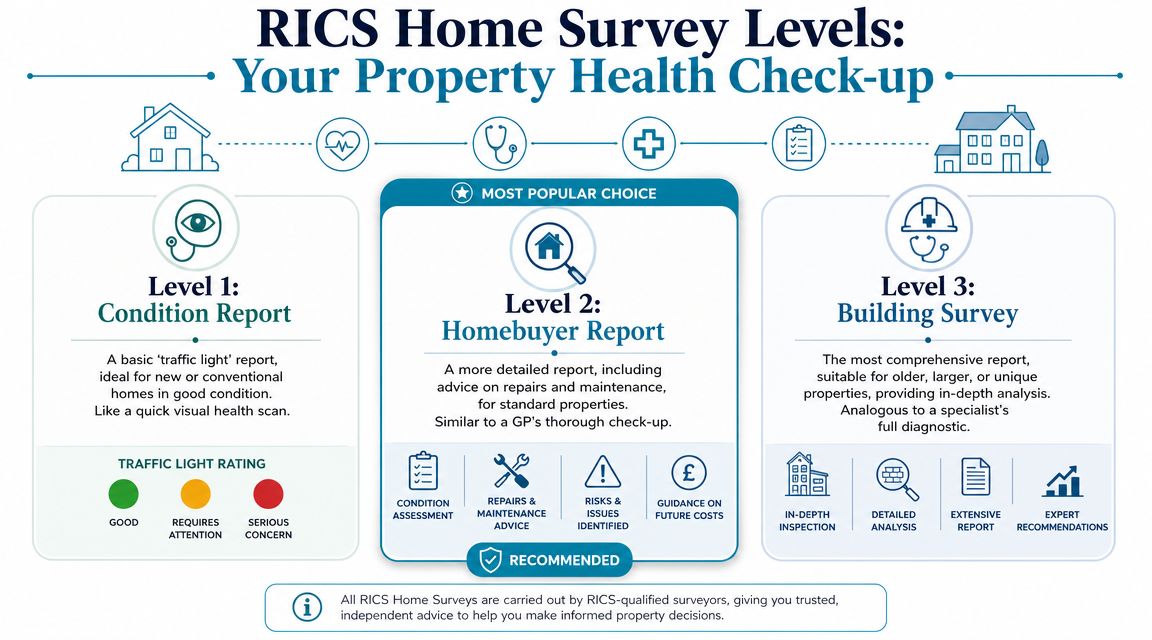
RICS survey levels work like different strengths of diagnostic test. They all involve a visual inspection, but they do not all give you the same depth of advice, the same help with repair planning, or the same basis for price negotiations.
| Survey level | Best suited to | What you get |
|---|---|---|
| Level 1 | Newer, conventional homes in apparently good order | A basic condition snapshot |
| Level 2 | Standard residential properties | A visual inspection with advice on defects, risks, and maintenance |
| Level 3 | Older, altered, larger, unusual, or visibly defective properties | A fuller analysis of construction, defects, likely causes, and repair implications |
The practical question is simple. What level of uncertainty can you afford?
Level 1 is the lightest option. It suits a fairly modern, conventional property where you want an independent overview of condition but do not need detailed advice on repairs.
That limitation matters. If the property turns out to have hidden age-related problems, a Level 1 report may confirm there is an issue without giving much guidance on what it means in pounds and pence. For a first-time buyer with a tight post-completion budget, that can leave too much guesswork.
Level 2 is often the sensible middle ground for a standard flat, terrace, semi, or modern detached house. The surveyor carries out a more detailed visual inspection and reports defects using the familiar traffic-light ratings described in the RICS guide to house surveys. Green means no significant defect noted. Amber means repair, replacement, or closer attention is needed. Red means serious or urgent concerns.
That colour system is helpful because it sorts findings by priority. A few amber items may mean routine ownership costs. Red items can change the transaction. They may justify asking the seller to reduce the price, carry out works, or provide paperwork. They may also lead your solicitor to raise extra enquiries if the issue points to unauthorised alterations, missing certificates, or wider building safety concerns.
RICS also notes in that same guide that some Level 2 surveys identify issues that lead to renegotiation. The point for buyers is straightforward. A survey fee is small compared with the cost of inheriting a defective roof, widespread damp, or unsafe electrics.
Level 3 is usually the right choice where the property is older, has been extended, uses unusual materials, or already shows signs of movement, damp, decay, or poor alteration work. It gives the surveyor more scope to explain how the building is put together, what may be going wrong, and which defects are likely to be more than cosmetic.
This is often where buyers save themselves from a false economy. An old cottage, converted flat, or heavily altered house can hide expensive problems behind neat decoration. A Level 3 report is more likely to connect the dots. For example, it may link cracking to movement, staining to roof failure, or cold spots to defects in the building fabric rather than simple condensation.
That has a legal angle as well as a financial one. If a report raises questions about structural changes, fire safety, or compliance with building regulations, your next step is rarely "just see how it goes". It is usually to get specialist advice before exchange, then decide whether to proceed, renegotiate, or walk away.
A simple rule works well. Match the survey to the building, not to your optimism.
If you are torn between Level 2 and Level 3, ask yourself one question. If the survey uncovers a major defect, do you need enough detail to budget, negotiate, and decide whether the legal risk is acceptable? If the answer is yes, Level 3 is usually money well spent.
Buyers who want a clearer explanation of how report wording and consistency changed under the current framework should read Survey Merchant's guide to the new RICS Home Survey Standard before booking. For buyers comparing what is inspected at a higher level, the partner guide to HVAC and structural inspection points is also a useful reference point, even though home surveys are not the same as commercial inspections.
Your offer has been accepted, and now someone you may never have met is about to spend a few hours deciding whether the house is broadly sound, with hidden expenses, or hiding problems that could change your purchase. That inspection is less mysterious once you know the sequence. A surveyor works through the building in the same way a good doctor works through symptoms, looking for patterns, causes, and the likely cost of putting things right.

A surveyor will usually begin with the setting, then work from the top of the building down. That means checking the roof, chimneys, flashings, gutters, walls, windows, pointing, external joinery, visible drainage features, boundaries, and outbuildings.
There is a practical reason for that order. Defects often start high up and show themselves elsewhere. A slipped tile can lead to damp staining in a bedroom ceiling. Blocked gutters can soak masonry, which then shows up inside as peeling paint or mould. Poor ground levels can bridge the damp-proof course and create a problem that looks, at first glance, like an internal decorating issue.
The external check often carries the biggest financial consequences because repair costs can rise quickly once scaffolding, access equipment, or specialist contractors are involved. Guidance from the Royal Institution of Chartered Surveyors on home surveys helps explain why surveyors focus so closely on condition, risk, and visible signs of deterioration rather than cosmetic presentation.
Inside, the surveyor is rarely judging one stain or one crack in isolation. The job is to connect the dots.
A brown mark on a ceiling may point back to the roof. A sticking window may suggest simple wear, but if several openings are distorted in the same area, the question becomes whether there has been movement. Springy floors can mean ordinary age-related deflection, or they can point to timber decay beneath. The report matters because each of those findings leads to a different decision. You might budget for repairs, ask the seller to investigate further, renegotiate the price, or ask your solicitor to check whether past alterations had the right approvals.
Typical inspection points include:
That last point causes confusion for first-time buyers. A surveyor may note an older fuse board, dated pipework, or a boiler near the end of its expected life, but they are not carrying out a full electrical test or dismantling the heating system. The finding is often a prompt for the next step, such as an EICR, a gas check, or a drainage survey. In other words, the survey does not always give the final answer. It often tells you where a more targeted answer is needed before you exchange contracts.
If you want a straightforward buyer’s view of the process, this guide on what a surveyor checks during a house survey gives a useful overview.
For readers who like a practical checklist mindset, even commercial inspection resources can help frame the way professionals work through building components. The article on HVAC and structural inspection points is one example of how systematic the process becomes once you break a property into elements.
A short visual explanation can make the inspection process easier to picture:
Surveyors do more than list defects. They connect symptoms to likely causes, estimate the level of risk, and flag where the legal or financial position may depend on further specialist advice.
Your report arrives on a Tuesday evening. You open it expecting a simple yes or no, then find coloured ratings, defect notes, and terms that sound far more serious than they may be in practice. That moment catches many first-time buyers out. A survey report is less like a school exam result and more like a risk map. Its job is to show what may cost you money, delay your purchase, affect insurance, or justify a renegotiation.

Damp is one of the findings buyers misread most often. “Damp” in a survey is not a diagnosis on its own. It is a signpost. The cause could be condensation from poor ventilation, rain getting in through defective gutters or brickwork, a plumbing leak, or moisture trapped where ground levels bridge the damp-proof course. According to a technical overview from SnagIt Ltd, surveyors may use tools such as moisture meters and crack gauges during inspection. For you, the financial question is simple. Is this a housekeeping and ventilation issue, or does it point to hidden timber decay, plaster repairs, or a larger building defect? If mould is mentioned, a practical room-by-room note-taking tool such as Onsite Pro Restoration's mold checklist can help you record visible patterns before you pay for follow-up advice.
Cracking and movement need the same calm reading. Hairline cracking in plaster often comes from drying, thermal movement, or ordinary settlement. Wider or patterned cracks around openings, with sticking doors or sloping floors, can suggest something more significant. The important question is not “is there a crack?” but “what is this crack telling us about the building?” If the surveyor suspects ongoing movement, that can affect mortgage lender confidence, insurance terms, and your willingness to proceed without a specialist structural opinion.
Roof defects often sound dramatic because survey wording is cautious by design. A slipped tile, worn flashing, blocked valley, or aging felt may be manageable routine maintenance. A roof defect linked to active water ingress is different. Once water gets in, repair costs rarely stop at the roof covering. You may then be paying for damaged insulation, stained ceilings, rotten timbers, and redecoration as well.
The condition ratings matter because they help you sort findings into action points, not because they label a home as good or bad.
That “so what” test is where many buyers need the most help.
A red rating for damp in a bathroom may mean modest extraction and redecoration costs. A red rating for widespread damp in ground-floor walls may point to plaster replacement, joinery repairs, and further investigation into the true cause. A comment about movement may be historic and already stabilised, or it may raise questions your lender will want answered. If a survey raises concern over value as well as condition, a formal RICS Red Book valuation report can help separate repair anxiety from evidence about what the property is worth in its current state.
Buyer’s lens: Ask which findings affect safety, mortgageability, insurance, legal liability, or your budget in the first two years.
That question keeps the report in proportion. Older houses often produce longer reports because age brings wear, upgrades, and patch repairs. A lengthy list of manageable defects can still sit within a sensible purchase. A short report with one unresolved structural issue, one serious damp pattern, or one legal concern around alteration can have far bigger consequences. The significant risks become visible when you translate each finding into cost, timescale, and lender or insurer response.
A standard house survey often works like a triage document. It identifies the broad issues and tells you whether you need a more focused investigation before you proceed.
A few examples make this easier to understand.
If the surveyor sees signs of persistent moisture, timber decay, or mould risk, the next step may be a dedicated damp and timber inspection. Buyers often benefit from using a room-by-room checklist before that follow-up visit. Something as practical as Onsite Pro Restoration's mold checklist can help you note visible symptoms and patterns before a specialist attends.
If the roof isn’t safely accessible, a drone roof inspection may be sensible. If electrics look dated, you may need an Electrical Installation Condition Report. If a ceiling coating, soffit, garage roof, or textured finish raises suspicion, an asbestos survey may be appropriate. A standard survey points you towards the right next question. It doesn’t answer every specialist one itself.
A lot of confusion comes from using one word, “survey”, to describe very different services.
A measured survey is not a condition survey. It records dimensions and layout for design, legal, or construction purposes. For extensions, renovation planning, and some leasehold matters, measured surveys using Scan to BIM can achieve ±2mm accuracy at 50m range, creating detailed models at LOD 300, according to this explanation of BIM in surveying and measured surveys. That matters because as-built discrepancies can create expensive clashes during works, especially where walls, beams, or service runs aren’t where the drawings suggest.
A Red Book valuation is different again. That’s a formal valuation service used for matters such as probate, matrimonial proceedings, tax, lending, or dispute resolution. If your need is value rather than condition, a guide to RICS Red Book valuation will be more relevant than a home survey.
One practical route many buyers take is to start with a Level 2 or Level 3 survey, then add the specific reports that the findings justify. Survey Merchant is one UK platform that connects clients with multi-disciplinary surveyors for that mix of work, including building surveys, valuations, damp reports, drone inspections, leasehold services, and measured surveys.
This is the part many buyers don’t hear clearly enough. A standard survey does not cover everything.
The survey is a visual, non-invasive inspection. That means the surveyor doesn’t start opening up floors, cutting into walls, lifting fitted finishes, or dismantling building elements unless the instruction is specifically for a more invasive investigation and permission has been given.
That limitation isn’t a weakness in the profession. It’s the boundary of the service. A surveyor can report what is visible, what is reasonably accessible, and what symptoms suggest. They can’t certify hidden conditions they haven’t been allowed to expose.
Some of the most important exclusions are these:
The overview of what a surveyor does during a property survey puts this plainly. Standard surveys perform visual checks but exclude invasive tests, and they may flag fire-related concerns without providing the formal EWS1 documentation many flats require.
A good survey tells you where uncertainty remains. That’s useful information, not a flaw in the report.
Once the report arrives, buyers usually have one of three realistic paths.
Proceed at the agreed price if the findings are consistent with the age and type of property and the repairs feel manageable.
Renegotiate if the report identifies work that changes the value equation. In such situations, clear cost commentary, urgency ratings, and recommended follow-up reports become powerful. You’re no longer saying, “I’m worried about the house.” You’re saying, “The survey identifies specific defects with repair implications, so the agreed price needs revisiting.”
Walk away if the risk is beyond your budget, your appetite, or your timetable. That can be disappointing, but it’s often far cheaper than inheriting a building problem you can’t fund.
The best use of a survey is calm and selective. Start with the red items and any recommendation for urgent further investigation. Then look at amber items that affect early ownership costs, safety, or insurability.
When buyers need help turning findings into action, they usually need one of four things:
That’s where a matching service can be useful. Rather than treating every property the same, Survey Merchant connects buyers with surveyors whose experience fits the instruction, whether that’s a Level 2 for a conventional home, a Level 3 for an older building, or a follow-up report for a specific defect.
If you need a survey, valuation, or follow-up inspection, Survey Merchant can help you find a qualified surveyor suited to the property and the issue you’re dealing with. The aim isn’t to make the decision for you. It’s to give you clear evidence so you can buy, renegotiate, or walk away with confidence.
Survey Merchant provides vetted RICS surveyors across 100+ UK locations at fixed fees:
→ Level 2 Home Survey (HomeBuyer Report)
→ Level 3 Building Survey (full structural survey)
→ RICS Red Book property valuations
→ Party wall surveyors — notices, awards & schedules of condition
→ Expert witness surveyors — CPR Part 35 reports for property disputes