We use cookies to improve your experience on our site, analyze site traffic, and assist in our marketing efforts. By clicking "Accept all," you agree to the storing of cookies on your device. You can choose to "Reject all" non-essential cookies. For more information, please read our Cookie Policy.
Renters' Rights Act: £65-a-Year Landlord Database Fee Confirmed for December 2026 Launch – What Landlords Must Do Now (October 2026)
October 2026 news: the Renters' Rights Act landlord database fee is confirmed at £65 per property per year from December 2026. NRLA backlash, market pressures and the practical steps landlords should take now.
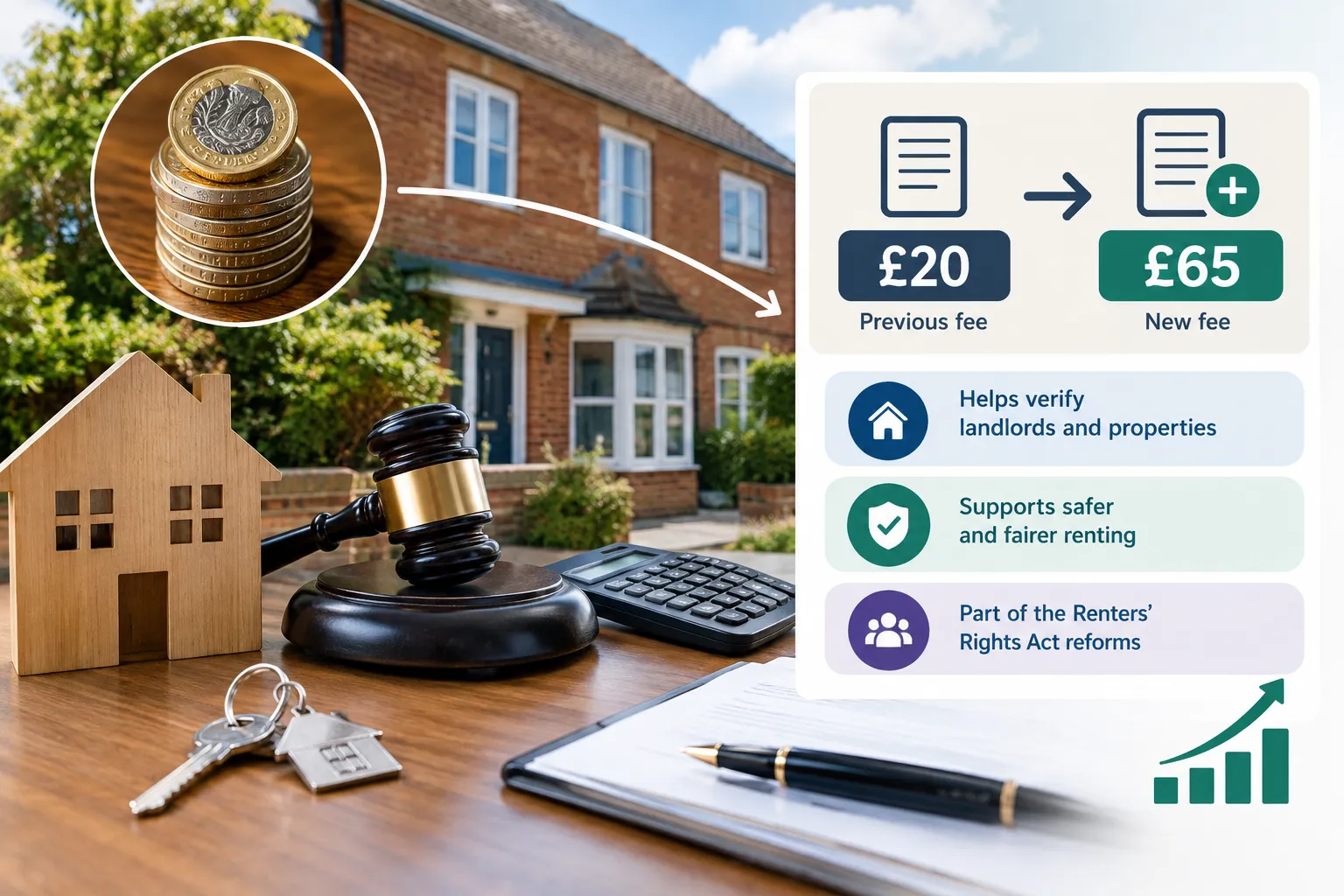
A £65 charge sounds trivial until it is multiplied by more than five million rented homes. That single number now sits at the centre of a political and financial storm sweeping the private rented sector. The Renters' Rights Act landlord database fee of £65 was confirmed in early October 2026, and it is already being described by industry leaders as roughly seven times higher than the figure first projected when the legislation was drafted. For landlords across England, the countdown to the December 2026 launch has officially begun.
This article explains what the fee covers, why it has triggered such fierce backlash, and the practical steps landlords should take in the weeks ahead.
Key Takeaways
The Renters' Rights Act landlord database fee of £65 applies per property, per year, and launches in December 2026.
Across more than 5 million private rented properties, the fee could raise at least £327 million annually.
The National Residential Landlords Association (NRLA) says £65 is around seven times the original impact assessment estimate.
The fee has become politically charged, with Conservative shadow housing secretary Katie Lam signalling the Act's burdens should go, and Labour pushing back.
Landlords should document property condition now, including a RICS survey or condition report, ahead of registration.
What Is the £65 Landlord Database Fee, and Why Is It Seven Times the Original Estimate?
The Private Rented Sector database is one of the central pillars of the Renters' Rights Act. It requires every landlord in England to register each rented property on a national system, creating a searchable record intended to raise standards and give tenants more transparency about who owns and manages their home. Confirmed in reporting from 5 to 6 October 2026, the database will go live in December 2026, and registration will carry an annual cost of £65 per property.
That figure has shocked much of the sector. With over 5 million private rented homes in England, the fee is expected to generate at least £327 million a year in revenue. The NRLA has pointed out that this is roughly seven times higher than the amount originally forecast in the government's own impact assessment when the Act was being drafted.
NRLA chief executive Ben Beadle did not hold back in his criticism, noting that the fee now costs more than a car MOT. He described the scheme bluntly, saying "what we have on offer is a costly mess" and warning that "landlords and tenants are being ripped off in the name of consumer protection." His comments reflect a broader concern that a measure designed to protect renters may end up pushing costs onto them instead, since landlords facing higher overheads often pass expenses through in rent reviews.
Industry Backlash and Political Fallout Over the £65 Landlord Database Fee
The landlord database fee has quickly become a flashpoint beyond the housing sector itself. At the Conservative Party conference on 5 October 2026, shadow housing secretary Katie Lam made headlines by saying of the Renters' Rights Act, "I don't care where it comes from. It's got to go." The party later clarified that her comments referred to regulatory burdens within the Act rather than a formal pledge to repeal the legislation entirely.
Labour quickly seized on the remarks, framing them as an attack on tenant protections. Meanwhile, the Green Party has taken the debate in a different direction, with its leader backing a three-year rent cap as a more direct response to affordability pressures in the rental market.
"Landlords and tenants are being ripped off in the name of consumer protection." — Ben Beadle, NRLA chief executive
This cross-party tension suggests the database fee will remain a contested issue well beyond its December 2026 launch, with landlords caught between competing political narratives while still needing to comply with the rules as they stand today.
Market Pressures Landlords Are Already Facing
The database fee lands at a time when the private rented sector is already under financial strain. Fleet Mortgages reported average rental yields of 7.9% across July to September 2026, up from 7.5% in the same period of 2025. Greater London recorded the lowest average yield at 6.4%, despite having the highest average monthly rent in the country at £2,597.
Rents overall continue to climb. Zoopla data shows rents are now 2.6% higher than a year earlier. At the same time, borrowing costs remain elevated, with Moneyfacts reporting that the average five-year fixed mortgage rate reached 6.00% in early October 2026. For landlords juggling higher mortgage costs, rising rents, and now a new annual compliance fee, margins are being squeezed from multiple directions.
Market Indicator
Figure (2026)
Average rental yield (July–September, Fleet Mortgages)
7.9%
Lowest yield region (Greater London)
6.4%
Average London rent
£2,597/month
Annual rent growth (Zoopla)
2.6%
Average 5-year fixed mortgage rate (Moneyfacts)
6.00%
Database fee per property
£65/year
What Landlords Must Do Now Before December 2026
With the launch date set for December 2026, landlords have a limited window to prepare. The core requirement is straightforward: register each rented property on the new database and pay the £65 annual fee. Beyond that administrative step, landlords should treat this period as an opportunity to strengthen their overall compliance position.
A key practical move is documenting property condition before registration takes effect. A RICS Level 2 or Level 3 survey, or a formal condition report, provides independent, dated evidence of the state of the property. This kind of documentation is useful well beyond the database itself. It supports deposit protection claims, strengthens a landlord's position in any future dispute with a tenant, and demonstrates proactive compliance if standards are ever questioned.
Practical steps landlords should prioritise include:
Gathering ownership and management details for each rental property ahead of registration.
Commissioning a RICS survey or condition report to create a dated record of property condition.
Reviewing rent levels against current local market data, given rising yields and rent growth.
Budgeting for the £65 per-property annual fee across an entire portfolio.
Monitoring further guidance as the December 2026 launch approaches, since implementation details may still evolve.
Scotland's Parallel Shake-Up
England is not alone in tightening private rented sector rules. In Scotland, new regulations under the Housing (Scotland) Act 2025 came into force on 6 October 2026, introducing a separate set of reforms for landlords operating north of the border. While the specific mechanics differ from the database fee in England, the timing underscores a broader UK-wide trend: governments across the country are moving toward greater regulation, transparency, and oversight of the rental market. Landlords with properties in both jurisdictions should treat compliance as a live, ongoing task rather than a one-off exercise.
Frequently Asked Questions
What is the Renters' Rights Act landlord database fee of £65 for? It is an annual registration charge landlords must pay for each rented property listed on the new Private Rented Sector database, set to launch in December 2026.
Why is the £65 fee controversial? The NRLA says it is roughly seven times higher than the figure originally projected in the Act's impact assessment, and warns the overall cost nationally could exceed £327 million a year.
Does the fee apply per property or per landlord? It applies per property, per year, meaning landlords with multiple rentals will pay the fee for each individual home.
Will the Renters' Rights Act be repealed? No confirmed repeal has been announced. Comments from Conservative shadow housing secretary Katie Lam were later clarified as referring to regulatory burdens, not a formal pledge to scrap the Act.
What should landlords do before the December 2026 launch? Landlords should prepare to register each property and pay the fee, and consider commissioning a RICS survey or condition report to document property condition in advance.
Conclusion
The confirmation of the £65 landlord database fee marks a turning point for England's private rented sector. With a December 2026 launch date now fixed, landlords face a new annual cost layered on top of rising mortgage rates and shifting market yields. The political debate around the Act is far from settled, but compliance obligations are not waiting for that debate to conclude.
The most sensible move now is preparation, not speculation. Landlords should gather property records, budget for the new fee across their portfolio, and consider a RICS Level 2 or Level 3 survey or condition report to create a clear, dated record of property standards. Acting early will make registration smoother and provide valuable protection if property condition or compliance is ever challenged.