We use cookies to improve your experience on our site, analyze site traffic, and assist in our marketing efforts. By clicking "Accept all," you agree to the storing of cookies on your device. You can choose to "Reject all" non-essential cookies. For more information, please read our Cookie Policy.
Renters Rights Act September 2026: What UK Landlords and Buy-to-Let Investors Face Now
Section 21 is gone. The Renters Rights Act 2025 took effect on 1 May 2026, applying to every existing and new tenancy in England. A September 2026 briefing for landlords, buy-to-let investors and pre-purchase survey buyers.
Section 21 no-fault evictions are gone. As of September 2026, that single sentence has rewritten the risk calculation for roughly 2.3 million private landlords across England. Four months after the biggest shake-up of tenancy law in a generation, the private rented sector has quietly crossed into a new era, and many buy-to-let investors are still catching up with what it means for their portfolios.
The Renters Rights Act 2025 conversation has moved well beyond parliamentary debate. The legislation is now law, the transition deadline has passed, and landlords, tenants and mortgage lenders are living with the consequences. This briefing sets out what changed, what is still coming, and what it means for anyone holding or buying rental property right now.
Key takeaways
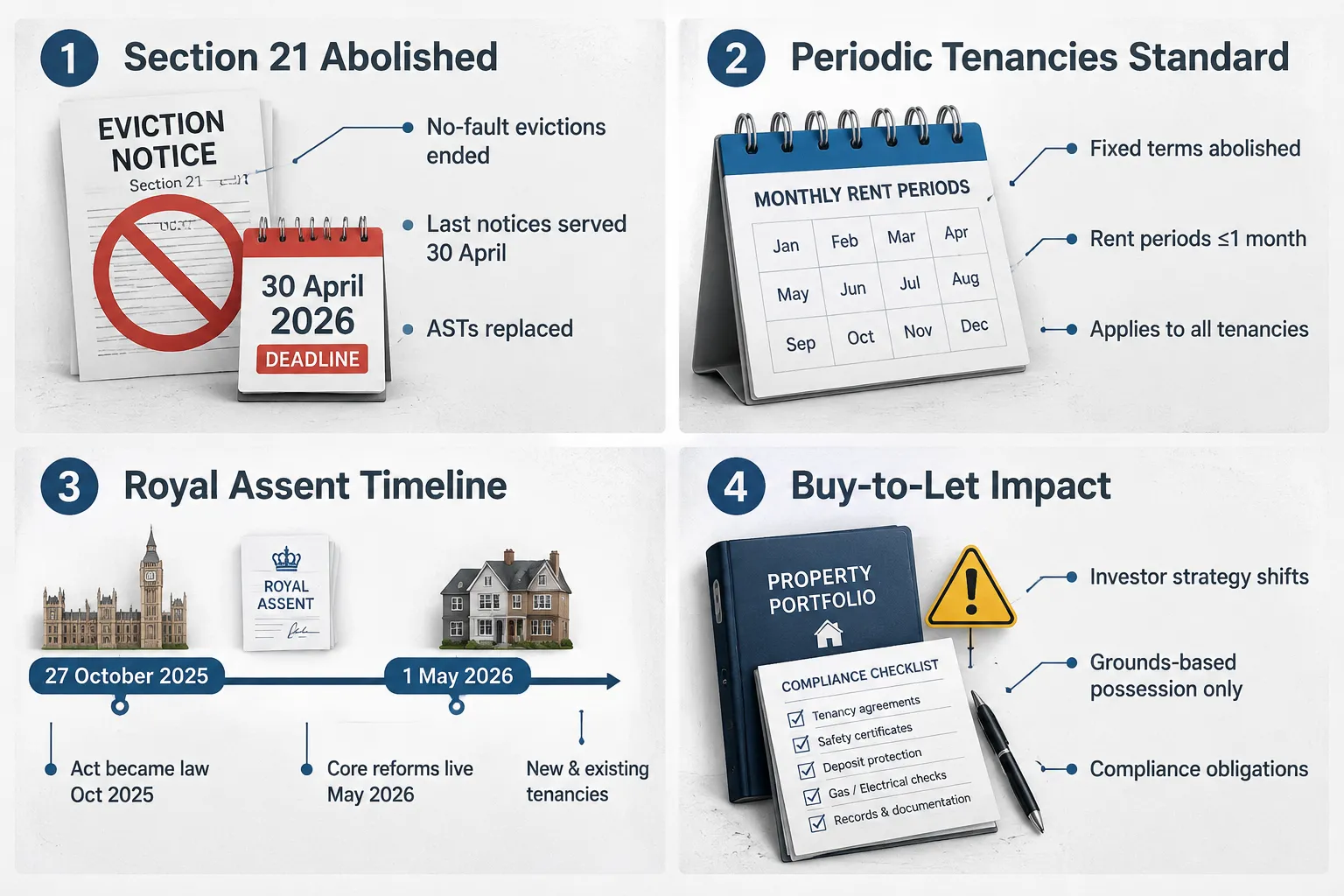
The Renters Rights Act 2025 received Royal Assent on 27 October 2025, and its core tenancy reforms took effect on 1 May 2026, covering both new and existing tenancies.
Section 21 no-fault evictions can no longer be served; ASTs have been replaced by periodic assured tenancies with monthly rent periods.
All existing tenancies moved onto the new regime in a single big-bang transition, rather than waiting for fixed terms to expire.
A national PRS property database and stronger enforcement framework are planned from late 2026, alongside an expanding Decent Homes Standard for rented homes.
Credit analysts flag longer possession timelines and looming energy-efficiency costs as the key medium-term risks for buy-to-let landlords and lenders.
The legal foundation: from Bill to Act
The legislation now shaping every tenancy in England began life as the Renters Rights Bill, completed its passage through Parliament on 22 October 2025, and received Royal Assent five days later on 27 October 2025, becoming the Renters Rights Act 2025. GOV.UK collection pages and the Ministry of Housing, Communities and Local Government implementation roadmap, both refreshed in August 2026, confirm the Act's current status and set out how reforms are being phased in.
The Renters Rights Act 2025 came into force on 1 May 2026 across new and existing tenancies.
That roadmap, last updated 24 August 2026, is the clearest single reference point for landlords planning ahead. It confirms the new tenancy regime came into force on 1 May 2026 and signals further phases stretching into the late 2020s, including database rollout, expanded standards enforcement and additional secondary legislation.
What actually changed on 1 May 2026
From close of business on 30 April 2026, landlords lost the ability to serve new Section 21 notices. From 1 May 2026, assured shorthold tenancies and fixed-term assured tenancies were abolished outright, replaced by periodic assured tenancies in which rent periods cannot exceed one month.
Crucially, this was not a gradual, tenancy-by-tenancy transition. Every existing tenancy in the private rented sector was pulled into the new framework on the same date, regardless of when the original agreement began. Landlords could not simply wait out a fixed term to delay compliance.
New paperwork landlords must get right
Two new documentation duties came in alongside the tenancy changes:
For tenancies starting on or after 1 May 2026, landlords must issue a standard written statement of terms in the prescribed format at the outset of the tenancy.
For tenancies that already existed, landlords had to issue an official information sheet setting out tenants' core rights within one month of commencement, that is, during May 2026.
Missing these obligations is not a technicality. Failure to provide the correct paperwork can undermine a landlord's ability to rely on possession grounds later, so this is one of the most common compliance gaps NRLA advisers report among members.
Section 21 is dead, but landlords are not without recourse. The Act retains a grounds-based possession system: landlords can still recover property for specific, defined reasons such as selling the property, moving in themselves or a family member, persistent rent arrears, or anti-social behaviour. The Law Society and Shelter both describe the reform as rebalancing, not eliminating, landlord rights, aiming to give tenants greater long-term security while preserving legitimate routes to possession.
The practical difference is procedural friction. Every possession now requires a formal ground, correct notice and often a court application, rather than a simple two-month no-fault notice. This has direct knock-on effects for how quickly landlords can act when something goes wrong.
Old system versus new framework
Feature
Pre-May 2026 (AST + Section 21)
From 1 May 2026 (Periodic assured tenancy)
Tenancy type
Fixed-term or periodic AST
Periodic assured tenancy only
No-fault eviction
Available via Section 21
Abolished
Rent period
Could exceed one month
Capped at one month
Written terms
Not always standardised
Prescribed statement of terms required
Possession route
Notice-only for no-fault
Grounds-based, often court-led
Courts, enforcement and the coming PRS database
One reason possession claims are taking longer is the court system itself. Industry body Propertymark reported on 4 September 2026 that the Online Procedure Rule Committee has published a draft practice direction for a new digital County Court possession service, intended to modernise how possession claims are processed in England and Wales. Operational timelines remain in flux, and landlords should not assume faster turnaround just because the process is digital.
A national PRS database and a landlord ombudsman are due to roll out from late 2026.
Looking further ahead, the MHCLG roadmap confirms that a second implementation phase from late 2026 will introduce a national database of PRS properties, consolidating landlord, property and compliance information for use by tenants, councils and enforcement teams. A new landlord ombudsman scheme is also part of the wider reform package, giving tenants a formal complaints route outside the courts and adding another compliance touchpoint landlords will need to register with as rollout continues.
Decent Homes Standard arrives in the private sector
Alongside tenancy security, the Act extends stronger property standards into private renting. Official information sheets and government guidance updated in August 2026 confirm higher housing standards will apply to rented homes and to certain temporary and supported accommodation, echoing the Decent Homes Standard long used in social housing.
For landlords, this means damp, mould, heating adequacy and general property condition are no longer just good practice, they are becoming enforceable minimums with inspection and reporting implications. Buy-to-let investors buying older stock should treat this as a core underwriting factor, not an afterthought.
Buy-to-let strategy: exit decisions and mortgage planning
Research released on 25 August 2026 by credit rating agency KBRA on UK buy-to-let RMBS gives a sober read on where this leaves investors. The analysis notes that tenancy reform under the Renters Rights Act, combined with planned 2030 energy-efficiency standards, is expected to test landlord resilience by lengthening possession timelines, raising enforcement and carrying costs, and demanding fresh capital investment that could squeeze refinancing capacity.
The same research finds that, as of mid-2026, credit performance across UK buy-to-let RMBS pools remains broadly stable, but flags regulatory change and mandatory energy upgrades as the key medium-term risks to margins and leverage. In plain terms: portfolios are not in crisis, but the cushion for error is thinner than it was.
Practical implications for landlords weighing an exit or expansion:
Selling requires a ground. Landlords planning to sell must use the correct possession ground and notice period; spontaneous no-fault exits are no longer an option.
Voids cost more to manage. Longer possession timelines mean rent-arrears cases can run longer before recovery, affecting cash flow modelling.
Refinancing assumptions need revisiting. Lenders are increasingly factoring compliance and EPC trajectory into buy-to-let underwriting.
Portfolio review is now routine advice. The NRLA urges landlords to proactively review tenancy agreements, notice templates and compliance files rather than waiting for enforcement action.
Surveys and inspections before buying tenanted property
For buyers and investors commissioning surveys ahead of a purchase, due diligence has expanded well beyond structural condition. A pre-purchase survey in 2026 should confirm:
Whether the property is compliant with the incoming Decent Homes Standard expectations for damp, mould and heating.
Whether existing tenancy paperwork, statement of terms and information sheet, was correctly issued during the May 2026 transition window.
Whether any pending possession claim relies on a valid ground rather than a defunct Section 21 notice.
The current EPC rating and the likely cost of reaching future energy-efficiency thresholds flagged in industry analysis.
Buying a tenanted investment property without checking these points is now a materially bigger gamble than it was two years ago. A clean structural survey no longer tells the whole compliance story.
Frequently asked questions
Is Section 21 completely abolished as of September 2026? Yes. No new Section 21 notices could be served after close of business on 30 April 2026, and the notice type no longer exists under the current tenancy framework.
Do landlords still have any way to recover their property? Yes, through grounds-based possession, for example, sale of the property, owner or family occupation, arrears or anti-social behaviour, but these routes typically require formal notice and often a court process.
Did tenancies that started years ago automatically change on 1 May 2026? Yes. The transition applied to new and existing tenancies alike in a single implementation date, so long-standing tenancies moved onto the new periodic assured tenancy structure without waiting for a fixed term to end.
What is the PRS database and when does it arrive? It is a planned national database consolidating landlord and property information for tenants, councils and enforcement bodies, expected to roll out from late 2026 as part of a further implementation phase.
How does this affect buy-to-let mortgage and refinancing decisions? Analysts note that longer possession timelines and upcoming energy-efficiency requirements are likely to pressure margins and refinancing capacity, even though overall credit performance remained stable as of mid-2026.
Next steps for landlords and investors
The Renters Rights Act story is no longer about anticipating change, it is about managing a new operating environment that is already in force. Section 21 is gone, periodic tenancies are standard, documentation obligations are real, and a database plus expanded standards enforcement are on the way.
Landlords should audit tenancy paperwork issued around May 2026, confirm every notice template reflects grounds-based possession, and review property condition against Decent Homes Standard expectations. Buy-to-let investors should stress-test refinancing plans against slower possession timelines and future energy-efficiency costs. Buyers commissioning surveys should insist on compliance checks alongside structural findings before completing any tenanted purchase. Acting now, rather than reactively, remains the clearest way to protect returns under the new regime.