Valuation
Jul 16, 2026
Section 42 notice valuation: your 2026 UK guide
Unlock the secrets of section 42 notice valuation with our 2026 UK guide. Learn how to negotiate lease extensions effectively and avoid pitfalls.

A Section 42 notice valuation is the formal process by which a leaseholder determines the premium they offer to pay for a statutory lease extension under the Leasehold Reform, Housing and Urban Development Act 1993. The valuation fixes the price basis at the exact date the notice is served, making the timing of service one of the most consequential decisions in the entire process. Get it right and you control the negotiation from a position of knowledge. Get it wrong and you risk overpaying, losing statutory rights, or having your claim rejected outright. This guide covers the valuation components, cost expectations, professional roles, and negotiation strategy every leaseholder needs to understand in 2026.
The lease extension premium is calculated using three core components: the reduction in the freeholder’s ground rent income, the reversion value of the property at lease expiry, and, where applicable, marriage value. Each component is assessed against the property’s open market value and the lease term remaining on the date the Section 42 notice is served.
Lease length is the single most powerful driver of premium cost. The shorter the remaining term, the higher the premium, because the freeholder’s reversionary interest becomes more valuable as the lease approaches expiry. A flat with 90 years remaining will attract a far lower premium than the same flat with 65 years left.

Marriage value is the factor that catches most leaseholders off guard. When the lease falls below 80 years, the marriage value, which is the additional market value created by extending the lease, must be included in the premium calculation, often doubling the cost compared to leases above this threshold. The freeholder is legally entitled to 50% of that marriage value uplift, and there is no way to negotiate around it.
Ground rent also feeds into the calculation. Higher ground rents increase the income stream the freeholder loses by granting the extension, which pushes the premium upward. This is particularly relevant for properties with escalating ground rent clauses, where the income stream compounds over time.
To illustrate the real-world impact: a London flat valued at £350,000 with 70 years remaining carries an estimated lease extension premium of between £25,000 and £45,000. That range reflects the sensitivity of the calculation to small changes in comparable evidence and the deferment rate applied.
Pro Tip: Use an online lease extension calculator as a rough guide before instructing a surveyor, but treat any figure as indicative only. Actual premiums depend on comparable sales evidence and technical rate assumptions that only a qualified RICS surveyor can apply accurately.
The valuation date is fixed as the exact date the Section 42 notice is served. Every figure used in the premium calculation, including the open market value of the property, the remaining lease term, and the ground rent schedule, is assessed as at that date, regardless of how long negotiations subsequently take.
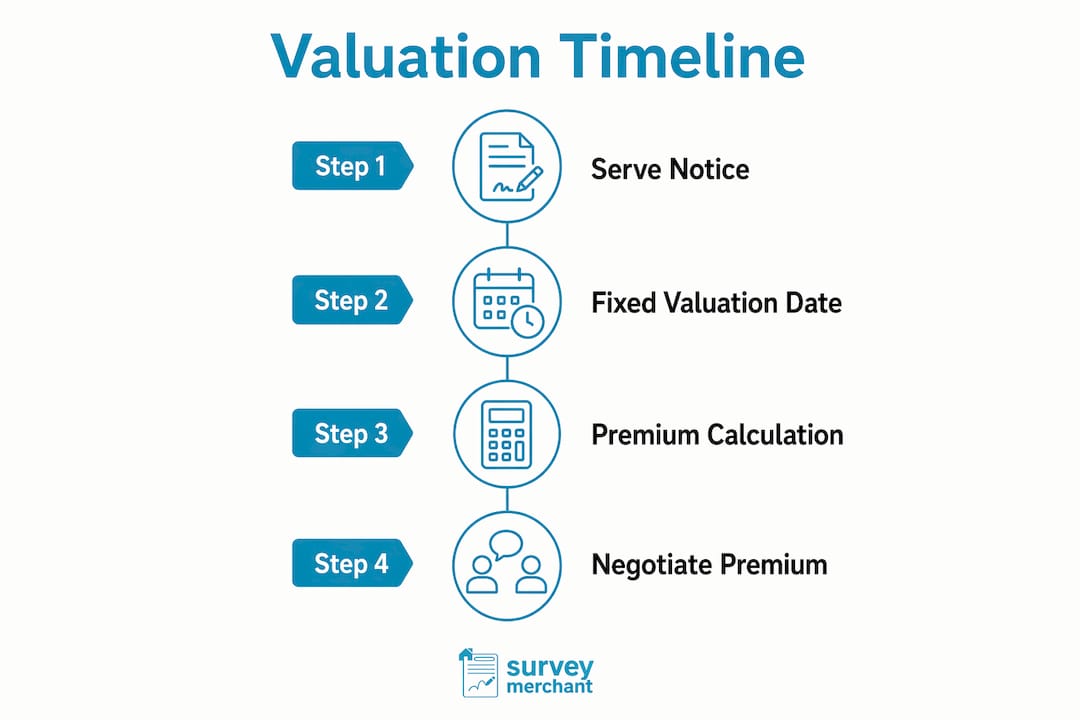
This creates a powerful strategic incentive to act early. Serving the notice earlier locks in the premium to a potentially lower market value, which is particularly important in a rising property market. If London flat prices increase by 5% between the date you instruct a solicitor and the date the notice is actually served, your premium calculation rises accordingly.
The lease term also shortens every single day. A leaseholder who delays serving notice by 12 months on a flat with 81 years remaining may find themselves below the 80-year marriage value threshold by the time the notice is served, triggering a substantially higher premium. That one year of delay can add tens of thousands of pounds to the cost.
| Scenario | Lease term at notice | Marriage value applies? | Estimated premium impact |
|---|---|---|---|
| Act promptly | 82 years | No | Lower premium, no marriage value |
| Delay 18 months | 80.5 years | Borderline | Risk of marriage value triggering |
| Delay 3 years | 79 years | Yes | Premium potentially doubled |
| Delay 5 years | 77 years | Yes | Significant additional cost |
The table above illustrates why the lease extension timeline is not just an administrative concern. It is a direct financial variable.
Pro Tip: If your lease is currently between 81 and 84 years, treat the 80-year threshold as a hard deadline. Instruct a solicitor and surveyor immediately. The cost of acting now is almost always lower than the cost of waiting.
The Section 42 notice valuation requires two distinct professionals: a specialist RICS chartered surveyor and a leasehold solicitor. Neither role is optional. Instructing both a specialist solicitor and a chartered valuation surveyor is the only way to produce an accurate premium offer and a legally valid notice.
The surveyor’s role is to calculate the premium using comparable sales evidence, current deferment and capitalisation rates, and the specific lease terms. A surveyor without specific lease extension experience will struggle with the technical assumptions that determine whether your opening offer is credible. The Leasehold Advisory Service (LEASE) recommends instructing a surveyor who regularly handles lease extension work, not simply any RICS-qualified valuer. Surveymerchant connects leaseholders with specialist lease extension surveyors who have the precise expertise this process demands.
The solicitor’s role is equally technical. The Section 42 notice must comply with strict statutory requirements under the 1993 Act. A defective notice can be declared invalid, which wastes the leaseholder’s costs and resets the clock entirely.
Typical costs break down as follows:
These figures are for a standard residential flat. Complex cases, high-value properties, or disputed valuations will push costs higher. Budget for the full range from the outset rather than being surprised mid-process.
The initial premium in the Section 42 notice is a strategic opening position, set at the lower end of a reasonable range to invite negotiation, not a final offer. The freeholder then has two months to respond with a counter-notice, which typically includes their own surveyor’s higher valuation. The gap between the two figures becomes the subject of negotiation.
The negotiation phase typically unfolds as follows:
The valuation figure must be genuine and realistic, not artificially low, to satisfy statutory requirements and avoid antagonising the freeholder. A deliberately undervalued offer can damage the negotiation relationship and, in extreme cases, lead to the freeholder applying to court to have the notice struck out.
“The entire lease extension process triggered by Section 42 notice service is highly time-sensitive, with statutory deadlines that, if missed, can cause the tenant to lose rights entirely.” Lease extension process overview, Compare My Move
Once the notice is served, strict statutory deadlines govern every subsequent step. Missing a deadline can result in the loss of the right to extend under that notice, forcing the leaseholder to start again and pay professional fees twice. Professional oversight from the moment the notice is served is not a luxury. It is the mechanism that keeps the process on track.
For leaseholders who want to understand the full procedural picture before committing, the step-by-step lease extension guide from Surveymerchant covers each stage from eligibility through to completion.
A Section 42 notice valuation fixes the lease extension premium at the date of service, making early action and professional expertise the two most important factors in controlling cost.
| Point | Details |
|---|---|
| Valuation date is fixed | The premium is calculated using market value and lease term on the exact date the notice is served. |
| Marriage value doubles costs | Leases below 80 years trigger marriage value, which can double the premium compared to leases above this threshold. |
| Act before 80 years | Serving notice while the lease exceeds 80 years avoids marriage value and locks in a lower premium. |
| Two professionals required | Both a specialist RICS surveyor and a leasehold solicitor are needed to produce a valid, accurate notice. |
| Opening offer is strategic | The initial premium is a genuine but lower-end figure designed to open negotiation, not close it. |
In my experience working with property owners across the UK, the single most common and costly error is waiting too long to serve the Section 42 notice. Leaseholders often assume they have plenty of time when the lease shows 83 or 84 years remaining. They do not. By the time they instruct professionals, receive advice, and have the notice prepared, the lease can easily have slipped below 82 years. Another year of delay and marriage value becomes a real risk.
The statutory framework under the 1993 Act is genuinely protective for leaseholders. The freeholder cannot refuse to grant the extension if the eligibility criteria are met. But that protection only works if the process is followed with precision. I have seen cases where a poorly drafted notice was declared invalid on a technicality, costing the leaseholder their professional fees and months of time. The statutory right is only as strong as the notice that triggers it.
The negotiation phase also rewards patience and preparation. Leaseholders who arrive at the table with a well-evidenced valuation from a specialist surveyor consistently achieve better outcomes than those who instruct a generalist or try to manage the process themselves. The freeholder’s surveyor will test every assumption in your valuation. You need someone who can defend it.
My advice is straightforward: if your lease has fewer than 85 years remaining, treat the Section 42 process as urgent. Instruct a specialist surveyor and solicitor now. The cost of professional advice is trivial compared to the premium increase that accumulates with every year of delay.
— Surveymerchant
Navigating a Section 42 notice valuation without specialist support is a risk most leaseholders cannot afford to take. Surveymerchant connects you directly with RICS-qualified valuation surveyors who specialise in lease extension premiums, ensuring your opening offer is accurate, defensible, and compliant with the 1993 Act.

Whether your lease has 90 years remaining or is already below the critical 80-year threshold, Surveymerchant’s panel of RICS valuation surveyors provides the precise, impartial advice you need to protect your position. From calculating the initial premium to supporting negotiations with the freeholder’s surveyor, the right professional makes a measurable difference to your final cost. Connect with a specialist today and take control of your lease extension from the outset.
A Section 42 notice valuation is the formal assessment of the premium a leaseholder offers to pay for a statutory lease extension under the Leasehold Reform, Housing and Urban Development Act 1993. The valuation is fixed at the date the notice is served and forms the basis for negotiation with the freeholder.
Marriage value applies when the remaining lease term falls below 80 years at the date the Section 42 notice is served. It represents the additional market value created by extending the lease, and the freeholder is entitled to 50% of it, which can significantly increase the total premium.
A specialist surveyor’s valuation report typically costs between £500 and £1,500, with solicitor fees adding £1,500 to £3,000. Total professional costs before the premium itself generally range from £2,000 to £3,500, plus the freeholder’s reasonable legal and valuation fees.
Yes. The initial premium in the notice is an opening position, and the freeholder will typically respond with a counter-notice proposing a higher figure. Surveyors for both parties then negotiate, and if agreement cannot be reached, either party may apply to the First-tier Tribunal (Property Chamber) for a determination.
Missing a statutory deadline can result in the loss of your right to extend under that notice, requiring you to start the process again and incur professional fees a second time. Professional oversight from the date of service is the only reliable way to avoid this outcome.
Survey Merchant provides vetted RICS surveyors across 100+ UK locations at fixed fees:
→ Level 2 Home Survey (HomeBuyer Report)
→ Level 3 Building Survey (full structural survey)
→ RICS Red Book property valuations
→ Party wall surveyors — notices, awards & schedules of condition
→ Expert witness surveyors — CPR Part 35 reports for property disputes