Valuation
Jul 16, 2026
House Valuation London: Your 2026 Expert Guide
Get an accurate house valuation london with our 2026 guide. Explains RICS Red Book standards, costs, types, & how to prepare your property for a surveyor.

If you're trying to price a flat for sale, sense-check an asking price before you buy, or deal with probate on a London property, you're probably facing the same problem: everyone has a number, but not every number is worth trusting. An agent gives you an optimistic figure. A portal gives you a range. A lender orders a valuation that tells you very little. Meanwhile, the decision you're about to make could affect your mortgage, tax position, negotiation strategy, or sale timeline.
That’s why house valuation london isn’t just about finding out what a property is “worth”. In practice, a valuation is a tool. Used properly, it helps you avoid overpricing, challenge weak assumptions, spot hidden risk, and negotiate from evidence instead of instinct.
You agree a price on a flat in Wandsworth, then the lender’s figure comes back lower. The deal stalls, the renegotiation starts, and everyone suddenly wants to know what the property is worth. In London, that gap between expectation and evidence can cost far more than the valuation fee.
A house valuation is a professional opinion of value prepared for a defined purpose on a specific date. The purpose shapes the figure, the method, and the level of scrutiny. A valuation for secured lending, probate, tax, dispute resolution, or pre-sale planning may concern the same property, but it does not answer the same question.
That matters in London because small errors become expensive quickly. A modest difference in floor area, condition, lease terms, or block reputation can shift value sharply, especially in markets where buyers compare homes by price per square metre and lenders apply tighter checks. I often see owners focus on décor and asking prices while the core issue lies elsewhere, such as an overstated floor plan, an awkward layout, or defects in a relatively new development that buyers will factor in immediately.
Used properly, a valuation helps you make decisions before the market makes them for you.
For a seller, it can set a realistic pricing range, test whether improvement works are likely to pay back, and show whether the property should be marketed for speed or for best price. For a buyer, it provides a disciplined view of risk before you commit more money on legal fees, surveys, and mortgage costs. For an owner remortgaging or dealing with probate or divorce, it gives a figure that can stand up to scrutiny rather than a hopeful estimate.
A lender will also look at value through its own risk lens. If you want the distinction explained in more detail, this guide to what a mortgage valuation is is a useful reference.
The common mistake is not getting a valuation. It is using the wrong figure for the wrong job.
Estate agents provide marketing advice. That can be useful when testing buyer appetite and setting an asking price, but it is not the same as a formal valuation prepared by a surveyor who must justify the conclusion with comparable evidence and a clear basis of value.
In practice, the costly problems are usually quite ordinary:
A sound valuation brings those issues to the surface early. That is where the financial value lies. It can support a price reduction before exchange, strengthen your negotiating position, stop you over-improving before sale, or prevent a probate or matrimonial figure being challenged later.
In a volatile London market, the best use of a valuation is not merely to attach a number to a property. It is to identify where the risk sits, how that risk affects price, and what you should do next.
Different valuations exist because different decisions carry different risks. People often ask for “a valuation” as if there’s one standard product. There isn’t. The right instruction depends on who will rely on it and what they need it for.
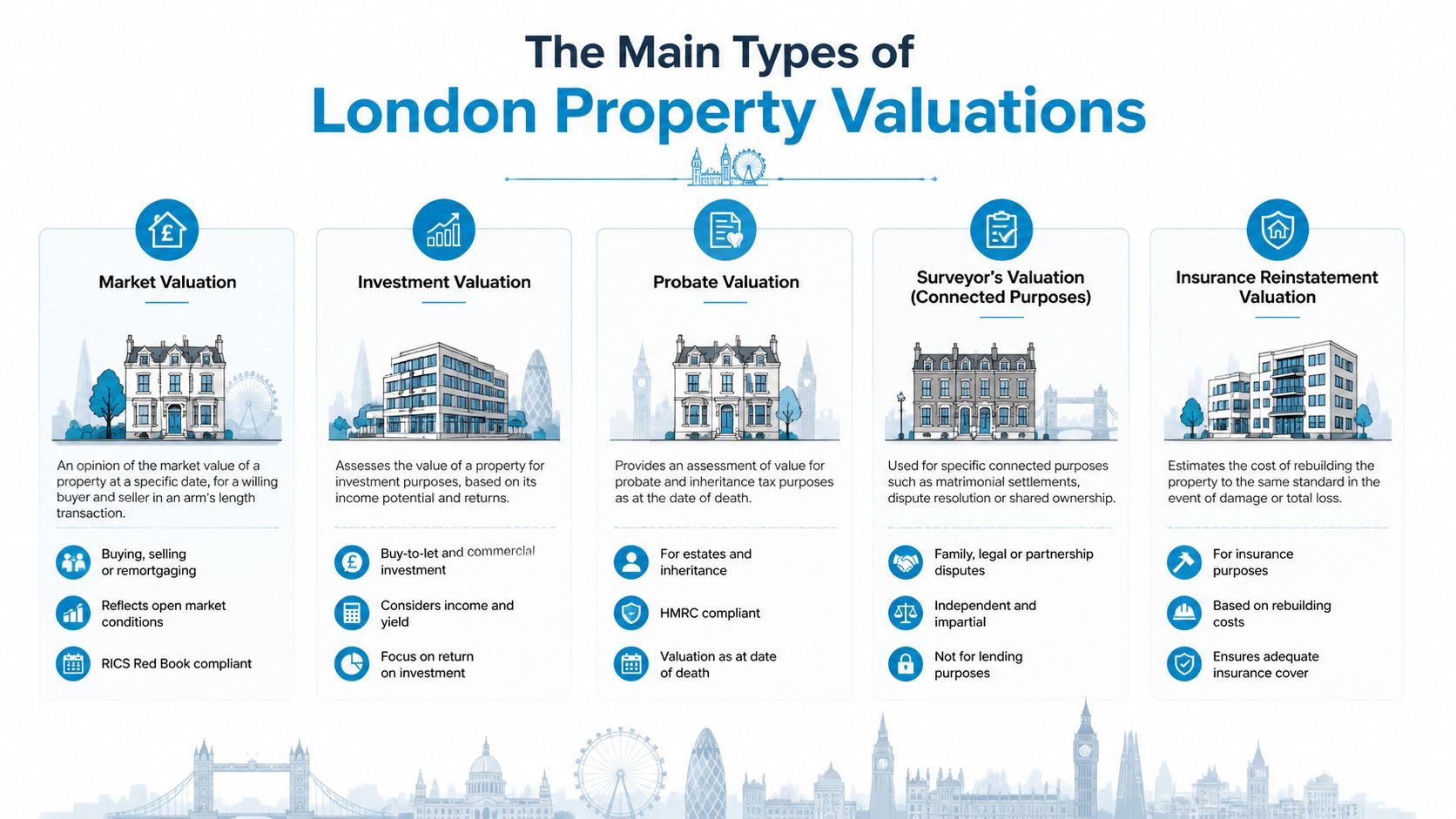
A market appraisal from an agent can help if you're choosing an asking price and a sales approach. It may reflect local buyer sentiment and current competition. But it isn't usually designed for legal reliance, and it doesn't carry the same evidential weight as a formal valuation by a qualified surveyor.
A mortgage valuation is different again. It is usually commissioned for the lender’s benefit, not yours. It answers a narrow lending question: is the property adequate security for the loan? If you want a fuller explanation of that distinction, this guide on what a mortgage valuation is is a useful starting point.
Then there’s the RICS Red Book valuation, which is the format typically used where independence, compliance, and a clear basis of value are essential. That includes probate, matrimonial matters, tax-related work, Help to Buy, and other situations where the number may be scrutinised later.
The easiest way to choose is to match the valuation to the decision.
| Need | Most suitable valuation | Main limitation if you choose the wrong one |
|---|---|---|
| Selling strategy | Agent appraisal or formal valuation | You may get marketing advice, but not a figure built for legal reliance |
| Mortgage lending | Lender’s mortgage valuation | It doesn't replace a survey and may tell you little about condition |
| Probate or legal dispute | RICS Red Book valuation | An informal estimate may not carry enough weight |
| Help to Buy or formal scheme requirement | Scheme-compliant formal valuation | A standard market appraisal may be rejected |
| Early desktop sense-check | AVM | It can miss nuances that materially affect value |
AVMs have become common because they’re quick. They use data, algorithms, and historic patterns to generate a value range. They can be useful as an opening reference point, especially if you're trying to sense-check a price before deciding whether to proceed.
But they have clear limits. Hometrack’s valuation material notes that AVMs can provide instant estimates, yet lack nuance, particularly where condition, upgrades, or hidden drawbacks matter. The same source states that a one-grade EPC improvement can boost a London property’s value by 5% to 10%, and that retrofit costs can sit in the £10,000 to £30,000 range, all of which may need judgement that a desktop model won’t fully capture in an individual case. That detail appears in Hometrack’s property valuation report information.
An AVM is useful for orientation. It isn't a substitute for someone inspecting the property when condition, layout, defects, or legal context could alter value.
That trade-off matters in London because stock is so varied. Two flats in the same postcode can diverge sharply in value once you account for floor plan efficiency, building management, lease structure, outlook, or recent works. Data helps. Inspection finishes the job.
A seller in Clapham lists a flat at what looks like a sensible price. The photos are polished, the kitchen was replaced two years ago, and the agent’s floor plan says 900 sq ft. Then the lender’s valuation comes back lower. The measured area is smaller than advertised, the lease has less appeal than competing flats nearby, and minor defects in the block raise questions about future costs. That is how value shifts in London. Usually through detail, not headline features.
A valuer’s job is to test what the market will pay, not what a property appears to promise at first glance. In London, small differences in layout, tenure, building quality, outlook, and repair liability can move value materially. Used properly, a valuation is not just a box to tick for a lender or probate file. It is a pricing tool. It helps owners avoid overpricing, helps buyers avoid overpaying, and gives both sides a clearer view of risk.

Location still matters, but the useful questions are more precise than “is it a good area?”. Value turns on how buyers compare one property against nearby alternatives. Distance to stations, school catchments, noise, street character, parking pressure, and the quality of the immediate building all affect the pool of willing buyers.
Condition and specification come next, but only where the market will pay for them. A new kitchen does not automatically add its cost to value. The same applies to double glazing, bathrooms, and fitted joinery. If the work only brings the property up to the local standard, it may protect value rather than increase it. If it is poorly executed, buyers may discount the price instead.
Several factors regularly catch owners out:
For formal instructions, these judgments should sit within a recognised reporting standard. A clear explanation of that framework is set out in this guide to a Red Book valuation.
Floor area is one of the biggest sources of error in London pricing. If the stated size is wrong, the comparable evidence can point to the wrong value before the inspection has even started.
Research reported by the Evening Standard’s coverage of UCL findings found widespread overstatement in sales particulars, with a meaningful share of listings materially inaccurate. In a city where price per square foot is watched closely, that can distort asking prices, negotiations, and lender expectations.
This matters most with flats, loft conversions, split-level layouts, and properties with sloping ceilings or awkward circulation space. I often find that owners rely on an old agent’s plan that was never checked against measured survey standards. A difference that looks minor on paper can become expensive once a buyer, lender, or surveyor applies a tighter measurement basis.
Presentation has a role here too. Good marketing helps buyers understand the accommodation, but it should never disguise it. If an agent wants to enhance property photos, that is fine. The images still need to reflect the actual scale, light, and condition of the property.
Condition affects value because it affects cost, risk, and the size of the buyer pool. Cosmetic wear usually changes value less than owners expect. Defects that suggest future expenditure or dispute change it more.
New-build property is a common example. Buyers often assume “new” means trouble-free. In practice, unresolved snagging, poor finishes, failed mastic joints, uneven floors, defective glazing, and balcony or drainage issues can reduce confidence and delay sales. If the building is still working through warranty claims or management problems, the impact can spread beyond one flat.
Older London homes raise different questions. Damp, movement, altered chimney breasts, removed walls without clear approval, tired roofs, and patch repairs all need judgment. Some issues are manageable and already reflected in local buyer behaviour. Others make the property harder to mortgage or narrow the market to cash buyers and developers, which can pull value down fast.
The practical point is simple. The best valuation is the one that exposes these issues early enough for you to use them. Sellers can correct inaccurate plans, gather lease documents, and fix defects that improve saleability. Buyers can renegotiate, budget properly, or walk away before costs mount. In a volatile London market, that is where a valuation earns its fee.
Individuals become more comfortable with a valuation once they understand the sequence. It isn’t a mysterious exercise, and it shouldn’t feel like one. A proper process is methodical, and each stage has a purpose.
The work starts before anyone arrives at the property. The valuer reviews the instruction, checks the purpose of the report, and gathers background material. That usually includes title or tenure information where relevant, comparable sales evidence, mapping, and local market context.
The key point is this: the inspection is not the start of the thinking. It’s the point where desk research gets tested against the property itself.
For formal work, the basis of value and reporting standard also need to be clear from the outset. If you want a clearer explanation of the reporting framework, this overview of a Red Book valuation sets out why that standard matters.
The site visit is where assumptions often change. A valuer checks size, layout, condition, accommodation, any apparent alterations, and the broader building context. For flats, that can include common parts, block condition, access, outlook, and anything that affects marketability.
The visit is not a full building survey unless that has also been instructed. Even so, visible defects, quality issues, and unusual features still matter because they influence value.
Typical points a valuer will consider include:
Good valuers don't just record features. They decide which features the market will pay for, ignore, or penalise.
Back at the desk, the valuation is refined. Comparable evidence is reviewed again in light of what was observed. Adjustments are made for differences in size, condition, specification, location, and sale context.
The finished report should explain the property, the basis of value, the figure reached, and any assumptions or limiting factors. If the valuation is for negotiation, its primary utility lies in the reasoning behind it. That reasoning is what lets a buyer challenge an asking price, or a seller avoid drifting into an unrealistic launch figure.
A sound valuation rarely comes from one dramatic insight. It comes from lots of small judgements, each made carefully and backed by evidence.
A weak valuation often starts before the inspection. I see it when an owner instructs the wrong type of surveyor, sends over an old floor plan, or leaves out paperwork for an extension or lease variation. In London, those mistakes can affect lending, pricing strategy, and negotiation strength.

Choose a RICS Chartered Surveyor. If the report will be relied on for lending, tax, court, probate, or another formal purpose, check that the valuer is also a Registered Valuer and carries Professional Indemnity insurance.
The next test is fit for purpose. A surveyor who regularly handles probate work may not be the right person for a Help to Buy valuation. A valuer used to suburban freehold houses may not be the best choice for a short-lease flat in a complex London block. Local knowledge matters, but instruction-specific experience matters just as much.
Ask direct questions before you book:
One practical route is to use a matching service that places the instruction with a suitably qualified surveyor from its panel. Survey Merchant offers that kind of referral service for valuation and survey work, including London properties.
Preparation is about accuracy, not presentation. The aim is to help the valuer measure the right accommodation, understand what has changed, and identify anything that could affect marketability or buyer demand.
Start with the documents. Have planning permissions, building control completion certificates, lease details, service charge information, major works records, warranties, guarantees, and party wall paperwork ready if they apply. If the flat has a share of freehold, deed of variation, or recent lease extension, put that to hand as well. Missing paperwork does not always reduce value by itself, but it often creates uncertainty, and uncertainty usually weakens a buyer's position or slows a lender's decision.
Floor plans deserve special attention.
In London, inaccurate floor areas cause real problems. If an agent's plan includes non-habitable space incorrectly, misses restricted head height in a loft conversion, or measures on a gross rather than net basis, the asking price may already be built on the wrong number. Give the valuer the latest plan if you have one, but expect it to be checked against what is on site. If the layout has changed, say so clearly.
Access also matters. Make sure the surveyor can reach lofts, terraces, basements, meter cupboards, plant areas, garages, storage rooms, and any outbuildings included in the title. A locked room or inaccessible roof terrace can leave the report subject to assumptions that are avoidable.
Then provide a simple written schedule of improvements. Focus on work that changes how the market sees the property: window replacement, heating upgrades, insulation, kitchen and bathroom renewal, structural alterations, roof works, and reconfiguration that improves usable space. Cosmetic tidying has its place, but durable improvements carry more weight. This guide on ways to increase the value of your home before an RICS Red Book valuation is useful if you want to separate genuine value-adding work from cosmetic effort.
Be frank about defects. That includes leaks, movement, unresolved disputes, Japanese knotweed, cladding concerns, damp, and problems in the common parts of a block. New build owners should be careful here. Snagging items that look minor in isolation, such as poor finishes, sticking doors, cracked sanitary ware, or misaligned windows, can affect the valuer's view of quality, saleability, and near-term cost to a buyer. If defects are extensive, a snagging report gives the issue structure and helps frame a price discussion properly.
One more practical point. Sellers preparing for a valuation often spend too much time on appearance and too little on evidence. Buyers do the same in reverse. They focus on defects but forget to test whether the floor area, tenure details, and alteration history support the figure being discussed. That is why a valuation works as a strategy tool, not just a number on a page.
If you work in agency or development and source different real estate leads, this distinction matters even more. The quality of the lead may start the conversation, but the quality of the information behind the property usually decides whether the agreed price stands up under scrutiny.
Clean, accessible, documented, and accurately described is the standard to aim for.
The report matters because it turns inspection notes and market evidence into something you can act on. Too many clients skip to the figure and ignore the wording around it. That’s a mistake. The explanation often carries as much value as the number.
A formal valuation report typically sets out the property description, the inspection date, the basis of value, assumptions, and the final opinion of value. It may also refer to tenure, apparent condition, location context, and any matters that could affect marketability.
Read it in this order:
One point many owners miss is that market value and reinstatement cost are not the same thing. Market value relates to what the property may achieve in the market on the valuation basis used. Reinstatement cost is an insurance concept linked to rebuilding, not resale.
The report should help you make a decision, not just file a document away. Buyers can use it to challenge unsupported pricing. Sellers can use it to set a realistic launch figure and defend it with evidence. Executors and solicitors can use it as part of a broader legal and tax process.
It can also help you spot the next problem before it becomes expensive. If the report hints that the issue is not demand but presentation, legal clarity, or weak lead quality, your next step may be operational rather than financial. For agents and developers looking at pipeline quality, understanding different real estate leads can be useful because not all enquiries convert at the same level, and that affects pricing strategy and time on market.
A valuation report is strongest when you use it as a decision document. Not as a trophy figure, and not as a bargaining chip detached from the evidence inside it.
A common London problem is this. An owner relies on an online estimate, agrees a price, then a lender's valuation comes back lower because the floor area is overstated, the lease details were misunderstood, or a new-build flat has defects that affect marketability. At that point, the valuation is no longer an abstract figure. It affects borrowing, negotiations, and whether the deal holds together.
Formal valuations have a shelf life because London prices can shift quickly at local level, even when headline market commentary sounds stable. Lenders often treat a valuation as valid for about three months, based on the purpose and the property. If the matter drifts, expect the figure to be reviewed or refreshed.
A mortgage valuation serves the lender. It checks whether the property is suitable security for the loan amount being requested.
A survey does a different job. It examines condition, defects, repair risk, and in some cases whether further specialist advice is needed. Buyers of new-build homes often miss this distinction. A flat can look immaculate on completion and still have defects, poor finishes, incomplete works, or issues with common parts that matter to value and saleability.
Yes, if you have evidence rather than opinion. The strongest challenges point to factual errors such as an incorrect floor area, missing room, wrong tenure, overlooked extension, or a comparable sale that is clearly more relevant than the evidence used.
Floor plans are a regular source of trouble in London. If the marketed area is inflated, even by a modest amount, the price per square foot analysis can be pushed off course. I also see owners rely on achieved prices from superior flats in the same block without allowing for aspect, floor level, condition, or service charge differences. A good challenge is precise and documented.
Yes, probate usually requires a valuation at the date of death, not the date the property is eventually sold. That can become sensitive in a market that has moved between those dates.
The instruction needs to be framed properly from the start because probate valuations may later be reviewed alongside tax filings, sale evidence, and other estate documents. If there is any doubt over condition at the valuation date, gather photographs, repair records, and details of any issues known at the time.
They are useful for a rough starting point. They are not reliable enough where lending, probate, tax, legal reliance, unusual layouts, short leases, title issues, or defects are involved.
London stock is too varied for automated estimates to handle every case well. Converted houses, split-level flats, homes over shops, and recently completed developments can all produce misleading outputs if the underlying data is weak. Use the estimate as a prompt to ask questions, not as the answer.
If you need a formal valuation or an impartial view before you buy, sell, refinance, or deal with probate, Survey Merchant can help you find the right surveyor for the instruction. The aim is to get a report that supports a decision with evidence, and helps you avoid expensive mistakes before they affect price or timing.
Survey Merchant provides vetted RICS surveyors across 100+ UK locations at fixed fees:
→ Level 2 Home Survey (HomeBuyer Report)
→ Level 3 Building Survey (full structural survey)
→ RICS Red Book property valuations
→ Party wall surveyors — notices, awards & schedules of condition
→ Expert witness surveyors — CPR Part 35 reports for property disputes