Leasehold
Jul 22, 2026
How to Extend a Lease: Step-by-Step 2026 UK Property Guide
Learn how to extend a lease on your UK residential property. Our 2026 guide covers eligibility, costs, the statutory process, and how to avoid common pitfalls.

You check your lease term because you're thinking about selling, remortgaging, or getting organised. Then you see the number and it's lower than you expected. Maybe it's in the high 70s. Maybe it's already in the low 70s. At that point, extending the lease stops being an admin task and becomes a financial decision.
That's the part many owners miss. Knowing how to extend a lease matters, but timing matters just as much. A short lease affects value, buyer interest, lender appetite, and the premium you may have to pay to the freeholder. Leave it too late and the same flat can become far more expensive to sort out than it would have been a year earlier.
I deal with this from the valuation side. The legal process is important, but the primary mistake usually happens before the solicitor is instructed. It happens when a leaseholder waits, assumes the freeholder will be reasonable, or starts a formal claim without a proper valuation strategy.
A flat can look straightforward to sell until the lease term comes up. Then the buyer's solicitor asks questions, the lender tightens its criteria, and the price starts to move for the wrong reason. I see that pattern regularly. Owners focus on the kitchen, the service charge, or the asking price, while the lease length is doing more to shape value than any of them.
The point that changes the numbers is 80 years unexpired. Once the term drops below that line, marriage value becomes part of the premium on a statutory lease extension. In practice, that often means a noticeable jump in cost for no practical benefit to the leaseholder. Waiting can turn a manageable job into an expensive one.
That is why the 80-year mark matters so much. It is a pricing threshold.
A shorter lease affects value in two ways. First, it increases the likely cost of fixing the problem. Second, it narrows the pool of buyers because some lenders become more cautious as the term reduces. A flat with a healthy lease is easier to finance, easier to compare with similar sales, and easier to market without discounting for risk.
The pressure usually increases well before the lease becomes very short. By the time a lease is getting close to 80 years, sensible owners should already be asking what delay is likely to cost, not whether the issue can be ignored for another year.
From a surveyor's point of view, this is the main strategic mistake. Leaseholders treat the extension as an admin exercise and miss the timing issue that drives the bill.
Practical rule: Treat lease length as a financial planning issue first, and a legal process second.
That matters whether you plan to stay or sell. If you stay, extending earlier can protect the flat's long-term value and reduce the risk of a steeper premium later. If you sell, a stronger lease position usually makes the property easier to mortgage and easier to agree at a sensible price.
Lease terms also work differently from business premises. Residential lease extension strategy is driven by statutory rights, valuation mechanics, and lender appetite. Commercial leases are negotiated on a different basis, and this guide on how to negotiate your next commercial workspace lease is a useful contrast.
Start with one question. What is the cost of waiting?
That question usually leads to better decisions than asking whether the paperwork can wait. At Survey Merchant, we advise clients to look at the remaining term, the likely premium, and the timing risk before anything else.
Before spending money on valuation or legal work, check which route is open to you. Leaseholders often assume they can force an extension immediately, or they assume the only option is whatever the freeholder offers. Neither assumption is safe.
There are two basic ways to extend a lease.
The statutory route gives qualifying tenants the right to add 90 years to the existing term at a peppercorn rent, meaning zero ground rent. That legal framework is what gives leaseholders real bargaining protection. Without it, the freeholder can offer terms that look attractive at first glance but work badly over time.

Use this as a first filter before you instruct anyone.
If those points broadly fit, the next step is to confirm the details with a specialist solicitor and a surveyor who understands leasehold valuation.
The safest first conversation is not “How cheaply can I do this?” It is “Do I qualify, and which route protects me best?”
A practical point from experience. Plenty of owners are technically eligible but still choose the wrong route because the freeholder starts with an informal offer. That offer might be quicker. It might even have a lower immediate fee profile. But if it preserves ground rent, shortens the effective benefit, or buries costly clauses in the draft, it can be poor value.
The eligibility stage is also where owners uncover title issues, ownership timing problems, or gaps in documents. Those aren't unusual. They just need dealing with before the formal claim is launched.
This is the decision point that shapes everything after it. Both routes can work. They do not offer the same protection.
An informal extension is a private deal with the freeholder. It can suit a cooperative building where both sides want a quick resolution and the draft terms are practical.
The attraction is obvious. It may move faster. It can feel less rigid. In some cases, the legal paperwork is lighter at the outset. But none of that matters if the freeholder offers a lease that preserves or reshapes the ground rent in a way that damages value later.
Informal deals go wrong when leaseholders focus only on the headline premium and ignore the lease wording.
The statutory route is slower and more formal, but it gives you structure. You are not asking for a favour. You are exercising a legal right, assuming you qualify.
That matters because the framework sets the baseline outcome. The lease is extended by 90 years and the new rent becomes a peppercorn rent. If the figures are disputed, there is a route for determination rather than endless argument.
For most owners, that makes the statutory route the benchmark against which any informal offer should be tested.
If an informal deal is worth doing, it should compare well against the statutory outcome. If it doesn't, the apparent convenience usually isn't worth much.
| Feature | Informal (Voluntary) Extension | Statutory (Formal) Extension |
|---|---|---|
| Basis of deal | By agreement with the freeholder | Legal right if you qualify |
| Term added | Whatever the freeholder agrees | 90 years added |
| Ground rent outcome | May continue, increase, or be restructured | Peppercorn rent |
| Speed | Can be quicker if both parties cooperate | More procedural and structured |
| Control over terms | Freeholder has wider scope to propose terms | Core outcome fixed by statute |
| Risk profile | Higher risk of unfavourable wording or changing position | Lower risk because the framework is defined |
| When it suits | Straightforward buildings with sensible freeholders | Most cases where protection and certainty matter |
In practice, I'd only treat an informal offer seriously once the leaseholder knows the likely statutory premium and the value of the rights they'd be giving up by not using the formal route.
A leaseholder with 81 years left is often dealing with one problem. A leaseholder with 79 years left is dealing with a more expensive one. That is why premium calculation matters so much. The valuation method changes once the lease drops below 80 years, and that shift can add a large sum to the price.

The premium is usually built from three recognised elements:
Marriage value is the part owners need to understand early. A flat with a shorter lease is usually worth less than the same flat with a longer one. Extending the lease increases the flat's value. Below 80 years, part of that uplift is payable to the freeholder through the premium. That is the cost cliff edge people hear about, and it is very real in practice.
If you want the detail behind that calculation, our guide to marriage value in lease extensions explains how it affects price and negotiation.
The figures are not produced from a simple online calculator. A proper valuation looks at the unexpired term, ground rent pattern, flat value, lease terms, relativity, and the market evidence available for comparable sales. Small changes in assumptions can move the premium by thousands. That is why two surveyors can agree on the framework but still argue over the number.
Below 80 years, timing becomes a financial strategy, not an administrative task. Delay can mean paying for marriage value when you could have avoided it by starting earlier. I regularly see owners focus on the legal process first and the valuation second. In cost terms, that is the wrong way round.
A short lease can also affect saleability and mortgage options, which puts indirect pressure on value even before the extension starts. That does not mean every flat follows the same pricing pattern. Prime central London, outer London, and regional markets behave differently. Ground rent terms matter too, especially where the existing lease contains higher or escalating rent.
This short video gives a useful overview of the cost jump that happens below the threshold.
The surveyor's role is to produce a figure that can be defended in negotiation, not just a rough estimate for budgeting. That means reading the lease carefully, checking title details, analysing comparables, and applying the statutory assumptions properly. A weak opening valuation can cost a leaseholder money because it sets the tone for everything that follows.
Panel valuers also find that process discipline matters. Good valuation work is technical, but it also depends on organised file handling between surveyor and solicitor. Firms reviewing systems and workflows may find this background on legal practice management for real estate firms useful because poor matter management often creates delay, duplicated work, and avoidable cost.
The practical point is simple. Get the valuation advice before the lease crosses the 80-year line if you can. If it has already dropped below that point, get a precise figure and a negotiation plan, because the premium is now driven by assumptions that need careful handling.
Once eligibility is confirmed and the valuation strategy is in place, the formal route follows a clear sequence. The process starts with preparation, not paperwork.
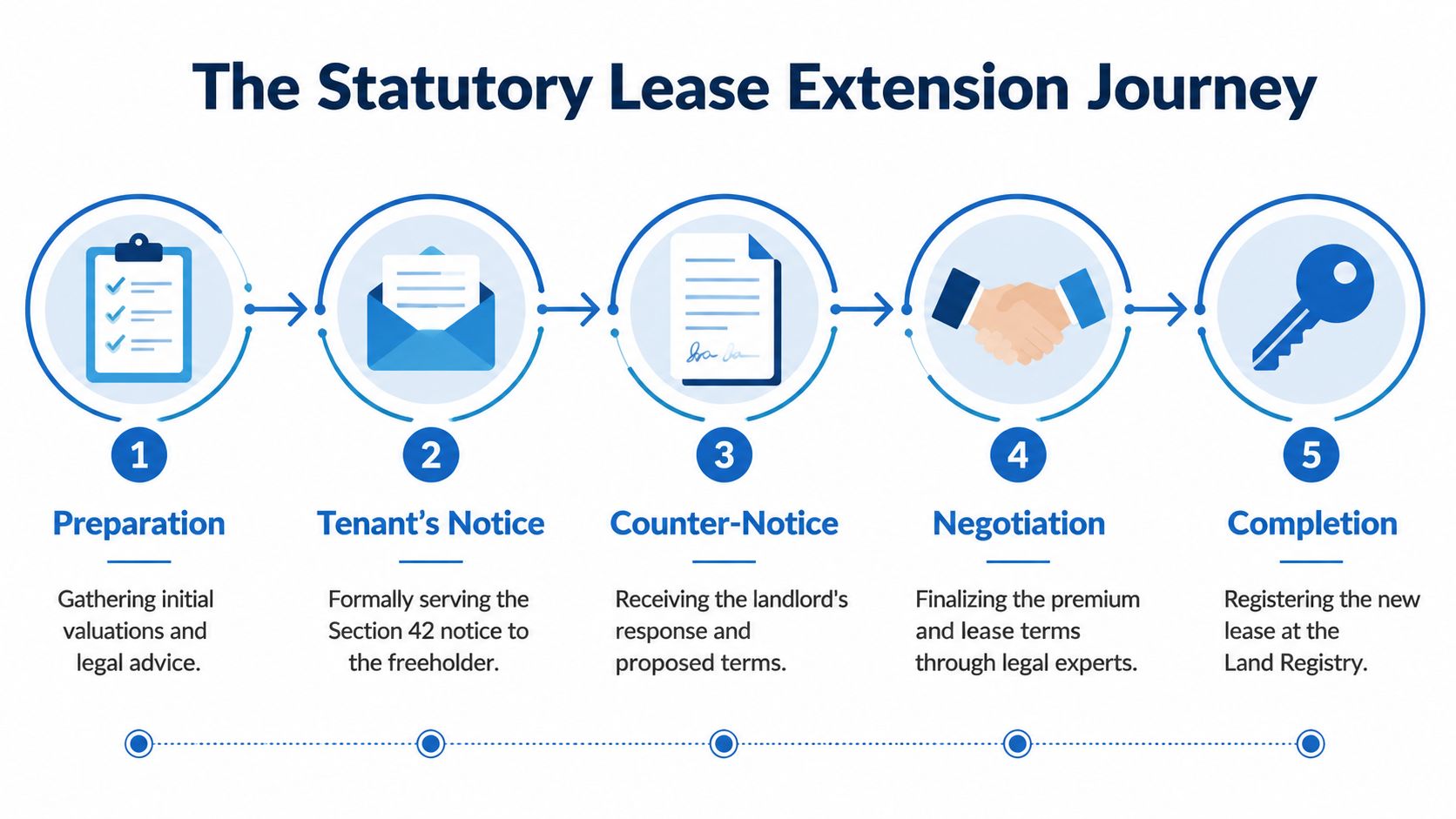
Get your team in place first. In practice, that means a specialist solicitor and a surveyor who regularly handles lease extension valuation and negotiation.
The solicitor checks entitlement, title position, lease terms, and notice requirements. The surveyor values the premium and advises on the opening offer. If you are choosing between firms, it helps to understand what matters on the technical side, and this guide on choosing a surveyor for a lease extension covers the practical points.
I'd also look for advisers who run organised matter handling rather than ad hoc email chains. For firms reviewing workflow, this overview of legal practice management for real estate firms is useful background on how structured legal operations support property transactions.
The formal process begins when the tenant serves the Section 42 notice. That is the claim document that starts the statutory route. It sets out the leaseholder's claim and proposed terms.
The freeholder then has to respond with a Section 45 counter-notice. From there, the parties either move toward agreement or narrow the issues in dispute.
According to the Leasehold Advisory Service overview of getting started with a lease extension, around 70% of cases are resolved through negotiation between the leaseholder's and freeholder's surveyors without going to a tribunal.
On the ground: Most statutory claims do not fail because the law is unclear. They become expensive because the preparation was weak.
A practical sequence usually looks like this:
After the counter-notice, the surveyors negotiate the premium and any remaining valuation points. Many cases settle here because both sides can see the likely range of outcomes.
If agreement cannot be reached, the dispute can be referred to the First-tier Tribunal for determination. That is a backstop, not the desired path. Tribunal preparation takes time, costs money, and raises the importance of having strong valuation evidence.
Completion then involves finalising the deed, paying the premium and relevant costs, and registering the new lease at HM Land Registry.
The process is procedural, but the commercial reality is simple. Good preparation gives you an advantage. Weak preparation gives the freeholder room to dictate the pace and the price.
Lease extension cases usually become costly for familiar reasons. They are rarely dramatic mistakes. More often, they are ordinary decisions made too late or with too little scrutiny.
The worst time to think seriously about a lease extension is when a buyer has already raised it or a remortgage has already stalled. By then, the owner is negotiating under pressure.
The better approach is to deal with the lease while you still have options. That keeps the timing in your hands and avoids being forced into a rushed informal deal.
Freeholders know that simplicity sells. A short email with a suggested premium can look appealing compared with instructing a solicitor and surveyor.
But a simple offer can still contain poor long-term terms. If the new lease keeps an unfavourable ground rent structure or gives less value than a statutory deal, the “easy” option can depress the flat's appeal later.
A cheap-looking extension can be expensive if the lease wording is bad.
This is the mistake I see most often. Owners spend time shopping for the cheapest legal quote, then treat the valuation as a box-ticking exercise.
That is backwards. Valuation disputes account for up to 40% of contested cases, and engaging a qualified RICS surveyor early can produce 15 to 20% cost savings through stronger opening offers and counter-negotiation, according to RICS valuation standards guidance.
If you want a practical negotiation framework, this ultimate lease extension negotiations guide is worth reading before figures are exchanged.
A lease extension is not only a price negotiation. It is a statutory process with formal notices, deadlines, title checks, draft terms, and registration steps. One weak document can create delay or weaken your position.
Keep these basics in mind:
The owners who get the best outcomes usually aren't the most aggressive. They are the best prepared.
It depends on the route and the behaviour of the other side. Informal deals can be quicker if the freeholder is responsive and the terms are straightforward. Statutory claims tend to be more deliberate because notices, responses, negotiation, and completion all have to be handled properly.
If there is a sale or remortgage in the background, tell your advisers early. Timing pressure changes how the matter should be managed.
Yes, in many cases a seller can start the statutory process and transfer the benefit of the claim to a buyer. That can make the flat more saleable because the buyer does not have to wait to become eligible in their own right.
This has to be handled carefully in the sale documentation. It is a point for your solicitor, not something to sort out informally late in the transaction.
A missing freeholder does not always end the matter. There are legal routes for dealing with absent landlords, but the evidence and procedure need to be handled correctly.
If that is your situation, treat it as a specialist case from day one. The title investigation and legal strategy matter more than usual.
Sometimes, yes. If leaseholders in a building are eligible and organised, collective enfranchisement can be the stronger long-term solution because it changes control as well as term length.
But it is not automatically better for every flat owner. It requires coordination with other leaseholders, collective decision-making, and a different level of legal and valuation work. If your immediate problem is a shrinking lease on a single flat, an individual statutory extension may be the cleaner route.
You may still need to extend the lease. A share of freehold does not make the lease term irrelevant. Buyers and lenders still look at the actual lease length.
In many share of freehold buildings, the practical route is simpler because the participating owners can agree an extension among themselves. But the legal documents still need doing properly, especially if a mortgage lender must consent.
If your lease term is getting uncomfortably close to the point where value and cost start moving against you, get the valuation position clear before you commit to a route. Survey Merchant connects property owners with qualified surveyors for lease extension valuation and related leasehold advice, which helps you understand the likely premium, the risks in the lease terms, and the negotiating position before formal steps are taken.
Survey Merchant provides vetted RICS surveyors across 100+ UK locations at fixed fees:
→ Level 2 Home Survey (HomeBuyer Report)
→ Level 3 Building Survey (full structural survey)
→ RICS Red Book property valuations
→ Party wall surveyors — notices, awards & schedules of condition
→ Expert witness surveyors — CPR Part 35 reports for property disputes