Valuation
Jul 16, 2026
What is a valuation survey? A UK buyer's guide
Discover what is a valuation survey and why it's crucial for UK buyers. Learn how this assessment impacts your property purchase.

A valuation survey is a professional assessment of a property’s market value, carried out primarily to satisfy a mortgage lender’s security requirements. The term is widely used, but the industry standard name is a mortgage valuation. Both phrases refer to the same thing: a surveyor’s opinion of what a property would sell for on the open market on a given date. Crucially, this assessment serves the lender, not you as the buyer. Understanding that distinction before you exchange contracts is one of the most financially important things you can do in any property transaction.
A valuation survey focuses on market value, not condition. The RICS Red Book defines market value as the price a willing buyer and seller would agree on the valuation date, entirely separate from the physical state of the building. That means a surveyor conducting a mortgage valuation is answering one question for the lender: “Is this property worth at least what we are being asked to lend against it?”
The physical inspection, when it happens at all, is brief. Mortgage valuations last 15–20 minutes, producing a tick-box style report rather than a detailed written analysis. Compare that with a full building survey, which can take several hours and includes photographs, detailed notes, and repair advice. The difference in depth is significant.

Some valuations never involve a site visit at all. Lenders increasingly use Automated Valuation Models (AVMs), which are algorithm-based desktop assessments drawing on Land Registry data and comparable sales. AVMs are common for standard properties in well-documented areas, but they cannot detect damp, subsidence, or any physical defect.
Typical costs for a valuation survey range from £150 to £1,500, depending on property value and complexity. Many lenders include the fee for standard properties up to £500,000, though the fee is usually non-refundable if your mortgage application fails. You can estimate likely costs using a property survey cost calculator before committing.
The standard process runs as follows:
Pro Tip: Ask your lender upfront whether their valuation will involve a physical visit or an AVM. For older, unusual, or extended properties, push for a physical inspection.
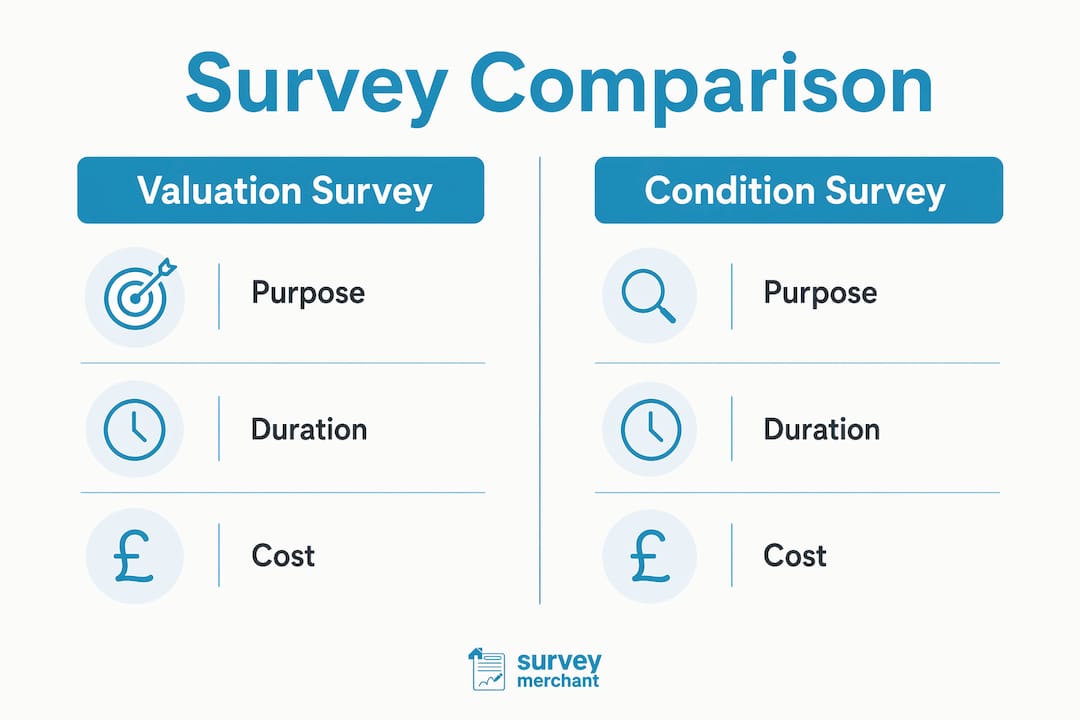
Valuation and condition surveys serve entirely different purposes. Valuation focuses on price; surveys focus on condition. Conflating the two is the most common and costly mistake buyers make.
A RICS Level 2 HomeBuyer Report (the standard condition survey for typical properties) costs £400–£800 and includes a detailed assessment of the property’s condition, flagging defects, damp, drainage issues, and items needing urgent attention. A RICS Level 3 Building Survey goes further still, covering the full structure and fabric of the building with repair cost estimates. Neither of these is what a mortgage valuation provides.
| Feature | Valuation survey | Condition survey (RICS Level 2/3) |
|---|---|---|
| Primary purpose | Lender’s security | Buyer’s protection |
| Defect reporting | None | Detailed |
| Physical inspection | Brief or none | Thorough, several hours |
| Report length | Short, tick-box | Comprehensive, written |
| Commissioned by | Lender | Buyer |
| Cost range | £150–£1,500 | £400–£1,500+ |
| Duty of care | To lender | To buyer |
The legal ownership of the valuation report matters too. Valuation reports belong to the lender. You may never receive a copy, and the surveyor owes no duty of care to you as the buyer. If the valuation misses a serious defect and you suffer a financial loss as a result, you have no legal recourse against the valuer.
Key differences buyers should understand:
For a clearer picture of how condition-based reports differ from one another, the guide on condition surveys vs structural surveys is worth reading before you decide which level of inspection you need.
Relying solely on a mortgage valuation leaves buyers exposed to significant financial risk. A property can achieve full market value and still contain £30,000 worth of structural repairs that the valuation never mentioned. That is not a hypothetical. It is a pattern that plays out repeatedly in UK property transactions every year.
For sellers, understanding the valuation process matters for a different reason. If a surveyor values your property below the agreed sale price, the buyer’s lender may refuse to lend the full amount. That triggers a renegotiation or, in many cases, a collapsed sale. Sellers who understand how market value is assessed can price more accurately from the outset and avoid that outcome.
The financial and negotiating advantages of commissioning a full condition survey are real:
Pro Tip: If a lender’s valuation comes in below the agreed price, commission an independent RICS valuation immediately. A second opinion from a RICS valuation expert can support a formal challenge.
Buyers should not rely solely on lender valuations. This is especially true for older properties, non-standard construction, or any home that has been extended or significantly altered. The importance of property surveys before purchase cannot be overstated when the stakes involve six-figure sums.
A valuation survey is a starting point, not a finish line. Used alongside a condition survey, it gives you a complete picture of both market value and physical state. Used alone, it leaves critical gaps.
For a thorough overview of the UK property survey types available to buyers, including when each level is appropriate, that guide covers the full range from Level 1 to Level 3 assessments.
A valuation survey confirms market value for the lender, not property condition for the buyer, making an independent condition survey the only reliable protection for your purchase.
| Point | Details |
|---|---|
| Valuation serves the lender | The report belongs to the lender and carries no duty of care to the buyer. |
| Physical inspection is not guaranteed | AVMs and desktop valuations are common, especially for standard properties. |
| Condition is not assessed | A satisfactory valuation does not mean the property is free of defects or costly repairs. |
| Independent surveys protect buyers | Commission a RICS Level 2 or Level 3 survey before exchange for full condition insight. |
| Upgrade options exist | Many lenders offer combined valuation and condition reports for an additional £150–£400. |
Buyers treat the mortgage valuation as a green light. The lender says the property is worth what they are paying, the mortgage is approved, and the assumption follows that everything must be fine. That assumption costs people money every single year.
I have seen buyers move into properties with serious roof defects, failing drainage systems, and damp that was visible to any trained eye, all of which a 15-minute valuation walk-through never flagged. The valuer was not negligent. They were doing exactly what they were instructed to do: confirm the property was worth the loan amount. Nothing more.
The uncomfortable truth is that viewing a survey as an expense is the wrong frame entirely. A full condition survey costing £600 that identifies £15,000 of structural repairs is not a cost. It is a return. It gives you the information to renegotiate, to walk away, or to budget properly. The valuation survey gives you none of that.
My advice to anyone buying property in 2026 is simple. Treat the mortgage valuation as the lender’s paperwork. Then commission your own survey, independently, from a qualified RICS surveyor who works for you and no one else. That is the only way to know what you are actually buying.
— N
Knowing what a valuation survey covers is the first step. Getting the right professional to carry it out is the next.

Surveymerchant connects buyers and sellers across the UK with qualified RICS surveyors for expert valuation services and full condition assessments. Whether you need a standalone mortgage valuation, a Level 2 HomeBuyer Report, or a comprehensive building survey, Surveymerchant matches you with an impartial specialist suited to your property type and location. Every surveyor on the panel is vetted for qualifications and experience. You get a clear report, written for you, with no conflict of interest.
A valuation survey is a professional assessment of a property’s market value, carried out by a RICS-registered surveyor on behalf of a mortgage lender. It confirms the property is worth the amount being borrowed, but does not assess the building’s physical condition.
No. A valuation survey does not report on defects, damp, structural problems, or repair needs. For that information, buyers must commission a separate RICS condition survey, such as a Level 2 HomeBuyer Report or a Level 3 Building Survey.
The valuation report legally belongs to the lender, not the buyer. Buyers may receive the valuation figure but often do not receive the full report, and the surveyor owes no duty of care to the buyer.
Valuation survey fees typically range from £150 to £1,500 depending on property value and complexity. Many lenders cover the cost for standard properties, though fees are usually non-refundable if the mortgage application does not proceed.
Many lenders allow buyers to upgrade to a combined RICS Home Survey and valuation for an additional £150–£400. This provides both a market value figure and a detailed condition assessment in a single report.
Survey Merchant provides vetted RICS surveyors across 100+ UK locations at fixed fees:
→ Level 2 Home Survey (HomeBuyer Report)
→ Level 3 Building Survey (full structural survey)
→ RICS Red Book property valuations
→ Party wall surveyors — notices, awards & schedules of condition
→ Expert witness surveyors — CPR Part 35 reports for property disputes