Leasehold
Jul 16, 2026
How Long Does a Lease Extension Take: Key Stages & Timeline
How long does a lease extension take - Discover how long a lease extension takes in the UK. Our 2026 guide covers 3-12 month timelines, statutory vs. informal

Most lease extensions take 3 to 12 months, and some straightforward cases complete in just over 3 months. The timeline largely depends on whether you go down the statutory or informal route, and how cooperative your freeholder is.
If you're reading this because you've checked your lease term and realised it's getting shorter, you're in the same position as many leaseholders who contact advisers a little later than they'd like. The legal process isn't usually difficult because the new lease itself is complex. It takes time because notices have to be served properly, valuers need to assess the premium, solicitors need to agree wording, and landlords don't always move quickly.
That uncertainty is what catches people out. A leaseholder often asks one simple question, how long does a lease extension take, expecting one fixed answer. In practice, there isn't one. There is a workable range, a set of formal deadlines if you use the legal route, and a handful of predictable delay points that can either keep matters moving or drag the process out.
A leaseholder can instruct advisers in the same week as a neighbour and still finish months later. The difference usually comes down to route, preparation and how the freeholder responds once the process starts.
That is why a lease extension timeline feels so broad in practice. Time is not lost in one block. It is lost in stages: checking whether the leaseholder qualifies, getting the valuation right, serving the correct notice if the formal route is used, negotiating the premium, then getting legal documents agreed and completed. If one stage slips, the rest follows it.
The useful way to plan this is to stop asking only, "How long will it take?" and start asking, "Where will the time go?" That gives you a roadmap rather than a rough estimate. If you need a wider overview of the statutory process for lease extensions, start there before you set expectations on timing.
Owners often focus on the final date, but the earlier decisions usually shape the whole timetable.
I regularly see delays caused before the legal process has properly started. Missing title documents, uncertainty over the competent landlord, a late valuation instruction, or a freeholder who replies slowly can all add weeks without anyone feeling that the case has "officially" begun.
The 80-year point also changes the pace of decision-making. Once a lease drops below that threshold, valuation becomes more sensitive and the room for delay narrows. That does not just affect the premium. It affects how quickly you should get advice, how carefully the claim should be prepared, and whether an informal offer is really saving time or effectively postponing a better protected route.
A sensible timeline is built backwards from the work involved. Check the route first, line up the valuation and legal team early, then allow for negotiation and drafting rather than treating them as minor final steps.
You receive an offer from the freeholder saying they can sort the extension quickly. It sounds attractive, until you realise speed is only one part of the decision. The route you choose affects not just how long the matter takes, but how much control you have if terms change, replies slow down, or the draft lease comes back with conditions you did not expect.
In practice, there are two routes. The statutory route follows a legal procedure with defined rights and formal stages. The informal route, also called a voluntary extension, is a private deal negotiated with the freeholder.
That choice shapes the whole timetable.
The statutory route is usually slower to start because valuation, notice drafting, and legal checks need to be done properly. In return, once the claim is validly started, there is a framework around the process. The informal route can begin with a phone call or an email, so it often feels faster at the outset. The trade-off is straightforward. If the freeholder delays, changes the premium, or tries to insert less favourable terms, there is no built-in procedure forcing matters forward.
For leaseholders trying to judge timing realistically, this is the key point. A lease extension is not one single clock. It is a series of stages, and the route you choose decides where time is fixed, where it is negotiable, and where it can be lost.
If you want a fuller legal overview of the statutory process for lease extensions, read that before deciding that the quickest opening conversation will produce the best result.
| Feature | Statutory (Formal) Route | Informal (Voluntary) Route |
|---|---|---|
| How it works | Starts under a legal process with formal notices | Starts by direct negotiation with the freeholder |
| Who can use it | Available only if the leaseholder qualifies | Can be discussed at any stage if the freeholder is willing |
| What you get | Standard legal outcome for qualifying claims, subject to the type of property | Terms depend entirely on what is agreed |
| Timing | More predictable once the claim has started properly | Can be quick early on, but can also drift without warning |
| Control | Better procedural protection if the other side is slow or difficult | Freeholder controls whether discussions continue and on what terms |
| Flexibility | Less room to change the structure of the deal | More room to vary term, ground rent, and other clauses |
| Best suited to | Leaseholders who want enforceable procedure and stronger negotiating position | Leaseholders with a cooperative freeholder and simple objectives |
A voluntary deal is not automatically the faster deal. I often see informal matters lose time in negotiation, then lose more time when the leaseholder asks for advice on revised ground rent clauses or other wording that would have been dealt with differently under the formal route.
The sensible approach is to compare both paths at the start. Ask how long each is likely to take in your case, what legal protection you will have if talks go wrong, and whether an apparently quick offer is still attractive once the full terms are reviewed.
A leaseholder can do everything right and still find that a statutory lease extension takes months. That is normal. The formal route is built around legal notices, response periods and negotiation windows, so the timeline is shaped as much by procedure as by the complexity of the lease itself.
A commonly cited completion range is 2 to 12 months, as explained in Sam Conveyancing's breakdown of lease extension timing. The useful question is not just how long it might take overall, but where that time is spent and which stages tend to stall.
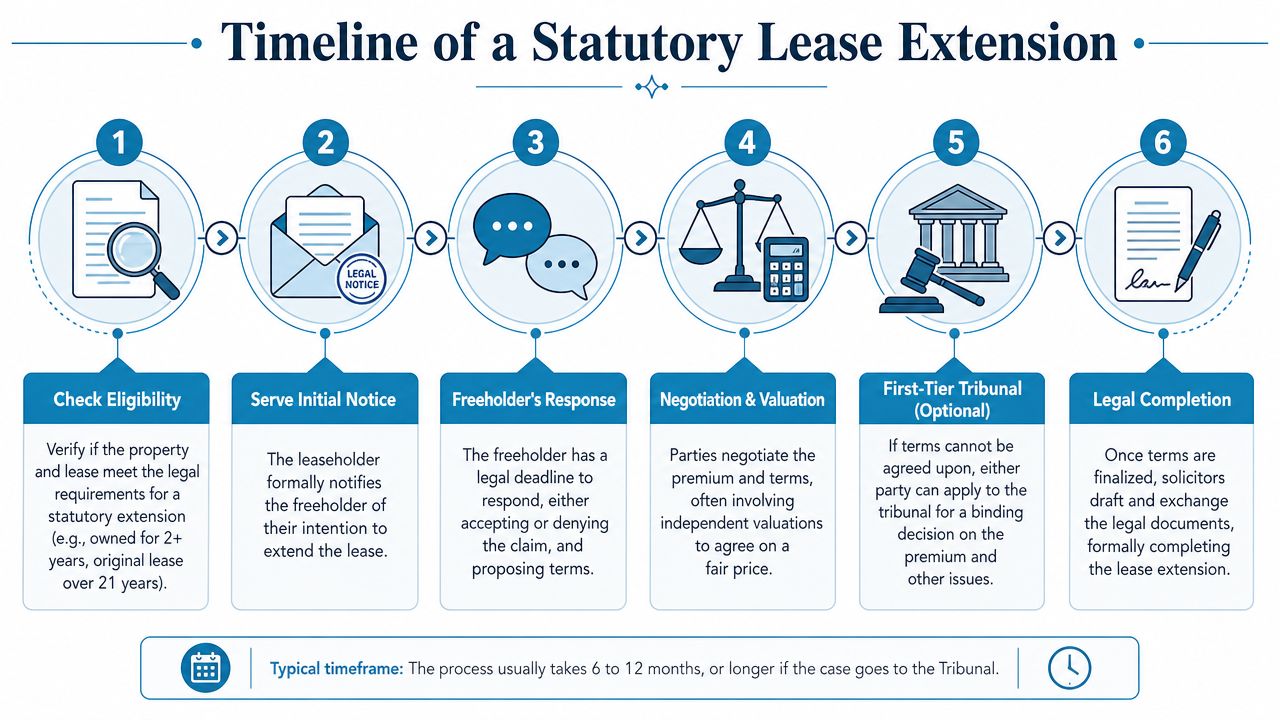
The clock does not really start on the day the new lease is completed. It starts earlier, with preparation.
First, check whether you qualify. In England and Wales, a leaseholder usually needs to have owned the flat for at least two years before serving a statutory claim. If that requirement is not met, the timeline is decided for you. You wait, unless there is another route available in the wider transaction.
Then comes valuation. This is one of the most underestimated parts of the process. A realistic valuation gives your solicitor a sensible figure to include in the tenant's notice and gives the freeholder less room to say the claim was pitched without proper advice. A poor opening valuation often creates delay later because the parties spend longer arguing over a gap that should have been narrowed at the outset.
For owners weighing up how the valuation should be prepared, Understanding survey types for enfranchisement is helpful background. The level of survey input can affect both speed and the quality of negotiations.
Once the Section 42 notice is served, the statutory timetable takes over.
The landlord can ask for evidence of your right to claim within 21 days. The counter-notice is then due within 2 months. After that, if price or terms remain disputed, there is a negotiation period and a deadline for any Tribunal application. Those legal intervals are the reason the formal route rarely finishes in a matter of weeks.
In practice, the roadmap usually looks like this:
That sequence gives the statutory route one of its main strengths. You can see where your time is going. If the matter slows, it is usually possible to identify whether the delay sits in valuation, notice compliance, landlord response, negotiation, or final conveyancing.
A short explainer can also help if you want to see the process visually:
Most statutory claims do not end in a Tribunal hearing. They settle through negotiation. The difference between a six-month matter and a much longer one is often the size of the gap between the parties' valuation positions and how quickly each side takes a realistic view.
In a practical sense, experience holds considerable importance. If the notice figure is too aggressive, or the freeholder's response is pitched unrealistically high, weeks can disappear in valuers' correspondence before the solicitors can push the lease wording to the finish line. If a Tribunal application becomes necessary, the case gains structure but the overall timescale lengthens.
Owners also tend to underestimate the final stage. Agreement on premium is a major step, but it is not the end of the job. The solicitors still need to settle the form of the new lease, deal with lender consent where there is a mortgage, approve execution documents and complete the post-agreement formalities.
That is why the statutory route should be viewed as a staged process, not a single event. If you want a realistic estimate, ask your surveyor and solicitor to map the claim from valuation to completion and identify where your case is most likely to slow.
An informal lease extension doesn't have the same built-in timetable. That can be helpful, but it can also be the reason a matter drifts. If the freeholder wants to do a deal and both sides are commercially sensible, discussions can begin quickly and sometimes feel more straightforward than a formal claim.

The informal route often starts with a simple approach to the freeholder or managing agent. If they are open to a deal, the parties can move directly into discussing price and broad terms without waiting for statutory notices and formal deadlines.
That early speed is attractive, especially if you're also dealing with a sale, remortgage or a buyer who wants reassurance. There is less ceremony at the beginning. Fewer mandatory steps can make it feel more efficient.
The trade-off is control. The freeholder doesn't have to keep negotiating on any set timetable, and they can propose terms that don't mirror the statutory outcome. That may include a premium you don't accept, lease wording that benefits them, or other clauses that need careful scrutiny.
Common sticking points in the informal route include:
An informal extension can still be the right choice if the landlord is pragmatic and the paperwork is handled carefully. It just isn't a route where speed is guaranteed by the system. Speed depends on personalities, commercial pressure and how well the proposed deal has been tested before legal drafting starts.
The difference between a clean 3 to 12 month process and a drawn-out one is usually not one dramatic problem. It's usually a cluster of smaller issues. Specialist commentary places the typical timeframe at about 3 to 12 months, while one firm reports an average of 5 to 8 months from instruction to completion, with some matters completed in just over 3 months, which underlines how much cooperation and complexity affect progress, as noted by The Lease Extension Company on expected timescales.
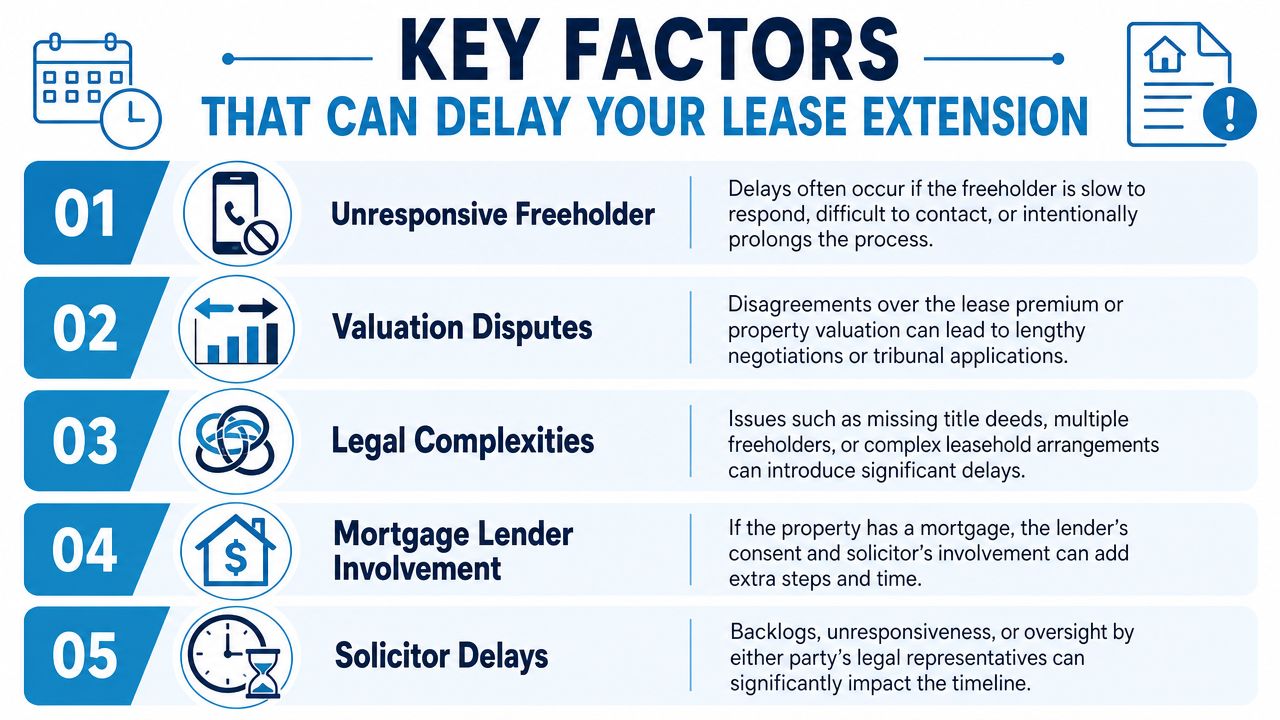
Some problems are procedural. Others are entirely human.
Working rule: Most delays are preventable at the outset, but hard to fix once the file is already drifting.
You can't control every variable, but you can reduce avoidable delay.
The practical takeaway is simple. Most leaseholders lose time before the legal process even properly begins. Once the right people are instructed and the route is chosen clearly, the matter usually becomes more manageable.
A common mistake is to treat a lease extension as routine conveyancing with a valuation attached. It is not. If the wrong notice is served, the premium is pitched badly, or the lease terms are not checked properly at the start, weeks can be lost and the cost can rise.
The surveyor and the solicitor handle different parts of the timetable, and the job moves faster when both are experienced in lease extensions. The surveyor advises on premium, opening position and negotiation strategy. The solicitor checks eligibility, reviews title and lease terms, serves or responds to notices, deals with drafting, and keeps the matter on track to completion.
That division of labour matters because the formal and informal routes fail in different places. On the statutory route, legal deadlines and notice validity are the pressure points. On the voluntary route, the risk is often agreeing heads of terms that look quick but leave rent, term, or drafting points unresolved. A specialist team spots those issues early and tells you where the time is likely to go.
Timing also affects cost. Leave it too late and the valuation exercise usually becomes harder, not easier. I regularly see leaseholders focus on the premium alone and miss the wider problem. Delay can narrow your options, complicate negotiations and create pressure if a sale or remortgage is already in motion.
If you're comparing valuers, this lease extension surveyor guide explains what to look for. One route available to owners is Survey Merchant, a UK platform that connects clients with surveyors for lease extension and enfranchisement valuation work through its panel-matching model.
Good advisers do more than carry out tasks. They help you choose the right route, set a realistic timetable, and avoid the kind of errors that are expensive to correct once the matter is underway.
If you need a lease extension valuation, Survey Merchant can help you find a suitable surveyor for the job. Getting valuation advice in place early gives you a clearer view of premium, timing and whether the formal or informal route is likely to work better for your property.
Survey Merchant provides vetted RICS surveyors across 100+ UK locations at fixed fees:
→ Level 2 Home Survey (HomeBuyer Report)
→ Level 3 Building Survey (full structural survey)
→ RICS Red Book property valuations
→ Party wall surveyors — notices, awards & schedules of condition
→ Expert witness surveyors — CPR Part 35 reports for property disputes