Building Surveying
Aug 2, 2026
How to ensure survey compliance in UK property
Learn how to ensure survey compliance in UK property with essential checks before hiring a surveyor. Secure accuracy and reliability!

Survey compliance in UK property and construction comes down to three things: verifying that your surveyor holds current RICS membership, confirming the firm operates under regulatory oversight, and checking that the survey report meets the applicable professional standards. Get those right before you commission anything else.
Before you book a surveyor, run through these immediate checks:
Pro Tip: Ignore marketing language on a surveyor’s website until you have confirmed their status in the RICS directory. A firm can describe itself however it likes; the directory tells you what is actually true.
Credential verification is not a one-off box-tick. It runs from your first search through to reading the final report.

1. Check RICS membership in the official directory
The RICS ‘Find a Surveyor’ tool is the only reliable starting point. Marketing claims, LinkedIn profiles, and letterheads are not substitutes. Verify surveyor credentials through the official route before any other step.
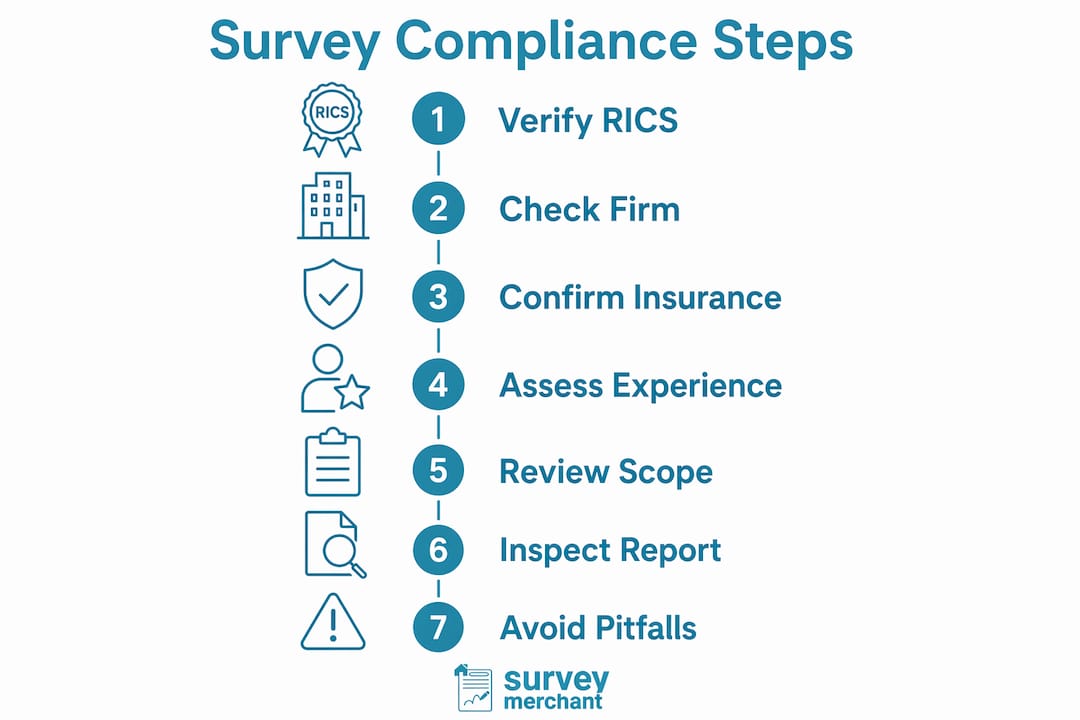
2. Confirm the firm’s regulatory status and insurance
A surveyor can be an RICS member while working through a non-regulated firm. That matters because professional indemnity insurance is tied to the firm’s regulatory standing, not just the individual’s membership. Confirm both are current.
3. Assess relevant experience with your property type
A surveyor who specialises in Victorian terraces may not be the right choice for a 1960s concrete-frame commercial building. Ask directly. Insurance and relevant experience offer vital consumer protection and increase confidence that surveys are accurate and reliable.
4. Understand the survey scope against UK building regulations
The RICS Home Survey Standard sets mandatory requirements for residential surveys. For commercial or construction projects, the applicable standard shifts. Confirm which standard governs your survey before signing any terms of engagement.
5. Review the report for compliance indicators
A compliant report names the standard it follows, states the surveyor’s RICS membership number, and clearly defines the scope of inspection. Vague language about “areas not inspected” without explanation is a red flag. Cross-reference the report’s findings against any planning permissions or building regulations notices relevant to the property.
6. Watch for common pitfalls
Relying on informal credentials, accepting verbal assurances about insurance, or commissioning a Level 1 condition report when a Level 3 full building survey is warranted are the most frequent errors. Each one can leave you without recourse if something goes wrong.
Pro Tip: Ask the surveyor specifically about risks associated with your property’s age, construction method, and location. A surveyor who cannot answer that question with specifics has probably not worked on enough comparable properties.
Compliance signal: RICS issues Practice Alerts to all members and regulated firms in the UK, updating them on regulatory changes. A surveyor who is unaware of recent alerts relevant to your property type is not keeping pace with their obligations.
RICS is the governing professional body for surveyors across the UK, and its regulatory framework is what gives survey compliance its teeth. The Standards and Regulation Board leads oversight, monitors compliance, and provides training to keep regulated firms current.
The RICS Rules of Conduct set out what members and firms must do. The core obligations are not abstract:
That last point is worth dwelling on. Surveyors must use professional judgement to apply ethical principles and comply with the Rules of Conduct to maintain public trust. Compliance with the wording of a standard is not always sufficient; RICS expects conduct that meets the spirit of those standards too.
For party wall matters specifically, the RICS party wall professional standard makes clear that statutory compliance and ethical conduct are complementary obligations, not alternatives. A surveyor cannot hide behind the Act if their conduct falls below RICS expectations.
RICS membership functions as the primary mechanism for consumer recourse if negligence or inaccuracies occur. If a regulated firm’s work falls short, the complaints-handling procedure and alternative dispute resolution process give clients a structured route to challenge it.
Regulatory note: RICS monitors compliance and provides help and training to members and regulated firms. That ongoing oversight is a key reason why working with a regulated firm carries more weight than working with an unregulated one, regardless of individual qualifications.
Surveymerchant’s approach to surveying best practices starts before a surveyor ever visits a property. Every professional in its network is verified against the RICS directory, confirmed to be operating through a regulated firm, and checked for appropriate professional indemnity insurance.
The matching process goes further than credential confirmation. Surveymerchant aligns clients with surveyors who have direct experience of the relevant property type, whether that is a listed residential building, a commercial premises, or a construction project requiring structural assessment. That specificity matters because a technically qualified surveyor without the right sector experience can still produce a report that misses critical issues.
Client benefits from using Surveymerchant for compliance assurance include:
Pro Tip: When commissioning through any platform or directly, ask to see the surveyor’s RICS membership number before the survey date. Cross-check it in the directory yourself. A compliant professional will not hesitate.
For projects where surveys support planning permission applications or land acquisition decisions, the stakes of non-compliance are higher still. Surveymerchant’s vetting process is designed with those higher-stakes scenarios in mind.
Ensuring survey compliance in UK property requires verified RICS credentials, a regulated firm, appropriate insurance, and a report that explicitly references the governing professional standard.
| Point | Details |
|---|---|
| Verify via RICS directory | Always confirm membership through the official RICS ‘Find a Surveyor’ tool, not marketing materials. |
| Regulated firm matters | A surveyor’s individual RICS membership does not guarantee the firm is regulated; confirm both separately. |
| Insurance is non-optional | Professional indemnity insurance is the client’s primary protection if a survey report proves negligent or inaccurate. |
| Match experience to property type | Relevant sector experience is as important as formal qualification for ensuring survey accuracy. |
| Surveymerchant pre-vets compliance | Surveymerchant verifies RICS status, firm regulation, and insurance for every surveyor in its network before matching clients. |
Finding a qualified surveyor is straightforward. Finding one who is RICS-registered, working through a regulated firm, insured, and experienced with your specific property type is where most clients run into difficulty.

Surveymerchant removes that difficulty. Whether you need a Level 3 full building survey for a complex residential purchase or a commercial property survey for a business premises, every surveyor in the Surveymerchant network has been verified against RICS records and matched to your property type. You get a compliant professional, not just an available one. Submit your property details today and receive a matched surveyor recommendation built around your compliance requirements.
Survey Merchant provides vetted RICS surveyors across 100+ UK locations at fixed fees:
→ Level 2 Home Survey (HomeBuyer Report)
→ Level 3 Building Survey (full structural survey)
→ RICS Red Book property valuations
→ Party wall surveyors — notices, awards & schedules of condition
→ Expert witness surveyors — CPR Part 35 reports for property disputes