Building Surveying
Aug 2, 2026
How to identify property defects before you buy
Learn how to identify property defects before you buy. Avoid costly surprises by spotting issues like structural damage and damp.

Spotting property defects before you commit is the single most effective way to avoid a purchase that costs far more than the asking price suggests. The main categories to check are structural movement, exterior fabric, interior damp and cracking, and key systems including electrics, plumbing, and heating. A preliminary walk-around using a checklist referenced against RICS standards underpins sound buying decisions, but it complements rather than replaces a full building survey.
The most telling signs across all defect types are:
Pro Tip: When assessing cracks, look at width, taper, and location together. An isolated hairline crack in plaster is rarely serious. A tapered crack that widens toward the top, crosses both internal and external walls, and sits near a window or door frame is a different matter entirely and warrants a structural engineer’s opinion.
The exterior is your first and most accessible source of evidence. Work from the roof down, taking your time at each element rather than scanning the whole façade at once.

Roof defects are often visible from the pavement with binoculars. Look for missing, cracked, or slipped tiles; moss and lichen growth, which retains moisture and accelerates decay; and any sagging along the ridge line or between rafters. A sagging roof line usually points to rafter or purlin failure rather than a tile problem, and repair costs are considerably higher.
Walls tell a long story if you read them carefully. Horizontal cracks in brick courses can indicate wall tie failure, particularly in cavity walls built before 1982 when galvanising standards were lower. Vertical cracks at the junction of an extension and the original building are common and often reflect differential settlement rather than active subsidence. Damp patches that reappear after dry spells suggest water is penetrating the masonry rather than condensing on the surface.
Gutters and downpipes are frequently overlooked. Blocked or leaking gutters are a leading cause of damp in UK properties, saturating the wall below and eventually working inward. Check for green staining on brickwork beneath joints, and look for gaps between the gutter and fascia board.
Chimneys deserve close attention. Leaning stacks, cracked flaunching (the mortar bed around the chimney pot), and eroded pointing all allow water ingress. A chimney that has been capped but not properly sealed can still allow moisture to track down inside the breast.
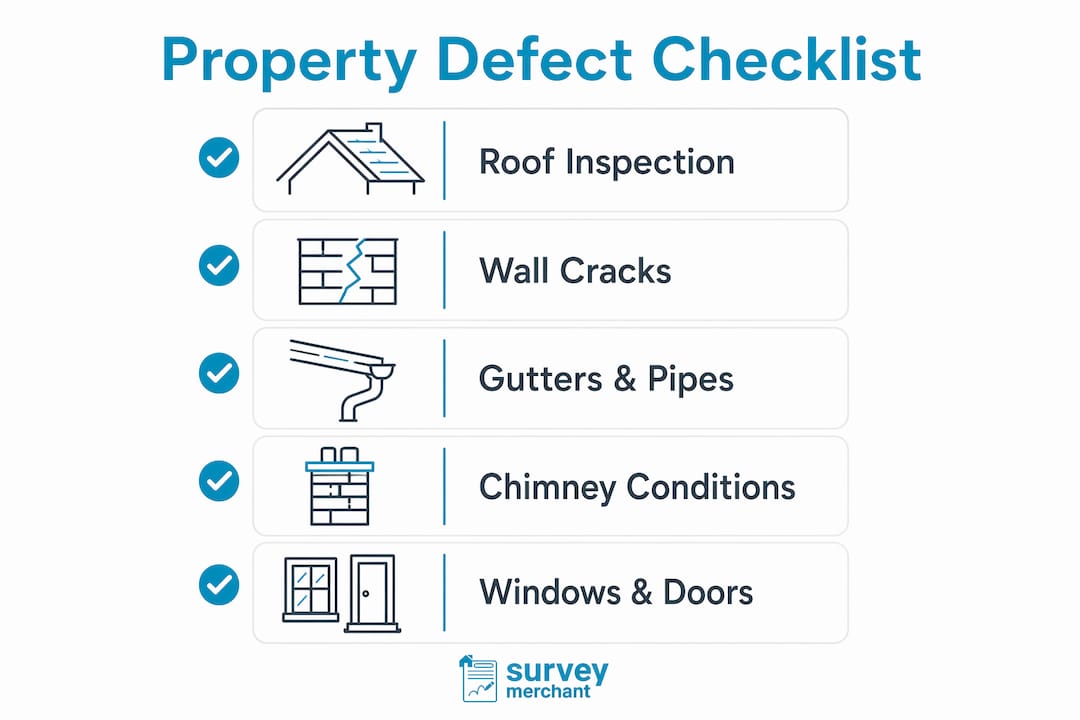
Windows and doors at the exterior reveal rot in timber frames, failed double-glazing seals (look for condensation between panes), and gaps at the frame perimeter that let in draughts and rain.
| Defect | Visible sign | Urgency |
|---|---|---|
| Missing roof tiles | Gaps in tile courses, daylight in loft | High |
| Sagging roof | Ridge line dips, rafters visible | High |
| Wall tie failure | Horizontal cracking at regular intervals | High |
| Gutter blockage | Green staining below joints, overflow marks | Medium |
| Chimney flaunching crack | Mortar crumbling around pot | Medium |
| Failed window seal | Condensation between double-glazed panes | Low–Medium |
| Timber frame rot | Soft or discoloured wood at sill or frame base | Medium |
Interior defects range from purely cosmetic to structurally significant, and the difference is not always obvious at first glance. Damp and mould are the most common findings in UK residential surveys, and they cluster in predictable places: external corners of rooms, beneath windows, around chimney breasts, and in poorly ventilated bathrooms and kitchens.
Distinguishing types of damp matters because the remedy differs. Rising damp produces a tide mark at low level, typically below one metre, with salts crystallising on the wall surface. Penetrating damp appears at mid-wall or ceiling level, often following rain, and tends to be localised near a specific external defect such as a blocked gutter or failed pointing. Condensation, the most common of the three, forms on cold surfaces and is worst in winter, producing black mould spots rather than a tide mark. Surveyors use moisture meters alongside visual checks to confirm the type and extent.
Pro Tip: Visit the property in winter or after a prolonged wet spell if you can. Damp that is invisible in August can be obvious in January, particularly penetrating damp through solid masonry walls. If you can only visit in summer, ask the seller directly whether any damp has been treated or redecorated recently.
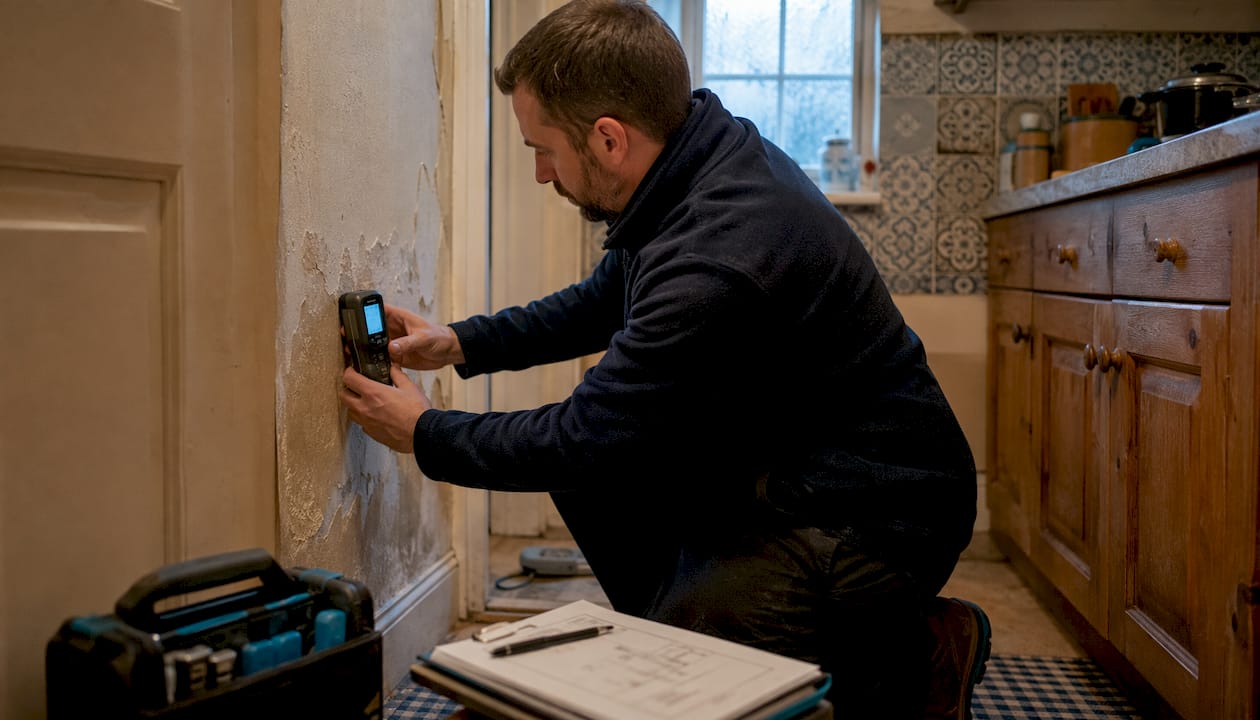
Cracks inside follow the same diagnostic logic as exterior ones. Fine hairline cracks in plaster at ceiling corners are almost always caused by thermal movement or minor settlement and carry no structural implication. Cracks that are wider than 3mm, taper noticeably, or run diagonally from the corners of door and window frames warrant proper investigation. Stair-step cracking in internal blockwork is a more serious indicator.
Floors are worth testing physically. Walk slowly across solid floors listening and feeling for hollow spots, which can indicate failed screed or a void beneath. Timber floors that bounce or flex excessively suggest joist decay or inadequate support. Sloping floors, particularly when combined with sticking doors, point toward structural movement rather than a cosmetic issue.
Cosmetic defects, by contrast, are surface-level: hairline cracks in fresh plaster, minor scuffs, dated décor, or worn carpets. They cost money to fix but carry no structural implication. The practical test is whether the defect has a clear, benign cause and whether it is getting worse.
Structural defects are the category that most buyers fear, and with good reason. The three main causes of structural movement in UK properties are subsidence (ground moving downward beneath the foundations), settlement (the building compressing under its own weight over time), and heave (ground swelling upward, often due to clay expansion or tree removal).
Crack characteristics are the primary diagnostic tool. Width matters: cracks below 1mm are cosmetic; those between 1mm and 5mm require monitoring; anything above 5mm needs specialist assessment. Taper matters too, because a crack that is wider at one end than the other indicates directional movement. Location is the third variable: cracks near openings (doors and windows) are more significant than those in the middle of a blank wall, because openings are the weakest points in a structure.
The RICS consumer guide to subsidence notes that there is rarely cause for real concern unless cracks appear suddenly and exceed 3mm in width. Signs that collectively suggest active subsidence include new or expanding cracks in plasterwork and external brickwork, doors or windows sticking without explanation, wallpaper tearing at seams, and new sloping or dipping of solid ground floors.
Soil type and environment influence risk significantly. Clay soils shrink in dry summers and swell in wet winters, making properties on clay more vulnerable to seasonal movement. Properties near large trees are at higher risk because roots extract moisture from clay, causing shrinkage beneath the foundations. Leaking drainage pipes are a frequently overlooked cause of localised subsidence, particularly on chalk or clay soils, and a CCTV drain survey alongside a structural assessment gives a far more accurate diagnosis than a visual inspection alone.
Pro Tip: Always inspect internal and external walls at the same location simultaneously. A crack visible only internally may be superficial plaster movement. The same crack running through both the internal plaster and the external brickwork at the same point is a clear sign of through-wall structural movement.
When cracks are active, growing, or accompanied by other movement indicators, the right step is a structural engineer’s report rather than a standard building survey. A building surveyor can identify and categorise defects; a structural engineer provides the calculations and remediation specification.
Systems defects are less visible than structural ones but carry serious safety and cost implications. A basic visual check during a viewing can flag the issues that warrant further investigation.
Electrical systems to examine:
Plumbing checks to carry out:
Heating system indicators:
Questions to ask the seller or estate agent: when was the boiler last serviced, is there an electrical installation condition report (EICR), and has any plumbing been replaced in the last decade?
UK property law operates on the principle of caveat emptor (buyer beware), which places the burden of investigation firmly on the buyer. However, this principle has an important exception: sellers have a legal duty to disclose latent defects in title, including restrictive covenants and easements that cannot be discovered through inspection alone.
The distinction between patent and latent defects is central to understanding your legal position. A patent defect is visible and discoverable on inspection, such as a cracked wall or a missing roof tile. A latent defect is hidden and not apparent even to a careful buyer, such as an undisclosed right of way or a drainage easement. Sellers must disclose latent defects regardless of whether the buyer asks. As Halsbury’s Laws of England confirms, the duty to disclose applies to latent incumbrances and defects in title even without a direct enquiry from the buyer.
A High Court ruling in SPS Groundworks & Building Ltd v Mahil made clear that including a defect in a legal pack is not sufficient to discharge the duty of disclosure. The defect must be specifically brought to the buyer’s attention, not buried in documents. For sellers, this means a cautious full-disclosure approach is both legally safer and practically sensible, since the boundary between latent and patent defects is often genuinely uncertain.
Pro Tip: As a buyer, do not rely on the legal pack alone. Commission a RICS Level 3 Building Survey (formerly the Building Survey or Full Structural Survey) for any property that is older, non-standard in construction, or shows visible signs of defects. For properties with suspected structural movement, request a structural engineer’s report in addition. Review title documents with your solicitor before exchange, not after.
For buyers, the practical steps are: instruct a solicitor to review the title carefully, raise pre-contract enquiries about any known defects, and obtain an appropriate survey before exchanging contracts. Failure to do so leaves you with limited recourse once the transaction completes. For title defect risks in particular, specialist legal advice is worth the cost.
Pest damage is one of the more easily missed defect categories because the evidence is often small and easy to overlook during a quick viewing. Timber is the primary target, and the consequences can be structurally significant.
Wood-boring insects, including the common furniture beetle (Anobium punctatum), the deathwatch beetle, and the house longhorn beetle, leave characteristic exit holes in timber roughly 1mm–2mm in diameter for the furniture beetle and up to 6mm for the longhorn. Fresh frass (fine powdery dust or pellets) beneath or around the holes indicates active infestation rather than historic damage. Check roof timbers, floor joists, and any exposed structural timber in cellars or under-floor voids.
Dry rot (Serpula lacrymans) is a fungal rather than insect problem but produces similarly serious structural damage. It appears as a white or grey cotton-wool-like growth on timber, often accompanied by a musty smell and cuboidal cracking of the wood itself. Dry rot can travel through masonry to reach unaffected timber, which is why localised treatment rarely solves the problem without identifying the moisture source that triggered it.
Rodent activity is worth checking in roof voids and under floors. Gnawed wiring is a fire risk, and rodent runs through insulation are a sign of an ongoing problem rather than a historic one. Ask whether the property has had pest control treatment and whether a warranty is in place.
You do not need specialist equipment to carry out a useful preliminary inspection. A small kit and a methodical approach will reveal far more than a casual walk-around.
Work to a consistent sequence: exterior first (roof to ground), then interior room by room from top floor to ground floor, finishing with the loft and any basement or cellar. A checklist referenced against RICS guidance keeps the inspection structured and ensures nothing is missed.
A building survey is not a luxury for older properties. It is the mechanism by which you find out what you are actually buying before you are legally committed to it.
The RICS offers three survey levels for residential properties. A Level 1 Condition Report is a basic traffic-light summary suited to new builds or conventionally constructed properties in good condition. A Level 2 HomeBuyer Report adds more detail and is appropriate for standard properties without obvious defects. A Level 3 Building Survey is the most thorough option, covering all accessible parts of the property with detailed defect analysis and repair recommendations. For any property built before 1919, non-traditionally constructed, or showing visible signs of movement or damp, a Level 3 survey is the appropriate choice.
The financial case for a survey is straightforward. A Level 3 survey typically costs several hundred pounds. Discovering after purchase that a property needs a new roof, underpinning, or full rewiring costs tens of thousands. Surveys also give buyers negotiating leverage: a documented defect report supports a price reduction request or a requirement for the seller to carry out remedial work before exchange.
Beyond cost, a survey provides legal protection. If a surveyor misses a defect that was reasonably accessible and visible at the time of inspection, you may have a professional negligence claim. That protection does not exist if you buy without a survey.
Not every defect requires a specialist. The practical skill is knowing which findings you can monitor or budget for, and which ones need expert input before you proceed.
Cosmetic defects (hairline plaster cracks, worn finishes, dated fittings) carry no structural implication and can be priced into your renovation budget. They do not affect the decision to buy.
Moderate defects (failed window seals, blocked gutters, minor roof tile replacement, early-stage timber rot in a window sill) are common in older properties and have predictable repair costs. A builder’s quote before exchange gives you the information you need to negotiate.
Serious defects require professional assessment before you commit. These include:
For structural concerns, instruct a structural engineer rather than relying on a general building surveyor’s report alone. For damp that a moisture meter confirms is elevated but whose source is unclear, a specialist RICS damp surveyor can distinguish rising damp, penetrating damp, and condensation accurately. Acting on the right diagnosis saves money; acting on the wrong one wastes it.

Knowing how to spot defects is the first step. Getting a qualified professional to assess them properly is what protects your money and your legal position. Surveymerchant connects UK property buyers and homeowners directly with vetted, RICS-qualified surveyors across the country, matching each client to the right specialist for their specific situation, whether that is a full building survey, a structural engineering report, or a targeted damp assessment.
There is no need to search through directories or take recommendations on trust. Surveymerchant’s panel covers residential and commercial properties, and the matching process accounts for property type, location, and the specific defects you need investigated. You get a clear scope, a qualified surveyor, and a report you can act on.
If you have spotted something during a viewing that concerns you, or you want a thorough inspection before exchange, get in touch with Surveymerchant today and book the survey that fits your property and your situation.
A preliminary inspection using RICS-referenced criteria is the foundation of sound property buying, but serious defects in structure, damp, or key systems always require a qualified surveyor’s assessment before you commit.
| Point | Details |
|---|---|
| Structural cracks need context | Cracks that are notably wide, taper, and cross both internal and external walls near openings indicate active movement requiring specialist assessment. |
| Exterior inspection starts at the roof | Missing tiles, sagging gutters, and cracked chimney flaunching are the most common and costly exterior defects in UK residential properties. |
| Sellers must disclose latent defects | UK law requires sellers to specifically bring hidden title defects to buyers’ attention; burying them in a legal pack does not discharge that duty. |
| Survey level should match property risk | Properties built before 1919 or showing visible defects warrant a RICS Level 3 Building Survey, not a basic condition report. |
| Surveymerchant matches you to the right expert | Surveymerchant connects buyers and homeowners with vetted RICS surveyors for building surveys, structural reports, and specialist damp assessments across the UK. |
Survey Merchant provides vetted RICS surveyors across 100+ UK locations at fixed fees:
→ Level 2 Home Survey (HomeBuyer Report)
→ Level 3 Building Survey (full structural survey)
→ RICS Red Book property valuations
→ Party wall surveyors — notices, awards & schedules of condition
→ Expert witness surveyors — CPR Part 35 reports for property disputes