Leasehold
Jul 16, 2026
Renewing a Lease: Your 2026 UK Guide
Our 2026 guide covers renewing a lease in the UK, including residential & commercial renewals, legal notices, negotiation, and costs. Secure your best terms.

You look at the lease date and realise it's no longer a future problem. For a flat owner, that might mean worrying whether the lease term is becoming a drag on value and mortgageability. For a business tenant, it usually means something more immediate: do you stay, renegotiate, downsize, or move before the landlord controls the timetable?
That's why renewing a lease is rarely just paperwork. It's a valuation problem, a timing problem, and a negotiation problem wrapped into one. The clients who tend to get the best outcomes are not the ones who start arguing hardest. They're the ones who start earliest, gather proper evidence, and keep both the legal process and the commercial reality in view.
The first mistake is treating expiry as an event. It's really a decision point. By the time a leaseholder calls because “the lease is nearly up”, the useful question isn't whether renewal is possible. It's whether enough time remains to protect bargaining strength.
For a residential owner, the issue often starts with a growing unease about the remaining term and the cost of delay. For a commercial occupier, the pressure feels different. The business may need continuity, but it may also need different space, more flexibility, or bargaining power against a proposed rent increase. In both cases, the default choices are the same: renew on the best terms available, or leave on a plan rather than in a panic.

A client who starts early can test assumptions, gather valuation evidence, and decide whether the landlord's opening position is reasonable. A client who waits until the deadline is close usually ends up reacting instead of negotiating. That's when weak terms creep in: an unsupported premium, a vague market-rent figure, or a poorly drafted document that stores up trouble later.
Practical rule: Start before the landlord's timetable starts controlling yours.
The right next step depends on what sort of lease you have. A long residential lease extension follows a very different route from a tenancy renewal or a business lease renewal. If you own a leasehold flat and need the statutory route explained in plain terms, start with understanding the lease extension process.
What works is simple. Read the lease, identify the key dates, check whether any notice is needed, and get advice before you discuss figures. What doesn't work is opening with “what will the landlord accept?” before you know what the lease, statute, and market evidence support.
A leaseholder with 82 years left on a flat lease and a retailer with nine months left on a shop lease are both dealing with a "renewal". Their legal rights, deadlines, and valuation risks are entirely different. Treat them as the same problem and the cost usually shows up later, in a higher premium, weak negotiating position, or a rushed agreement.
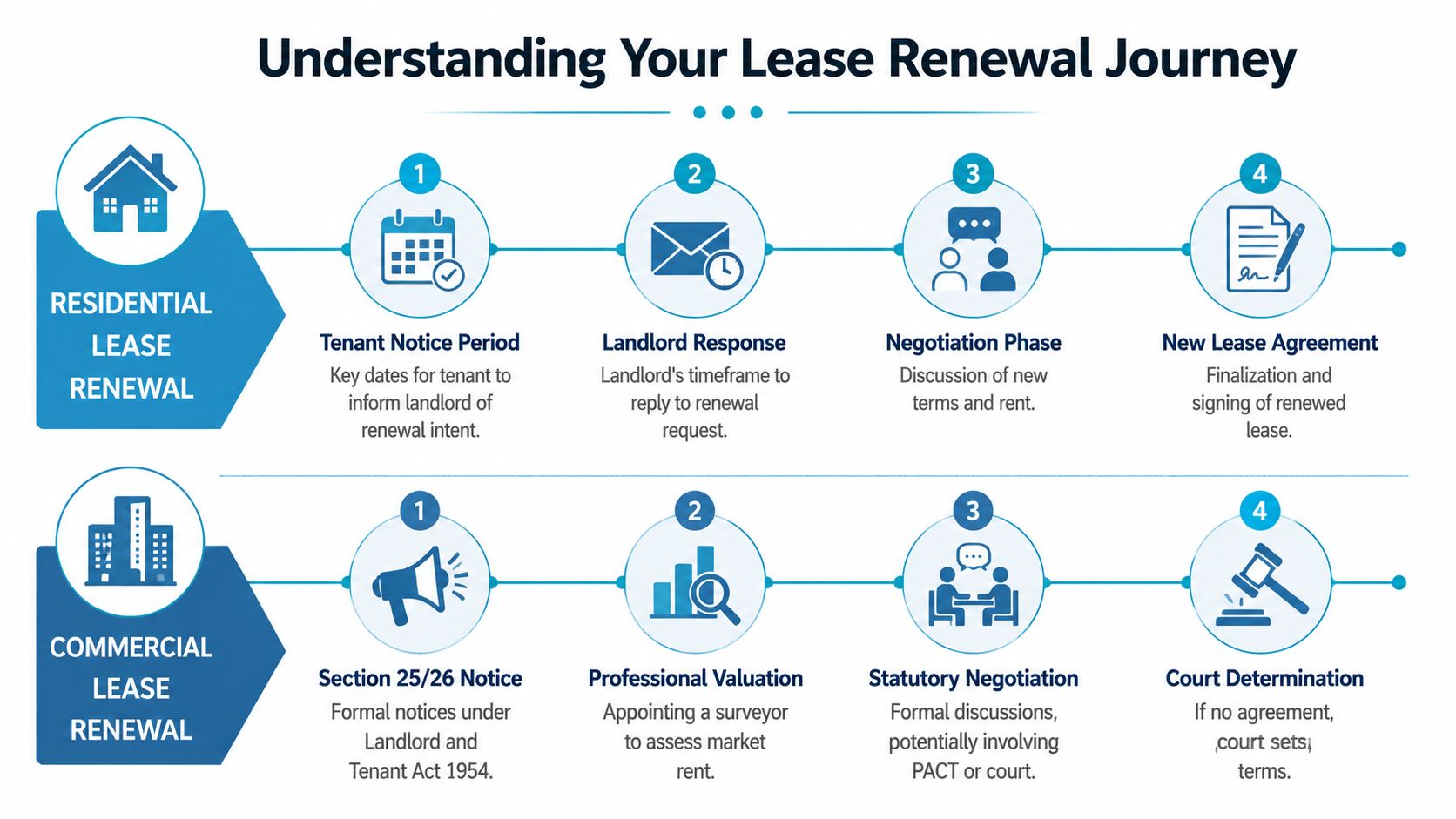
For qualifying long residential leaseholders in England and Wales, the starting point is the Leasehold Reform, Housing and Urban Development Act 1993. That statutory route gives the right to add 90 years to the existing term and reduce ground rent to a peppercorn. The legal position has also been affected by the Leasehold and Freehold Reform Act 2024, so timing and advice matter more where a client is deciding whether to proceed now or wait for secondary changes to take effect, as outlined in this summary of the 1993 Act and the 2024 reforms.
That is a different exercise from renewing an assured shorthold tenancy or other residential letting arrangement. In a tenancy renewal, the main questions are usually practical. Does the tenancy continue periodically, is a new fixed term proposed, what notice does the contract require, and does the paperwork accurately reflect what has been agreed between landlord and tenant? The legal route is often simpler, but careless timing still creates avoidable disputes.
Commercial renewals sit in a third category. Here, the tenant may have statutory protection, no protection at all, or a lease contracted out of renewal rights. The answer affects far more than occupation. It affects rent review assumptions, incentives, fit-out decisions, staffing plans, and whether relocation is a genuine option or an empty threat. For readers comparing how other jurisdictions approach landlord discretion, these Texas landlord lease renewal rights show why local advice matters. The UK position turns on different legislation, notice procedures, and valuation evidence.
| Aspect | Residential Lease Extension (Statutory) | Commercial Lease Renewal |
|---|---|---|
| Core purpose | Extend the term and protect long-term value | Secure continued occupation on workable business terms |
| Main legal route | Leasehold Reform, Housing and Urban Development Act 1993 | Lease terms and, where applicable, business tenancy legislation |
| Valuation question | What premium is justified for the longer lease | What rent and package reflect the market and the tenant's alternatives |
| Timing risk | Delay can worsen the premium and reduce flexibility | Delay weakens bargaining power and can remove relocation options |
| Evidence needed | Specialist lease extension valuation | Rental comparables, lease analysis, and occupancy cost review |
| Typical mistake | Serving notice without understanding the valuation position | Focusing on headline rent and missing repair, term, break, or incentive issues |
Count back from the date that can hurt you.
For a long residential lease extension, that usually means looking well before the term falls into a range where value starts to be affected more sharply. Waiting narrows your room to plan, and it hands the timetable to the other side. A leaseholder who takes advice early can decide whether to proceed under the statutory route, pursue an informal deal, or hold position for a reason. A leaseholder who starts late is often forced to react to the landlord's figures instead.
For residential tenancy renewals, the key dates are more administrative but still important. Review the agreement early, check whether notice is required, and confirm what happens at expiry. The UK government's guidance on private renting tenancy agreements is a better reference point for this article than generic overseas workflow material because it reflects the framework tenants and landlords are working within.
Commercial tenants need a longer runway. In practice, I usually want the lease, title position, and occupation strategy reviewed well before expiry, especially if the business may stay only on revised terms. CoreNet's commercial renewal strategy note is useful on one point in particular. Renewal should be tested against relocation, not discussed in isolation.
That trade-off matters. A tenant with time can compare renewal against moving costs, fit-out spend, dilapidations exposure, rent-free periods, and operational disruption. A tenant without time usually ends up arguing about headline rent after the landlord has already worked out that leaving is no longer realistic.
A lease renewal often starts with a figure from the other side that sounds reasonable enough to accept. Then the detail comes out. The rent ignores incentives on comparable deals, the premium assumes an aggressive reading of the lease, or the repair liability has not been priced in at all. That is usually the point at which clients realise valuation is not an academic exercise. It is the basis for deciding whether the proposed terms are fair.
A surveyor's job is to test value against the lease, the market, and the available alternatives. In both residential and commercial matters, that work gives you a defensible position before numbers are traded. It also shows where the critical pressure points lie. Sometimes that is the headline figure. Quite often it is a secondary term with a bigger financial effect over time.
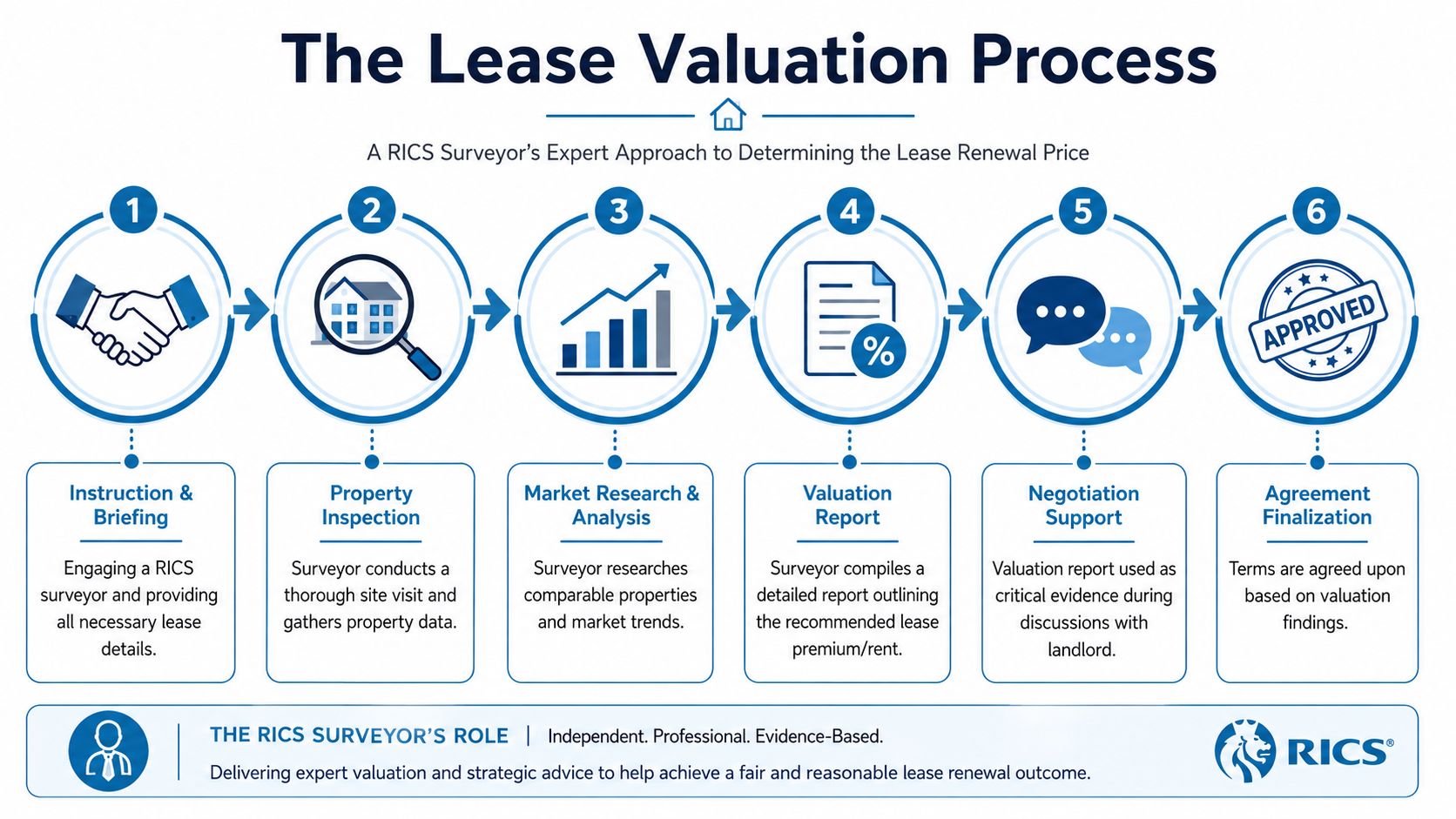
For a long lease extension, the valuation exercise is aimed at estimating the likely premium and explaining how that figure is constructed. The surveyor reviews the lease terms, the unexpired term, the ground rent pattern, and the flat's value in its current leasehold state. A proper report should do more than produce a headline number. It should show the assumptions, the points of judgment, and the parts of the calculation that are most likely to be disputed.
Residential negotiations can go wrong very quickly when a leaseholder starts discussing price without understanding what is driving it. If the term is short enough to affect value materially, or the lease contains wording that creates scope for argument, the landlord's opening position may be far more ambitious than the client expects.
That is where good advice earns its fee.
A good residential valuer will usually identify not just a figure, but a range, the basis for that range, and the risk of the matter becoming more expensive if it drifts into formal dispute.
In a commercial renewal, the valuation question is different. The main issue is usually market rent, but the fundamental decision is broader than rent alone. The tenant needs to know the cost of staying on the landlord's proposed terms compared with the cost of renewing on revised terms or moving elsewhere.
That means examining comparable lettings properly, not just quoting asking rents or headline deals. Incentives, fit-out contributions, rent-free periods, repairing liability, service charge exposure, break options, and building quality all affect the true position. A unit that looks cheaper on rent can still be the worse deal once those items are priced in.
This is also where valuation supports strategy rather than merely recording opinion. In practice, I want the numbers tested against actual occupation needs. A warehouse occupier may tolerate a higher rent for stronger loading provision and less operational disruption. An office tenant may accept a shorter term if flexibility matters more than a small saving on annual rent. The right outcome depends on use, cash flow, and how expensive it would be to move.
A useful report explains the route to the conclusion and gives you material you can negotiate from with confidence.
Look for these features:
The strongest report is one you can use line by line in negotiation, not one that simply states a conclusion.
It is also worth asking a practical question at the outset. Is the surveyor only valuing, or are they also handling negotiations? Those skills overlap, but they are not the same. A valuer establishes what the evidence supports. A negotiator decides how and when to deploy that evidence to improve terms without hardening the landlord's position too early.
Once the evidence is in place, negotiation becomes much more straightforward. Not always easy, but straightforward. The discipline is to keep the discussion anchored to comparable evidence, lease mechanics, and practical outcomes instead of drifting into unsupported positions.
An informal chat with the landlord or managing agent feels efficient. Sometimes it is. More often, it weakens your negotiating position too early. If you open with “we'd like to stay, what can you do?”, you've already told the other side that continuity matters to you before establishing what the market supports.
A better approach is to settle your internal position first. Decide what terms are acceptable, what terms are aspirational, and what would make relocation or another option more sensible. Then present a reasoned case.
Use your evidence to do three things:
Many occupiers often lose ground. The landlord says the new rent reflects “fair market value”, and the tenant responds by asking for a discount. That's weak negotiation because it accepts the landlord's framework before testing the valuation basis.
Guidance on this point is often thin, but one persistent gap is exactly how to challenge a landlord's market-rent increase. Leasing commentary drawing on RICS principles stresses transparent market evidence and early formal valuation advice, rather than vague requests for a reduction, in discussions around fair market value clauses and renewal terms, as described in this analysis of common tenant renewal mistakes.
So don't say, “That feels high.” Say something closer to this:
That is a professional challenge. It doesn't accuse. It tests.
A landlord is far more likely to move on price when you attack the valuation method than when you attack the number alone.
For residential leaseholders, the same principle applies in a different form. Don't negotiate a premium by instinct or by what a neighbour mentioned. Use a valuer's reasoning, understand the assumptions, and let the evidence do the heavy lifting.
Renewal costs almost always exceed the figure people first focus on. In residential matters, that may be the premium. In commercial matters, it may be the proposed rent. Neither tells the whole story.
Before you decide whether renewing a lease makes sense, budget for the transaction as a package and compare it with realistic alternatives.
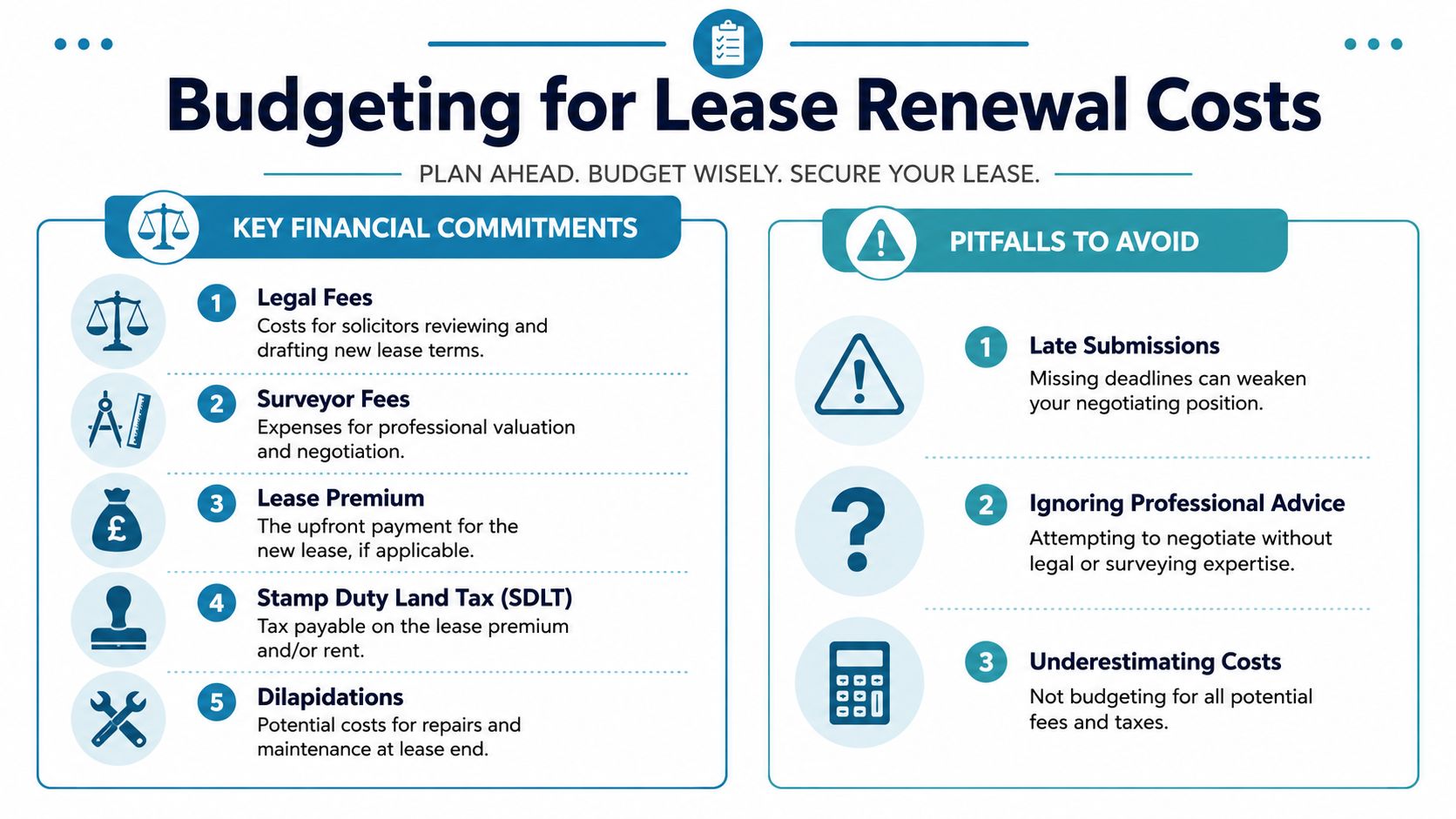
The obvious professional costs are the legal fee and the surveyor's fee. But there are usually other items sitting behind those.
A practical checklist looks like this:
For leaseholders trying to sense-check the likely extension figure before instructing, a rough starting point can help frame the conversation. One option is the Survey Merchant lease extension estimator, which is useful for early budgeting before formal valuation advice is obtained.
A short explainer can also help if you're reviewing the wider cost picture and obligations around renewal and exit:
The most expensive errors are rarely dramatic. They're usually quiet assumptions left unchallenged.
One common mistake is to treat renewal as a simple stay-or-go decision. That's too narrow. Occupiers increasingly have to consider flexibility, break options, subletting potential, refurbishment demands, energy-performance expectations, and whether the space still suits the way the business operates. Commentary on modern occupier decisions has stressed the importance of weighing total occupancy cost, including dilapidations and refurbishment, against the cost and flexibility of moving, because renewal may not be the right choice even where the current rent appears competitive, as discussed in this review of renewal versus relocation mistakes.
Other recurring pitfalls include:
A cheap renewal can become an expensive occupation if the space no longer fits, the break rights are poor, or the repair burden is underestimated.
For residential owners, the parallel mistake is waiting until the lease term has become uncomfortable in the market and then expecting a simple, low-friction extension. Delay rarely improves negotiating position. It usually narrows it.
Once terms are agreed in principle, the matter isn't finished. It's only safe once the legal documents reflect exactly what was negotiated and any required registration or post-completion step has been handled correctly.
Use a short final review before signing:
The right time to instruct a surveyor is often sooner than anticipated. For a commercial occupier, that usually means well before expiry or any break date if the decision could affect rent, fit-out, or relocation strategy. For a residential leaseholder, it means as soon as the lease term starts becoming a strategic concern or once a formal step is being considered. If you already know expert input is needed, speak to a specialist lease extension surveyor before figures are floated casually to the freeholder.
Good outcomes usually come from the same sequence. Check the legal position early, value the problem properly, negotiate from evidence, then complete with care.
A stalled renewal is usually a valuation problem, a legal problem, or both. The first job is to identify which one you are dealing with.
In residential leasehold cases, disagreement often centres on the premium, the length of the new term, or the wording of the lease. In commercial renewals, the dispute is more often about rent, repair liability, breaks, incentives, or the length of commitment. If the figures are far apart, each side should test its position against proper valuation evidence before spending more on correspondence that goes nowhere.
If agreement still looks unlikely, move onto the formal route in time. For residential matters that may mean tribunal. For commercial cases it may mean the statutory or court process that applies to the tenancy. Delay usually costs more than a clear decision.
Sometimes, yes. Whether they can do so lawfully depends on the type of lease and the rights attached to it.
A residential tenant on an assured shorthold tenancy is in a very different position from a long leaseholder seeking a lease extension. A business tenant may have renewal protection, but that protection is not automatic in every case and landlords can oppose renewal on specific legal grounds. I regularly see clients assume that because they have paid rent on time, renewal must follow. That is not a safe assumption.
The practical point is simple. Check the lease, confirm the statutory position, and do not rely on general rules borrowed from a different type of occupation.
Act now, and start with the documents already in hand.
Check the lease or tenancy agreement for notice requirements, expiry dates, rent review wording, and any clause dealing with continuation after the term ends. Then confirm what outcome you want. Some occupiers need a short extension for flexibility. Others should be fixing terms early because uncertainty is already affecting budgeting, staffing, lending, or future sale plans.
If you are in a residential tenancy, the immediate question is often whether the tenancy rolls on and on what basis. If you are dealing with a commercial lease or a long residential lease, the bigger risk is agreeing figures informally before the valuation work has been done. Once a number has been floated, it can shape the whole negotiation.
Yes, it matters, but not because every case is suddenly handled under a new set of settled rules.
My view in practice is that the Act matters now in two ways. First, it has changed expectations. Leaseholders are more aware that reform is underway, and freeholders are adjusting their positions accordingly. Second, it makes old rule-of-thumb advice less reliable, particularly where a client is deciding whether to act now or wait for further commencement and secondary legislation.
What it does not do is remove the need for a case-specific valuation and legal review. If a leaseholder has a short term left, a sale pending, or lender pressure, waiting for reform to bed in may be the wrong commercial decision. If timing is flexible, there may be merit in reviewing whether upcoming changes could affect premium or process. That is a judgment call based on the lease length, the property value, and the client's timetable, not a vague instruction to “wait and see.”
If you need help renewing a lease, extending a residential lease, or obtaining valuation evidence before negotiating, Survey Merchant can connect you with a suitable UK surveyor for lease extension and lease advisory work so you can start with proper evidence rather than guesswork.
Survey Merchant provides vetted RICS surveyors across 100+ UK locations at fixed fees:
→ Level 2 Home Survey (HomeBuyer Report)
→ Level 3 Building Survey (full structural survey)
→ RICS Red Book property valuations
→ Party wall surveyors — notices, awards & schedules of condition
→ Expert witness surveyors — CPR Part 35 reports for property disputes