Valuation
Jul 16, 2026
Matrimonial valuation: what you need to know in 2026
Discover what you need to know about matrimonial valuation in 2026. Ensure fair asset division with expert guidance on legal standards.

A matrimonial valuation is an independent, professional assessment of a property’s market value, used in divorce and separation proceedings to support equitable asset division. It is the evidential foundation upon which financial remedy negotiations, mediation, and court proceedings rely. Without a credible, standards-compliant report, any figure placed before a court or solicitor is little more than an estimate. The matrimonial home is the most commonly assessed asset, though investment properties and commercial holdings frequently feature in marital asset assessments too.
A matrimonial valuation in the UK is only legally credible when it complies with RICS Red Book Global Standards. The Royal Institution of Chartered Surveyors publishes these standards to define what constitutes a formal valuation, and courts expect compliance without exception. A figure produced outside this framework, regardless of who produced it, does not carry the same weight in financial remedy proceedings.
Under the Red Book, a compliant valuation must include:
The distinction between a formal valuation and a non-valuation matters enormously in divorce proceedings. Automated Valuation Models (AVMs), estate agent estimates, and desktop assessments do not meet Red Book valuation requirements and are routinely rejected as evidence. The biggest risk in matrimonial valuations is not the numerical outcome but whether the report meets recognised standards and processes to withstand legal scrutiny.
Pro Tip: Ask any valuer you instruct to confirm in writing that their report will comply with RICS Red Book Global Standards and is suitable for use in financial remedy proceedings. This single question filters out unsuitable practitioners immediately.
The UK and the United States share the same underlying goal, producing a credible, court-admissible property value opinion, but the professional frameworks and procedural rules diverge significantly.

| Feature | UK (RICS) | US (USPAP) |
|---|---|---|
| Governing standard | RICS Red Book Global Standards | Uniform Standards of Professional Appraisal Practice (USPAP) |
| Expert appointment | Single Joint Expert, instructed by both parties | Each party typically instructs their own certified appraiser |
| Report type | RICS-compliant valuation report | Certified appraisal report |
| Effective date | Usually current market value at date of report | Can be date of separation, date of filing, or date of trial |
| AVMs and broker opinions | Not admissible as valuation evidence | Courts reject AVMs as inadmissible evidence |
| Retrospective valuations | Permitted under RICS guidance | Valid under USPAP; common in equitable distribution cases |
In England and Wales, the Single Joint Expert (SJE) model is the default under the Family Procedure Rules. Both parties jointly instruct one RICS-registered valuer, whose report carries presumptive authority unless successfully challenged. This reduces costs and adversarial conflict, though it does not eliminate disputes entirely.
In New York and other US states operating under equitable distribution principles, each spouse typically retains a separate certified appraiser. The court then weighs competing reports, which increases costs and the scope for litigation. Retrospective appraisals, where the valuer assesses market value at a past effective date such as the date of separation, are more common in the US and add procedural complexity.
The practical implication for anyone in the UK is clear. The SJE process concentrates significant evidential weight on a single report, making the choice of valuer and the quality of that report more consequential than in jurisdictions where competing appraisals are the norm.
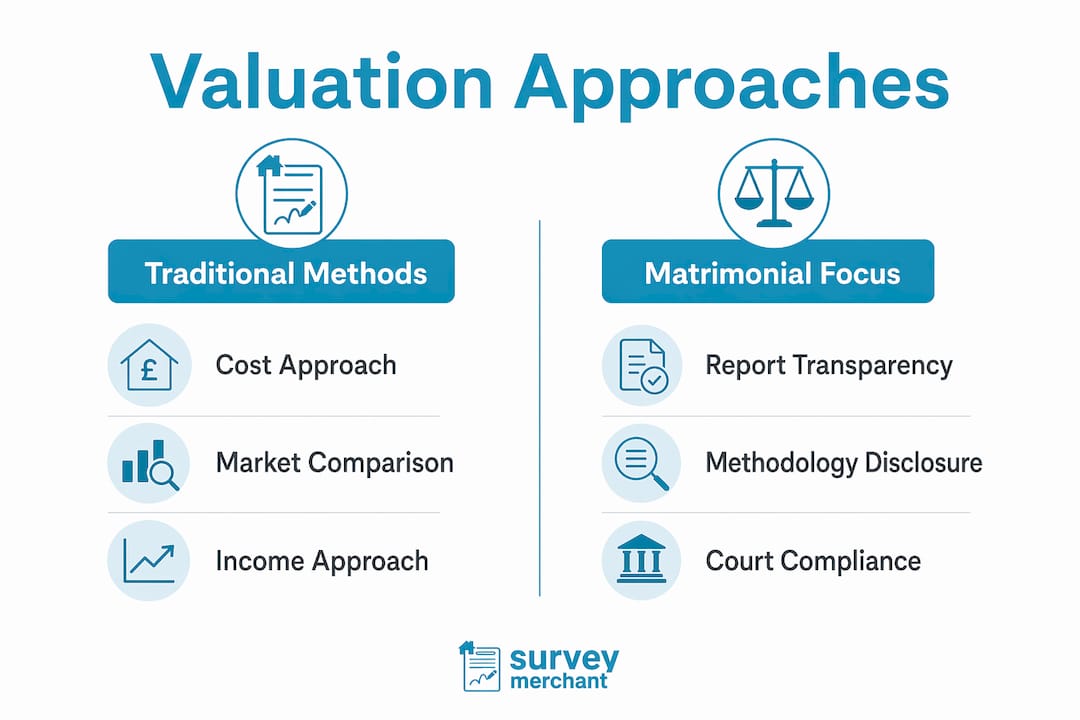
RICS and the International Valuation Standards classify valuation as the opinion of value on a stated basis at a specified date, implemented through three recognised approaches. Valuers must disclose which approach and method they applied, and why, to ensure transparency and withstand legal scrutiny. The choice of approach is not arbitrary. It reflects the nature of the asset and the available evidence.
The market approach compares the subject property against recent sales of comparable properties, adjusting for differences in size, condition, location, and specification. For residential matrimonial homes, this is the most commonly applied approach. A valuer in Manchester assessing a semi-detached property will analyse recent sales within the same postcode, adjusting for material differences such as an extended kitchen or a south-facing garden.
The income approach estimates value based on the income a property generates or could generate. Discounted cash flow (DCF) models and capitalisation of income methods both fall within this approach. It applies most directly to buy-to-let properties, commercial premises, or mixed-use assets forming part of the marital estate.
The cost approach determines value by reference to the cost of replacing or reproducing the asset, adjusted for depreciation and obsolescence. This approach is less common in residential matrimonial valuations but becomes relevant for specialist properties, such as a converted barn or a property with significant structural alterations, where comparable sales data is limited.
Valuers must report their chosen approach, method, and model transparently. A report that states a figure without explaining the methodology is not Red Book compliant and is vulnerable to challenge. Understanding which approach your valuer has applied, and why, is not just academic. It directly affects how defensible the figure is if the other party disputes it.
Disputes over valuation evidence in UK divorce proceedings are more common than most people expect, particularly where the matrimonial home represents a large proportion of the total asset pool. The procedural framework for resolving them is well established, though not without cost.
The primary mechanism is the Daniels v Walker application, a formal legal procedure that allows a party to challenge a Single Joint Expert’s report and seek permission to instruct their own expert. The Daniels v Walker application requires the applicant to satisfy two tests: the proposed challenge must not be fanciful, and the instruction of a second expert must be necessary in the interests of justice. Courts apply these tests strictly and will not grant permission simply because one party dislikes the figure.
Key considerations in valuation disputes include:
Pro Tip: If you believe the SJE’s figure is wrong, instruct a shadow expert to review the methodology before committing to a Daniels v Walker application. The cost of that review is far lower than the cost of a failed application.
A matrimonial valuation follows a structured process, and knowing what to expect reduces both anxiety and the risk of procedural errors that could affect your financial settlement.
The process typically involves:
The timing of the valuation matters more than most people realise. Valuation dates materially influence fair market value, particularly when property markets are moving. In a rising market, a trial-date valuation will produce a higher figure than one dated at separation, which may benefit one party over the other. Discuss the implications of valuation timing with your solicitor before instructing a valuer.
Choosing a credible Single Joint Expert reduces the likelihood of challenges and increases the probability that the report will be accepted without further dispute. Valuation report quality depends on conflict-of-interest management and the valuer’s compliance with both professional and court duties, not just the numeric outcome.
A matrimonial valuation is only legally credible when it is produced by a qualified RICS valuer in full compliance with Red Book Global Standards, with methodology disclosed and the valuation date carefully considered.
| Point | Details |
|---|---|
| RICS Red Book compliance | Only Red Book-compliant reports are accepted as valuation evidence in UK divorce proceedings. |
| Single Joint Expert model | UK courts default to one jointly instructed valuer, making the choice of expert critical. |
| Valuation date matters | Market conditions at the valuation date directly affect the concluded figure and settlement outcome. |
| Disputes via Daniels v Walker | Challenges to SJE reports require satisfying a two-part legal test; written questions are a lower-cost first step. |
| Avoid informal estimates | AVMs, estate agent opinions, and desktop assessments are not admissible and increase litigation risk. |
Most people entering divorce proceedings focus on the number. What will the house be worth? That instinct is understandable, but it misses the more consequential question: will the report survive scrutiny?
In my experience working across the UK property sector, the reports that cause the most damage in financial remedy proceedings are not the ones with the wrong number. They are the ones produced by valuers who did not understand their duties as a court expert, who failed to disclose their methodology clearly, or who had an undisclosed conflict of interest. A figure produced by the wrong person, however accurate, can be challenged and discredited at significant cost to both parties.
The other pattern I see repeatedly is individuals attempting to save money at the instruction stage by relying on online tools or informal agent estimates. Using AVMs or non-specialist reports risks inadmissibility and additional litigation costs that far exceed the original saving. The credibility of the report is the product you are paying for, not just the number at the end of it.
Engage a valuer early, confirm their RICS accreditation and experience with matrimonial instructions, and treat the report as a legal document from the moment it is commissioned. That approach saves time, money, and considerable stress.
— Surveymerchant
Surveymerchant connects individuals going through divorce with qualified, RICS-accredited valuers who understand the specific requirements of matrimonial proceedings. Every valuer in the Surveymerchant network is vetted for professional compliance, ensuring that reports meet Red Book Global Standards and are suitable for use in financial remedy negotiations and court proceedings.

Whether you need a Single Joint Expert appointment or an individual RICS valuation service for your matrimonial home, investment property, or commercial asset, Surveymerchant matches you with the right specialist for your circumstances. The instruction process is straightforward, and all reports are produced to the standard courts and solicitors expect. For complex assets, Surveymerchant also provides access to full building survey services where condition assessment forms part of the valuation evidence.
A matrimonial valuation is an independent, professional assessment of a property’s market value, produced by a qualified RICS valuer for use in divorce or separation proceedings. It provides the evidential basis for fair asset division in negotiations, mediation, and court.
Yes. In the UK, a valuation presented in financial remedy proceedings must comply with RICS Red Book Global Standards to be admissible and credible. Reports produced outside this framework, including AVMs and estate agent estimates, are not accepted as valuation evidence.
A Single Joint Expert is a RICS-registered valuer jointly instructed by both parties in UK divorce proceedings. Their report carries presumptive authority, and challenging it requires a formal Daniels v Walker application satisfying strict legal tests.
Yes. Valuation dates affect market value materially, particularly in fluctuating markets. A valuation dated at separation may differ significantly from one dated at trial, which can favour one party depending on market direction.
You can submit written questions to the Single Joint Expert under FPR 25.10 as a first step. If concerns remain, a Daniels v Walker application can be made to seek permission for a second expert, though courts apply proportionality tests strictly before granting it.
Survey Merchant provides vetted RICS surveyors across 100+ UK locations at fixed fees:
→ Level 2 Home Survey (HomeBuyer Report)
→ Level 3 Building Survey (full structural survey)
→ RICS Red Book property valuations
→ Party wall surveyors — notices, awards & schedules of condition
→ Expert witness surveyors — CPR Part 35 reports for property disputes