We use cookies to improve your experience on our site, analyze site traffic, and assist in our marketing efforts. By clicking "Accept all," you agree to the storing of cookies on your device. You can choose to "Reject all" non-essential cookies. For more information, please read our Cookie Policy.
Efflorescence is the white salt bloom on brickwork and walls. Find out what causes it, whether it signals damp, how to remove it safely and when to get a survey.
Efflorescence is the chalky white (sometimes grey) powder that appears on brickwork, render, concrete and plastered walls when water carrying dissolved salts evaporates and leaves the salts behind. It is one of the most common things our surveyors are asked about, because it looks alarming and is often mistaken for mould, frost damage or a failed damp-proof course. The good news is that in most cases efflorescence is cosmetic. The important caveat is that it is always evidence that water has been moving through the wall, and in a UK home that moisture needs explaining. This 2026 guide covers what efflorescence is, why it forms, how to remove it safely, when it signals damp, and how a suitably qualified, accredited surveyor investigates it.
Key takeaways
Efflorescence is a salt deposit, not a growth. Water dissolves soluble salts in bricks, mortar, concrete or the ground, carries them to the surface and evaporates, leaving a white powdery bloom.
It is usually harmless to the structure. The Mineral Products Association notes it “should weather away” and does not cause permanent disfigurement unless the wall stays persistently damp.
It is still a moisture clue. New brickwork drying out is normal; efflorescence that keeps returning on an older wall points to a water source such as a leaking gutter, bridged damp-proof course or rising damp.
Remove it dry. A stiff nylon brush on a dry day is the recommended first step. Avoid pressure washers, wire brushes and casual use of acid cleaners.
Damp is on the rise. The English Housing Survey 2024–25 (published 29 January 2026) found 5% of dwellings, around 1.4 million homes, had a damp problem, up from 4% in 2021–22.
Get it checked before you buy. A Level 2 or Level 3 survey by an accredited surveyor will tell you whether the bloom is a cosmetic drying-out issue or the visible symptom of a bigger defect.
What is efflorescence?
Efflorescence is a crystalline deposit of water-soluble salts that forms on the surface of masonry as moisture evaporates. The salts, typically sulfates and carbonates of sodium, potassium and calcium, originate in the bricks, mortar, sand, concrete or the soil behind a wall. Water dissolves them, migrates to the surface and dries, leaving a white, grey or off-white powder. It is cosmetic rather than structural in most cases, but it always indicates water movement through the wall.
Typical efflorescence on a Victorian brick elevation, concentrated in the lower courses where ground moisture and splash-back are greatest.
The word comes from the Latin efflorescere, “to flower out”, which is a fair description of how the salts seem to bloom from the face of a wall after a wet spell. The industry reference most UK surveyors rely on is the Mineral Products Association’s MPA Mortar Data Sheet 08: Efflorescence and bloom on masonry (Issue 6, October 2023), which explains that almost all building materials contain water-soluble salts that dissolve in construction water and reappear at the surface as the building dries.
What causes efflorescence on brickwork and walls?
Three things have to be present at the same time for efflorescence to form: soluble salts, water to dissolve them, and a path for that water to reach a surface where it can evaporate. Remove any one of the three and the bloom stops. In practice the salts come from a handful of sources:
Clay bricks. Some clays naturally contain sulfates. Modern bricks sold in the UK are classified for soluble salt content under BS EN 771-1 (categories S0, S1 and S2, with S2 the lowest-salt grade), but older and reclaimed bricks were never tested.
Cement and lime mortars. Portland cement releases calcium hydroxide (free lime) as it cures. When it reaches the surface it reacts with carbon dioxide to form calcium carbonate, which the MPA calls “lime bloom” and which is especially visible on dark pigmented mortars.
Sand and aggregates. Unwashed sand can carry sea salt or other contaminants; the Designing Buildings Wiki notes that sodium and potassium salts are far more soluble than calcium salts and so “tend to appear much more quickly”.
Groundwater and soil. Where a wall is in contact with wet ground, or the damp-proof course has failed or been bridged, ground salts (including nitrates and chlorides) are drawn up with the moisture. This is why efflorescence and rising damp so often appear together in the bottom metre of a wall.
Weather. Efflorescence is worse after sustained or heavy rain and in cold, damp winters, and tends to fade in dry summers. Rain followed by rapid drying in sun is the classic trigger.
Why new homes and extensions get it first
Freshly built brickwork contains a great deal of water from the mortar, from rain during construction and from bricks that were stored uncovered on site. As the wall dries out during the first year or two, that water carries salts to the face and a bloom appears. Brick manufacturers and the MPA both stress that bricks should be stored off the ground and covered, and that new masonry should be protected from rain until copings, sills and roofs are in place. Efflorescence on a brand-new extension is therefore common and usually self-limiting; the surveyor’s job is to make sure the detailing (copings, sills, drips, cavity trays and the damp-proof course) is correct so that it does not become a permanent feature.
Is efflorescence a sign of damp?
Efflorescence is a sign that water has passed through the wall, so the honest answer is “sometimes”. What matters is where the water came from and whether it is still arriving. Our surveyors treat the pattern of the bloom as a diagnostic map:
A horizontal band in the lowest 1–1.5 m of an external or internal wall, often with a tide mark, blistering paint and salt-contaminated plaster, is the classic signature of rising damp or a bridged damp-proof course. Read our damp-proof course guide for the signs of failure.
Localised patches below a window sill, beneath a parapet or next to a downpipe point to penetrating damp from defective sills, copings, flashings or leaking rainwater goods.
An even bloom across a whole new elevation is almost always construction water drying out.
Salts on the inside face of a chimney breast usually come from hygroscopic salts in old flue deposits rather than from external water, and need a different remedy (removing the contaminated plaster and ventilating the flue).
There is an important secondary effect. Hygroscopic salts, chlorides and nitrates in particular, attract moisture from the air. Once plaster is contaminated with them it can feel damp and show staining even after the original water source has been fixed. That is why a damp specialist will often recommend re-plastering with a salt-resistant render rather than simply redecorating. For the full picture of the three types of damp and how they are told apart, see what causes damp in a house.
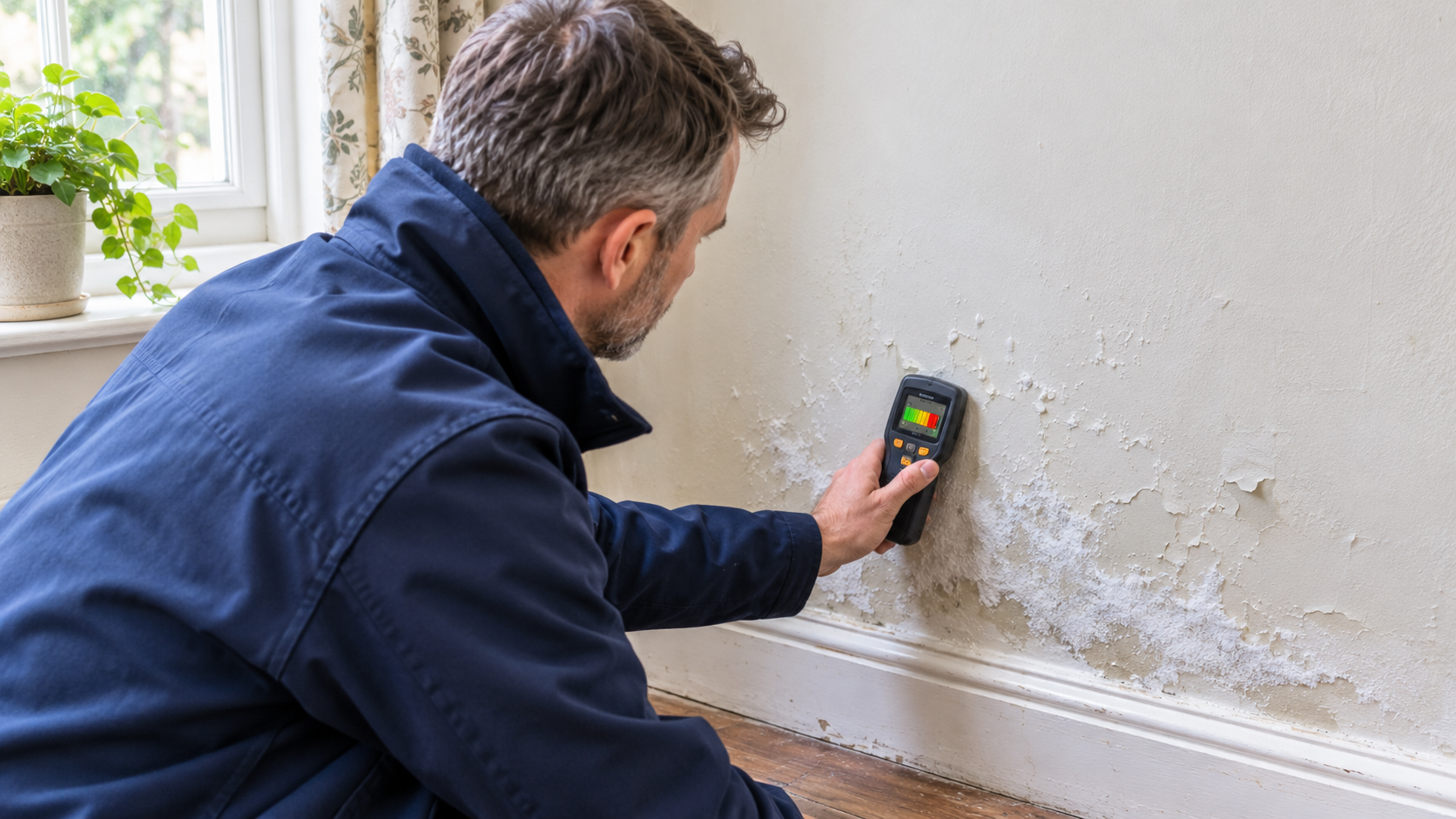
A surveyor combines moisture-meter readings, salt analysis and external inspection to decide whether efflorescence is cosmetic or the symptom of a live damp problem.
Efflorescence, lime bloom, grey efflorescence or mould? A comparison
Several white or grey deposits look alike from the pavement. Telling them apart changes the remedy, so it is worth knowing the differences before reaching for a cleaner.
Deposit
What it looks like
Typical cause and timing
Harmful?
Treatment
White salt efflorescence
Fluffy or crystalline white powder; brushes off when dry; often returns after rain
Soluble salts in bricks, mortar or ground water; common in the first 1–2 years of new masonry or where a wall is persistently wet
Cosmetic unless moisture is permanent
Dry stiff-brush; fix the water source; allow to weather
Lime bloom (calcium carbonate)
Thin, hard, chalky film on mortar joints and concrete; does not brush off easily
Free lime from cement reacting with CO2 in damp conditions; more visible on dark mortars
Cosmetic
Weathers slowly; proprietary cleaners or diluted acid on a trial area, following manufacturer advice
Grey (gypsum) efflorescence
Dull grey haze or crust on or just under the brick face; does not brush off
Gypsum crystals forming from processes in the mortar; appears months or years after construction; linked by industry commentators to changes in modern mortar formulations and wet weather
Disfiguring; difficult to remove
Specialist cleaning (light abrasive methods carry a risk of damaging the brick face); improve water shedding
Subflorescence (salt crystallising inside the brick)
Flaking, spalling or powdering brick faces; salts visible in the fresh scar
Salts crystallising beneath the surface where evaporation happens inside the pore structure, often after the use of impermeable paints or sealants
Yes, progressive decay of the masonry
Remove the water source and any impermeable coating; replace badly spalled bricks; use breathable finishes
Mould
Black, green or grey spots and smears, often fuzzy; musty smell; wipes rather than brushes off
Condensation on cold surfaces, poor ventilation, high indoor humidity
Health risk, especially for respiratory conditions
A quick field test: dab a little water on the deposit. Efflorescence salts will dissolve and disappear temporarily; lime bloom and gypsum will not. Mould smears when rubbed and usually has a smell.
How to remove efflorescence from brick and masonry
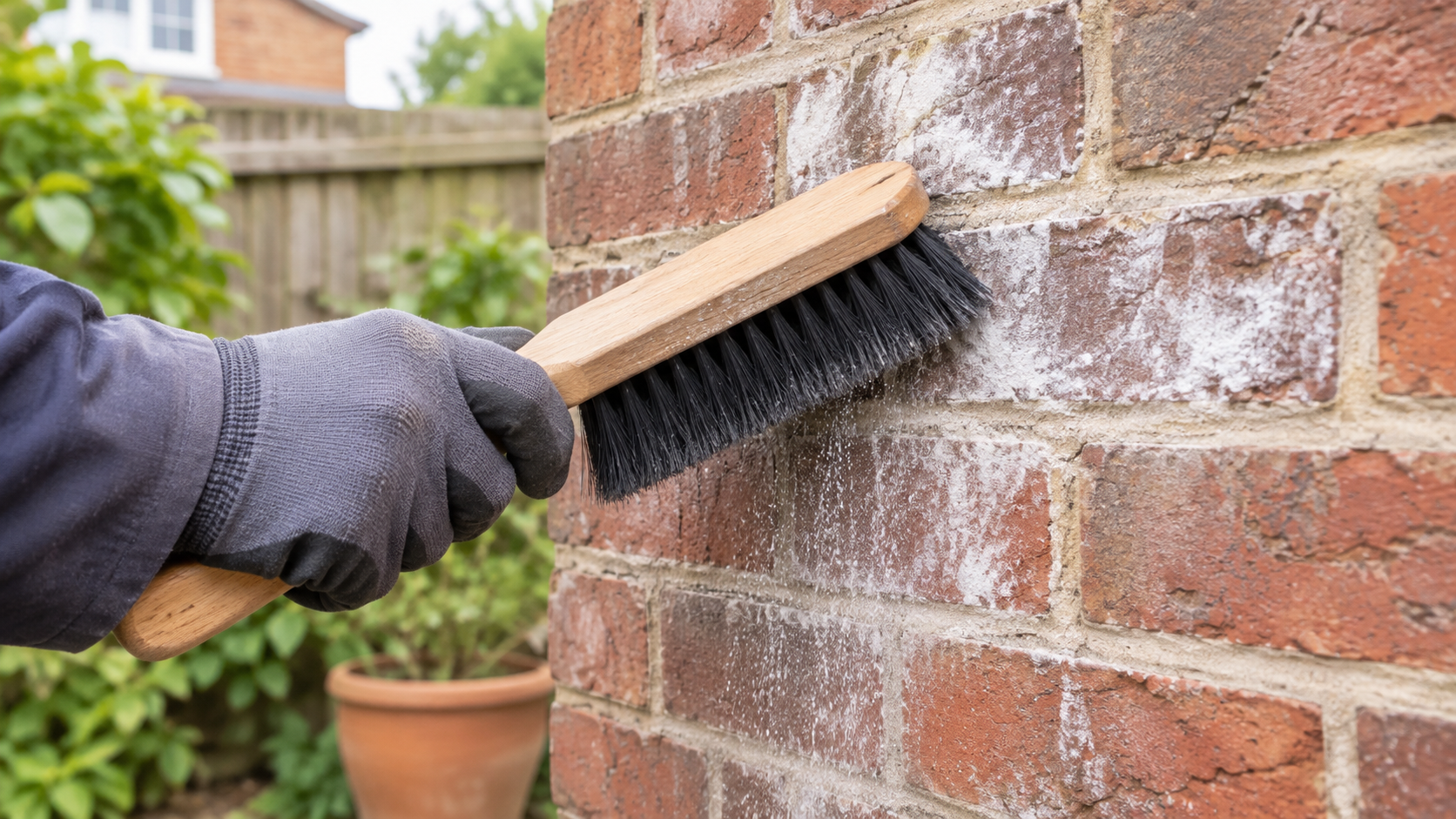
The MPA data sheet is clear that “brushing with a stiff brush when dry” is the best method of removal, and that most efflorescence will weather away by itself. Our recommended sequence is:
Wait for a dry spell. Brushing wet salts simply dissolves them back into the wall, where they will re-emerge.
Dry-brush with a stiff nylon or bristle brush. Avoid wire brushes, which score the brick face and leave rust marks, and avoid pressure washers, which drive more water into the wall and can erode soft lime mortar.
Vacuum or sweep up the powder so it is not washed back into the base of the wall.
Repeat as the wall dries. New brickwork may need two or three rounds over the first year.
Only then consider a proprietary efflorescence remover. These are typically mild acids. The MPA advises trialling a small inconspicuous area first, consulting the brick manufacturer and wearing goggles and protective clothing. Acid can etch mortar, discolour bricks and, on historic or lime-built walls, do lasting damage. BS 8221 Parts 1 and 2 cover the cleaning and surface repair of buildings.
Do not seal the wall. Silicone water repellents and masonry paints applied over salty, damp brickwork trap moisture and salts inside, converting harmless efflorescence into damaging subflorescence and spalling.
Dry brushing on a dry day is the method recommended by the Mineral Products Association; pressure washing and wire brushes should be avoided.
How to treat efflorescence on interior walls and plaster
Internally, white fluffy salts on plaster or paint tell you that moisture has been evaporating through that surface. Brush the salts off dry and bag them. If the plaster is sound and the water source has been found and fixed (for example a leaking pipe or a bridged damp-proof course), let the wall dry fully, which can take weeks or months, then redecorate with a breathable paint. If the plaster is soft, blown or keeps producing salts, it is usually contaminated with hygroscopic salts and should be hacked off to at least 300 mm above the highest sign of damp and replaced with a salt-inhibiting renovating plaster. Painting over the salts with a stain blocker without addressing the moisture is the single most common mistake we see in pre-sale redecoration, and an experienced surveyor will spot it.
How to prevent efflorescence
Design and maintain parapets, sills, copings and drips so water is shed clear of the wall (BS 5642-1 covers copings and sills).
Keep gutters, downpipes and gullies clear so rainwater is not discharged against brickwork.
Maintain the damp-proof course and keep external ground, paving and planters at least 150 mm below it.
On new work, store bricks covered and off the ground, cover unfinished walls overnight and in rain, use factory-produced mortar and specify low-salt (S2) bricks where appearance matters.
Use lime-based, breathable mortars and finishes on solid-walled period homes so that moisture can escape without crystallising inside the brick. Our guide to surveying a Victorian house explains why breathability matters so much in pre-1919 construction.
Efflorescence and damp: what the 2026 data and new laws mean for owners and landlords
Damp is becoming more, not less, common in English homes. The Government’s English Housing Survey 2024–25 headline report on housing quality, published on 29 January 2026, reports that 5% of dwellings (about 1.4 million) had a damp problem in 2024, up from 4% in 2021 and 2022. The private rented sector was worst affected at 10%, compared with 7% of social homes and 4% of owner-occupied homes. Penetrating damp was recorded in 2% of dwellings and rising damp in around 1%, with both rising since 2019, while 30% of households said they had experienced condensation, damp or mould in their home.
The legal backdrop is tightening too. Awaab’s Law came into force for social landlords in England on 27 October 2025, requiring investigation of significant damp and mould hazards within 10 working days, a written summary within 3 working days of the investigation concluding, and the hazard to be made safe within 5 working days (24 hours for emergencies). Under the Renters’ Rights Act 2025 the Government is now extending the regime to private tenancies: its consultation Extending Awaab’s Law to private rented tenancies and to licences was published on 9 October 2026 and closes on 18 December 2026. For landlords, a tenant’s photo of “white mould” that is in fact efflorescence still deserves a prompt, documented inspection, because the moisture behind it may well be a reportable hazard.
Separately, the trade press has highlighted a growing number of cases of grey gypsum efflorescence on relatively recent brick facades, a form that appears months or years after completion and cannot simply be brushed off. Building Design magazine reported that the problem has been linked by brick-industry technical advisers to changes in modern mortar formulations and prolonged wet exposure, and that remediation is difficult without risking damage to the brick face. If you are buying a newer home with an unexplained grey haze on the brickwork, ask your surveyor to comment on it specifically.
What a surveyor does when they find efflorescence
On a Level 2 or Level 3 home survey, efflorescence is recorded as a condition observation and then investigated for cause. A suitably qualified, accredited surveyor will typically:
Map the extent and height of the salts and relate them to the damp-proof course, ground levels, sills, copings, chimney stacks and rainwater goods.
Take electrical moisture-meter readings in a grid pattern internally and externally, noting that salt contamination can inflate surface readings, and use deep-probe or carbide testing where accuracy matters.
Check for bridging: raised paths, render over the DPC, debris in the cavity, or internal floor screeds above DPC level.
Look for impermeable coatings (cement render, masonry paint, sealants) that stop the wall breathing.
Recommend further investigation, usually a specialist damp and timber report, only where the evidence points to a live defect rather than historic drying-out.
Set the finding in context for the purchase: whether it affects value, mortgageability or a lender’s retention, and what a reasonable remediation budget looks like. Our house survey cost guide explains what each level of report includes.
Survey Merchant’s panel includes surveyors regulated or accredited by bodies such as RICS, CIOB and RPSA, among others, matched to the age and construction of the property. For a solid-walled Victorian terrace with salts at skirting level, that means a surveyor who understands lime mortar and historic damp-proofing; for a 2019 new build with a grey bloom, one who knows modern cavity-wall detailing and NHBC standards.
Why choose Survey Merchant for your efflorescence and damp survey?
Efflorescence is cheap to brush off and expensive to misdiagnose. Choosing the right surveyor is what turns a white powder into a clear answer. Here is why UK buyers, owners and landlords use Survey Merchant:
An accredited panel matched to the job. We draw on suitably qualified surveyors accredited by RICS, CIOB, RPSA and other recognised UK bodies, and pair you with one whose experience fits your property type.
Nationwide UK coverage with local knowledge. Whether the salts are on a Cornish cob cottage or a Manchester new build, we have surveyors who know the local construction and ground conditions.
Fast turnaround. We work to get your inspection booked and your report back quickly, written in plain English with photographs and clear recommendations.
Transparent, competitive fixed fees. You know the price before you instruct, with no hidden extras.
Impartial advice. You get an independent professional opinion on what the wall needs, not a quotation from a company selling damp-proofing treatments.
End-to-end support. From choosing between a Level 2 and Level 3 survey to interpreting the findings and negotiating on price, our team stays with you until you have what you need.
Sometimes. Efflorescence proves that water has moved through the wall and evaporated, but on new brickwork that water is usually construction moisture drying out. On an older wall, a horizontal band of salts in the bottom metre points to rising damp or a bridged damp-proof course, while patches below sills or beside downpipes suggest penetrating damp. A surveyor uses the pattern, moisture readings and external inspection to decide.
Is efflorescence harmful to a house?
Surface efflorescence is cosmetic and does not weaken brickwork, and the Mineral Products Association notes it normally weathers away. It becomes harmful when salts crystallise beneath the surface (subflorescence), which flakes and spalls the brick face, or when the moisture that causes it is left unresolved and leads to rot, plaster failure or mould.
How do I remove efflorescence from brick?
Wait for a dry day and brush the salts off with a stiff nylon or bristle brush, then sweep up the powder. Avoid wire brushes and pressure washers, which damage the brick and push water back into the wall. Repeat as the wall dries. Use a proprietary acid-based remover only as a last resort, on a trial area first and following the brick manufacturer's advice.
How do you treat efflorescence on interior walls?
Brush the salts off dry, find and fix the water source, and let the wall dry fully before redecorating with a breathable paint. If the plaster is soft, blown or keeps producing salts it is probably contaminated with hygroscopic salts and should be removed to at least 300 mm above the damp line and replaced with a salt-inhibiting renovating plaster. Do not simply paint over it with a stain blocker.
Does efflorescence go away on its own?
On new masonry it usually does, fading over the first one to two years as construction water dries out and rain gradually washes the salts away. Efflorescence that keeps returning on an established wall will not disappear until the source of moisture is removed, because each wetting and drying cycle brings fresh salts to the surface.
Will efflorescence affect my mortgage or survey?
A valuer or surveyor will note efflorescence and look for its cause. Cosmetic drying-out on a new build rarely affects value, but if it is linked to rising or penetrating damp, a lender may ask for a specialist damp and timber report or apply a retention until repairs are done. A Level 2 or Level 3 survey from an accredited surveyor will tell you which situation you are in before you commit.