We use cookies to improve your experience on our site, analyze site traffic, and assist in our marketing efforts. By clicking "Accept all," you agree to the storing of cookies on your device. You can choose to "Reject all" non-essential cookies. For more information, please read our Cookie Policy.
Planning Permission Cost UK 2026: Fees & Full Guide
A complete 2026 guide to planning permission cost in the UK: statutory fees by nation, the December 2026 English fee rise, exemptions, Planning Portal charges, hidden professional costs and expert tips to keep your budget down.
If you are planning an extension, a loft conversion or a new build in 2026, one of the first questions is simple: how much does planning permission cost in the UK? The honest answer is that the planning permission cost is made up of two parts – the statutory application fee paid to your council, and the far larger “hidden” costs of drawings, surveys, pre-application advice and conditions. This guide sets out every figure you need for England, Wales and Scotland, including the new English fee schedule due to take effect on 8 December 2026, so you can budget with confidence.
Key takeaways
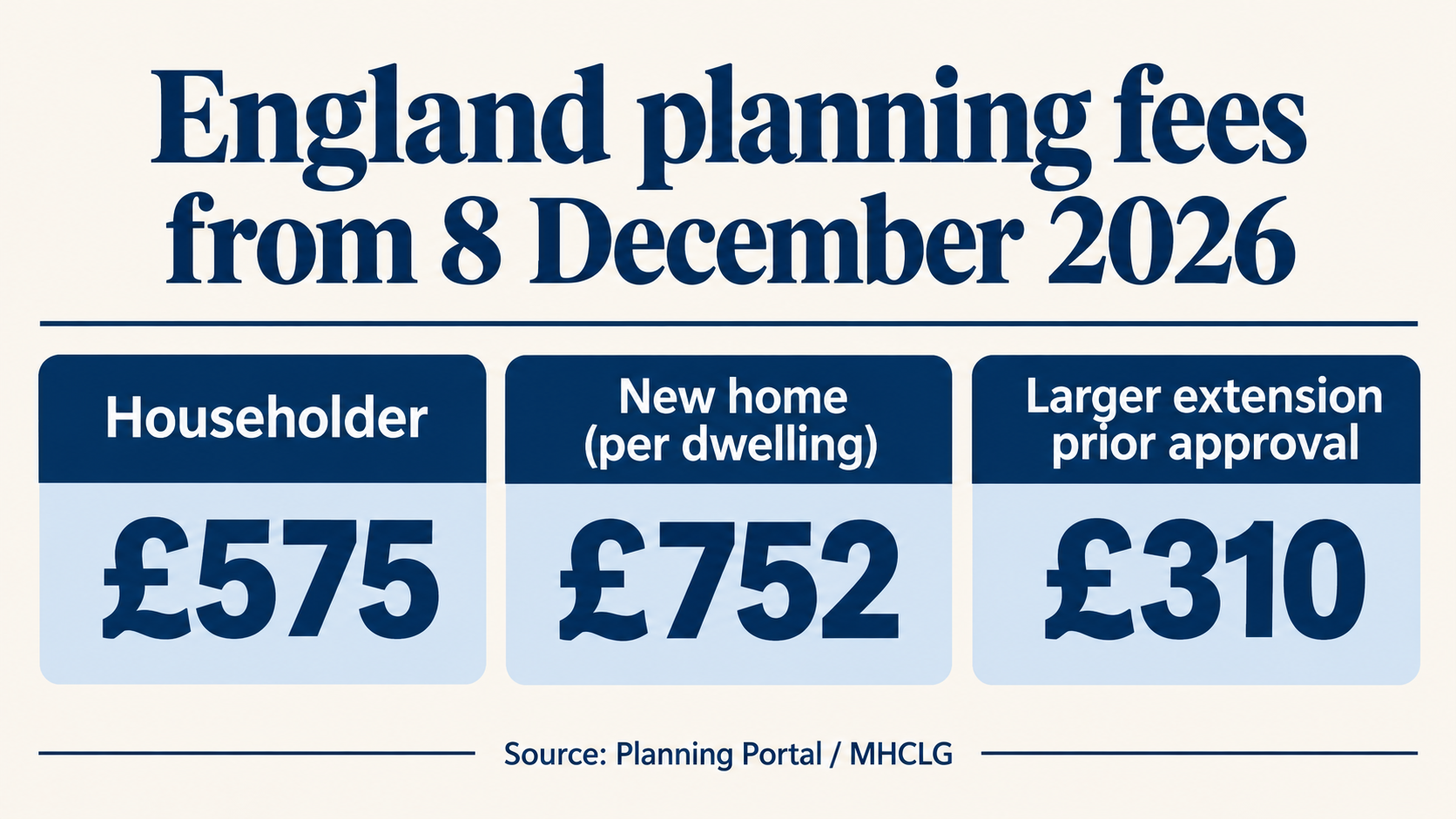
In England a standard householder planning application (extensions and alterations to one home) costs £548 today and rises to £575 for applications made on or after 8 December 2026, subject to the final parliamentary steps.
Full applications for fewer than 10 new homes rise from £610 to £752 per dwelling; prior approval for a larger home extension rises from £249 to £310.
Wales charges £585 for a householder application (since 1 December 2025); Scotland charges £371 (since 1 April 2026).
The application fee is usually the smallest part of the bill: drawings, measured surveys, ecology and tree reports, pre-application advice and discharging conditions typically add £1,500–£6,000+ to a domestic project.
From 2027 English councils are expected to be able to set fees up to 30% above the national default, and fees will be uprated for inflation every April.
Using a suitably qualified, accredited surveyor early (for measured, topographical or condition surveys) reduces the risk of refusals, re-submissions and repeat fees.
How much does planning permission cost in the UK in 2026?
In 2026 a householder planning application costs £548 in England (rising to £575 from 8 December 2026), £585 in Wales and £371 in Scotland. New homes cost £610–£752 per dwelling in England. Add drawings, surveys and professional fees, and a typical home extension’s total planning permission cost is around £2,000–£6,000.
The application fee is only one line in the budget – drawings, surveys and advice usually cost far more.
Planning application fees in England in 2026
English fees were uprated by 3.8% (September 2025 CPI) on 1 April 2026, according to the Planning Portal (30 January 2026). A much bigger change follows in December. On 16 July 2026 the Ministry of Housing, Communities and Local Government published its response to the “Fees for planning applications” consultation, confirming a new National Default Fee Schedule designed to recover around 90% of councils’ estimated processing costs. The draft amending regulations were approved by the House of Commons on 27 October 2026 and are due to apply to applications made on or after 8 December 2026, subject to completing the remaining parliamentary steps. Crucially, the fee is fixed by the date you submit, not the date the council validates or decides your application.
England planning fees: current versus 8 December 2026
Application type (England)
Fee from 1 April 2026
Fee from 8 December 2026
Householder – extension or alteration to a single home
£548
£575
Works within the curtilage (gates, fences, walls, some outbuildings)
£272
£285
Full application – fewer than 10 new dwellings (per dwelling)
£610
£752
Full application – 10 to 49 new dwellings (per dwelling)
£659
£818
Outline application – site under 0.5 ha (per 0.1 ha)
£610
£719
Change of use of a building or land (other than to homes)
£610
£732
Prior approval – larger home extension
£249
£310
Prior approval – commercial to residential (Class MA, per dwelling)
£260
£323
Lawful development certificate – existing use
Same as full fee
Same as full fee
Lawful development certificate – proposed use
Half the full fee
Half the full fee
Non-material amendment (householder / other)
£46 / £309
£53 / £360
Discharge of conditions (householder / other)
£89 / £309
£125 / £435
Section 73 vary or remove a condition (householder / major)
£89 / £2,076
£112 / £3,150
Permission in principle
£531 per 0.1 ha
£825 flat fee
General maximum fee (full applications)
£427,537
£513,512
Figures are taken from the Planning Portal’s forthcoming fees schedule for England. Prior approval routes that were previously free also pick up a new £310 flat fee from December, and the next inflation uplift is scheduled for 1 April 2027.
Headline English planning fees from 8 December 2026 (source: Planning Portal / MHCLG).
Planning Portal service charge
If you apply online through the Planning Portal, a service charge is added to many applications with a fee over £100: Band 1 is £99 including VAT for simpler application types and Band 2 is £149 including VAT for more complex ones, while some application types attract no charge. Applying directly to the council’s own portal, where available, avoids it.
What is free or reduced?
Listed building consent carries no fee (though associated planning permission does).
Works to improve access for a disabled person are exempt.
Parish and community councils pay 50% of the normal fee.
Planning appeals remain free – the government has decided not to introduce an appeal fee.
The old “free go” for a resubmission after refusal was abolished in December 2023 and has not been reinstated, so a refused scheme now costs a second full fee.
Planning permission cost in Wales, Scotland and Northern Ireland
Planning is devolved, so fees differ across the UK:
Wales: the Welsh Government’s fee document raised fees by an average of around 50% from 1 December 2025. A householder application now costs £585 and each new dwelling (up to 25) costs £667.
Scotland: under Planning Circular 1/2026, applications made on or after 1 April 2026 pay £371 for a householder extension or alteration and £742 for a single new house.
Northern Ireland: the Department for Infrastructure publishes its own scale of fees – check the current schedule before submitting.
The real cost of planning permission: fees beyond the application
Ask any experienced surveyor or planning consultant and they will tell you the same thing: the council fee is the cheap bit. A compliant application needs accurate drawings, and increasingly needs supporting reports. The HomeOwners Alliance and Homebuilding & Renovating publish typical 2026 ranges, summarised below.
Sloping sites, boundaries, accurate existing drawings
Tree (arboricultural) survey
Around £300–£1,000
Trees on or near the site, TPOs, conservation areas
Ecological appraisal
£600–£1,500 (more if protected species found)
Barns, roofs with bat potential, rural plots
Planning consultant
£1,000–£3,000+
Complex, refused or appeal cases
Structural engineer (basic residential)
£350–£450
Openings, steels, removal of load-bearing walls
Building regulations approval
£300–£500+ (plans plus inspections)
After planning, before and during construction
Discharge of conditions (England)
£89 now; £125 from 8 December 2026 (householder)
Each request to sign off a condition
For a typical single-storey rear extension in England, a realistic all-in planning permission cost in 2026 is therefore £2,000–£4,500; a two-storey or more complex scheme with tree and ecology reports can comfortably exceed £6,000 before a brick is laid. Remember to factor in building regulations approval, which is a separate process with its own fees, and the wider cost of a house extension.
Do you need planning permission at all?
Before paying anything, check whether your project falls under permitted development. Many single-storey extensions, loft conversions and outbuildings can be built without a full application – our permitted development rights guide explains the limits. Where you rely on permitted development, a lawful development certificate (half the normal fee for proposed works) gives you formal proof for lenders and future buyers. GOV.UK’s “Planning permission: when you need it” page and the Planning Portal’s interactive house are the best free starting points.
If work has already been carried out without consent, a retrospective planning application costs the same as a normal application – but the risk of enforcement makes professional advice essential.
Once permission is granted, conditions, building regulations and party wall matters still need to be managed.
Why are English planning fees rising, and what comes next?
Councils have long argued that planning fees do not cover the cost of the service. The government’s July 2026 response sets the new default at roughly 90% of cost rather than full recovery, to keep a small taxpayer contribution and an incentive for efficiency. Two further changes are coming:
Local fee setting. The Planning and Infrastructure Act 2025 (Royal Assent 18 December 2025) gives ministers power to let individual councils vary fees. The government intends to bring forward separate regulations by the end of 2026 allowing authorities to charge up to 30% above the national default where they can evidence higher costs. Expect fees to diverge between councils from 2027.
Annual indexation. Fees are now uprated each April in line with September CPI, so the December 2026 figures will rise again on 1 April 2027.
Statutory consultee surcharge. A further consultation on a surcharge to fund bodies such as Natural England and the Environment Agency is expected later in 2026.
The practical lesson for 2026 is that fees only move one way. If your drawings are ready, submitting a valid application before 8 December 2026 locks in the lower fee – but a rushed, invalid application simply gets returned, so quality matters more than speed.
How to keep your planning permission cost down
Get accurate existing drawings. A measured survey by a suitably qualified, accredited surveyor prevents the single most common cause of delay – plans that do not match the building. See the role of surveys in planning permission.
Use pre-application advice wisely. For conservation areas, listed buildings or anything unusual, a few hundred pounds up front can avoid a £575 refusal and resubmission. Our guide to pre-application versus full planning permission explains when it pays.
Bundle conditions. Discharge-of-condition fees are charged per request, so submit all the details in one go.
Check the programme. Knowing how long planning permission takes helps you time surveys, party wall notices and builder quotes so nothing expires.
Deal with neighbours early. Extensions on or near a boundary usually trigger the Party Wall etc. Act 1996 – a separate cost covered in our guide to party wall agreements for extensions.
Why choose Survey Merchant for your planning project?
Planning permission is a paperwork exercise built on accurate information about your property. Survey Merchant connects you with suitably qualified, accredited surveyors regulated by bodies such as RICS, CIOB and RPSA, matched to the job in hand – whether that is a measured building survey to produce reliable existing drawings, a topographical survey for a sloping or awkward plot, a condition or structural inspection before you extend, or a party wall surveyor once consent is granted. Here is why homeowners and developers use us:
Accredited panel across RICS, CIOB and RPSA, so your survey is carried out by a professional with the right competence for the task.
Nationwide UK coverage with local surveyors who understand their council’s planning officers and validation requirements.
Fast turnaround – helping you submit before fee increases and keep contractors on programme.
Transparent, competitive fixed fees quoted up front, with no hidden extras.
Impartial advice on whether you need a survey, planning permission or a lawful development certificate at all.
End-to-end support from pre-purchase building surveys through planning, party wall and building regulations.
Fees correct at 19 November 2026. Statutory fees change regularly – always confirm the current figure with your local planning authority before submitting.
Related guides
No items found.
Book a RICS surveyor
Survey Merchant provides access to a panel of accredited and chartered surveyors across 100+ UK locations at fixed fees:
How much is planning permission for an extension in the UK?
In England a householder application for an extension costs £548, rising to £575 for applications made on or after 8 December 2026. Wales charges £585 and Scotland £371. On top of the fee, expect £1,000–£3,500 for planning drawings and, where needed, measured surveys, tree or ecology reports and pre-application advice.
When do the new planning application fees in England start?
The new National Default Fee Schedule is due to apply to applications made on or after 8 December 2026, following approval of the draft regulations by the House of Commons on 27 October 2026. The fee is fixed by the date you submit, not the date the council validates or decides the application, and fees will be uprated for inflation again on 1 April 2027.
Is planning permission free if my application is refused and I resubmit?
No. The old 'free go' for a resubmission within 12 months of a refusal was abolished in England in December 2023 and has not been reinstated, so a revised application costs a second full fee. Appealing a refusal to the Planning Inspectorate remains free, although professional costs for preparing the appeal apply.
How much does a lawful development certificate cost?
A lawful development certificate for a proposed use or operation costs half the fee of the equivalent planning application (for example roughly £274 today for householder works in England), while a certificate for an existing use or operation costs the same as the full application fee. It is a worthwhile investment where you rely on permitted development rights.
How much does it cost to discharge planning conditions?
In England discharging conditions on a householder permission costs £89 per request now and £125 from 8 December 2026; for other development it is £309 rising to £435. Because the fee is charged per request rather than per condition, submitting all the required details together in one application saves money.
Can councils in England set their own planning fees?
Not yet, but soon. The Planning and Infrastructure Act 2025 gives the government power to introduce local fee setting, and regulations are expected by the end of 2026 allowing authorities to charge up to 30% above the national default where they can evidence higher costs. Until those regulations are in force, the national fee schedule applies everywhere in England.