We use cookies to improve your experience on our site, analyze site traffic, and assist in our marketing efforts. By clicking "Accept all," you agree to the storing of cookies on your device. You can choose to "Reject all" non-essential cookies. For more information, please read our Cookie Policy.
A 2026 UK guide to dating your home: free and low-cost records, an era-by-era table of features and survey findings, HM Land Registry's October 2026 consultations and which survey to book.
“When was my house built?” is one of the most searched property questions in the UK, and for good reason. The age of your home shapes everything from your buildings insurance premium and mortgage options to the hidden defects a surveyor will look for, the materials used in its walls and roof, and whether asbestos, lead pipework or non-standard construction might be lurking behind the plaster. The good news is that, in 2026, most homeowners can pin down a build date (or at least a tight date range) in under an hour using free or low-cost public records. This guide walks through every reliable method, from the HM Land Registry title register and the EPC register to historic Ordnance Survey maps, census returns and the architectural clues built into the house itself.
Key takeaways
Start with the free sources: the Energy Performance Certificate (EPC) register records a “construction age band” for most homes, and your mortgage valuation or home survey report will usually state an approximate build date.
HM Land Registry rarely states the build year, but a £7 title register and the deeds it references often reveal the first conveyance or lease, which is a strong clue for post-1900 homes.
Historic Ordnance Survey maps (free via the National Library of Scotland) let you bracket a build date to within a decade or two by spotting when your plot first appears.
Older homes dominate the stock: 20% of owner-occupied and 32% of private rented homes in England were built before 1919 (English Housing Survey 2024–25), so dating a house is often a question of period rather than year.
Age drives survey choice: a pre-1945 property usually merits an RICS Home Survey Level 3 (building survey); a post-1980 home in good order is often suited to a Level 2.
October 2026 update: HM Land Registry has launched consultations (closing 22 December 2026) on simplifying fees and opening up land ownership data, which could make some title information free in future.
How do I find out when my house was built?
To find out when your house was built, check your home survey or mortgage valuation report, look up the construction age band on the property’s EPC at GOV.UK, download the £7 HM Land Registry title register for the date of the first lease or conveyance, then confirm the period using historic Ordnance Survey maps and the house’s architectural features.
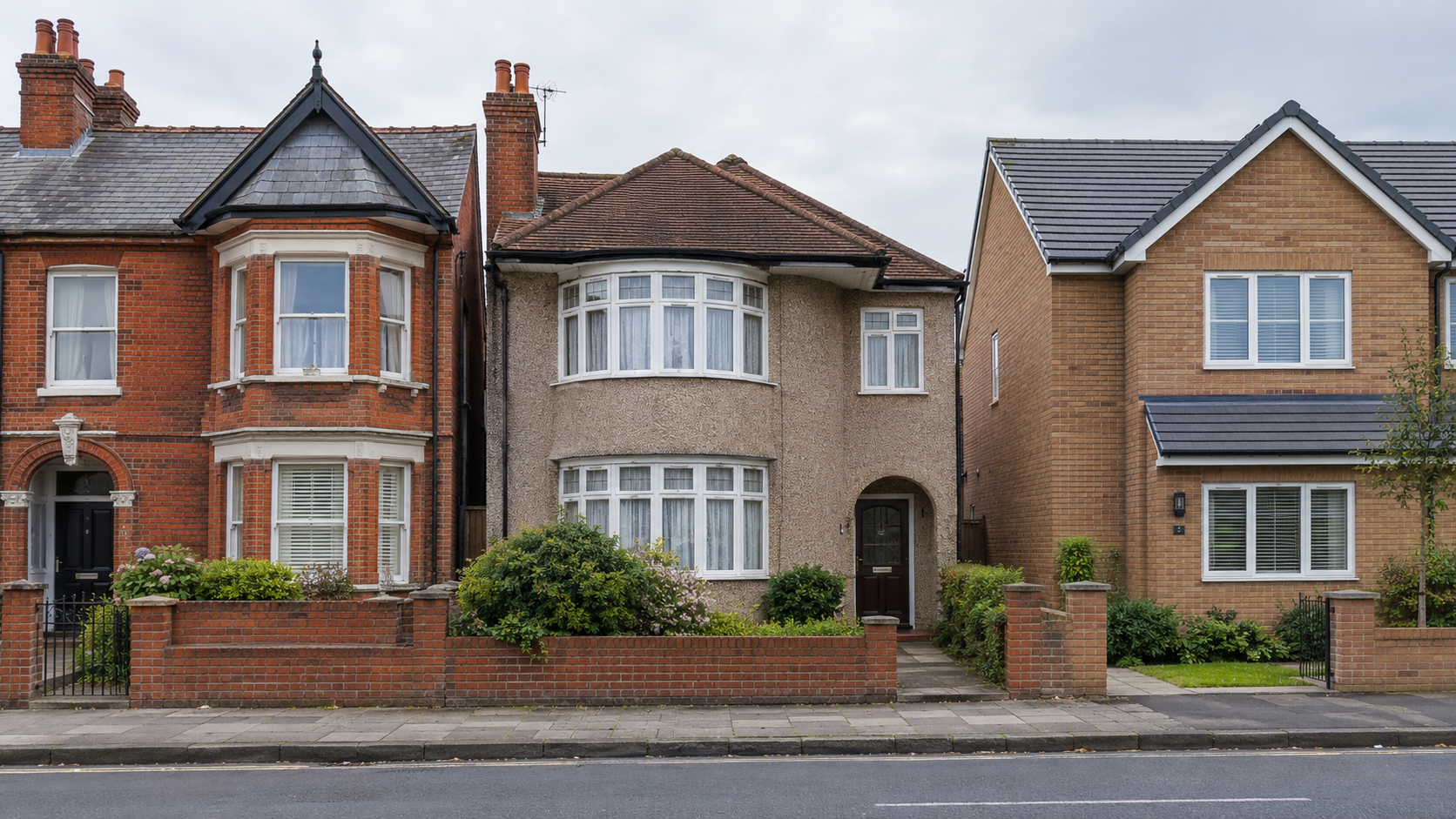
Victorian, inter-war and modern homes sit side by side on many UK streets; each era brings its own construction methods and survey priorities.
Why the age of your house matters in 2026
Knowing the build date is not a trivia exercise. It affects:
Insurance and rebuild cost. Insurers price buildings cover on age, construction type and rebuild value, and older homes with solid walls, slate roofs or timber floors are more expensive to reinstate. Our guide to rebuild cost versus market value explains why that figure matters.
Mortgage lending. Lenders ask for the construction type and approximate age on every valuation. Pre-1919 solid-wall houses, system-built post-war homes and other non-standard constructions can trigger extra conditions, retentions or declined applications. See our piece on defects in homes of unconventional construction.
Hidden hazards. Asbestos-containing materials were used widely from the 1930s until the UK ban in 1999, so a 1960s or 1970s build date puts Artex ceilings, soffits and floor tiles firmly on the checklist; read our Artex and asbestos guide. Lead water pipes are common in homes built before 1970, and early cavity walls with corroding wall ties are a 1920s–1980s issue.
Energy performance. The Office for National Statistics found that property age is the single biggest factor in energy efficiency: only 12% of English homes built before 1900 achieved an EPC rating of C or better, compared with almost all homes built from 2012 onwards (ONS, January 2022).
1. Check your home survey or mortgage valuation report
The quickest answer is often already in your paperwork. RICS Home Survey Level 2 and Level 3 reports, and most lender valuation reports, include an “approximate year of construction” or “age of property” field, because the surveyor needs it to assess construction type and typical defects. If you bought recently, look in your completion pack; if you are buying now, your surveyor will tell you. Our comparison of Level 2 versus Level 3 surveys shows exactly what each report covers.
2. Look up the EPC on the GOV.UK energy certificate register
Every home sold or let in England, Wales and Northern Ireland since 2008 should have an Energy Performance Certificate, and the assessment data behind it includes a construction age band (for example “1930–1949” or “2007 onwards”). Search the Find an energy certificate service by postcode; the certificate page describes the walls, roof and windows “as built”, and the open EPC dataset published by the Ministry of Housing, Communities and Local Government lists the age band for each assessment. Scotland has its own EPC register. This is a free, two-minute check, and it is the method we recommend trying first. Bear in mind the band is the assessor’s best judgement rather than a documented date, so treat it as a strong indicator. For the wider rules, see our guide to EPC certificate requirements.
3. Download the HM Land Registry title register (£7)
HM Land Registry holds the ownership records for registered land in England and Wales, and anyone can download the title register and title plan for £7 each through the Search for property information service. The register does not usually state a build year, but it is still one of the most useful documents you can buy, because it lists:
the date of the lease (for leasehold flats and houses), which for a purpose-built block is often within a year or two of completion;
the date of the first registration and any conveyances, restrictive covenants or easements referred to in historic deeds, many of which carry dates that pre-date or coincide with construction;
the names of the original developer or estate, which you can then trace in local archives.
Pre-registration deeds may still be held by your solicitor or lender, and for a small number of properties registered under the Land Registry Act 1862 the original handwritten volumes survive. If you want to go further into the ownership history, our guide to running an ownership search on a property explains the process step by step.
4. Ask the local authority: planning and building control records
Councils keep planning registers and building control files, and many have digitised applications going back to the 1940s. A search of the planning portal for your address may show the original consent for the estate, later extensions or a change of use. For houses built since the mid-1960s, when national Building Regulations came into force, there may also be a completion certificate or inspection record. Local studies libraries and county record offices hold earlier rate books, electoral registers and street directories that confirm when a house was first occupied.
5. Compare historic Ordnance Survey maps
The National Library of Scotland hosts a free, zoomable archive of historic Ordnance Survey mapping that covers England and Wales as well as Scotland, with editions from the 1840s through to the 1960s. Open maps.nls.uk, find your street on the side-by-side viewer and step through the map editions: the moment your plot changes from field or orchard to a drawn building brackets the construction date, usually to within 10–20 years. Fire insurance plans (Goad maps) held by the British Library do the same job for town centres.
Historic maps, deeds and the Land Registry title register together can date most UK homes to within a decade.
6. Use census returns and the 1939 Register
Census returns from 1841 to 1921 are available online through The National Archives and commercial genealogy sites, and the 1939 Register fills the gap before the 1951 census. If your address appears in one census but not the previous one, you have a ten-year window. Street names and house numbers changed frequently in the Victorian period, so cross-check with the maps in step 5.
7. Check the listed building registers
If your home is listed, its entry will include a date or period of construction, often with the architect and notable alterations. Search the National Heritage List for England, Cadw in Wales, Historic Environment Scotland, or the Department for Communities register in Northern Ireland. Conservation-area appraisals published by councils also date whole streets. Listing brings its own consent rules, which we cover in our guide to what Grade II listing means.
8. Read the building itself: architectural clues
A surveyor dates a house in the first five minutes from its form and materials, and you can learn the same clues. Look for a date stone or plaque on the gable or above the door (common on Victorian, Edwardian and 1930s houses), the bond pattern of the brickwork (Flemish bond usually means solid walls and pre-1920s; stretcher bond indicates a cavity wall), the roof covering (natural slate before the 1920s, concrete tiles after 1945), window types and the height of the ceilings. The table below summarises the main eras.
UK house eras at a glance: dates, features and typical survey findings
Era
Approximate dates
Tell-tale features
Common survey findings
Georgian
1714–1837
Symmetrical facades, tall sash windows, parapets, stucco or soft red brick
Timber decay, lime mortar erosion, movement in bowed walls, inadequate foundations
Victorian
1837–1901
Bay windows, decorative brickwork, slate roofs, high ceilings, lath-and-plaster
Rising and penetrating damp, rotten joist ends, lead pipework, chimney defects
Edwardian
1901–1918
Wider plots, red brick with render or mock timber framing, larger halls, square bays
Early cavity walls, roof spread, original services
Inter-war
1919–1939
Semi-detached pairs, pebbledash, curved bays, hipped roofs, metal Crittall windows
Wall tie corrosion, flat-roof bays, asbestos in later builds
Post-war
1945–1964
Simple brick or system-built, concrete tiles, large windows, prefabs
Non-standard construction (PRC, steel frame), asbestos, poor insulation
Late 20th century
1965–1999
Timber-frame and brick-skin estates, UPVC windows, flat-roof extensions
Cavity insulation problems, flat-roof failure, asbestos until 1999 ban
Modern
2000 onwards
NHBC or similar warranty, open-plan layouts, high EPC bands
Snagging defects, warranty claims, cladding and fire-safety compliance
Can I find out when my house was built by postcode, for free?
Partly. A postcode search of the GOV.UK EPC register is free and gives you the construction age band for every assessed home on your street, and the National Library of Scotland maps are free to browse. Several insurance and property websites also offer “when was my house built” calculators by postcode; these generally draw on the same EPC and Land Registry data, so they are a convenient shortcut but not an independent source. Be wary of sites that charge for “reports” that simply repackage public records you can access directly for free or for £7.
What the house-age data says about UK homes
England has one of the oldest housing stocks in Europe. The English Housing Survey 2024–25 (published 4 December 2025) estimates 25.6 million dwellings in England, and reports that 20% of owner-occupied and 32% of private rented homes were built before 1919, while 29% of social rented homes date from the 1945–1964 rebuilding boom. In practical terms, roughly one in five homes you might buy was constructed before the First World War with solid walls, lime mortar and no damp-proof course, which is exactly why a suitably qualified, accredited surveyor will usually recommend a Level 3 building survey for anything pre-war.
An experienced surveyor can date a house from its brick bond, roof covering and joinery before a single record is opened.
October 2026 update: HM Land Registry consults on fees and open data
On 27 October 2026 HM Land Registry launched two public consultations, both closing on 22 December 2026. The first proposes replacing value-based Scale 2 registration fees (for transfers at nil or under value, and for registering a mortgage) with simple fixed fees; the second, “Future of access to HM Land Registry information”, proposes making mappable ownership datasets for most land in England and Wales free to the public, with detailed title information free for public bodies and public-interest researchers. HMLR notes that all titles are already publicly available but are mostly bought individually as PDFs at £7, and that bulk ownership data already exists for the 16% of titles held by corporate bodies. Information about most ordinary homeowners would stay protected. The official copy fee itself rose from £3 to £7 on 9 December 2024, so if the proposals go ahead, researching a property’s history could become cheaper from 2027. Full details are on GOV.UK.
Which survey should you book once you know the age?
Once you have a build date, matching it to the right level of inspection is straightforward:
Pre-1945 (Georgian, Victorian, Edwardian, inter-war): an RICS Home Survey Level 3 or equivalent full building survey, so that solid walls, timber floors, roof structures and historic alterations are inspected in detail.
1945–1980, especially system-built or non-standard homes: Level 3, with a specific brief covering asbestos, wall ties, PRC or steel-frame construction and flat roofs.
1980 onwards, conventional construction in reasonable condition: a Level 2 (HomeBuyer) survey is usually proportionate, upgraded to Level 3 if the house has been extended or converted.
New-build under warranty: a professional snagging inspection before completion or within the first two years.
Whatever the era, use a suitably qualified, accredited surveyor regulated by a recognised UK body such as RICS, CIOB or RPSA. Current fees are set out in our house survey cost guide.
Why choose Survey Merchant for your house survey?
Dating a house is the easy part; understanding what that age means for the fabric of the building, and what it will cost to put right, is where an experienced surveyor earns their fee. Survey Merchant makes that step simple:
An accredited panel matched to the job. We work with suitably qualified surveyors accredited or regulated by bodies including RICS, CIOB and RPSA, and we match the surveyor’s experience to the age and construction of your property, from Victorian terraces to post-war system builds.
Nationwide UK coverage with local expertise. Surveyors who know the building types, soils and local-authority records in your area.
Transparent, competitive fixed fees. Clear quotes up front, with no hidden extras for older or larger homes.
Fast turnaround. Prompt inspection dates and clearly written reports, so your purchase or remortgage is not held up.
Impartial advice. We do not sell the property, lend on it or insure it, so our only interest is giving you an accurate picture.
End-to-end support. From choosing the right survey level to explaining the findings and helping you renegotiate or plan repairs.
How can I find out when my house was built for free?
Search the GOV.UK Find an energy certificate service by postcode: the EPC assessment records a construction age band for most homes in England, Wales and Northern Ireland. Then browse the National Library of Scotland's free historic Ordnance Survey maps to see when your plot first appears. Your mortgage valuation or home survey report will also state an approximate build year at no extra cost.
Does the Land Registry tell you when a house was built?
Not directly. The £7 HM Land Registry title register shows the current owner, price paid, mortgages, covenants and easements, and for leasehold property the date of the lease. Those dated deeds and leases are strong clues, especially for homes built after 1900, but the build year itself is rarely stated, so combine the register with the EPC age band and historic maps.
Can I find out when my house was built by postcode?
Yes. The EPC register and most online house-age calculators work by postcode and will show the construction age band for each assessed property on your street. Postcode tools are convenient, but they draw on the same public EPC and Land Registry data, so check the original sources before relying on a date for insurance or a survey brief.
Why does the age of my house matter?
Age determines construction type, likely defects and hazards. Pre-1919 homes usually have solid walls, no damp-proof course and lead pipework; 1930s to 1990s homes may contain asbestos; post-war system-built homes can be non-standard construction that lenders restrict. Age also affects buildings insurance, rebuild cost, EPC performance and which level of survey a suitably qualified, accredited surveyor will recommend.
Which survey should I get for an old house?
For a house built before 1945, or any property that is non-standard, extended, converted or visibly in poor condition, an RICS Home Survey Level 3 (full building survey) is the usual recommendation. A conventional home built after 1980 in reasonable order is often suited to a Level 2 HomeBuyer survey. Survey Merchant can match you with a suitably qualified, accredited surveyor for either.
What is changing at HM Land Registry in 2026?
On 27 October 2026 HM Land Registry opened two consultations, closing 22 December 2026, on replacing value-based Scale 2 registration fees with fixed fees and on making land ownership datasets free to the public, with detailed title information free for public bodies and public-interest researchers. Information about ordinary homeowners would remain protected. Official copies currently cost £7 each.