We use cookies to improve your experience on our site, analyze site traffic, and assist in our marketing efforts. By clicking "Accept all," you agree to the storing of cookies on your device. You can choose to "Reject all" non-essential cookies. For more information, please read our Cookie Policy.
Artex Asbestos: 2026 UK Guide to Testing, Risks & Costs
Artex and other textured coatings applied before the 1999 ban may contain chrysotile asbestos. Learn how to test, what HSE rules apply in 2026, what it costs to cover or remove, and how surveys report it.
If you own, rent or are buying an older British home, there is a good chance it has at least one textured ceiling. The question that follows is almost always the same: does this Artex contain asbestos, and what should I do about it? This 2026 guide answers that question properly. It explains when Artex and other textured coatings contained asbestos, how to get a ceiling tested, what the current UK rules say about disturbing or removing it, what it realistically costs, and how a house survey treats suspected asbestos Artex when you are buying.
Key takeaways
Artex and similar textured coatings applied before the mid-1980s commonly contained a small proportion of white (chrysotile) asbestos; anything applied before the UK ban in 1999 should be treated as suspect until tested.
You cannot identify asbestos by eye. The only reliable method is laboratory analysis of a sample, typically £30–£50 per sample at a UKAS-accredited lab, or £200–£250 for a professional sampling visit.
Intact, painted asbestos Artex that is left alone presents a low risk. The danger comes from sanding, drilling, scraping or demolition that releases fibres.
HSE classes most Artex removal as non-licensed work, but large-scale or deteriorating coatings removed by steam or gel become notifiable non-licensed work with extra legal duties.
A RICS Home Survey Level 2 or Level 3 will flag suspected asbestos materials but will not test them; budget for separate sampling before any refurbishment.
Covering (overboarding or skimming) is usually cheaper and safer than removal, with typical costs from around £300 to £2,000 per room depending on the method and whether asbestos is confirmed.
Does Artex contain asbestos?
Artex applied before the mid-1980s very often contains asbestos, usually white chrysotile at a few per cent by weight, added to strengthen the coating. Textured coatings applied up to the 1999 UK ban may also contain it, so the Health and Safety Executive advises treating any pre-2000 textured coating as suspect until a laboratory sample proves otherwise.
“Artex” is actually a brand name, but in Britain it has become shorthand for every swirled, stippled or fan-patterned ceiling finish applied from the 1960s onwards. Other trade names from the same era include Marblecoat, Newtex, Pebblecoat and Wondertex, and imported or leftover stock complicates the picture further. According to the HSE’s own asbestos FAQ, textured decorative coatings “commonly referred to as Artex” are one of the most frequent locations for asbestos in buildings constructed or refurbished before 2000. The asbestos content is low compared with materials such as insulating board or pipe lagging, and the fibres are well bound into the plaster-like matrix, which is why the material is considered lower risk when it is sound and undisturbed. If you are new to the subject, our guide to the different types of asbestos explains how chrysotile compares with the more hazardous blue and brown varieties.
Which years of Artex contained asbestos?
There is no single cut-off date that works for every ceiling, which is exactly why testing matters. The general timeline accepted across the UK asbestos industry is set out below.
Period
Likelihood that textured coating contains asbestos
What to do
Before 1970
Very likely for any original textured finish
Presume asbestos; test before any disturbance
1970 to mid-1980s
Likely; the peak decade for asbestos-containing Artex
Presume asbestos; test before any disturbance
Mid-1980s to 1999
Possible; major brands reformulated but other products and old stock remained in use
Treat as suspect; test if you plan to sand, scrape or remove
2000 onwards
Unlikely; all asbestos use banned in the UK from 1999
Confirm the ceiling has not been re-coated over an older layer
Two complications catch people out. First, many ceilings were re-textured in the 1980s or 1990s directly over an earlier asbestos-containing layer, so a modern-looking surface can hide an older one. Second, the age of the house is not the same as the age of the ceiling. A 1930s semi that was “modernised” in 1975 is a classic example, which is one reason our guide to surveying a 1930s house treats textured ceilings as a standing item on the checklist.
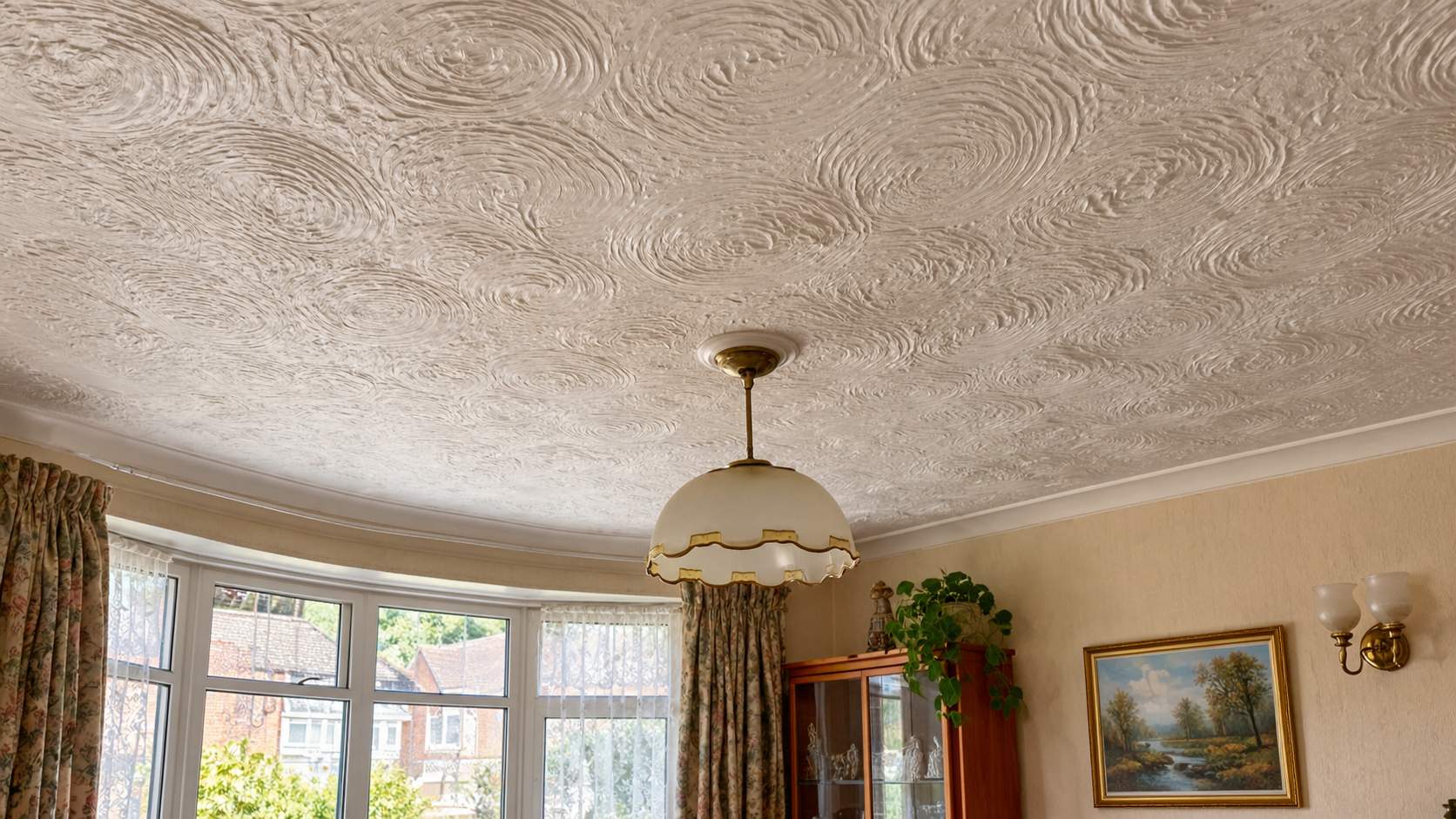
Swirled and stippled Artex ceilings from the 1960s to 1980s are the finishes most likely to contain chrysotile asbestos.
How do I know if my Artex has asbestos in it?
You cannot tell by looking, touching or smelling it. Asbestos fibres are microscopic, and a 1975 ceiling and a 1995 ceiling can be visually identical. There are only two ways to settle the question.
Option 1: a laboratory sample
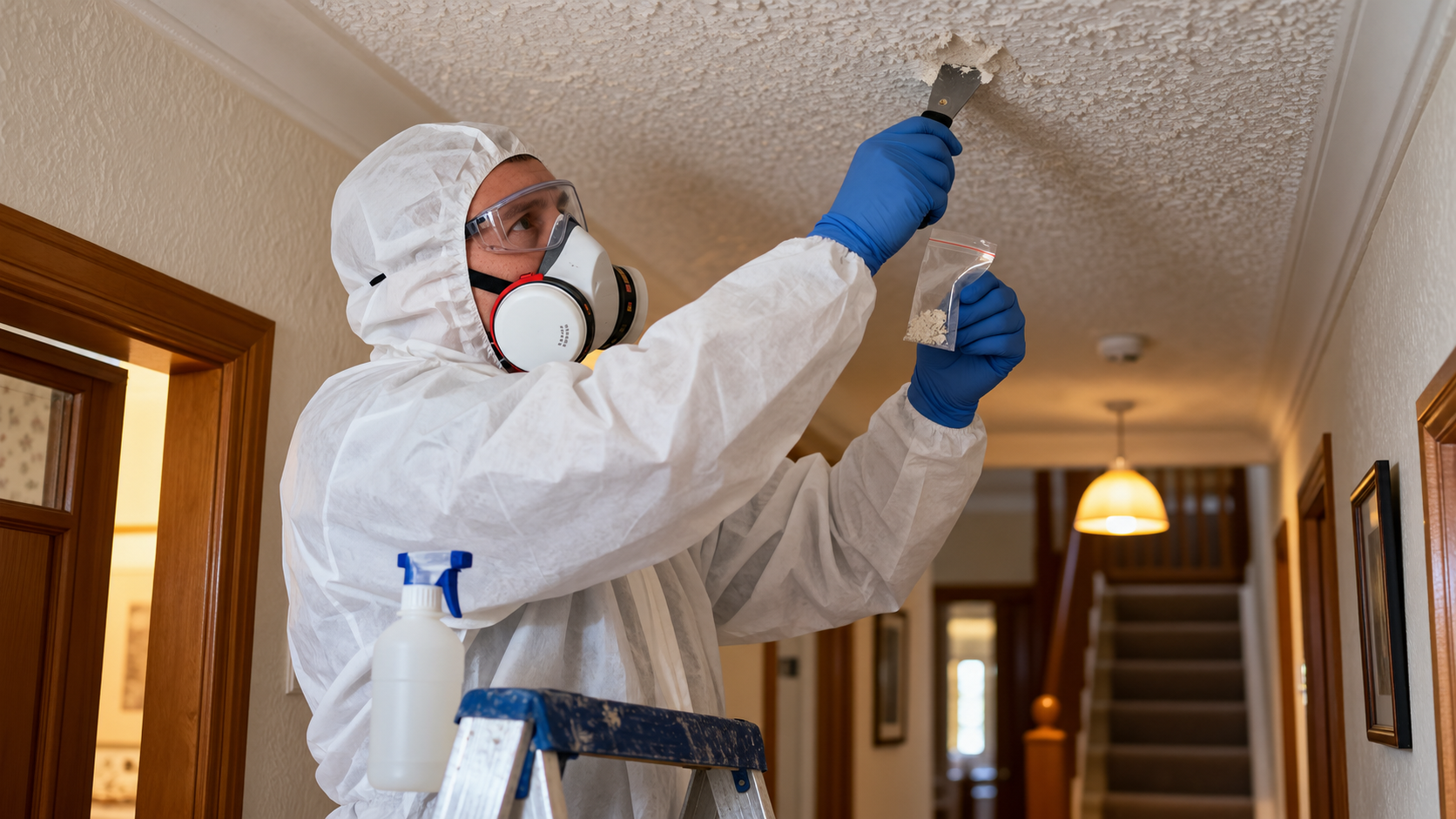
A small piece of the coating, roughly the size of a 50p coin, is sent to a laboratory accredited by UKAS (the United Kingdom Accreditation Service) for polarised light microscopy. The HSE requires asbestos analysts to be UKAS-accredited, and most labs now return results within 48 hours of receiving the sample. Costs in 2026 are modest: postal kits with analysis included are widely advertised from around £30 to £50 per sample, while a professional sampling visit typically costs £200 to £250 for a single room. If you take the sample yourself, follow the HSE’s precautions: wet the area first, wear a disposable FFP3 mask and gloves, use a hand tool rather than anything powered, seal the sample in two bags, and seal the sampled spot with PVA or paint afterwards.
Option 2: an asbestos survey
If you are planning wider works, or the property is pre-2000 and has never been assessed, a management or refurbishment and demolition survey by an asbestos surveyor is the better route. It samples every suspect material, not just the ceiling, and produces a register you can hand to builders. Our UK asbestos survey guide explains the difference between survey types and typical fees, and when to get an asbestos survey sets out the triggers that should prompt one.
Is asbestos in Artex dangerous?
The honest answer is: rarely, provided it is left alone. Chrysotile fibres in Artex are locked into a hard, painted coating, so an intact ceiling releases nothing measurable into the room. The HSE’s advice for householders is that materials in good condition should be left in place and checked occasionally for damage or deterioration. The risk changes completely when the coating is sanded, drilled, scraped dry, broken up during a ceiling collapse, or ripped down during a refurbishment. Those activities can release fibres in concentrations that matter, particularly to the tradesperson doing the work and to anyone else in the house.
The scale of the historic problem is a reminder of why the rules exist. In its April 2026 Global Asbestos Awareness Week campaign, the HSE repeated that asbestos remains the single greatest cause of work-related deaths in Great Britain, with around 5,000 deaths a year, and HSE inspector Rob Gidman noted that it still kills around 20 tradespeople every week because of past exposure (HSE press release, 1 April 2026). The lesson for homeowners is simple: never let anyone sand, scrape or drill into a textured ceiling of unknown age without a test result in hand.
Artex asbestos removal: the 2026 UK rules
The legal framework is the Control of Asbestos Regulations 2012. Regulation 4, the “duty to manage”, applies to non-domestic premises and to the common parts of blocks of flats, not to the inside of a privately owned house. However, Regulations 5 to 24 apply to anyone who employs people to work on asbestos, which means your builder, plasterer or electrician is bound by them the moment they touch your ceiling.
The HSE divides work on textured coatings into three categories, and the distinction matters for cost and compliance:
Non-licensed work. Removing small areas of textured coating using dust-reducing methods, or removing coatings that are not deteriorating, is non-licensed work. The HSE’s free Asbestos Essentials task sheets A26 to A29 cover drilling, inserting screws, removing roughly one square metre of coating, and cleaning up after a collapsed ceiling.
Notifiable non-licensed work (NNLW). According to the HSE’s NNLW guidance, “large-scale removal of textured decorative coatings using steaming or gelling methods” and removing deteriorating Artex with gel or steam will normally be NNLW. The contractor must notify the HSE online before starting, keep health records for each worker, arrange medical examinations and designate the work area.
Licensed work. A licence is not normally needed for Artex itself. It is needed if the coating sits on asbestos insulating board (AIB), which was common in 1960s and 1970s ceilings, soffits and airing cupboards. That is one more reason to have the substrate checked, not just the surface.
Enforcement is real. The HSE’s April 2026 inspection campaign highlighted a site manager who received a suspended prison sentence and a five-year director disqualification for failing to use a licensed contractor, with the companies involved fined a combined £88,300. Homeowners are not usually the target of enforcement, but anyone who knowingly asks an untrained tradesperson to rip down a suspect ceiling is exposing that person, and their own family, to a preventable hazard.
Finally, waste. Removed asbestos Artex is hazardous waste. It must be double-bagged or wrapped in heavy-gauge polythene, labelled, and taken to a licensed disposal site; GOV.UK directs householders to their local council for details of accepted sites, and many councils accept small, properly wrapped quantities at household waste recycling centres by appointment.
A laboratory sample is the only reliable way to confirm whether a textured coating contains asbestos.
Remove, cover or leave it? Your options compared
For most homeowners the sensible order of preference is: leave it, cover it, and only then remove it. Removal is the most expensive and most hazardous option, and it is often unnecessary. Here is how the options compare in 2026, using the ranges published in the most recent UK trade price guides (MyJobQuote, updated 14 September 2026).
Option
Typical cost per room (asbestos confirmed)
Typical cost per room (asbestos-free)
Time
Best for
Leave in place and paint
£80–£200 (decorating only)
£80–£200
Half a day
Sound, undamaged ceilings you can live with
Seal and coat
£350–£1,100
£300–£500
1–3 days
Minor surface damage; low disturbance
Plaster skim over
£300–£1,550
£250–£700
1–5 days
Firm Artex with shallow texture; smooth finish wanted
Overboard with plasterboard and skim
£450–£2,000
£400–£1,000
1–5 days
Heavy texture, cracks or loose areas; encapsulates the asbestos completely
Full removal (steam or gel, NNLW where applicable)
£300–£1,750 plus disposal
£250–£750
1–5 days
Structural work, downlights, or ceilings that must come down anyway
Laboratory sample / sampling visit
£30–£50 per sample; £200–£250 for a visit
Same
48 hours for results
Everyone, before any of the above
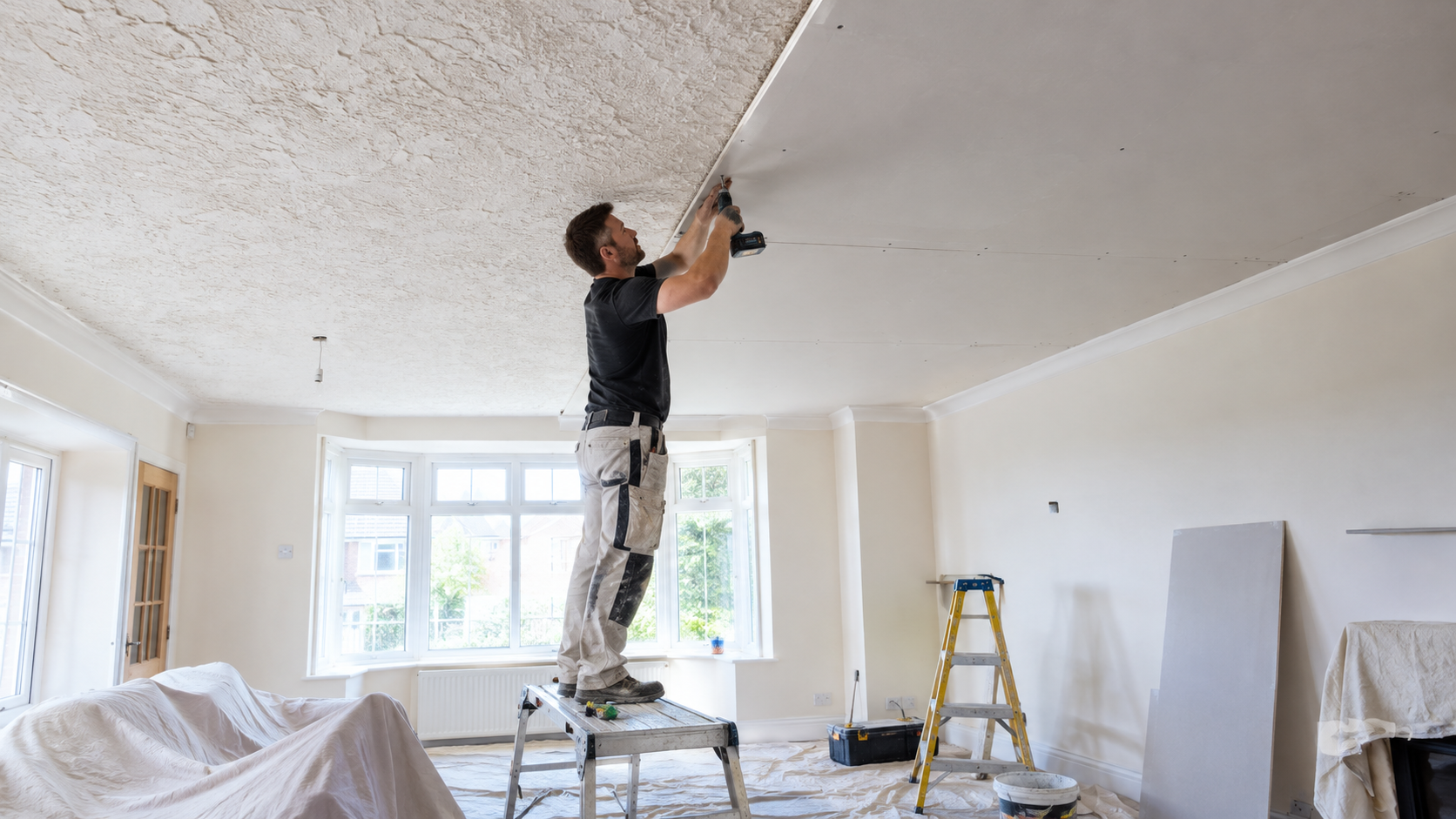
Overboarding deserves special mention. Fixing 9.5mm or 12.5mm plasterboard through the Artex into the joists and skimming the new surface encapsulates the asbestos permanently, gives a flat modern ceiling, and involves far less disturbance than removal. The screws do pass through the coating, so the HSE’s A27 task sheet precautions (wetting, hand tools where possible, shadow vacuuming with a Class H vacuum) still apply. Skimming directly over Artex is cheaper but plasterers are divided on it: the bond can fail where the texture is deep or the original coating is chalky, and any later crack or sag re-exposes the problem. Sanding asbestos Artex is never acceptable under any circumstances.
Buying a house with Artex ceilings: what your survey will and will not tell you
This is where most buyers are surprised. A RICS Home Survey, whether Level 2 or Level 3, is a visual inspection. The RICS description of the Level 2 service states plainly that “the surveyor does not carry out an asbestos inspection”, and the surveyor does not take samples or carry out specialist tests. What a competent surveyor will do is identify textured coatings, note the probable age of the property and its refurbishments, and “properly emphasise the suspected presence of asbestos containing materials” in the report, usually with a condition rating 2 or 3 and a recommendation for further investigation before any works.
In practice, that means you should expect to see wording such as “textured coatings to ceilings may contain asbestos; a specialist should test before disturbance” in almost any survey of a pre-2000 home. Treat it as a prompt, not a panic. The sensible next steps are to decide whether you intend to disturb the ceilings (downlights, loft conversions, knocking through and rewiring all count), commission sampling if you do, and factor realistic encapsulation or removal costs into your offer. Our article on negotiating the house price after your survey explains how to present that kind of cost evidence to a seller, and what to do when asbestos appears in a building survey report walks through the process in more detail. If you are still choosing a survey level, the Level 2 vs Level 3 comparison shows where the extra depth of a Level 3 inspection pays for itself on older, altered homes.
Mortgage lenders very rarely refuse to lend because of asbestos Artex. It is so common in the UK housing stock that it is simply priced in. What can cause valuation or insurance problems is damaged, debris-strewn or partially removed Artex, which suggests uncontrolled disturbance has already happened.
Overboarding with plasterboard encapsulates asbestos Artex permanently and is usually cheaper and safer than removal.
What changed in 2026?
Two developments this year are worth knowing about. On 18 May 2026 the HSE published its review of the Great Britain asbestos control limit and decided to keep it at 0.1 fibres per millilitre as a four-hour time-weighted average, rather than following the European Union’s cut to a lower limit. The HSE concluded that lowering the figure would push most asbestos work, including routine textured-coating removal, into the licensed regime without a matching reduction in risk, and that training, competence and site discipline do more to protect people than a change to the number. The EU has scheduled its own further review for 2029, so this debate is not over.
Separately, the HSE’s April 2026 unannounced inspection programme found three recurring failings among dutyholders: no asbestos management plan, inadequate training, and weak procedures for work that might disturb known or presumed asbestos. Although the duty to manage does not apply inside private homes, the same three failings describe exactly how most domestic Artex incidents happen, and landlords of houses in multiple occupation and blocks of flats are directly covered.
Choosing the right professional
Asbestos work attracts more than its share of unqualified operators, so credentials matter. For sampling and surveys, look for a surveyor holding a BOHS P402 (or equivalent) qualification and a laboratory with current UKAS accreditation. For removal, check whether the job is non-licensed, notifiable or licensed, and ask to see the contractor’s asbestos training certificates and, where relevant, the NNLW notification. For the property survey that starts the whole process, use a suitably qualified, accredited surveyor. Survey Merchant’s panel includes surveyors regulated or accredited by bodies such as RICS, CIOB and RPSA, matched to the age and type of the property, so a 1960s bungalow with textured ceilings throughout is inspected by someone who sees that construction every week.
Why choose Survey Merchant for your Artex and asbestos concerns?
Suspected asbestos is one of the most common findings in UK home surveys, and how it is reported makes a real difference to your budget and your negotiating position. Here is why buyers and homeowners choose Survey Merchant:
An accredited panel matched to the job. We work with suitably qualified surveyors accredited by RICS, CIOB and RPSA, among others, and we match the surveyor to the property type and era rather than sending whoever is nearest.
Nationwide UK coverage with local knowledge. From 1930s London suburbs to 1970s estates in the Midlands and the North, our surveyors know the regional construction habits that determine where asbestos is likely to be hiding.
Clear, plain-English reporting. Our reports tell you what the textured coating is likely to be, whether it is in a condition that matters, and exactly what to do next, rather than burying the issue in boilerplate.
Transparent, competitive fixed fees. You receive a fixed quote before you commit, with no hidden extras.
Fast turnaround. We understand that survey findings sit on the critical path of a purchase, and we prioritise prompt booking and reporting.
Impartial advice and end-to-end support. We do not sell removal services, so our advice on whether to leave, cover or remove is independent, and we can point you to accredited asbestos specialists where testing is needed.
No. Artex and similar textured coatings applied before the mid-1980s frequently contain a small proportion of white (chrysotile) asbestos, and any coating applied before the UK ban in 1999 should be treated as suspect. Coatings applied from 2000 onwards should be asbestos-free, but a newer surface can hide an older layer beneath, so testing is the only way to be sure.
How can I tell if my Artex ceiling has asbestos in it?
You cannot tell by looking. The only reliable method is to have a small sample analysed by a UKAS-accredited laboratory, which typically costs £30 to £50 per sample by post or £200 to £250 for a professional sampling visit, with results usually within 48 hours. If you plan wider works, a refurbishment and demolition asbestos survey is the safer option.
Is it safe to live with asbestos Artex?
Generally yes. Intact, painted Artex locks the fibres into a hard coating and releases nothing measurable. HSE advice is to leave sound materials in place and check them occasionally. The risk arises when the coating is sanded, drilled, scraped dry or broken up, so never disturb a textured ceiling of unknown age without a test result.
Do I need a licensed contractor to remove asbestos Artex?
Usually not. HSE classes small-scale removal with dust-reducing methods as non-licensed work, while large-scale or deteriorating coatings removed by steam or gel are notifiable non-licensed work, requiring online notification to HSE, health records and medicals for workers. A licence is needed only where the coating sits on asbestos insulating board.
How much does it cost to remove or cover Artex with asbestos?
Based on 2026 UK trade price guides, overboarding a room costs roughly £450 to £2,000 where asbestos is confirmed, skimming £300 to £1,550, and full removal £300 to £1,750 plus hazardous-waste disposal. Testing first costs £30 to £50 per sample. Covering is usually cheaper and safer than removal.
Will a house survey tell me if the Artex contains asbestos?
A RICS Home Survey Level 2 or Level 3 is a visual inspection; the surveyor does not take samples or carry out an asbestos inspection. A competent surveyor will identify textured coatings in a pre-2000 home, flag the suspected presence of asbestos and recommend testing before any disturbance, which you can use to negotiate or budget.