Leasehold
Jul 16, 2026
Best Types of Property Surveys for Different Home Ages
Compare RICS Level 1–3 and snagging surveys by property age, with costs, scope and advice on when to upgrade for modern, mid

When buying a home, the right property survey depends on the property's age and condition. Here's what you need to know:
Surveys can prevent unexpected repair costs and even help renegotiate prices - 10% of buyers have successfully done so. Always choose an RICS-accredited surveyor, and share any specific concerns for a tailored inspection.
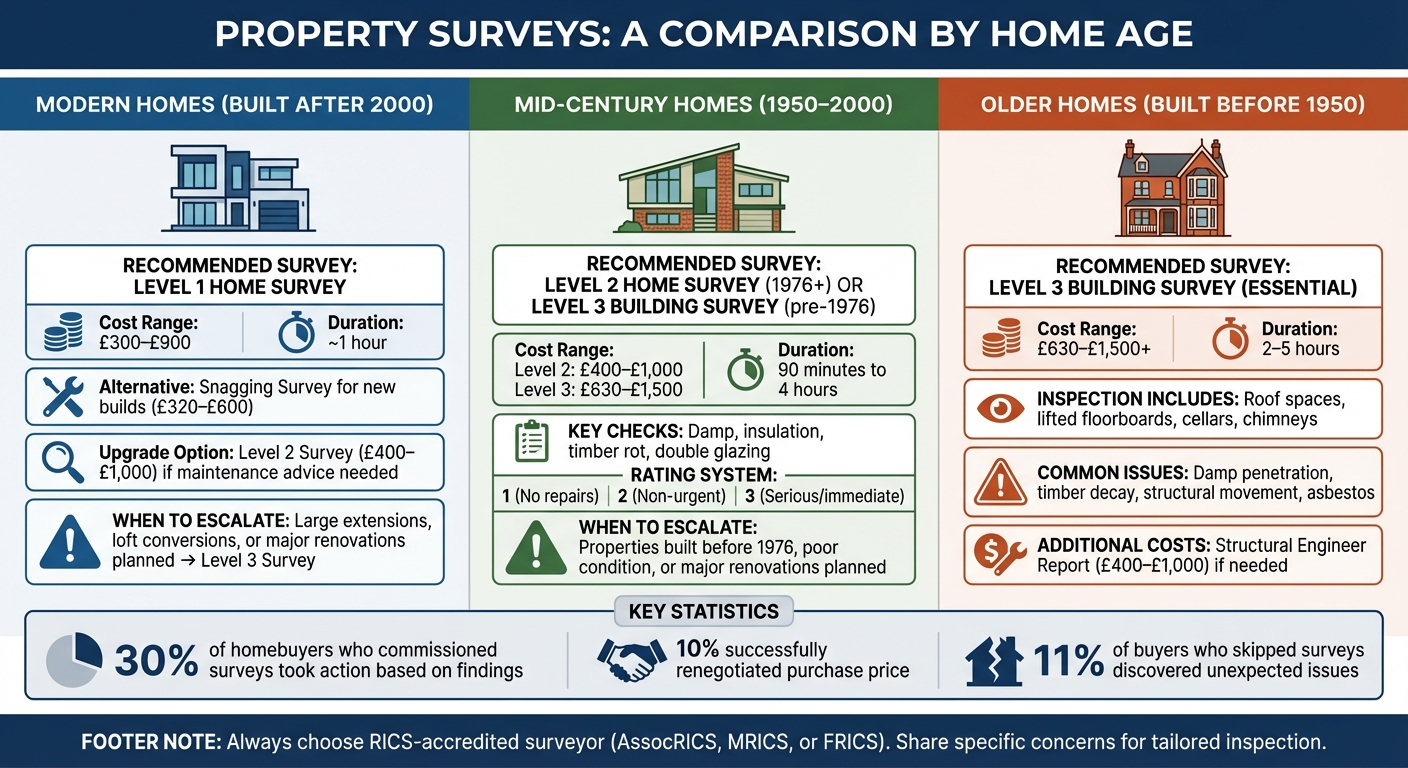
Property Survey Types by Home Age: Costs and Recommendations Guide
For homes built after 2000, the RICS Level 1 Home Survey (previously called the Condition Report) is a great option. This survey is suited to modern properties constructed with standard materials and in good condition [2][1].
"Choose an RICS Level 1 Home Survey if you're buying a conventional house, flat or bungalow built from common building materials and in good condition." – RICS [2]
If you're purchasing a brand-new build, a Snagging Survey might be more appropriate. This survey focuses on identifying minor issues, such as uneven plasterwork or windows that stick, along with small construction defects that developers should address under warranty [3][1]. Alternatively, the RICS Level 2 Home Survey is a solid choice for those seeking maintenance advice alongside a condition check [3][1].
The Level 1 survey provides a visual, non-invasive assessment of the building's condition, using a straightforward "traffic light" rating system. Surveyors inspect accessible areas without moving furniture or lifting floorboards. While the report flags urgent issues, it doesn't include repair advice or a valuation [3][4]. The inspection itself typically takes about an hour to complete [3].
Expect to pay between £300 and £900 for a RICS Level 1 Home Survey [3][7][8]. If you opt for a Level 2 survey, prices increase slightly, ranging from £400 to £1,000 [3][7]. For new builds, a Snagging Survey typically costs £320 to £600 [3][1].
Sometimes, even modern properties require a more detailed inspection. If the home has undergone significant structural changes, such as large extensions, loft conversions, or if major renovations are planned, upgrading to a Level 3 Building Survey is advisable [3][2][4]. This ensures any structural complexities or additions are thoroughly evaluated before you commit [2][5].
This guidance ensures that newer properties are assessed correctly before moving on to recommendations for older homes.
For mid-century homes, the choice of survey depends on their construction era and condition. Properties built from 1976 onwards are generally suited to a RICS Level 2 Home Survey, while those constructed before 1976 typically require the more detailed Level 3 Building Survey. This is because older homes are more likely to have structural wear or hidden defects [2][3].
"Level 3 is a full Building Survey, usually recommended for older properties, or those that have had extensive renovations." – Lee Hatwell, Director, Munday & Cramer [6]
If the property has undergone significant changes, like a loft conversion or an extension, or if it features non-standard construction methods, a Level 3 survey is recommended regardless of its age [3][4][5]. This ensures the assessment is thorough and addresses any complexities.
The Level 2 survey focuses on a visual inspection of key areas, including walls, ceilings, roofs, gutters, and any permanent outbuildings [9]. Surveyors will check for issues such as damp, assess insulation and damp-proofing, inspect timber for signs of rot or woodworm, and confirm that windows meet double glazing standards [9]. The findings are presented using a three-point rating system:
These inspections usually take between 90 minutes and four hours, depending on the property's size and complexity [3].
The cost of a survey varies based on its type and the property’s specifics:
A Level 3 survey is advisable for properties built before 1976, those in poor condition, or if you’re planning major renovations [2]. If a Level 2 survey uncovers serious issues (Rating 3 defects) such as suspected subsidence, significant damp, or compromised roof integrity, it’s wise to seek specialist quotes before proceeding [6]. Additionally, if certain areas are flagged as inaccessible, consider escalating to ensure no critical detail is overlooked [2]. This approach aligns the survey with the property's specific needs and any planned works.
For homes built before 1950, a more thorough evaluation is essential. The RICS Level 3 Home Survey (previously called a Full Structural Survey or Building Survey) is the most suitable choice. Older properties often conceal structural issues, and this survey involves a detailed, hands-on inspection. Surveyors will check roof spaces, lift floorboards, and examine cellars and chimneys to uncover hidden problems.
"Choose an RICS Level 3 Home Survey if you're dealing with a large, older or run-down property, a building that is unusual or altered, or if you're planning major works." – RICS Consumer Guide
This type of survey doesn’t just identify issues; it also provides a roadmap for repairs, including timelines and potential risks of delaying necessary work.
A Level 3 survey dives deeper than surface-level checks. Surveyors will inspect the roof space, lift loose floor coverings to examine sub-floors, test window functionality, and observe drainage systems in operation. For pre-1950 homes, they pay special attention to moisture, as traditional building materials handle dampness differently from modern materials.
The inspection usually takes between two and five hours, though it can last longer for more intricate properties. Common issues flagged include damp penetration, timber decay (like woodworm), structural movement, and the condition of load-bearing elements. Surveyors also identify any non-standard or hazardous materials, such as asbestos.
"The Level 3 survey will include everything you would get in a RICS Home Survey Level 2, plus it will describe the identifiable risk and causes of potential or hidden defects in areas not inspected." – Esther Shaw, Money & Property Journalist
The cost of a RICS Level 3 Building Survey generally falls between £630 and £1,500, depending on the property's size, location, and complexity. For larger or particularly intricate older homes, the price may go beyond this range.
If specific issues like foundation movement or roof damage are uncovered, you might need a Structural Engineer's Report. This additional service typically costs between £400 and £1,000. Interestingly, nearly 30% of homebuyers who had a survey in 2024 acted on the findings, with 10% successfully renegotiating the purchase price [3].
If your Level 3 survey contains numerous recommendations for "further investigations", it could indicate that the surveyor lacks the specialised expertise your property requires. In such cases, consider hiring a surveyor with experience in heritage features or unconventional construction methods.
"If the property is more than, say, 80–90 years old, is likely to need some repair work, has been extended, and you're looking for a more detailed report that explores the defects we identify and their prognosis, then a Level 3 survey is likely to be more appropriate." – Chris Bloor MRICS, Director, CJ Bloor Property Consultants
When arranging the survey, share any specific concerns - like visible cracks or damp areas - with the surveyor so they can focus on those issues. You can also request the report to include estimated repair costs and timelines, which can be a valuable tool during price negotiations. Tailoring the survey to match your property's age and condition ensures you’re well-prepared for the next steps.
Let’s break down the key benefits and drawbacks of the various property survey types, especially when considering different property ages and complexities.
Each survey type has its own balance of cost, time, and depth. Level 1 surveys are the most basic option, costing between £300 and £900 and taking roughly an hour to complete. While they’re quick and budget-friendly, they lack repair advice and rely on a simple "traffic light" system to highlight issues. This makes them less suitable for older or more intricate properties, where deeper insights are often necessary [3].
Level 2 surveys sit comfortably in the middle, offering more detail at a cost of £400 to £1,000. These inspections usually take three to four hours and include maintenance advice, along with an optional valuation. They’re a popular choice for homes built in the mid-20th century. However, since they don’t involve intrusive methods, problems like sub-floor rot or hidden damp may go unnoticed [3].
At the top end, Level 3 surveys provide the most thorough inspection, ideal for complex or older properties. They’re the most expensive, ranging from £630 to over £1,500, but their detailed approach includes checking roof spaces, lifting floorboards, and examining cellars - areas often skipped in less detailed surveys. The downside? They not only cost more but also take longer, with reports sometimes requiring up to 10 days for delivery. Still, their findings can be impactful: roughly 30% of homebuyers who commissioned a survey acted on the results, and about 10% successfully renegotiated the purchase price [3].
| Survey Level | Primary Advantages | Primary Disadvantages |
|---|---|---|
| Level 1 | Affordable (£300–£900); quick (~1 hour) | No repair advice; limited detail; no valuation |
| Level 2 | Moderate cost (£400–£1,000); includes maintenance advice; optional valuation | Non-intrusive (hidden issues may remain); not ideal for complex properties |
| Level 3 | Thorough inspections; identifies hidden issues; includes repair costs and timelines | Expensive (£630–£1,500+); longer process and report delivery |
For new builds, Snagging Surveys are another option, costing between £300 and £600. These focus on cosmetic defects but may overlook structural issues unless specifically requested. By weighing these factors, you can choose a survey that aligns with your property’s requirements and your budget.
Choosing the right survey depends on your home's age and condition. For modern homes built after 2000, a Level 1 survey usually suffices. Mid-century properties from 1950 to 2000 are better suited to a Level 2 report, while older or heavily altered homes (pre-1950) often require a more detailed Level 3 survey to identify potential hidden problems.
Recent statistics highlight the importance of surveys: 30% of homebuyers who commissioned surveys took action based on the findings. Among them, 10% managed to renegotiate the purchase price. On the other hand, 11% of buyers who skipped a survey later uncovered issues they hadn't anticipated [3]. These numbers make it clear - a survey is a smart way to protect your financial investment.
"A home survey provides a potential purchaser or existing homeowner with a 'health check' of a property." – Anthony Parkinson, Senior Specialist for Property Standards, RICS [6]
To ensure a thorough inspection, check that your surveyor is RICS-accredited (AssocRICS, MRICS, or FRICS) and carries professional indemnity insurance [2]. Share any specific concerns, like suspected damp, roof problems, or past renovations, so they can focus on these areas during their evaluation.
When selecting a surveyor, it’s crucial to confirm they are qualified and registered with a recognised body like the Royal Institution of Chartered Surveyors (RICS). Their expertise will help you choose the right survey type for your property, considering factors like its age, condition, and any particular concerns you might have.
For older or distinctive properties, a Building Survey (Level 3) is often recommended. This type of survey offers a detailed analysis of structural issues and highlights potential repair needs. On the other hand, newer and well-maintained homes might only require a Condition Report or a HomeBuyer Report, which are less comprehensive but still provide useful insights into the property’s condition.
Additionally, it’s wise to choose a surveyor with experience in properties similar to yours. This ensures they can spot issues that are specific to the property’s age, such as damp, subsidence, or outdated electrical systems. By hiring a professional with the right knowledge and background, you’ll gain a thorough and tailored evaluation of your home.
A property survey can greatly influence the amount you pay for a home by identifying potential problems that could affect its value. For instance, it might highlight structural issues, damp, or hidden defects that could lead to expensive repairs. Armed with this information, you could negotiate a lower purchase price to account for these costs, potentially saving thousands of pounds.
The survey type you select - whether it’s a basic Condition Report, a HomeBuyer Report, or a more detailed Building Survey - is crucial. A more thorough survey offers a clearer picture of the property's condition, helping you make an informed decision or renegotiate the price if needed. On the flip side, if no major issues are uncovered, the survey can give you confidence that the asking price is reasonable. In essence, a property survey ensures you're paying a fair price based on the home's true condition, while also helping you avoid unexpected financial surprises down the line.
If your home is on the older side, there are some tell-tale signs that might suggest it’s time for a thorough property survey. Keep an eye out for visible issues such as cracks in the walls or ceilings, damp patches, mould, or evidence of past repairs that may not have been done correctly. Older homes often come with hidden challenges too, like timber decay, subsidence, or outdated electrical and plumbing systems.
For these types of properties, a Building Survey (Level 3) is usually the most suitable option. This survey offers a detailed inspection of the property, identifying significant problems and providing professional advice on repairs or renovations that might be required.
To sum up, if your home has visible wear and tear, a history of repairs, or you suspect there could be hidden issues, a comprehensive survey can help uncover potential problems and ensure you feel confident in your investment.
Survey Merchant provides vetted RICS surveyors across 100+ UK locations at fixed fees:
→ Level 2 Home Survey (HomeBuyer Report)
→ Level 3 Building Survey (full structural survey)
→ RICS Red Book property valuations
→ Party wall surveyors — notices, awards & schedules of condition
→ Expert witness surveyors — CPR Part 35 reports for property disputes