We use cookies to improve your experience on our site, analyze site traffic, and assist in our marketing efforts. By clicking "Accept all," you agree to the storing of cookies on your device. You can choose to "Reject all" non-essential cookies. For more information, please read our Cookie Policy.
A complete 2026 guide to roof replacement cost in the UK: prices by house type and material, scaffolding and hidden extras, Building Regulations, planning and bat rules, and how an accredited surveyor helps you repair, replace or negotiate.
Knowing the realistic roof replacement cost before you commit is one of the most valuable pieces of information a UK homeowner or buyer can have. A full re-roof is usually the single most expensive maintenance job a house will ever need, and quotes vary wildly depending on the material you choose, where you live and what the roofer finds once the old covering comes off. This 2026 guide sets out current UK prices by house type and material, the hidden extras that catch people out, the Building Regulations and planning rules you must follow, and how a survey from a suitably qualified, accredited surveyor can stop you overpaying or buying a property with a roof that is about to fail.
Key takeaways
In 2026 a full pitched roof replacement on a typical UK home costs around £5,500 to £18,000, with a three-bed semi usually landing between £6,500 and £15,000.
Installed prices run from roughly £70 to £130 per square metre for concrete or clay tiles and £90 to £140 per square metre for natural slate; flat roofs are cheaper, at about £2,800 to £7,500.
Scaffolding, skip hire, timber repairs, insulation upgrades and chimney or flashing work can add £2,000 to £6,000 on top of the headline figure.
Replacing 50% or more of a roof covering is a “thermal element” renovation under Part L of the Building Regulations, so insulation usually has to be upgraded and the work must be signed off by building control or a competent person scheme.
Material prices for repair and maintenance work were 5.7% higher in June 2026 than a year earlier, according to Government statistics, so 2024 and 2025 quotes are now out of date.
A Level 3 building survey or specialist roof survey from an accredited surveyor costs a few hundred pounds and can be used to negotiate thousands off a purchase price when a roof is near the end of its life.
How much does a roof replacement cost in the UK in 2026?
The average roof replacement cost in the UK in 2026 is around £7,000 to £12,000 for a typical three-bed semi-detached house, with smaller terraces from about £5,500 and large detached homes reaching £18,000 or more. Installed costs generally fall between £70 and £140 per square metre depending on the roofing material, access and the condition of the roof timbers.
These figures come from comparing several 2026 trade price guides, including BookaBuilderUK, Fix My Roof and MyBuilder. They are national averages, so expect to pay 15–30% more in London and the South East and a little less in the North, Wales and Scotland.
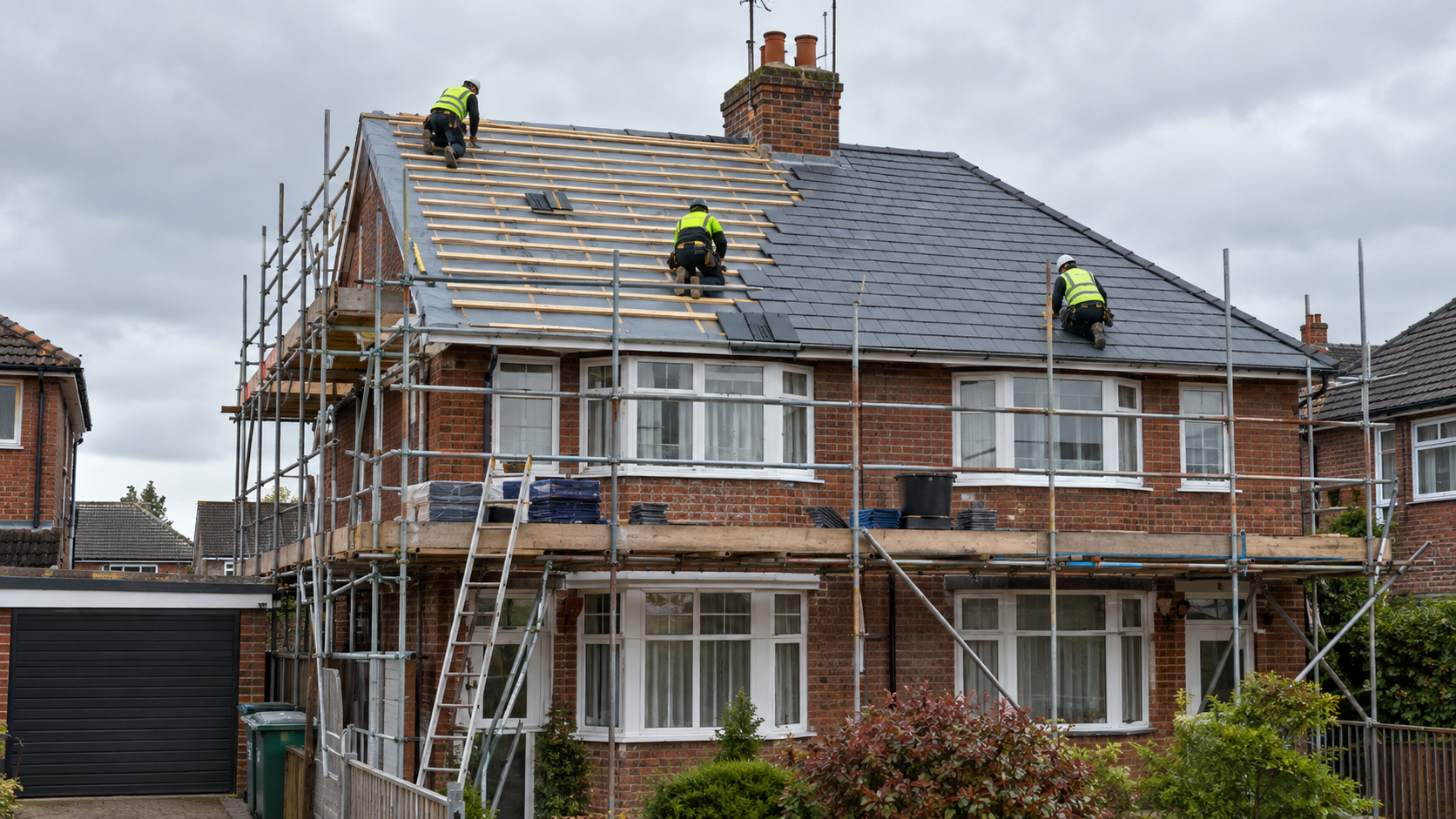
A full re-roof involves stripping the old covering, checking the timbers, fitting new membrane and battens, then laying the new tiles or slates.
Roof replacement cost by house type
Roof area is the biggest single driver of price, so house type is the quickest way to estimate a budget. The table below gives typical 2026 ranges for a full strip-and-replace in concrete or clay tiles, including labour, scaffolding and waste removal.
Property type
Typical roof area
Typical cost (2026)
Typical duration
Two-bed terraced house
60–80 m²
£5,500 – £9,000
2–4 days
Three-bed semi-detached
70–100 m²
£6,500 – £15,000
3–6 days
Four-bed detached
100–150 m²
£9,000 – £18,000+
5–10 days
Bungalow
80–120 m²
£5,500 – £11,000
3–6 days
Flat roof (extension or garage)
15–40 m²
£2,800 – £7,500
1–3 days
Partial re-roof (one slope or a repair section)
Varies
£1,500 – £4,500
1–3 days
Bungalows have a large roof relative to their floor area, which is why they often cost as much as a two-storey semi. Hipped roofs, which slope on all four sides, usually cost 10–20% more than simple gable roofs because they need more cutting, more hip tiles and more lead or dry-fix detailing.
New roof cost per square metre by material
Once you know the roof area, the material decides most of the rest. Natural slate and handmade clay cost the most up front but last the longest; concrete interlocking tiles are the budget option and still give 40–60 years of service.
Roof covering
Installed cost per m² (2026)
Cost for a 90 m² roof
Expected lifespan
Concrete interlocking tiles
£65 – £90
£5,900 – £8,100
40–60 years
Clay plain or pantiles
£75 – £105
£6,800 – £9,500
60–100 years
Natural slate (Welsh or Spanish)
£90 – £140
£8,100 – £12,600
80–120+ years
Composite or fibre-cement slate
£60 – £90
£5,400 – £8,100
40–60 years
EPDM rubber (flat roof)
£45 – £100
n/a
25–50 years
GRP fibreglass (flat roof)
£50 – £80
n/a
20–40 years
Torch-on felt (flat roof)
£40 – £65
n/a
10–20 years
Materials typically account for 25–55% of the total and labour for 40–50%, with roofers charging around £180–£250 per day in 2026. If you are weighing a flat roof option, our guide to mineral felt roofs explains why the cheapest covering is often the most expensive over 30 years.
What is included in a roof replacement quote?
A proper full re-roof quote should itemise the following. If any are missing, ask why.
Strip-off and disposal of the old covering, battens and underlay (skip hire £200–£600).
Scaffolding to the working elevations (£800–£1,500 front and back; £1,500–£3,000+ for a full wrap or a tall detached house).
Breathable membrane (£5–£10 per m²) and treated timber battens (£5–£8 per m²).
New tiles or slates, ridge and hip tiles, verge and eaves details, usually dry-fixed to current standards.
Lead or lead-alternative flashings to chimneys, abutments and valleys (£250–£800).
Ventilation at eaves and ridge, which is a Building Regulations requirement in most re-roofs.
Insulation upgrade where required by Part L (£400–£1,500).
Making good, waste removal and a written guarantee.
Hidden costs to budget for
The quote is based on what the roofer can see. Once the tiles are off, rotten rafters, failed wall plates, woodworm or a sagging purlin can add £500–£3,000. Chimney repointing or rebuilding adds £300–£1,500, a new roof window £500–£1,200 each, and difficult access (narrow streets, pavement licences, conservatories below the eaves) can push scaffolding up by £500–£2,000. A pre-works inspection reduces these surprises: if the chimney is already a concern, read our guide to chimney stack repairs.
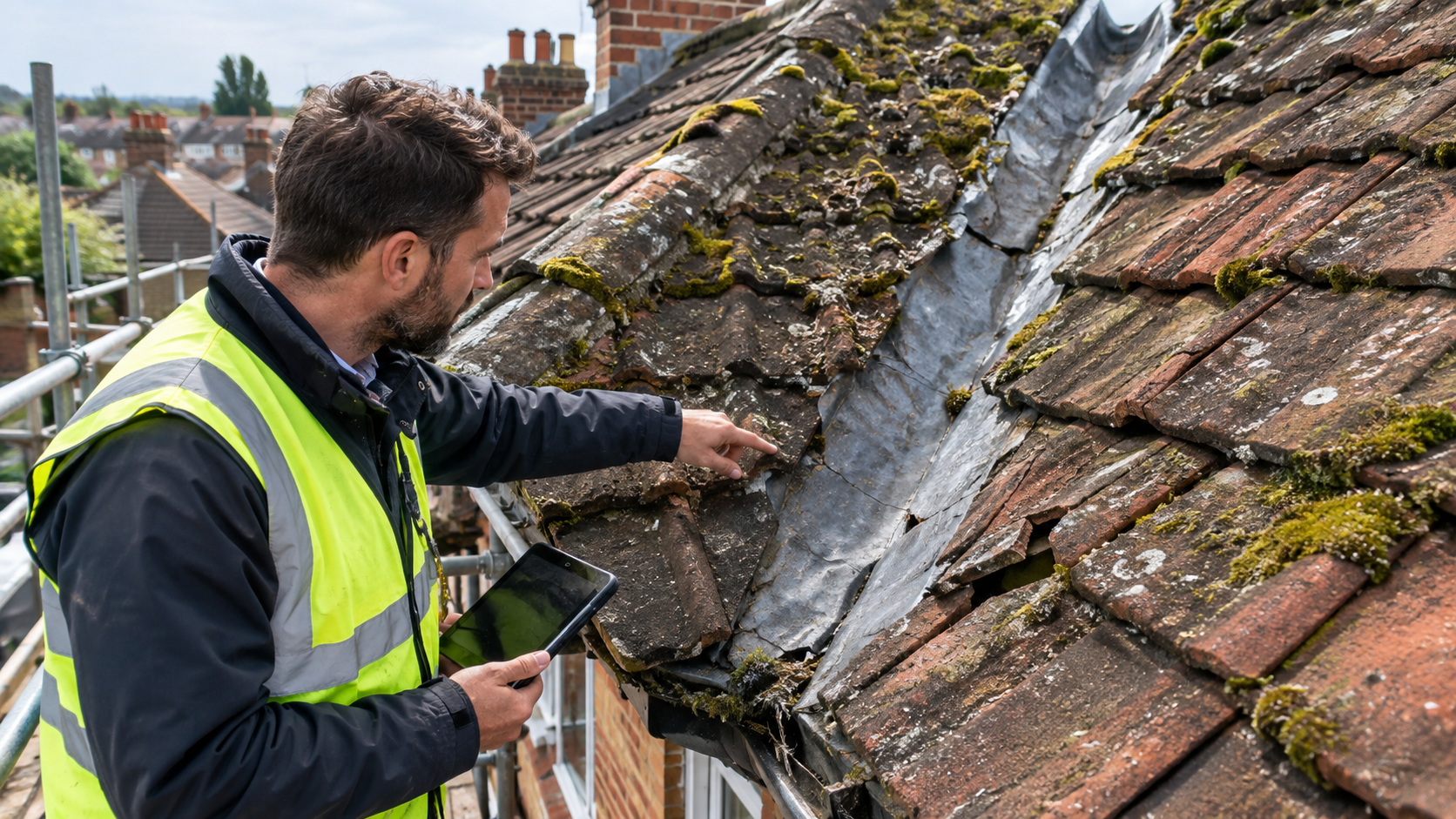
A close inspection of tiles, valleys and flashings tells you whether you need a repair, a partial re-roof or a full replacement.
What affects roof replacement cost the most?
Size and pitch: steeper roofs are slower and need more edge protection; every extra 10 m² adds roughly £700–£1,400.
Complexity: valleys, dormers, hips, chimneys and roof windows all add cutting, flashing and labour time.
Material choice: natural slate can cost double the price of concrete tiles for the same roof.
Location: London and the South East carry a 15–30% premium over the national average.
Timber condition: older homes often need batten, rafter or wall-plate repairs that cannot be priced until the roof is open.
Season and demand: roofers are busiest from spring to early autumn; winter bookings can be 5–15% cheaper, but weather delays are more likely.
Heritage constraints: listed buildings and conservation areas may require natural slate or handmade clay, adding 20–40% to material costs.
Roof replacement cost in 2026: what has changed?
Prices have not stood still. The Government’s construction building materials commentary for July 2026 (published 5 August 2026) reports that the material price index for repair and maintenance work rose 5.7% in the twelve months to June 2026, with a 1.5% jump in June alone. Clay-based products and aggregates were among the fastest-rising categories, which feeds directly into the price of clay tiles and mortar. If you are working from a quote obtained in 2024 or early 2025, ask for it to be refreshed.
Two other 2026 developments matter. The zero rate of VAT on the installation of energy-saving materials, including roof and loft insulation, remains in place until 31 March 2027 under HMRC VAT Notice 708/6, after which it reverts to 5%. A standard re-roof is still standard-rated at 20%, but where insulation is supplied and installed as a separate, principal supply it can qualify for the relief, so ask your contractor to price it separately. Secondly, the Future Homes Standard published in March 2026 is pushing new-build roof specifications towards thicker insulation and higher performance, and those expectations are increasingly reflected in how building control assesses re-roofing on existing homes.
Do you need Building Regulations approval or planning permission to replace a roof?
Building Regulations
Yes, in most full re-roofs. Guidance from Local Authority Building Control (LABC) confirms that renovating 50% or more of a roof covering is work to a “thermal element”, so a building regulations application is needed even if you use the same material, and the roof insulation must normally be brought up to the standard in Approved Document L (a U-value of 0.16 W/m²K for insulation at ceiling level, or 0.18 W/m²K at rafter level or for flat roofs, where it is technically and economically feasible). Approval is also needed if you change to a heavier covering, such as swapping slate for concrete tiles, because the structure may need strengthening, or if the new covering performs less well against fire or weather than the old one.
The simplest route is to use a contractor registered with the NFRC Competent Person Scheme, which is licensed by the Ministry of Housing, Communities and Local Government and UKAS-accredited. Registered roofers can self-certify the work, notify building control on your behalf and issue a Building Regulations Compliance Certificate, which your solicitor will ask for when you sell. Domestic refurbishments through the scheme also come with a ten-year insurance-backed guarantee. Without a certificate you may need a regularisation certificate later, which costs more and can involve opening up finished work.
Planning permission
Re-roofing in the same or similar-looking material is normally permitted development. The Planning Portal confirms that roof alterations which do not materially affect the external appearance usually need no planning permission, provided they do not project more than 150 mm from the existing roof plane or rise above the existing ridge. Listed buildings always need listed building consent, and conservation areas may restrict materials, so check with the local planning authority first. Our permitted development rights guide covers the detail.
Bats and protected species
All UK bat species are European protected species. GOV.UK guidance lists re-roofing as an activity that can harm bats and states that you will need an expert bat survey if a roost is suspected, with a Natural England mitigation licence where harm cannot be avoided. Disturbing a roost carries an unlimited fine and up to six months’ imprisonment, so older rural and semi-rural properties should budget £300–£800 for a preliminary roost assessment.
Repair or replace? How a surveyor decides
Not every tired-looking roof needs replacing. A surveyor will weigh the age and type of covering, the condition of the underlay (pre-1970s roofs often have none, or brittle bitumen felt), the number of slipped or cracked units, nail sickness in slate roofs, the state of the battens, and whether the structure shows sagging or spread. As a rule of thumb, if more than around 20–30% of the covering needs attention, or the underlay has failed across a slope, a full strip-and-replace is usually better value than piecemeal repairs that each cost £150–£500 and keep recurring.
In a Level 3 building survey, the roof is inspected from ground level with binoculars, from accessible windows and, where safe, from within the loft, and the report assigns a condition rating and a budget indication. Where the roof is high, complex or unsafe to reach, a drone roof inspection gives high-resolution images of every slope, valley and chimney for a fraction of the cost of scaffolding. For flat roofs, a specialist flat roof survey can identify trapped moisture with thermal imaging before it becomes a leak.
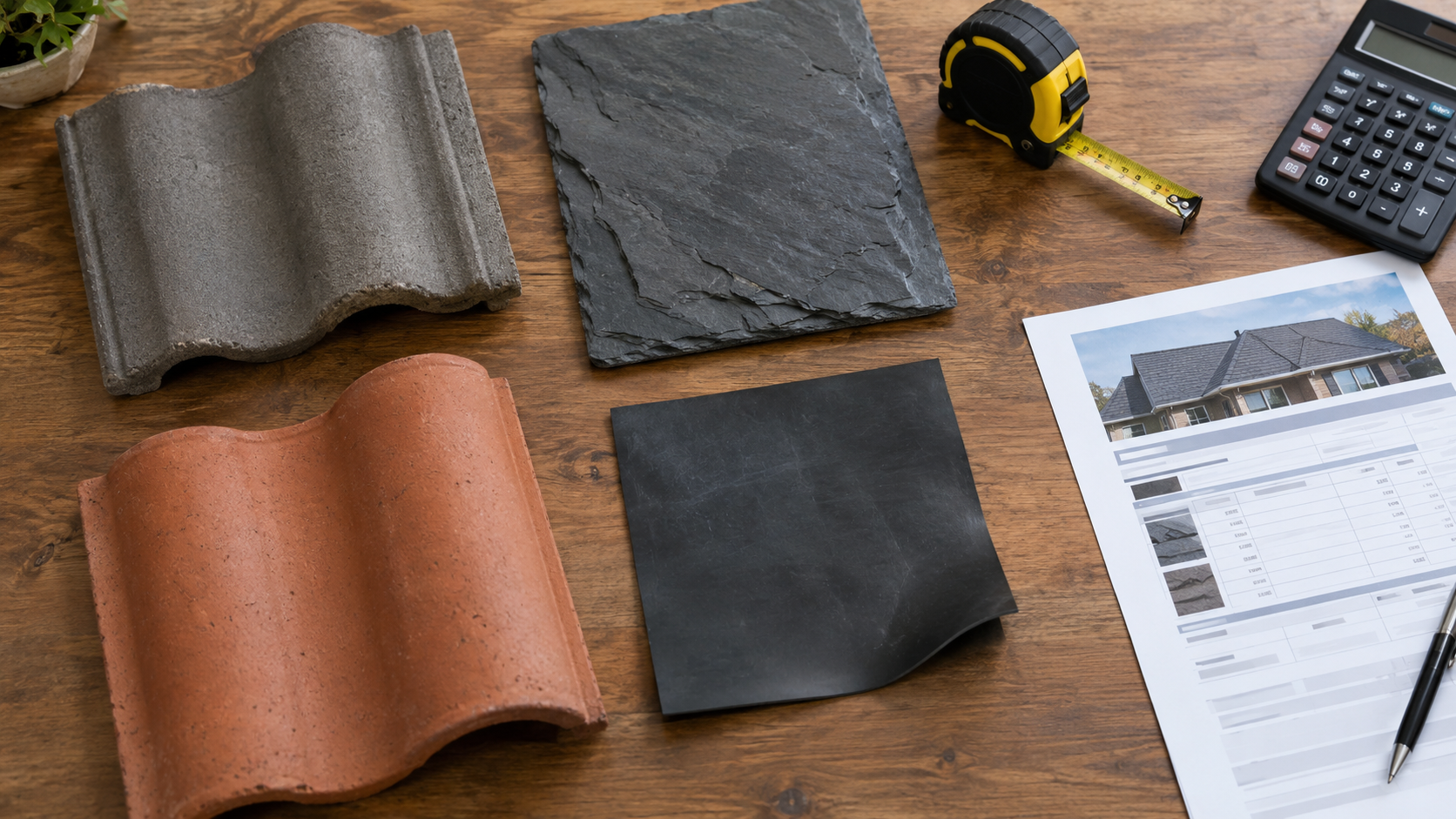
Comparing material samples against a written quote helps you judge whether a higher up-front price buys a longer-lasting roof.
How to keep your roof replacement cost down
Get at least three itemised quotes from roofers registered with a competent person scheme or TrustMark, and compare the scope line by line, not just the total.
Commission a survey first so you know whether you need a repair, a partial re-roof or a full replacement, and so quotes are based on the same facts.
Combine jobs: once scaffolding is up, chimney repointing, gutter replacement, fascia and soffit work and roof windows are far cheaper to do at the same time.
Book for late autumn or winter if the roof is watertight for now; prices are typically 5–15% lower outside the peak season.
Keep the insulation element separate on the invoice so any zero-rated VAT relief can be applied correctly.
Never pay more than a 20–25% deposit, and insist on a written guarantee backed by insurance.
If you are buying, use the survey to negotiate the house price or ask the seller to complete the work before exchange.
Why choose Survey Merchant for your roof replacement cost assessment?
Before you spend £10,000 or more on a new roof, or buy a house with one that may need replacing, it pays to have an independent expert look at it. Survey Merchant connects you with a nationwide panel of suitably qualified, accredited surveyors regulated by bodies such as RICS, CIOB and RPSA, matched to the job in hand, whether that is a Level 3 building survey on a Victorian terrace, a drone inspection of a complex hipped roof or a specialist flat roof survey. Our surveyors are impartial: they do not sell roofing work, so their advice on whether to repair or replace is based solely on the evidence.
You get transparent, competitive fixed fees agreed up front, fast turnaround on both the inspection and the written report, and local surveyors who know the construction types and roofing traditions in your area, from Welsh slate to Midlands clay pantiles. Every report sets out condition ratings, photographs and budget indications you can hand straight to a roofer, a solicitor or a seller, and our team supports you from booking through to any follow-up questions. For an overview of what a condition survey includes and how much it costs, see our house survey cost guide.
How much does it cost to replace a roof in the UK?
In 2026 a full pitched roof replacement typically costs £5,500–£9,000 for a terraced house, £6,500–£15,000 for a three-bed semi and £9,000–£18,000 or more for a detached home, including scaffolding and waste removal. Natural slate sits at the top of those ranges and concrete tiles at the bottom.
How long does it take to replace a roof?
Most domestic re-roofs take two to ten days once scaffolding is up: around 2–4 days for a small terrace, 3–6 days for a semi and 5–10 days for a large detached house. Weather, hidden timber repairs and complex details such as dormers or valleys can extend this.
Do I need building regulations approval to replace my roof?
Usually yes. Replacing 50% or more of a roof covering counts as renovating a thermal element under Part L, so insulation normally has to be upgraded and the work signed off by building control. Using a roofer registered with the NFRC Competent Person Scheme lets them self-certify and issue a compliance certificate.
How much does it cost to replace a flat roof?
A flat roof replacement on a typical extension or garage costs around £2,800–£7,500 in 2026. Torch-on felt is cheapest at £40–£65 per m², GRP fibreglass £50–£80 per m² and EPDM rubber £45–£100 per m², with EPDM and GRP lasting far longer than felt.
Do I need a bat survey to replace my roof?
If there is any sign or likelihood of bats roosting, yes. Bats are European protected species and GOV.UK lists re-roofing as work that can harm them. An ecologist's roost assessment typically costs £300–£800, and a Natural England mitigation licence is needed where harm cannot be avoided.
How do I know if my roof needs replacing or just repairing?
A Level 3 building survey or a specialist roof survey from a suitably qualified, accredited surveyor will assess the covering, underlay, battens and structure. As a rule, if more than 20–30% of the covering needs work or the underlay has failed, a full replacement is better value than repeated repairs.