Building Surveying
Aug 2, 2026
Mineral Felt Roof a Surveyor's Guide for UK Buyers
A surveyor's guide to the mineral felt roof. Learn about materials, lifespan, costs, common defects, and what to look for during a property viewing in the UK.

You've found a house you like. The kitchen works, the garden is the right size, and then you notice the flat-roofed rear extension or garage. That's usually the moment buyers start worrying about leaks, lifespan, and whether they're about to inherit a hidden bill.
That concern is reasonable. A mineral felt roof is common across the UK, and it can serve well when it's properly built and looked after. It can also fail early when someone has cut corners. In practice, the biggest mistake buyers make isn't misunderstanding the material. It's assuming the material tells the whole story.
On site, the question is rarely just “is this felt?”. The better question is “was it installed well, does it drain properly, and has anyone tried to patch it badly?”. That's what tends to separate a serviceable roof from one that becomes a negotiation point, an insurance headache, or a replacement project soon after completion.
Mineral felt turns up on all sorts of properties. Garages, dormers, bay roofs, small extensions, porches, and outbuildings often have it because it has long been a practical, familiar flat roofing choice in the UK.
For a first-time buyer, the roof can look deceptively simple. From the ground, you may only see a grey mineral finish and assume it's either fine or failing. Real life is less tidy than that. A roof can look acceptable from one angle and still have weak seams, poor edge detailing, or trapped moisture below the surface.
Practical rule: With mineral felt, workmanship usually matters more than appearances from the driveway.
That's why surveyors look beyond the top layer. Surveyors pay attention to falls, drainage points, junctions with walls, flashings, parapets, and signs that someone has carried out a rushed patch repair. A neatly painted patch can hide a poor repair just as easily as it can indicate sensible maintenance.
Buyers also tend to mix up different uses of felt. Some mean flat roof coverings. Others mean underlay beneath tiles. Those aren't the same conversation, and confusing them can lead to bad assumptions about durability, defects, and cost planning.
A sensible approach is to treat a mineral felt roof as a system, not a sheet.
If you're buying, don't panic when you see felt. But don't wave it through either. It needs a measured look, especially where the roof covers habitable space below.
A buyer often hears “felt roof” and pictures one simple layer rolled out over a flat surface. That is not how a serviceable mineral felt roof is built. It is a build-up of components that only works well if they are compatible, properly bonded, and fitted with care. In practice, poor installation causes more failures than the material label itself.
For flat roof work, mineral felt usually forms the waterproofing layer above a structural deck. The visible mineral surface is only the weathering finish. Beneath it, the roof may include more than one felt layer, reinforcement within the felt, insulation, and a vapour control layer depending on the design.
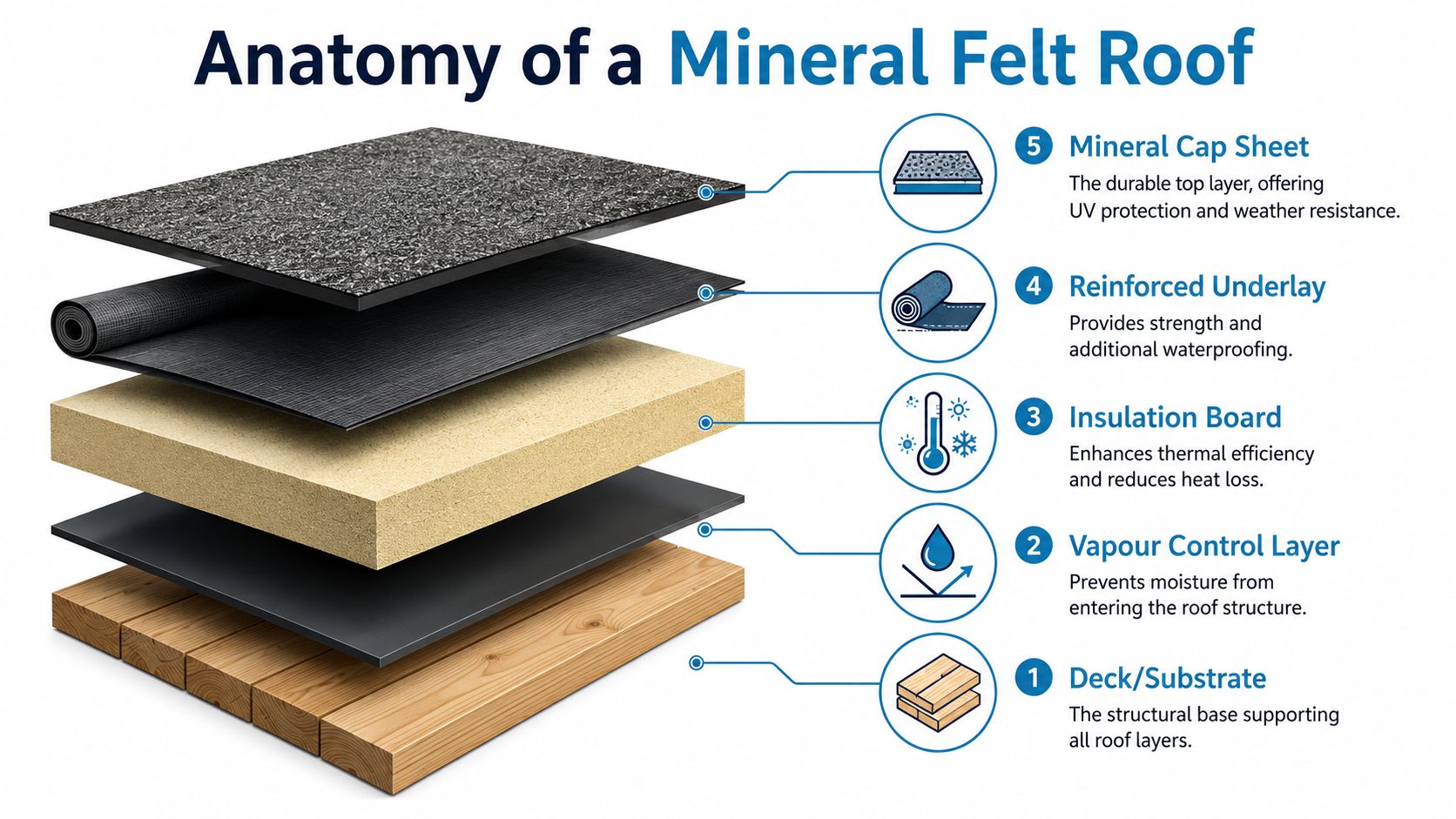
The main elements are usually:
That last point is where buyers are often caught out. A roof can have decent felt on top and still fail early because the edges, laps, or wall abutments were done badly.
Material descriptions can sound reassuring, but surveyors do not judge felt roofs by product name alone. They look at how the whole assembly has been put together and whether the detailing suits the roof shape, drainage, and exposure.
A sound mineral felt roof depends on several things happening together. The deck needs to be dry and secure. The layers need to be bonded correctly. The laps need to be formed cleanly. The upstands need enough height. Water needs a clear route to outlets or gutters. If one of those basics is missing, the roof can fail long before the felt itself has reached the end of its expected life.
This is why DIY work carries real risk. Homeowners often focus on the visible top layer, then miss the hidden causes of failure. I see the same pattern repeatedly on surveys. Patch repairs over damp decking, poorly sealed joints around pipes, and felt dressed onto weak edges with no proper support. Those jobs may hold for a season or two, but they rarely age well.
Mineral felt is a bitumen-based roofing material with a protective mineral surface on the exposed top layer. Older roofs may use traditional built-up felt systems. Newer installations are often torch-on systems or other modern felt assemblies. The broad principle is the same. Several layers work together to keep water out.
That does not mean every felt roof performs equally. An older overlay on top of previous coverings can hide defects below. A cheap replacement can look neat on day one and still be vulnerable if the substrate was not prepared properly. A well-specified felt roof on a simple garage may give reasonable service. A badly detailed felt roof over a habitable extension can become expensive quickly.
If you want to compare flat roof options, keep that trade-off in mind. The material matters, but with mineral felt the quality of installation usually matters more.
A buyer often sees a flat roof from ground level, hears that felt is the cheaper option, and assumes the decision is mostly about material. On site, the bigger question is usually who laid it, how carefully the details were formed, and whether the roof design suits the covering.
Mineral felt still has a clear place in the market. It is commonly chosen for garages, porches, and smaller extensions because the upfront spend is usually lower than EPDM or GRP. That can be perfectly reasonable. The catch is that felt is less forgiving of poor workmanship than many buyers expect. Bad laps, weak edge detailing, trapped moisture below the covering, or patching over failing substrate can shorten the roof's life long before the material itself should be worn out.
That point matters more than brochure comparisons.
Felt tends to suit simple roof shapes with straightforward drainage and limited penetrations. On a plain rectangular garage roof, installed by a competent roofer on sound decking, it can be a sensible and economical choice.
EPDM is often favoured where flexibility helps, particularly on roofs that may see a bit more movement. GRP is usually chosen where owners want a firmer, more uniform finish and are prepared for a higher initial outlay. Modern single-ply systems can also perform well, especially on larger or more specialised roofs, but they depend heavily on correct specification and installer experience.
In practical surveying terms, I would not rank these materials on headline lifespan alone. I would ask different questions. Is the roof shape simple or awkward. Are there multiple outlets, rooflights, or abutments. Has the installer detailed the edges and upstands properly. Was the deck dry and sound at the time of installation. With mineral felt, those answers often matter more than the sales pitch.
If you want a broader product overview, this guide to compare flat roof options is a useful companion read.
| Material | Typical Cost Position | Typical Service Life Position | Key Advantage |
|---|---|---|---|
| Mineral felt | Usually lower upfront cost | Usually shorter than EPDM and GRP | Lower entry price and widely used on simple domestic roofs |
| EPDM | Mid-range | Often longer than felt | Good flexibility and relatively simple detailing on suitable roofs |
| GRP | Higher upfront cost | Often among the longest-lasting domestic options | Hard-wearing surface and tidy appearance |
| Modern single-ply systems | Varies by specification | Varies by system | Can suit larger or more specialised flat roofs |
That table only helps if the installation is right. I have seen expensive flat roofs fail early because basic detailing was poor, and modest felt roofs give reasonable service because the roofer got the substrate, falls, joints, and edge details right first time.
For buyers, that is the comparison. Felt is not automatically the weak option. Poor felt installation is. If access is limited and you cannot inspect the roof safely from a ladder or upper window, a drone inspection can help you assess condition before exchange. This guide explains how to find a UK drone surveyor.
The first question most buyers ask is how long the roof will last. The more useful question is whether the roof in front of you is ageing normally or heading for trouble because it was put down badly.
Near the start of an inspection, I want to see the roof surface clearly, especially around laps, outlets, edge trims, and any point where the roof meets a wall or penetration.

A well-maintained mineral felt roof in the UK typically lasts 10 to 15 years, with basic felt roofs often around 10 to 12 years and higher-quality torch-on variants reaching 15 to 20 years or more, according to Salter Roofing's guide to felt roof lifespan. That same guidance notes that installation quality, weather exposure, and maintenance all influence the outcome.
The defect pattern is usually familiar. You may see blistering, cracking, bubbling, splitting at seams, lifted edges, or areas where water appears to linger. Buyers often assume these are signs of age. Sometimes they are. Often they also point to weak workmanship.
Peter Barry Surveyors states that poor workmanship, particularly from DIY installations, is the primary cause of flat felt roof defects like mould, cracking, and bubbling, and identifies DIY felt jobs as the “biggest culprit” in residential failures in its discussion of common flat roof defects.
That point matters more than most buying guides admit. A roof can be relatively recent and still be a poor roof.
Common warning signs include:
A proper diagnosis isn't just surface-level. Surveyors relate exterior defects to the building below. If the extension ceiling has staining near an abutment wall, for example, I'd be looking closely at the flashing and the upstand detail rather than blaming the middle of the roof by default.
Where safe access is limited, buyers should also consider options such as drones. This guide on how to find a UK drone surveyor explains the practical route when a close visual inspection from the ground won't answer enough questions.
A short video can also help you recognise the sort of felt roof issues that tend to matter in real inspections.
Defects on a mineral felt roof rarely stay local for long. Water travels, timber softens, and buyers end up paying for more than the original split.
The key point for a homebuyer is simple. Don't judge a mineral felt roof by age alone. Judge it by detailing, drainage, repair history, and the quality of the work.
A mineral felt roof doesn't need constant attention, but it does need sensible attention. The owners who get the best service life are usually the ones who notice small issues before they turn into saturation, decay, or repeated patching.
Annual visual checks and clearing debris from drainage outlets are specifically identified as important maintenance practices in the earlier lifespan guidance from Salter Roofing. Those jobs sound basic because they are basic, but they're also the tasks owners neglect most often.
A sensible maintenance routine looks like this:
None of that requires specialist knowledge. It requires consistency.
Some felt roofs respond well to local repair. A small isolated split or a limited patch of damage may be suitable for a professional patch repair if the surrounding roof remains sound. That's very different from a roof with widespread bubbling, multiple failed seams, or softness beneath the covering.
A practical way to think about repair choices is as a hierarchy:
Observation and minor maintenance
If the roof is basically sound, start with cleaning outlets, checking laps, and monitoring suspect areas.
Targeted professional repair
Where one defect is clearly identifiable, a roofer may repair that section without disturbing the whole roof.
More substantial remedial work
If defects are repeated but the substrate remains serviceable, more extensive intervention may still be possible.
Replacement
If the roof has broad failure, poor previous workmanship, or hidden deck problems, replacement is often the more honest solution.
If you're unsure where your roof sits on that scale, a dedicated roofing survey service can help distinguish between a repairable defect and a roof that's reached the point where more patching is false economy.
Site judgement: The cheapest repair is often the one that stops you paying for three more repairs over the next winter.
Owners also need to be realistic about DIY. Looking at a roof is fine. Cleaning outlets is fine. Amateur repairs to felt often aren't.
A common purchase scenario goes like this. The flat roof looks serviceable from ground level, the seller says it was “done a few years ago”, and the buyer budgets for little more than a minor patch if anything turns up. Then the roofer lifts the edge and finds wet decking, poor detailing, and a covering laid over older material to save time. The bill changes quickly.
That is why the cheapest-looking mineral felt roof is not always the cheapest roof to own. With felt, workmanship has a bigger effect on future cost than the material itself. A well-laid roof can give sensible service. A badly laid one can turn into repeated call-outs, internal damp, and an awkward insurance conversation.
Costs vary less by the label on the product than by what sits underneath it and how accessible the roof is. On site, the main price drivers are usually strip-off work, disposal, deck repairs, edge detailing, and safe access. Replacement over a simple garage is one thing. Replacement over a kitchen extension or occupied room is another, especially if the roof has been patched several times and nobody knows the condition of the deck below.
The parts of the quote that often catch buyers out are:
This is also where estimates can drift from each other. One contractor may price for a straightforward recover. Another may assume full strip and deck repairs because they have seen enough failed DIY jobs to expect hidden defects. If you want to compare quotes properly, ask each roofer to state what is included, what is excluded, and what would trigger extra cost. Tools such as Exayard roofing estimating software are useful for standardising scope, but the survey of the roof still matters more than the spreadsheet.
For a buyer, the practical question is simple. Are you looking at routine future maintenance, or a roof where poor installation has stored up a larger bill?
Older flat roofs cause confusion during surveys and sales. An existing roof does not become unlawful just because it was built to an older standard. The usual issue is whether proposed works count as repair, recover, or replacement, because that affects whether current thermal and construction requirements apply.
In plain terms, replacing a significant portion of the roof may bring Building Regulations into the discussion. Small repairs usually do not. That distinction matters because the cost of compliance can sit outside the headline roofing quote.
Where there is doubt, ask for the roofer's proposed scope in writing and check whether Building Control notification is needed. Buyers who want to understand likely professional fees alongside roofing costs can use this guide to UK roof survey costs and types.
Insurers usually focus on risk as it stands today. They are less interested in whether a seller meant well with a patch repair and more interested in whether the roof is weather-tight, draining properly, and free from obvious neglect.
An older mineral felt roof in fair condition is not automatically a problem. A roof with visible ponding, open laps, patchwork repairs, or signs of leakage below it is more likely to attract questions, exclusions, or requests for further information. This is one reason poor DIY work matters so much. Untidy repairs do not just shorten service life. They can affect resale, mortgage confidence, and how easy it is to place insurance on normal terms.
For owners and buyers alike, clear evidence helps. A recent inspection, photographs, invoices for competent work, and a realistic view of remaining life usually carry more weight than broad assurances that the roof is “fine for now.”
You arrive for a second viewing after rain. The flat roof looks ordinary from the garden, but there is a brown tide mark on the bedroom ceiling below and a rough patch of silver paint on the felt. That is the point where buyers need to stop looking at the roof as a material and start asking how well it was installed.
A mineral felt roof can give decent service. Poor detailing, rushed patching, and DIY torch-on work are what usually turn a manageable roof into an expensive problem. For buyers, that affects negotiation, future maintenance costs, and how confident you can be about the roof's remaining life.
From ground level or another safe vantage point, look for clues that separate normal ageing from workmanship concerns.
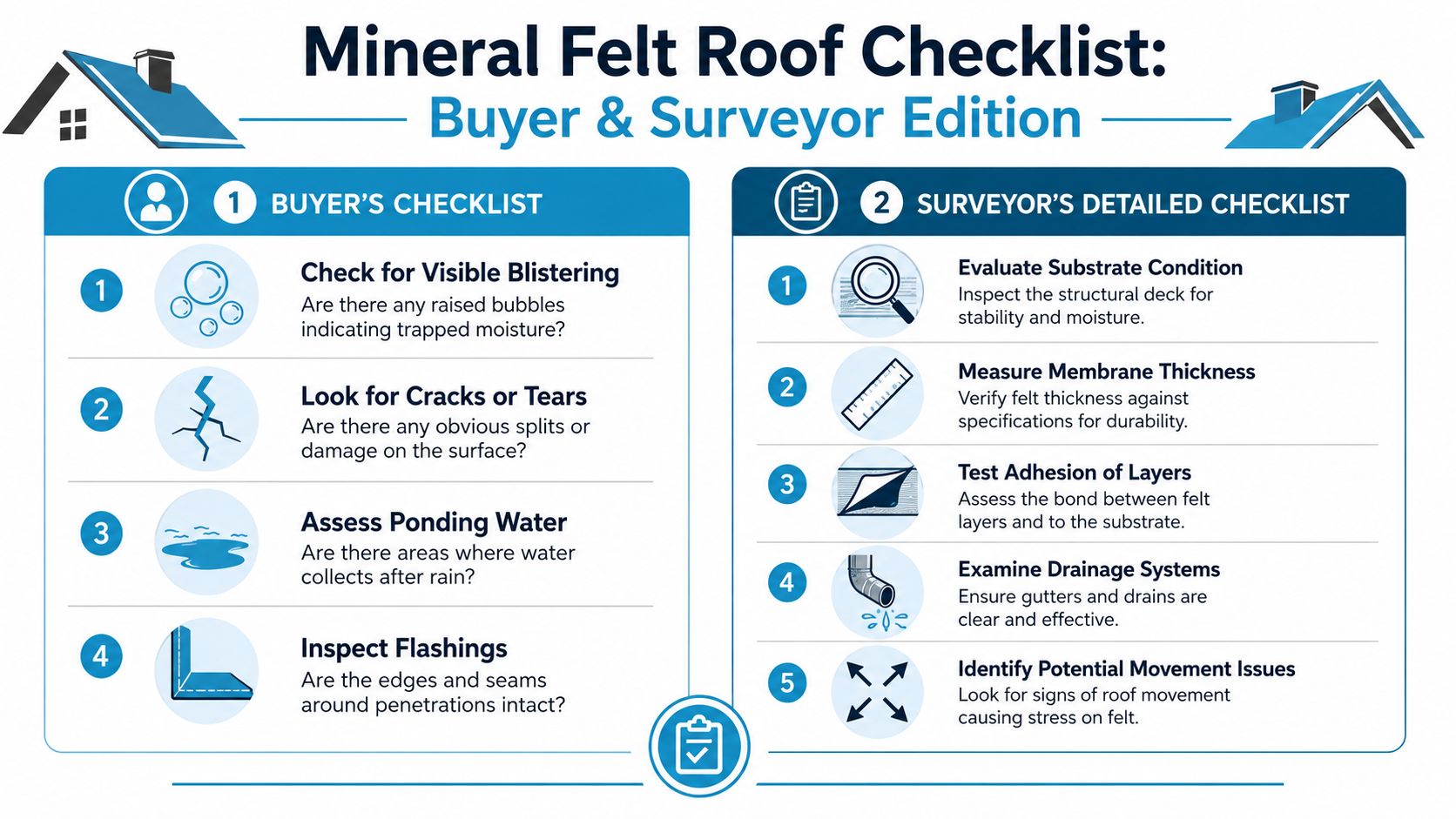
One caution matters here. A tidy-looking patch repair can hide poor workmanship. I often find that the underlying issue is not one split in the felt, but repeated short-term repairs over bad joints, weak upstands, or soft decking.
A proper inspection looks past the surface finish and checks whether the roof has been put together in a way that should keep water out over time. Installation quality is usually the deciding factor. The same mineral felt can perform reasonably well on one property and fail early on another because laps, edge details, and outlets were handled badly.
A surveyor should assess:
The key question is whether defects are isolated and repairable, or whether the roof shows a pattern of poor workmanship across the whole covering. That distinction has a direct effect on value. A local repair may be a minor negotiation point. A roof with widespread patching, open laps, and signs of trapped moisture is closer to a replacement decision.
If you want to understand likely fees before instructing, this guide to UK roof survey costs and types is a useful starting point. If you are comparing remedial quotes, tools such as Exayard roofing estimating software can also help you see how contractors build up roofing costs, which makes it easier to question vague allowances or very low prices.
A buyer can identify warning signs. A surveyor should tell you whether the problem is age, workmanship, or both, and whether that changes the price you are willing to pay.
If you're buying, selling, or managing a property with a mineral felt roof, Survey Merchant can help you find an impartial qualified surveyor for the right level of inspection. That gives you a clearer view of condition, likely remedial work, and the actual risk behind what may look like a simple flat roof.
Survey Merchant provides vetted RICS surveyors across 100+ UK locations at fixed fees:
→ Level 2 Home Survey (HomeBuyer Report)
→ Level 3 Building Survey (full structural survey)
→ RICS Red Book property valuations
→ Party wall surveyors — notices, awards & schedules of condition
→ Expert witness surveyors — CPR Part 35 reports for property disputes