We use cookies to improve your experience on our site, analyze site traffic, and assist in our marketing efforts. By clicking "Accept all," you agree to the storing of cookies on your device. You can choose to "Reject all" non-essential cookies. For more information, please read our Cookie Policy.
HMO Meaning: What Is an HMO? 2026 UK Licensing Guide
A plain-English 2026 guide to the HMO meaning: definition, mandatory and additional licensing, Renters' Rights Act penalties, minimum room sizes, fire safety, planning and surveys.
If you have seen the letters HMO on a property listing, a council letter or a mortgage form and wondered what they mean, you are not alone: “hmo meaning” and “what is an HMO” are among the most searched property questions in the UK. An HMO is a house in multiple occupation — a home shared by three or more people from more than one household. In 2026 the rules around HMOs have tightened considerably, with higher penalties, wider licensing and new duties for landlords, so getting the definition right matters. This guide explains the HMO meaning in plain English, when a licence is needed, the 2026 changes, minimum room sizes, fire safety, typical costs, and how a suitably qualified, accredited surveyor helps you stay compliant.
What is an HMO? The HMO meaning explained
An HMO is a house in multiple occupation: a property where at least three tenants live, forming more than one household, and sharing a toilet, bathroom or kitchen. A household is one person or members of the same family, so three unrelated friends sharing a flat form three households and therefore an HMO.
Households: more than one. Couples (married, civil partners or cohabiting), relatives, half-relatives and step-relatives count as one household.
Shared amenities: some or all occupiers share a kitchen, bathroom or WC.
Main residence: the property is the occupiers’ only or main home, and at least one of them pays rent.
Typical HMOs include student houses, professional house-shares, bedsits with shared kitchens, and some hostels and staff accommodation. A property converted into self-contained flats can also be a “section 257 HMO” if the conversion did not meet the 1991 Building Regulations and fewer than two-thirds of the flats are owner-occupied.
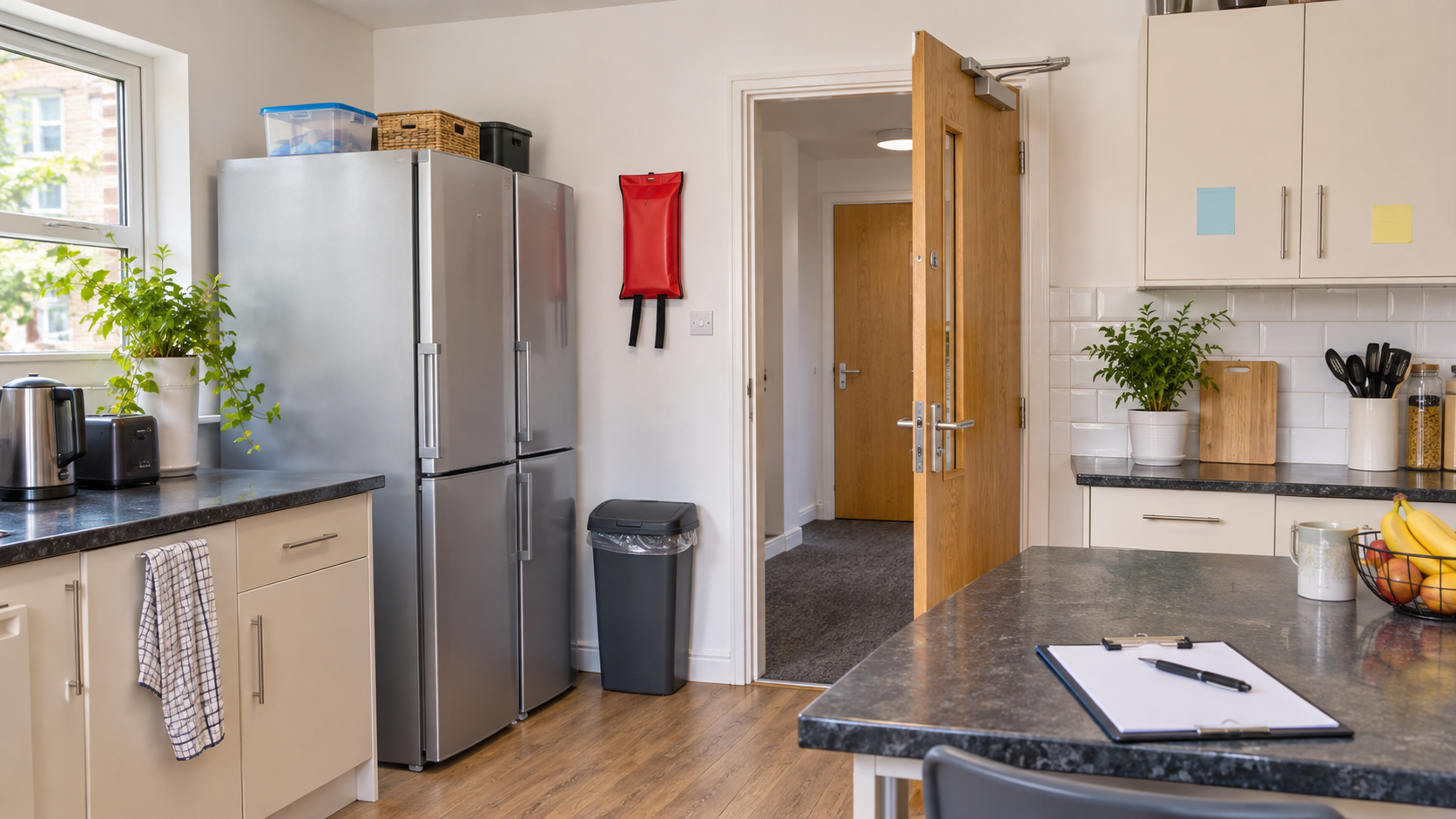
Many UK HMOs are ordinary terraced houses let room by room to unrelated sharers. Looks alone do not tell you whether the property is licensed or compliant.
Key takeaways
An HMO (house in multiple occupation) is a property where at least three tenants from more than one household share a kitchen, bathroom or toilet. A “large HMO” has five or more such tenants.
Large HMOs in England and Wales must be licensed by the local council under mandatory licensing; smaller HMOs may also need a licence where additional or selective licensing schemes apply.
Since 1 May 2026 the maximum civil penalty for licensing offences has risen from £30,000 to £40,000, and rent repayment orders now reach superior landlords.
Licensed HMOs must meet national minimum bedroom sizes (6.51 m² for one adult, 10.22 m² for two) and strict fire, gas, electrical and management standards.
Planning is separate from licensing: a small HMO for three to six people sits in Use Class C4 and may need planning permission where an Article 4 Direction is in force.
A measured survey, condition report or HMO-focused building survey from an accredited surveyor is the quickest way to prove room sizes and spot compliance failures before the council does.
What is the difference between an HMO and a large HMO?
A large HMO meets the same sharing and household tests but has five or more tenants. The distinction matters because large HMOs fall under mandatory licensing everywhere in England and Wales. Since 1 October 2018 the old “three storeys or more” requirement has been removed, so a two-storey terrace let to five sharers now needs a licence just as a tall Victorian villa does.
Type
Occupiers
Households
Licence required?
Not an HMO
Any number from one household (e.g. a family)
1
No (selective licensing may still apply)
Small HMO
3 or 4
2 or more
Only where the council runs an additional licensing scheme
Large HMO
5 or more
2 or more
Yes — mandatory licensing nationwide
Section 257 HMO
Converted flats, pre-1991 standards
Varies
Often under additional licensing; check with the council
Do you need an HMO licence in 2026?
According to GOV.UK’s HMO licence page, you must have a licence if you rent out a large HMO where the property is let to five or more people forming more than one household, some or all of them share facilities, and at least one pays rent. Each HMO needs its own licence, a licence lasts a maximum of five years, and it must be renewed before it expires. Smaller HMOs may need a licence depending on the local area.
There are three licensing routes to be aware of:
Mandatory licensing — large HMOs (five or more occupiers in two or more households).
Additional licensing — a council-designated scheme bringing smaller HMOs (typically three or four sharers) into licensing in all or part of its area.
Selective licensing — a scheme covering most privately rented homes in a designated area, including non-HMOs.
To grant a licence the council must be satisfied that the property is suitable for the number of occupiers, that the proposed licence holder and manager are “fit and proper” persons, and that satisfactory management arrangements are in place. Standard conditions include supplying an annual gas safety certificate, installing and maintaining smoke alarms, and producing electrical safety certificates on request.
What changed for HMOs in 2026?
This is where the 2026 picture differs from older guides. The Renters’ Rights Act 2025 began to take effect on 1 May 2026, and although HMO licensing still runs under the Housing Act 2004, the enforcement framework around it has changed:
Civil penalties rose to £40,000. Propertymark reports (13 August 2026) that from 1 May 2026 the maximum civil penalty for relevant Housing Act offences, including operating an unlicensed HMO or breaching licence conditions, increased from £30,000 to £40,000 per offence, and councils can impose it instead of prosecuting.
Superior landlords are now in scope. PropertyWire (22 April 2026) notes that freeholders and head lessees can face rent repayment orders of up to two years’ rent on unlicensed HMOs, closing the gap left by the Supreme Court decision in Rakusen v Jepsen. Investors who hold properties through intermediary companies or rent-to-rent arrangements are most exposed.
A national landlord database is arriving. Registration on the Private Rented Sector Database is planned to roll out regionally from late 2026 with an annual fee, but it does not replace mandatory, additional or selective licensing.
Licensing is spreading. Propertymark lists a wave of 2026 consultations: Ealing proposes a replacement borough-wide additional licensing scheme with fees of £1,300 for a three- or four-person HMO; Preston proposes a £1,050 five-year licence; Burnley £774 for a landlord’s first property; and Stoke-on-Trent plans a city-wide Article 4 Direction with limits on HMO concentration. Landlord Today reported on 21 August 2026 that Bolton’s new HMO scheme will charge £1,211 per property for five years, after the council logged 1,885 disrepair complaints in three years.
Damp and mould duties are tightening.Awaab’s Law already sets fixed timescales for social landlords, and the government is consulting on extending it to private rentals, which would hit HMOs with shared, hard-to-ventilate kitchens and bathrooms first.
Councils measure usable floor area, usually excluding space where the ceiling height is below 1.5 metres, so sloping attic rooms and box rooms are frequently where applications fail. Most authorities also publish amenity standards setting the number of kitchens, bathrooms, WCs and wash-hand basins required per occupier, and the 2018 regulations add a duty to comply with the council’s refuse storage scheme.
A measured survey records the usable floor area of every bedroom, which is exactly what a licensing officer will check.
HMO fire safety and management duties
Because unrelated occupiers cook, heat and smoke independently, HMOs carry a higher fire risk than single-family homes. The Management of Houses in Multiple Occupation (England) Regulations 2006 place ongoing duties on the manager to take safety measures, maintain water, drainage, gas and electricity supplies, keep common parts and living accommodation in good repair, and provide adequate waste disposal facilities — whether or not the HMO is licensed.
In practice a compliant HMO will usually have:
A mains-powered, interlinked fire detection system with heat detection in kitchens and smoke detection in escape routes and bedrooms.
FD30 fire doors with self-closers and intumescent strips to bedrooms and high-risk rooms, protecting a 30-minute escape route.
Emergency lighting where escape routes are long or complex, a fire blanket in each kitchen and clear signage.
A current Electrical Installation Condition Report (EICR), an annual gas safety record and portable appliance checks.
A written fire risk assessment under the Regulatory Reform (Fire Safety) Order 2005 for the common parts.
Shared kitchens are the highest-risk rooms in an HMO: fire doors, self-closers, heat detection and a fire blanket are standard licence expectations.
Does an HMO need planning permission?
Planning and licensing are separate regimes, and you can need both. Under the Planning Portal’s use classes guidance, a small shared house occupied by three to six unrelated people sharing amenities falls into Use Class C4, while an HMO with more than six residents is sui generis and always needs full planning permission. Changing a family home (Class C3) to a C4 HMO is normally permitted development, but a growing number of councils have made Article 4 Directions removing that right, so that even a three-person house-share needs an application. Check your local authority before you buy or convert, and bear in mind that an HMO which lacks planning consent can be refused a licence.
How much does an HMO licence cost?
Councils set their own fees, so there is no national figure. The 2026 consultations reported by Propertymark and Landlord Today give a realistic range of roughly £700 to £1,300 for a five-year licence, often split into an application fee and a grant fee, with discounts for accredited landlords or energy-efficient homes. Add to that the cost of works to meet standards — fire doors, alarm systems, electrical upgrades — which commonly run into several thousand pounds for an older terrace.
Item
Typical 2026 figure
Source
Five-year HMO licence fee
£700 – £1,300 per property
Council consultations (Propertymark, Aug 2026; Landlord Today, Aug 2026)
Maximum civil penalty per offence
£40,000
Renters’ Rights Act 2025, from 1 May 2026
Rent repayment order
Up to 2 years’ rent
Housing and Planning Act 2016 as amended
Prosecution fine
Unlimited
GOV.UK
Licence duration
Up to 5 years, renewed before expiry
GOV.UK
What happens if you run an HMO without a licence?
The consequences in 2026 are severe. The council can prosecute (unlimited fine) or impose a civil penalty of up to £40,000 per offence; tenants or the council can apply to the First-tier Tribunal for a rent repayment order of up to two years’ rent; and a conviction can mean failing the fit and proper person test for every other property you own. Mortgage lenders and insurers also treat unlicensed HMOs as a breach of terms.
Buying or valuing an HMO: what a surveyor checks
HMOs are valued differently from ordinary houses. A licensed, planning-compliant HMO with six lettable rooms may be worth more on an investment basis than the same house as a family home, but only if its compliance holds up. A specialist valuer appointed through our property valuation service will consider rental income, the licence and its expiry, planning status, Article 4 constraints and the cost of outstanding works.
Before purchase, a building survey tailored to HMOs should go further than a standard condition report and cover:
Measured floor areas of every bedroom against the 2018 minimum sizes, delivered as a measured building survey plan that can accompany the licence application.
The fire strategy: door sets, closers, compartmentation, alarm grade, escape routes and emergency lighting.
Amenity provision: kitchens, bathrooms and WCs per occupier against the council’s standards.
Services and certification: EICR, gas safety, Legionella risk, and the EPC rating ahead of the proposed EPC C deadline for rented homes.
Damp, mould and ventilation in shared rooms, where Awaab’s Law timescales will bite hardest.
Structural alterations from previous conversions, including removed walls, loft rooms and basement bedrooms that may breach building regulations.
Whichever professional you instruct, use a suitably qualified, accredited surveyor. In the UK that means practitioners regulated or accredited by bodies such as RICS, CIOB and RPSA, among others, who carry professional indemnity insurance and work to a published inspection standard.
Why choose Survey Merchant for your HMO survey or valuation?
Survey Merchant connects landlords, investors and buyers with a panel of suitably qualified, accredited surveyors across RICS, CIOB and RPSA, matched to the job rather than to whoever is nearest. For HMOs that means:
The right specialist: building surveyors who understand licensing standards, fire strategy and planning use classes, and valuers who price HMOs on an investment basis.
Nationwide coverage with local knowledge: our panel spans England and Wales, so your surveyor knows the local council’s amenity standards and whether an Article 4 Direction applies.
Fast turnaround: licence applications and purchase deadlines do not wait, so we prioritise quick booking and prompt reporting.
Transparent fixed fees: you receive a clear quote before you commit, with no hidden extras.
Impartial, practical advice: we have no stake in the sale or the letting, so the report tells you what the council will see, not what you hope to hear.
End-to-end support: from measured plans for the application to re-inspection after works, we stay with you until the licence is granted.
HMO stands for house in multiple occupation. It describes a property rented to at least three people who form more than one household and who share a kitchen, bathroom or toilet, such as a student house or a professional house-share.
What is the difference between an HMO and a large HMO?
Both share the same tests, but a large HMO has five or more tenants from two or more households sharing facilities. Large HMOs need a mandatory licence from the council anywhere in England and Wales; smaller HMOs only need one where an additional or selective licensing scheme is in place.
Do I need a licence for an HMO with three or four tenants?
Not under mandatory licensing, but many councils run additional licensing schemes that bring three- and four-person HMOs into licensing. Check with your local authority, and remember that an Article 4 Direction may also mean you need planning permission for a small HMO.
What is the minimum bedroom size for an HMO?
The 2018 mandatory licence conditions set 6.51 square metres for one person over 10, 10.22 square metres for two people over 10, and 4.64 square metres for a child under 10. Any room under 4.64 square metres cannot be used as sleeping accommodation.
What is the penalty for running an unlicensed HMO in 2026?
Since 1 May 2026 councils can impose a civil penalty of up to £40,000 per offence, or prosecute with an unlimited fine. Tenants or the council can also apply for a rent repayment order of up to two years' rent, and superior landlords such as freeholders can now be held liable.
Do I need a survey to get an HMO licence?
Councils do not always insist on one, but a measured survey proves bedroom floor areas and a building survey identifies fire safety, amenity and structural shortfalls before the licensing inspection. Using a suitably qualified, accredited surveyor from a body such as RICS, CIOB or RPSA avoids costly refusals and re-applications.