Building Surveying
Sep 9, 2026
Chimney Stack Repairs A Complete UK Guide for 2026
Worried about your chimney? Our UK guide to chimney stack repairs covers signs, costs, and regulations. Learn how to diagnose issues and find a surveyor.

A damp patch near the chimney breast often starts the same way. It appears after heavy rain, fades a little in dry weather, then returns darker and wider. Many homeowners look first at the roof covering, gutters, or the loft insulation. Quite often, the culprit is higher and more exposed than all of them.
A chimney stack is one of the hardest-working parts of the building envelope. It sits above the roofline, takes the full force of wind and rain, and is commonly neglected because it’s awkward to inspect properly from the ground. By the time symptoms show indoors, the defect outside has usually been developing for some time.
That doesn’t always mean a rebuild. In many cases, chimney stack repairs are straightforward if the diagnosis is correct. In other cases, what looks like a minor crack is the visible part of a wider failure involving mortar loss, failed flashing, sulphate attack, or movement in the stack itself.
Homeowners usually want the same three answers. What’s wrong, how serious is it, and what needs doing now rather than later. Those are the right questions. The wrong approach is to guess from one photograph, patch over the symptom, or accept the cheapest quote without understanding whether it addresses the cause.
A chimney rarely fails all at once. It usually gives warnings first. Damp, loose mortar, staining, fragments on the roof, and a slight lean all matter.
The practical route is to work through the problem in order. Start with the warning signs. Understand what causes them. Get a proper diagnosis. Then choose repairs that fit the actual defect, the age of the building, and the legal position if the stack is shared.
A typical call starts with uncertainty. There’s staining on the bedroom ceiling near the chimney breast, a musty smell after rain, or bits of mortar found in the gutter. The owner isn’t sure whether they need a roofer, a damp specialist, or a surveyor. That uncertainty is normal because chimney defects often imitate other problems.
A chimney stack sits at the junction of several vulnerable elements. There’s the masonry itself, the mortar joints, the flaunching around the pots, the flashing where the stack meets the roof, and often an old flue serving a fireplace that may no longer be in regular use. If one part fails, moisture can travel in unexpected ways and show up indoors some distance from the point of entry.
The key is to think of the chimney as a system, not just a pile of bricks on the roof. A crack near the top can let in water. Failed pointing can hold moisture in the walling. Defective flashing can direct water into the roof slope beside the stack. A blocked or redundant flue can worsen internal staining and condensation.
Most owners don’t need technical jargon. They need a sensible sequence.
What brings peace of mind isn’t being told that chimneys can be awkward. It’s knowing whether yours needs monitoring, repair, or urgent intervention.
The first task is simple. Separate what you can see inside the house from what you can see outside. That helps you describe the defect clearly when you speak to a professional.
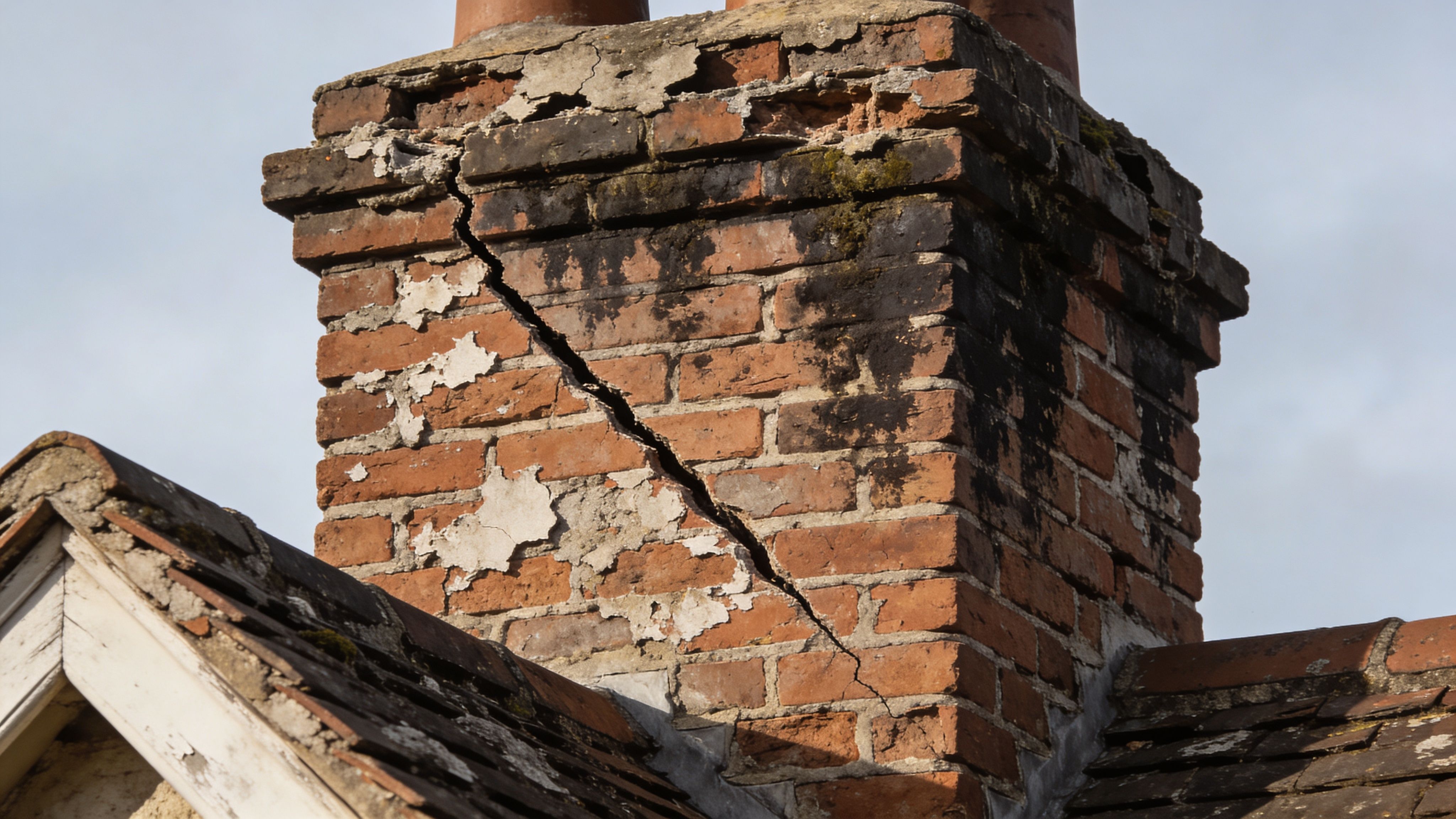
Many chimney problems announce themselves indoors before anyone notices the stack itself.
Not every damp mark near a chimney is caused by the stack. But if the pattern follows the breast, worsens in bad weather, or is paired with external masonry defects, the chimney moves high up the suspect list.
You don’t need to climb onto the roof to notice many warning signs.
Look for crumbling mortar joints, open gaps between bricks, and white salt deposits on the masonry. Check whether any bricks appear fractured, flaking, or missing their faces. Spalled brickwork often shows up as rough, broken surfaces rather than neat rectangular arrises.
Then stand back and judge the line of the stack. A stack that appears to lean, bulge, or twist should never be dismissed as character.
Practical rule: if the chimney looks out of plumb from street level, treat it as a structural concern until a professional says otherwise.
Other clues include:
Weather has made these issues harder to ignore. A Q4 2025 report cited as a joint finding by the Met Office and the Association of British Insurers recorded a 35% surge in claims for wind-damaged stacks compared with 2024, and noted that insurers may refuse claims where pre-existing defects were not documented, which is why regular inspection matters (wind-damaged stack claims and documentation issues).
That last point matters in practice. If you’ve noticed movement or deterioration and done nothing, an insurer may take a different view from an owner who can show the defect was being monitored and professionally assessed.
A chimney stack fails because it is exposed, porous, and often old. Once water gets in, several mechanisms start working at the same time.
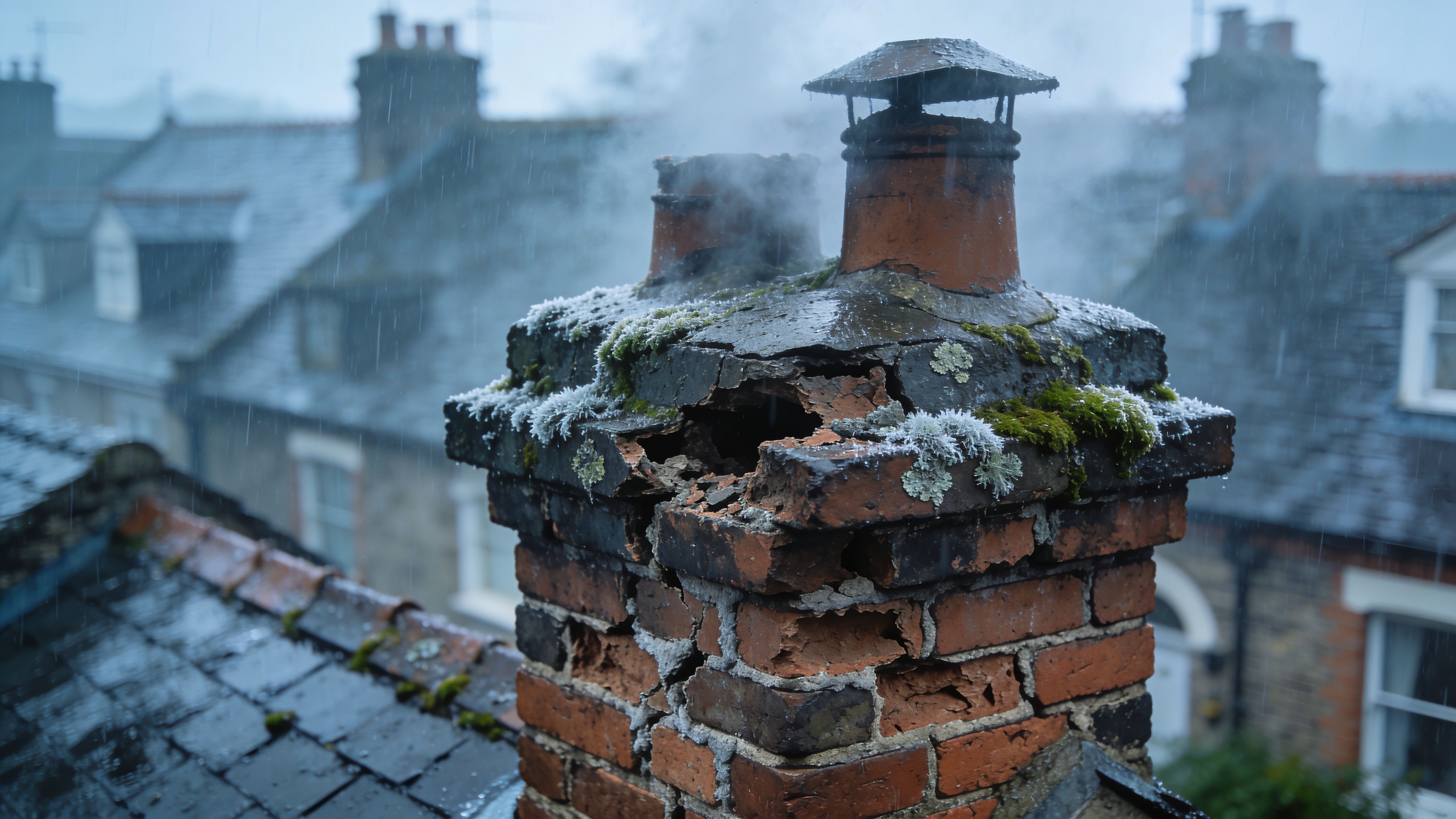
The most common cause is simple weathering. Rain enters through open joints, cracked flaunching, or porous brick faces. When temperatures drop, trapped moisture freezes and expands. That repeated freeze thaw cycle widens cracks, loosens mortar, and can break the face off softer bricks.
Wind-driven rain makes the process worse because chimneys are fully exposed above the roofline. The stack takes far more punishment than the masonry lower down the building. Once the upper courses and joints start to fail, water can travel downward through the structure and appear inside the property.
If you’re also dealing with internal moisture symptoms, it’s worth understanding how surveyors distinguish between sources of water ingress and condensation. A good overview of that wider diagnostic process is set out in these damp and timber reports.
Not every chimney problem is weather alone. Used flues can suffer from deposits and chemical attack. Older stacks may have mortar weakened over many years by flue gases and general ageing. Some defects also stem from movement in the building, particularly where the stack is tall or where past settlement has stressed the masonry.
The repair history matters as much as the original construction. One of the most common mistakes on older properties is using a hard cement-rich mortar on soft historic bricks. That may look neat at first, but it can trap moisture and force the bricks to fail before the joints do. In practical terms, the wrong mortar can accelerate the very damage the repair was meant to stop.
Typical causes I’d expect to see behind chimney stack repairs include:
Old chimneys usually don’t need harder materials. They need compatible ones.
That is why diagnosis comes before pricing. Two stacks can show the same damp patch indoors and need completely different remedies outside.
A proper diagnosis isn’t just someone glancing up from the driveway and saying, “It needs repointing.” Good inspection work narrows down the defect, the cause, the urgency, and the safest way to inspect further if access is difficult.
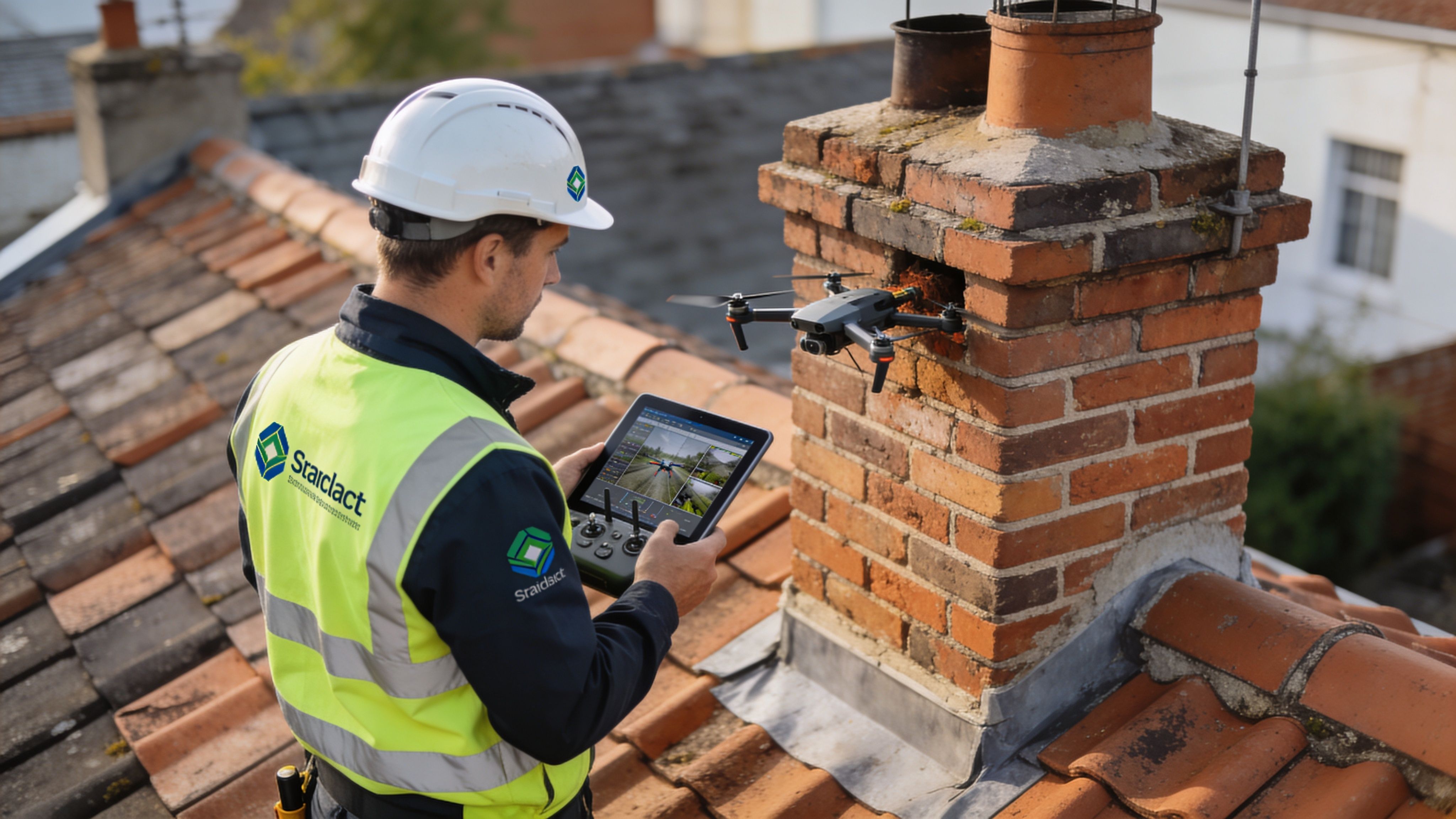
The first stage is usually a visual assessment. That includes the stack’s verticality, brick condition, mortar loss, visible cracking, state of the pots, condition of the flaunching, and lead flashing at abutments. Inside the house, the surveyor will relate high-level defects to staining, dampness, and any signs around the chimney breast or loft.
A structured roof-level inspection can be valuable, particularly when the stack can’t be safely seen in enough detail from ground level. For homeowners comparing options, this guide to a roof survey near me is useful because it explains when visual, drone, or closer-access inspections make sense.
A competent inspection also considers the building context. Is the property Victorian with soft brick and lime mortar. Is the stack shared. Is the flue still active. Has the owner had previous patch repairs. Those details affect the conclusion.
Where access is difficult, a drone survey can give clear imagery of defects at the top of the stack without immediate scaffolding. That is often enough to confirm failed pointing, open joints, damaged pots, or defects in the leadwork.
For larger or more complex buildings, a specialist inspection may be necessary. According to guidance on Class II rope-access stack inspections, these inspections may be used on complex or high-rise residential buildings under frameworks including CDM 2015, and can use hammer testing and ultrasonic gauging to assess issues such as crown corrosion or liner delamination with 95% accuracy in predicting failure loads.
That level of investigation is not routine for an ordinary house. It is, however, very relevant where the stack is unusually tall, difficult to access, visibly unstable, or part of a more complex residential block.
A short visual explanation can help if you’ve never seen how a modern roof-level inspection is carried out.
The purpose of diagnosis is not to produce a long defect list. It is to identify the repair that will actually stop the failure.
One factual option available to owners is to instruct a chartered surveyor through a platform such as Survey Merchant, which matches enquiries to relevant survey professionals for inspections including roof and defect reporting.
Most chimney stack repairs fall into a small number of categories. The important point is that each one solves a different problem. If the defect is misread, the repair won’t last.
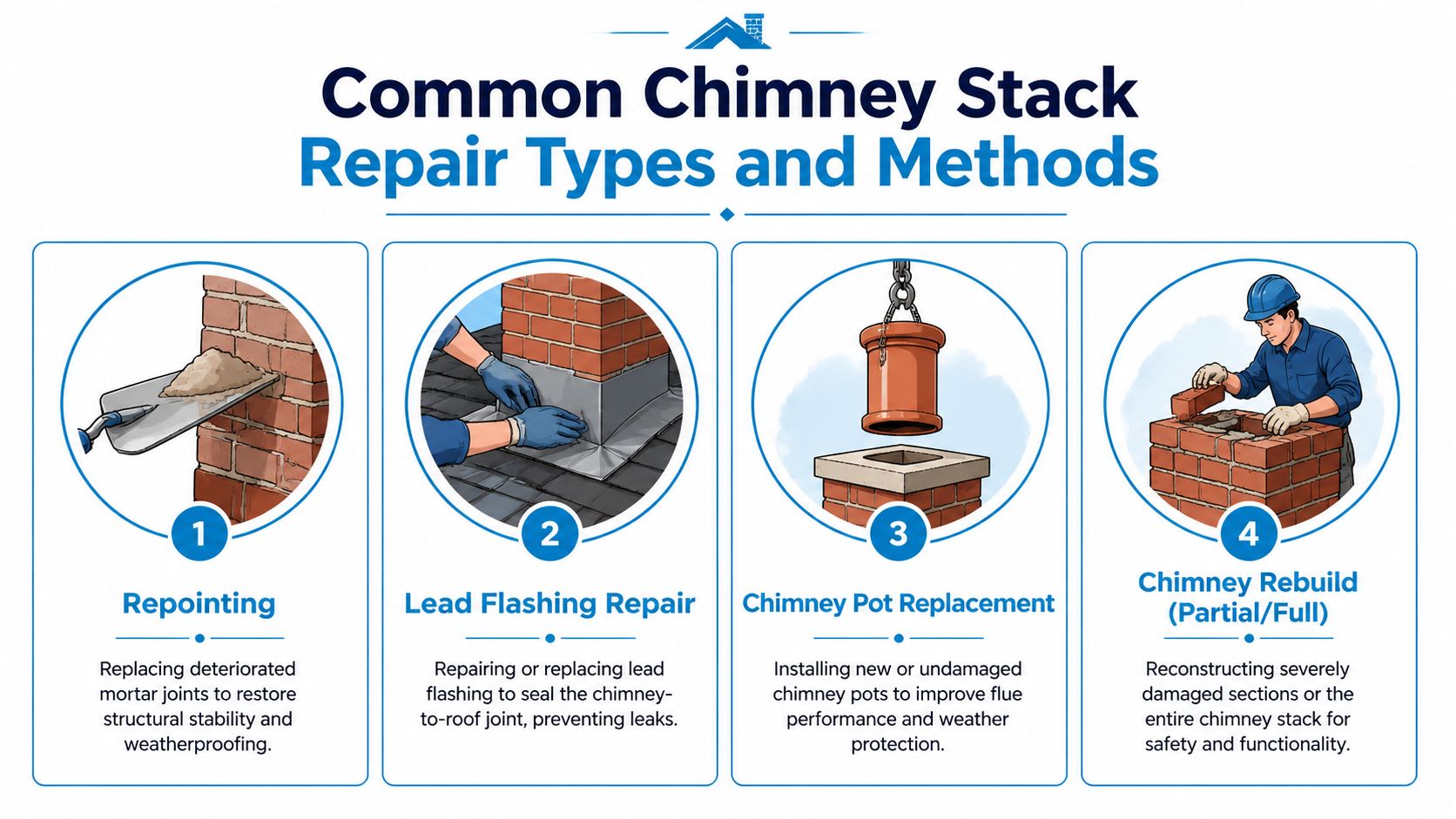
Repointing deals with failed mortar joints between the bricks. It does not solve every chimney defect, but it is one of the most important repairs where the masonry remains broadly sound and the joints have weathered back.
The process matters. According to Bradford Council guidance on chimney repair and maintenance, deteriorated mortar should be raked out to 20 to 25mm and replaced with a suitable mix, often lime-based for older stacks. The same source notes that a correctly repointed stack can reduce water absorption by 40 to 60% and potentially extend service life by 20 to 30 years.
In practical terms, good repointing restores weather resistance and helps the stack shed water properly. Bad repointing often does the opposite. Overly strong cement mortar, shallow filling, or smearing across brick faces are all poor signs.
Flashing is the weathering detail at the junction between the chimney and the roof covering. If it splits, lifts, or has been patched poorly, water can enter around the base of the stack even when the brickwork itself is sound.
Leadwork failures can mimic a masonry defect because the leak often appears near the chimney breast or in the loft around the stack. The remedy may involve redressing sound lead, replacing failed sections, or correcting poor detailing where previous work was rushed.
For owners who want a plain-English overview of how this junction is formed and repaired, How to Reflash a Chimney gives a useful visual explanation of the principle. The exact specification still needs to suit the roof covering, abutment detail, and condition on site.
At the top of the chimney, the mortar around the pots and upper surface is there to secure the pots and throw water clear. When that surface cracks or breaks away, water starts entering from above.
This defect is commonly missed from ground level. Owners often notice the indoor staining long before they realise the top of the stack is open. Localised repairs can work where the damage is modest and the stack is otherwise stable. Where the top is extensively degraded, more substantial rebuilding of the upper courses may be the safer option.
A damaged or loose chimney pot is not just a cosmetic issue. It affects weather protection, can compromise flue performance, and in bad cases creates a falling debris hazard.
Replacement is usually straightforward if access is already in place and the top of the stack is sound. The key is to ensure the pot is properly bedded and that any associated capping, venting, or termination detail is suitable for whether the flue is active, redundant, or ventilated.
Rebuilding becomes necessary when the stack has lost structural integrity. Typical triggers include deep cracking, severe brick failure, leaning, unstable upper courses, or repeated repair history with no durable result.
Sometimes only the upper section needs taking down and rebuilding. In other cases, the whole visible stack above roof level requires reconstruction. This is more intrusive than repointing or flashing repair, but it is often the correct answer where the masonry has gone beyond patch repair.
A useful way to compare the main options is below.
| Repair Type | Typical Problem Solved | Indicative Cost (2026) | Best For |
|---|---|---|---|
| Repointing | Eroded or open mortar joints | Cost varies with height, access, and extent of decay | Stacks with sound bricks but failed joints |
| Lead flashing repair | Leaks at chimney to roof junction | Cost varies with lead detail and roof access | Localised water ingress around stack base |
| Chimney pot replacement | Cracked, loose, or missing pots | Cost varies with access and pot condition | Defective terminals on otherwise stable stacks |
| Partial or full rebuild | Structural instability, severe cracking, major decay | Cost varies significantly by extent of rebuilding and scaffold needs | Unsafe or extensively deteriorated stacks |
If a quote doesn’t clearly say which defect it addresses, ask for that explanation in writing. A proper specification should tell you whether the contractor is repairing joints, top weathering, roof junctions, the pots, or the structure itself.
The stress of chimney stack repairs often comes less from the brickwork and more from the practical consequences. Who pays. Do you need notices. Will insurance help. Can the contractor just start.
There is no single reliable UK price that suits every chimney. Cost depends on access, height, scaffold requirements, whether the stack is on a main roof or a rear addition, the extent of masonry deterioration, whether the flashing also needs replacement, and whether the stack is shared.
That is why estimates based only on a phone call are of limited use. The same visible symptom, such as damp by the chimney breast, could result in a small flashing repair or a substantial rebuild above roof level.
The sensible way to compare quotations is to check whether each one includes:
Shared chimney stacks need extra care. In a terrace or semi-detached house, the stack may serve or straddle more than one property. If works affect a party structure, the Party Wall etc. Act 1996 may need to be considered before work starts. Owners who skip that step can turn a building defect into a neighbour dispute very quickly.
Leasehold properties add another layer. Under the Landlord & Tenant Act 1985 and the wider scrutiny created by the Building Safety Act 2022, freeholders are typically responsible for structural maintenance, and chimney defects on shared stacks can become a legal issue if responsibility is disputed.
Insurance is also more nuanced than many owners expect. Sudden storm damage may be treated differently from long-term deterioration or neglected maintenance. If water has entered internally, it helps to understand the general distinction insurers often draw between sudden insured events and gradual defects. This overview of understanding water damage insurance coverage is useful as background reading, though your own policy wording remains the deciding document.
For regulatory context, homeowners dealing with approvals, compliance, or related property work can also review these building regulations articles.
A contractor’s quote is not legal advice. If the chimney is shared, leased, or subject to an insurance claim, sort the paperwork position as carefully as the repair itself.
There are a few useful things you can do yourself. Stay at ground level. Look for loose mortar, leaning, cracked pots, or staining after rain. Check the loft if it’s safe to enter, and note any dampness or daylight near the chimney line. If the fireplace is redundant, look for fallen debris in the hearth or signs of moisture around the opening.
What you shouldn’t do is attempt DIY chimney stack repairs at height. Even minor-looking defects can involve unstable masonry, fragile roof coverings, or hidden failure at the top of the stack. Sealants and quick patch products are especially poor substitutes for correct repair. They often hide the defect briefly and make later diagnosis harder.
When you brief a surveyor or contractor, be specific. Say where the symptom is, when it appears, whether the flue is in use, whether the stack is shared, and whether previous repairs have been carried out. Send clear photos from ground level and from inside the affected room if relevant. That usually produces a better first response than saying, “I think the chimney is leaking.”
For broader property maintenance reading from a UK perspective, JRG Property's blog is one of several practical resources homeowners may find useful alongside formal survey advice.
If the stack is visibly leaning, dropping material, or causing active water ingress, don’t wait for the next storm to make the decision for you. Get it inspected properly, get the cause identified, and then repair the right part in the right way.
If you need an impartial opinion on chimney stack repairs, Survey Merchant can help you find a suitable UK surveyor for the job. A clear inspection report can identify the defect, explain the likely cause, flag legal issues such as shared ownership or party wall implications, and give you a sound basis for speaking to contractors or insurers.
Survey Merchant provides vetted RICS surveyors across 100+ UK locations at fixed fees:
→ Level 2 Home Survey (HomeBuyer Report)
→ Level 3 Building Survey (full structural survey)
→ RICS Red Book property valuations
→ Party wall surveyors — notices, awards & schedules of condition
→ Expert witness surveyors — CPR Part 35 reports for property disputes