Leasehold
Aug 2, 2026
7 Common Problems Found in Building Surveys
Surveys reveal seven costly defects—structural movement, damp and mould, roof and electrical faults, plumbing, poor insulati

Building surveys often highlight key issues that can lead to costly repairs if ignored. Here are the seven most common problems identified during inspections:
Key takeaway: A Level 3 survey can save you thousands by identifying these problems early. While the survey costs £600–£1,300, skipping it could lead to unexpected repair bills averaging £5,750 - or worse, £30,000 in severe cases. Always prioritise a thorough inspection before committing to a property.
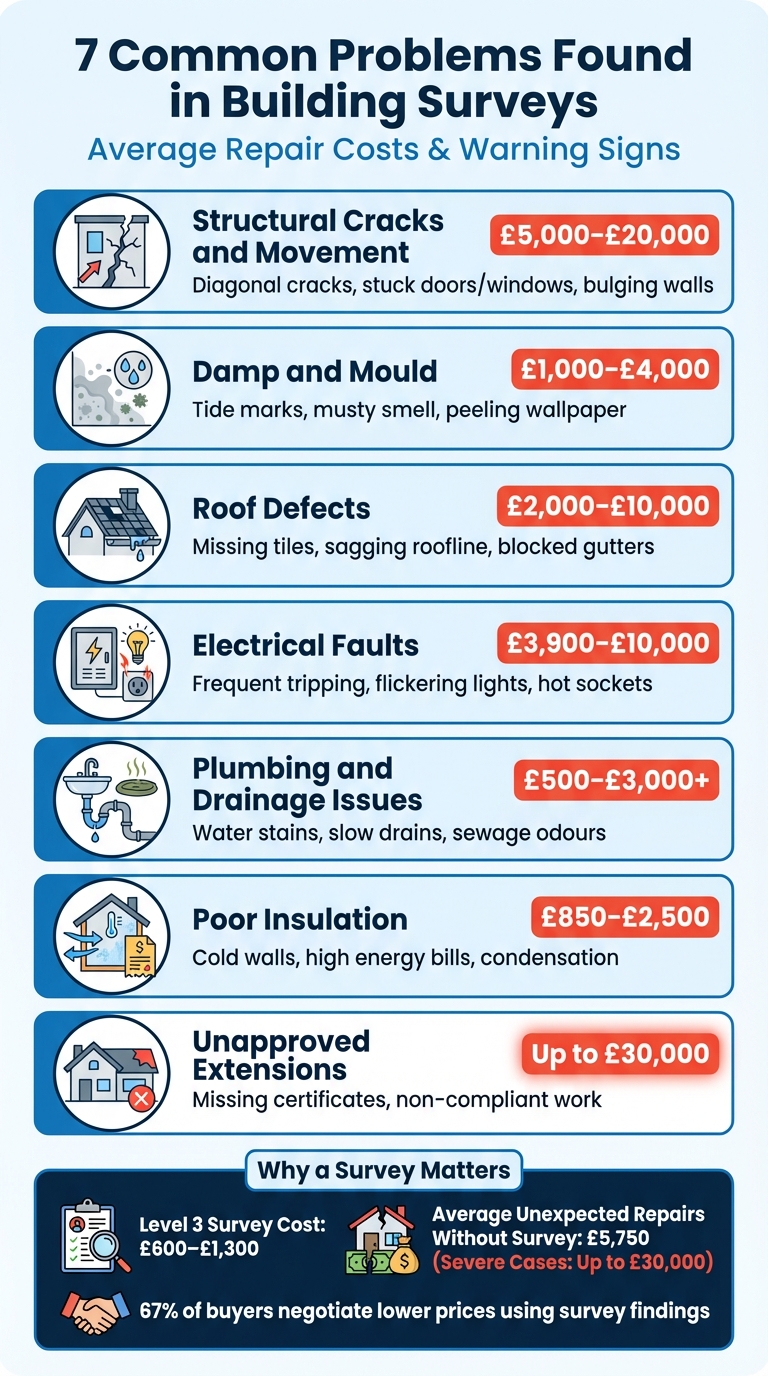
7 Common Building Survey Problems and Repair Costs
Structural cracks and movement often point to serious issues within a building's framework. When the ground beneath a property shifts or sinks, the foundations can become unstable, leading to widespread damage. This is particularly common in areas like London, where clay subsoil is prevalent. Clay expands when wet and contracts when dry, making it a frequent culprit behind subsidence [1][8].
The warning signs are often visible. Diagonal cracks that widen at the top can indicate foundation shifts or subsidence, while horizontal cracks in mortar joints - typically appearing every five to seven brick courses - may suggest corroded wall ties [6]. Other indicators include doors and windows that no longer close properly, bulging cavity walls, and wrinkled wallpaper (not caused by damp) [6].
"Subsidence can be a particular issue in the London area due to large areas of clay subsoil, so it's important to take expert advice in order to identify it early."
– James Brook, FRICS, Novello Surveyors [1]
Failing to address structural movement can lead to severe consequences. Properties with unresolved defects often become financial burdens, with repair costs spiralling out of control. Mortgage lenders may even refuse financing or require costly insurance guarantees before proceeding [5]. On average, fixing structural issues costs around £13,500, though severe cases can escalate into tens of thousands of pounds [5][2]. Interestingly, about 67% of buyers use survey findings to negotiate a lower purchase price when structural problems are identified [2].
Several factors contribute to structural instability. Shrinking clay subsoil, tree roots extracting moisture, and leaky drains eroding the ground are common causes [1][6][8]. Rusty wall ties are another issue, as they can expand up to seven times their original size, creating horizontal cracks across brick façades [6]. Additionally, the invasive Japanese Knotweed poses a unique threat. Its aggressive roots exploit existing cracks in concrete, brickwork, and foundations, gradually weakening a building's integrity [6][8]. Movement in key building components - like roofing, flooring, or structural frameworks - can also trigger further instability [4].
If a survey identifies movement, the next step is to commission a structural engineer's report. This report provides a detailed assessment of the issue, including the extent of foundation failure, the load-bearing capacity, and the overall damage, before suggesting solutions.
"A structural engineer's report is a specialised assessment that examines a particular structural concern, such as cracking in walls, deflection in floors, or issues with foundations."
– Chris Bloor, MRICS Chartered Surveyor, CJ Bloor Property Consultants [7]
For subsidence, underpinning is often required to reinforce existing foundations. This process typically costs between £5,000 and £20,000, depending on the severity of the issue [2]. Wall tie problems, if caught early, can be resolved by installing remedial ties, which avoids the need for extensive rebuilding [6]. Skipping surveys, however, can be a costly mistake - new homeowners often face unexpected repair bills averaging £5,750 after moving in [8].
The following sections will explore other critical defects, including issues with damp, roofing, and more.
Damp issues go beyond just cosmetic or structural concerns - they can severely affect both the building's condition and the health of its occupants. It's one of the most common problems uncovered during building surveys, as it impacts both the structure and the people living within it. There are three primary types to watch for: rising damp (groundwater travelling upward through porous materials), penetrating damp (water seeping in from outside), and condensation (the most widespread, caused by warm, humid air meeting cold surfaces) [10]. Early detection is key to addressing these problems effectively. Professor Michael Parrett FRICS highlights that true rising damp is relatively rare when an original damp-proof course is intact, noting:
"Failure of an original damp-proof course is extremely rare" [9].
The health risks associated with damp and mould are serious. Mould thrives in damp environments and produces mycotoxins - harmful substances that can be inhaled or absorbed through the skin. These toxins pose significant health risks, especially for vulnerable groups like children and the elderly. Keeping indoor temperatures between 18°C and 21°C can help prevent mould growth, as lower temperatures encourage spore development [9].
The growing awareness of damp-related problems is evident in the 82% increase in online searches about the issue between 2018 and 2020 [2]. Chris Bloor, an RICS-qualified surveyor, stresses the importance of addressing damp:
"Damp is more than an unsightly problem - it is a symptom of underlying building defects or environmental factors that, if ignored, can undermine structural integrity and compromise indoor health" [10].
In the next sections, we'll explore how to identify these problems and take the right steps to fix them.
Spotting damp early can save you from more extensive damage and costly repairs later. Each type of damp has its own tell-tale signs:
Surveyors use tools like moisture meters, thermal imaging, and detailed visual inspections to detect damp in vulnerable areas [10]. However, moisture meters can sometimes give misleadingly high readings due to other conductive materials, which is why professional analysis is crucial [9].
The solution depends on the type of damp you're dealing with:
Damp-proofing and ventilation upgrades typically range from £1,000 to £4,000 [12]. When tackling mould, use specialised mould cleaners rather than standard bleach, and always wear protective equipment like gloves, goggles, and a mask [9].
Addressing these issues promptly can protect both your home and your health.
Your roof serves as your home's frontline defence against the elements, so it’s no surprise that roofing issues are a common concern flagged in building surveys. In fact, online searches for roof-related problems have surged by 55% over the past two years [2], reflecting growing awareness of their impact.
Skipping a professional survey can lead to unexpected and costly repairs. Spotting problems early not only allows for timely fixes but also opens the door for price negotiations. Below, we’ll explore the most common roofing issues and what they might signal about your property.
Roof defects come in many forms, and surveyors often encounter a range of issues during inspections. One of the most frequent problems is damaged or missing tiles and slates. Signs to watch for include cracked or displaced tiles, curled shingle edges, and "bald spots" where the protective granules have worn away [13] [14] [3]. These may seem minor at first but can quickly lead to water damage inside the home.
A sagging roof is a more serious concern, often caused by ageing timber frames, moisture damage to beams, or the added weight of heavy concrete tiles from previous repairs [13] [15]. If the roofline appears uneven from the outside, it could indicate structural problems that need immediate attention.
Blocked or sagging gutters are another common issue. When gutters fail to drain properly, water can overflow, damaging fascia boards and causing damp [1] [3] [15]. Moss and debris build-up only make matters worse, which is why surveyors check for proper gutter slope to ensure effective drainage.
Flat roofs bring their own set of challenges. They’re particularly prone to water pooling, surface cracks, and general wear and tear [1] [15]. As Barons Property Centre notes:
"Flat roofs typically have a much shorter lifespan than traditional pitched roofs. If your survey indicates significant wear and tear or damage... replacement is often the best solution" [15].
Another frequent culprit behind leaks is defective flashing, particularly around chimneys and adjoining walls [3] [15]. Inside the home, damp patches on ceilings, peeling paint, rotting roof deck boards, and high attic moisture levels often point to external roof problems [13]. For areas that are hard to access, surveyors may use tools like pole cameras or infrared imaging to uncover hidden defects and check ventilation [1].
| Roof Component | Defect | Consequence |
|---|---|---|
| Tiles/Slates | Cracked, missing, or slipped | Water penetration and internal damp |
| Gutters | Blocked, sagging, or overflowing | Rotting fascia boards and penetrating damp |
| Flat Roof Surface | Water pooling or cracking | Rapid material deterioration and leaks |
| Roof Structure | Sagging or dipping roof line | Structural instability or potential collapse |
| Flashings | Gaps or deterioration | Leaks around chimneys and wall joints |
| Attic Space | Poor ventilation | Condensation, mould growth, and timber rot |
Dealing with roof issues quickly can save you from more expensive repairs down the line. The cost of fixing roof damage varies depending on the severity and the materials involved. For example, re-tiling a roof can range from £2,000 to £10,000, depending on the area affected and the type of tile used. Replacing gutters, especially if fascia boards also need work, can fall within a similar price range [16].
Flat roofs often require a different approach. Contractors may install tapered insulation to improve drainage and address water pooling [16]. However, because flat roofs have a shorter lifespan, they often need complete replacement rather than patch repairs, which can be more expensive.
Preventative maintenance is essential. Homeowners should inspect their roofs at least once a year, with additional checks after major storms [13]. Cleaning gutters and drains twice a year - in spring and autumn - helps keep them clear of debris and functioning properly [13]. Controlling moss and vegetation is also critical, especially in winter, as these can trap moisture and accelerate wear [13] [14].
Supreme Roofing Stroud highlights the importance of early intervention:
"Identifying and addressing these roof structure defects in time is key to preventing significant damage to the property" [13].
If major issues are uncovered, Barons Property Centre advises:
"If the survey throws up major roofing problems, a roofing contractor should be called for an expert opinion on the work that needs doing and how much it is likely to cost" [15].
Serious roof defects can even affect property transactions. Mortgage lenders may withhold offers or reduce valuations until repairs are completed or guaranteed [2] [15]. This makes a thorough roof inspection during your building survey all the more critical.
Electrical faults are some of the most serious yet tricky issues to uncover during building surveys. Since wiring is often concealed behind walls, potential hazards can remain hidden. Standard building surveyors typically rely on visual checks for electrical systems, as they aren't legally qualified to test utilities [8]. The Guild of Property Professionals explains:
"A Chartered Surveyor is not legally qualified to test any of the utilities in the property. That said, the survey report does usually have a section on 'services', with findings based on a visual assessment only." [8]
This makes specialist electrical inspections particularly important, especially for older properties. Outdated wiring and fuse boxes can present risks of fire or electric shock, and modern appliances often push older circuits beyond their limits [17][18]. Bolton Electrical Services highlights the danger:
"Hidden electrical faults are particularly dangerous because they don't always trigger alarms or trip switches, yet they can compromise safety and efficiency over time." [18]
Recognising early warning signs can help address electrical problems before they escalate.
Certain indicators should never be ignored. Frequent tripping of circuit breakers or RCDs often points to underlying issues [18]. Similarly, flickering or dimming lights can reveal an inconsistent power supply, while buzzing or humming sounds from sockets or the fuse box may indicate loose connections or overloaded circuits [18].
Other warning signs include hot sockets, scorch marks, or unusual buzzing noises from the fuse box, all of which signal immediate danger [18]. Checking for Residual Current Device (RCD) protection in your fuse box is another key safety measure, as many older systems lack this feature [18]. Outdated systems are often identifiable by old-style fuse boxes with wooden backs or replaceable wire fuses, sockets mounted in skirting boards, or cables insulated with black rubber, lead, or fabric - all of which should be replaced [19].
If faults are suspected, a detailed electrical inspection can help prioritise necessary upgrades. A professional Electrical Installation Condition Report (EICR) is crucial for identifying risks and ensuring compliance with UK regulations like BS 7671 [18]. For homeowners, an EICR is advised every 10 years, while landlords are legally required to obtain one every 5 years [19]. During the inspection, electricians assess circuits and assign hazard codes: C1 for immediate danger, C2 for action needed within 28 days, and C3 for recommended improvements [19].
Rewiring costs can vary significantly depending on property size. Estimates range from £3,900 for a one-bedroom flat to over £10,000 for a five-bedroom house [20]. Some sources suggest a minimum cost of £2,000 [6]. Generally, residential wiring should be checked or updated every 20–25 years [20].
To ensure compliance with BS 7671, hire an electrician registered with NICEIC, ELECSA, or NAPIT, as they can self-certify their work [20]. If you're buying a property, always request an electrical test certificate dated within the last 10 years, along with a boiler test certificate from the past 12 months [8].
Plumbing and drainage problems are some of the most common issues uncovered during building surveys, yet they’re often overlooked until they cause serious damage. Left unaddressed, these faults can escalate quickly, leading to costly structural repairs. Surveys typically assess whether your drainage system complies with current regulations and check for visible blockages or signs of disrepair [1].
The financial impact of ignoring these issues can be steep. Homebuyers who bypass surveys face unexpected repair bills averaging £5,750 after moving in, with plumbing faults being a major contributor [8][2]. A 2016 study revealed that blocked pipes and drains were the most frequent plumbing issue, affecting 35% of homeowners, followed by broken taps and toilets at 28.2% [22]. Below, we’ll explore the most common faults and their potential repair costs.
Here’s a closer look at typical plumbing problems identified during surveys.
Leaking pipes, often hidden behind walls or under floors, can manifest as water stains, damp patches, or mould growth [23]. Even a small leak can waste an astonishing amount of water - just one drip per second adds up to 2,083 gallons a year [23]. As Lee Company highlights:
"Ignoring a seemingly insignificant drip could be wasting thousands of gallons of water and thousands of dollars" [23].
Blocked drains are another frequent issue. Signs include slow-draining sinks, gurgling noises from pipes, and unpleasant sewage odours [22]. In some cases, tree roots can crack underground pipes, leading to leaks and even pest problems [1]. Meanwhile, sagging gutters clogged with debris or vegetation can allow water to seep into external walls, causing further damage [3]. Sudden spikes in your water bill might also signal hidden leaks behind walls or beneath floors [23].
Once faults are identified, acting quickly is key to preventing further damage.
CCTV drain surveys are a non-invasive way to locate blockages, collapsed pipes, or tree root intrusions [21]. For smaller cracks that might not appear on camera, hydrostatic testing offers another detection method [21]. Repair costs vary widely depending on the issue. For example, CCTV drain surveys and pipe replacements can cost anywhere from £500 to £3,000, but more complex problems - like a broken main line or extensive leaks - can push costs even higher [22].
Before moving forward with repairs, it’s worth checking whether the affected pipes fall within your property boundaries or are the responsibility of your local water supplier [24]. Additionally, reviewing your home insurance policy is a smart move, as some policies may cover accidental damage to drainage systems [24].
Beyond the structural and system-related issues, poor insulation can have a significant impact on energy efficiency, often leading to higher energy bills. Heating and cooling account for a substantial portion - 50–70% - of household energy costs [25]. In the UK, 19% of residential buildings were built before 1945, a time when modern thermal standards were non-existent. This makes older homes particularly prone to insulation problems [26]. Spotting these issues early, as with other survey findings, can help avoid mounting expenses.
Surveyors often rely on thermal imaging cameras to detect "cold spots", areas where heat escapes from a property [25]. Common signs of poor insulation include uneven room temperatures, cold interior walls or floors, heating systems that seem to run endlessly without achieving comfort, and recurring condensation on windows [25][27]. Other indicators include ice dams forming on roof edges and poorly insulated floors, which can account for up to 10% of a home's heat loss [25][26].
A sudden spike in energy bills - typically a 15–20% increase without any change in energy rates - can also signal insulation issues. Surveys may uncover additional problems, such as outdated boilers or properties failing to meet Energy Performance Certificate (EPC) standards, which exacerbate energy inefficiency [29].
Once energy inefficiencies are identified, loft insulation is often recommended as the first step in improving a property's thermal performance [28]. Current guidelines suggest 270mm of mineral wool insulation, which can cut heating costs by 20–30% when installed correctly [25][28]. For instance, insulating an uninsulated loft can save homeowners between £210 and £390 per year, while upgrading existing insulation from 120mm to 270mm can still yield annual savings of £20 to £35 [28].
The cost of loft insulation typically falls between £850 and £1,200, depending on the type of property [28]. Wall insulation, on the other hand, can range from £500 to £2,500, influenced by the size of the property and the materials used. It's crucial to ensure the loft is dry before adding insulation, as trapped moisture can lead to mould and reduce the insulation's effectiveness over time [28].
Making property changes without proper approval can lead to serious legal and financial headaches. Building regulations are updated regularly, so work that was acceptable years ago might not meet today’s standards [3]. These issues often come to light during surveys, which can disrupt sales or lead to costly renegotiations. On average, fixing unapproved work can set you back around £5,750, though in some cases, costs can soar to £30,000 [15][2]. Addressing these problems is crucial to protect the property's market value.
Surveyors often flag extensions, loft conversions, or structural changes that lack the necessary certifications. Missing documents, such as building regulation completion certificates, gas safety records, or electrical test certificates, are clear red flags [3]. Properties with unapproved work can face hurdles like mortgage refusals from lenders and denied insurance coverage until the work complies with regulations [6][15].
If unapproved work is identified, homeowners can seek "Regularisation" from their local authority's Building Control Body. This process provides retrospective approval for work completed after 11 November 1985 [3]. For buyers, it’s wise to request all relevant certificates from the seller. If the property has visible extensions, upgrading to a Level 3 Survey is a good idea, as it offers more detailed advice than standard surveys [3].
Boundary disagreements often arise from unclear property lines or neglected fences and hedges. The legal boundary - an invisible line established during land conveyance - can differ from physical markers like walls or fences, which may shift over time through formal or informal agreements [32]. For properties next to public land, clearly defined boundaries are especially important [3].
"Good boundaries make good neighbours" is a well-worn phrase for a reason. When the boundaries between properties are not clear, this can lead to disputes, which can cause stress and are costly and time-consuming to resolve. - RICS [32]
To avoid disputes, keep boundary features in good condition and consider getting a topographic survey from a chartered land surveyor if you’re planning construction or facing disagreements [32]. If disputes already exist, consulting a RICS-regulated firm ensures professional standards and indemnity insurance. Buyers can also check the Title Register and Title Plan from HM Land Registry (available online for £7 each) to identify restrictive covenants or easements. However, these documents usually only provide general boundary outlines rather than precise details [30][31]. Such legal intricacies highlight the importance of thorough checks when reviewing survey reports.
Getting a building survey is a smart move that can save you from unexpected expenses and serious property issues. In the UK, 67% of buyers use survey findings to negotiate a lower purchase price [2]. On the flip side, skipping a survey could leave you facing average repair costs of £5,750 - or even as much as £30,000 in severe cases [15][2].
As Novello [1] aptly says:
"Foregoing a building survey to save cash can be a false economy."
This highlights the importance of spotting potential problems before making a financial commitment. Common defects uncovered in a survey can influence your mortgage approval, insurance options, and the long-term value of your property. By identifying these issues early, you gain the chance to negotiate repairs with the seller, plan for future costs, or, if necessary, walk away from a risky purchase.
A survey doesn't just protect your investment - it simplifies your decision-making. From structural cracks to insulation problems, survey reports provide the critical insights you need. Partnering with services like Survey Merchant connects you with skilled surveyors who use advanced tools such as pole cameras and infrared technology to detect hidden issues that might escape notice during a standard viewing [1].
Structural cracks often point to movement within a building, and recognising them early can help address potential issues. Pay attention to long, straight cracks that run vertically or diagonally through brickwork or mortar. These are more likely to indicate structural problems compared to small, irregular hairline cracks in plaster. Watch for stair-step cracks in brick walls, cracks that grow wider over time, or those forming near doors, windows, or skirting boards, as they may signal settlement or subsidence. Additionally, doors and windows that start sticking or fail to close properly can also suggest underlying movement.
To keep an eye on potential movement, measure changes in cracks over several months. Movement exceeding 25 mm vertically or 6 mm laterally within a year is generally considered excessive and warrants attention. Tools like crack-monitoring gauges or simple marks on either side of a crack can help track any changes. If you observe rapid widening or movement beyond acceptable limits, it’s wise to arrange a full structural survey with a qualified surveyor to evaluate the situation and recommend appropriate solutions.
To keep damp and mould at bay, the first step is tackling any sources of excess moisture. Fix leaks as soon as possible, whether it's broken roof tiles, cracked render, or damaged gutters, as these can let water seep into your walls and floors. Make sure windows are sealed properly, and check that external walls are waterproof. If you live in an older property, you might want to think about adding a damp-proof course to deal with rising damp.
Ventilation plays a big role in cutting down condensation, which is a major trigger for mould. Use extractor fans in kitchens and bathrooms, open windows when you can, and create cross-draughts to let moist air escape. Aim to keep indoor temperatures steady at around 20 °C and relative humidity below 60%. For areas with poor ventilation, a dehumidifier can make a real difference.
Adding thermal insulation can help keep surfaces warm, reducing the chances of condensation. Avoid drying clothes indoors unless there's good airflow, and make it a habit to clear gutters and check for early signs of damp. Musty smells or small patches of mould should be dealt with quickly to stop them from turning into bigger, more expensive problems. By following these steps, you can maintain a dry, comfortable, and healthy home.
Spotting unapproved extensions during a building survey is crucial, as these additions might violate local planning laws or fail to meet building codes. This could lead to legal headaches for the new owner, including fines or enforcement actions.
Beyond legal troubles, unapproved extensions can lower a property's value and might demand expensive fixes to either bring them up to code or revert to the original design. Identifying these issues early helps buyers make smarter choices and steer clear of surprise costs.
Survey Merchant provides vetted RICS surveyors across 100+ UK locations at fixed fees:
→ Level 2 Home Survey (HomeBuyer Report)
→ Level 3 Building Survey (full structural survey)
→ RICS Red Book property valuations
→ Party wall surveyors — notices, awards & schedules of condition
→ Expert witness surveyors — CPR Part 35 reports for property disputes