Expert Witness
Sep 26, 2026
When to Hire an Expert Witness for Construction Defects
When defects are disputed, hidden, structural or costly, instruct a CPR Part 35 expert early to protect liability, scope and costs.

If the defect is disputed, hidden, structural, safety-related, or expensive to fix, I’d bring in an expert witness before any repair work starts. In many UK building disputes, that one step can affect liability, remedial scope, and settlement value. Costs often start at £5,000 to £15,000 for simpler cases, and can go past £50,000 where there are several issues.
In plain terms, I’d hire an expert when:
Why so early? Because once repairs begin, part of the proof may be gone. Photos and emails help, but they usually do not show why the problem happened or what work was actually needed. A CPR Part 35 report does that in a form the court can use.
Here’s the short version:
| Issue | When I’d instruct an expert |
|---|---|
| Poor workmanship | When the contractor disputes fault or compliance |
| Structural movement or cracking | Before any opening-up or repair work |
| Latent defects | As soon as the issue appears |
| Fire or cladding concerns | At once |
| Remedial cost dispute | When quotes differ by a large amount |
| Court or tribunal claim | Before formal proceedings gather pace |
So the main point is simple: don’t wait until the site has changed. If the dispute turns on cause, standard, safety, or cost, expert evidence is often the clearest way to prove the case.
Once expert evidence is needed, the report has to do two jobs: pin down the cause and separate liability from cost.
An expert witness is not there to fight your corner. Their main duty is to the court or tribunal, not to the party who instructs or pays them. If the report reads like advocacy, it tends to carry less weight. A good expert sets out the facts, explains the assumptions behind their view, and says plainly where more than one professional opinion may exist.
That process starts with inspection and a close review of the paperwork.
The expert inspects the defect, reviews the contract, drawings, specifications and site records, and checks compliance with Building Regulations, British Standards and accepted practice. If the cause is unclear, they may recommend testing. The report must comply with CPR Part 35 and include a declaration of impartiality and a statement of truth [7].
Diagnosis comes first. Valuation comes after.
The expert then separates cause and responsibility from remedial cost, often with input from a quantity surveyor or structural engineer. Those are not the same issue, and they are often dealt with by different experts.
Once the expert’s role is clear, the next step is timing. You should instruct an expert witness when the defect is in dispute, the cause isn’t clear, or the cost of putting it right could change the outcome.
Bring in an expert when snagging stops being a snagging list and turns into a dispute about compliance, cause or liability [6][4]. If a contractor says the work isn’t defective, or claims it complies with Building Regulations, you’ll often need independent technical evidence. Why? Because the dispute then comes down to cause, standard and who is responsible.
This becomes even more important when the defect is hidden, structural or tied to safety.
Latent defects often show up months or even years after completion. When something fails early, it may point to a problem with the materials, the installation, or the specification [4].
Structural concerns need fast action. If you suspect unsafe temporary supports or doubtful structural changes, an expert should be instructed before any remedial work starts. Once the work has been changed, proving the original defect becomes much harder [4][8]. The same goes for fire safety issues, including cladding and external wall systems, where surveyors and engineers are often instructed to assess compliance with current fire safety standards [5].
If poor design or weak supervision caused the defect, expert evidence may be needed to test whether the professional fell below the standard expected of a competent practitioner [1][6].
Money disputes come up all the time. If there’s a big gap between what a contractor says is due and what you think the finished work is worth, or if the cost of remedial works is disputed, a quantity surveyor acting as an expert can give an independent valuation [1][3]. For straightforward cases, expert witness costs usually range from £5,000 to £15,000. In more complex disputes with several issues, that can rise to £20,000 to £50,000+ [2].
If the project has stalled, an expert can help pin down whether the delay was caused by defective work, design problems or something else [8][1][3].
The timing of the instruction matters too. A well-timed expert report can strengthen the case and affect the weight the report carries.
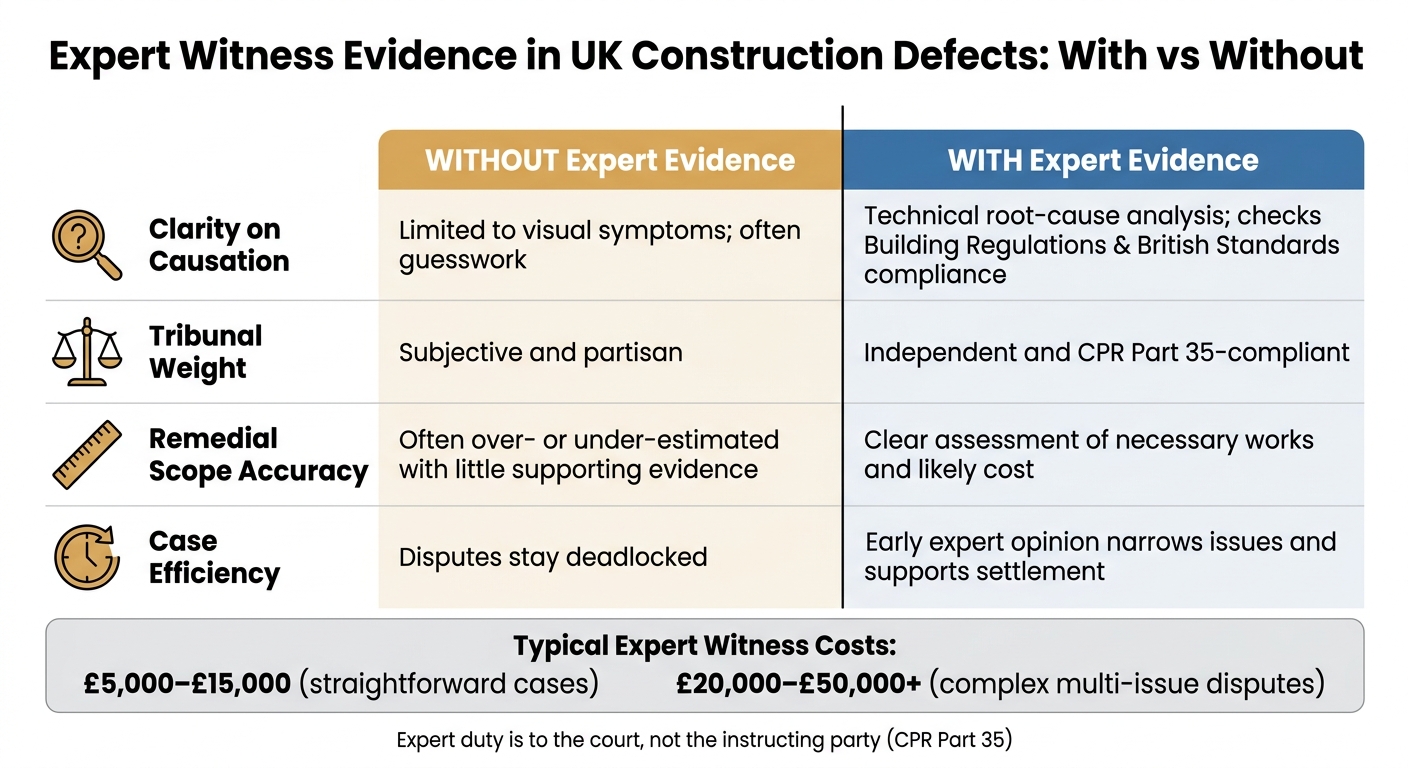
Expert Witness in UK Construction Defects: With vs Without
Once you know an expert is needed, the next issue is simple: how much difference can their evidence make?
In construction defect disputes, expert evidence often shapes the result on liability, scope and settlement. In defect claims, the report helps show the cause of the problem, whether the work meets Building Regulations and British Standards, and what remedial work is needed. The gap between having expert evidence and going without it tends to show up most clearly in the areas below.
| Feature | Without Expert Evidence | With Expert Evidence |
|---|---|---|
| Clarity on causation | Limited to visual symptoms and often reduced to guesswork | Technical analysis of the root cause, including whether the work complies with Building Regulations and British Standards |
| Tribunal weight | Subjective and partisan | Independent and CPR Part 35-compliant |
| Accuracy of remedial scope | Often over- or under-estimated, with little to support the figures | A clearer assessment of what is necessary and the likely cost |
| Case efficiency | Disputes stay deadlocked | Early expert opinion narrows issues and supports settlement |
Without expert input, parties often end up arguing from surface-level signs alone. That can leave causation unclear and the remedial scope poorly defined. With an expert report, the dispute is tied to technical analysis rather than assumption, which gives the tribunal a firmer basis for dealing with the claim.
Timing matters just as much as the report itself.
The value of expert evidence can fall fast if repairs begin before the expert has inspected the defects.
"Where remedial works have already taken place, it can be very difficult for an appointed expert to determine whether those remedial works, or the extent of them, were necessary." - Harrison Clarke [4]
The practical point is straightforward: instruct the expert before repair works start, unless urgent safety issues mean immediate action is needed. If works are already under way, it still makes sense to bring in an expert while the defects can still be seen and inspected.
"Getting a construction claims expert involved early can help strengthen your position, prevent escalation, and even encourage out-of-court settlements." - Simon Levy, Simon Levy Associates [6]
Early expert involvement helps clarify the merits of the case and can also keep costs down.
Once you know expert evidence is needed, the next step is simple: pick the right person to write it.
Choose a surveyor with direct experience of CPR Part 35 expert reports in defect disputes. In construction defect cases, that means someone who can deal with defect diagnosis, compliance issues and court-ready reporting. They should be able to explain the cause of the defect, who is responsible, and the likely remedial value.
Look for MRICS or FRICS status, hands-on defect diagnosis experience, knowledge of CPR Part 35 and a clear understanding that their duty is to the court. In plain terms, the expert needs to stand up on both fronts: the technical side and the legal process.
It’s also worth checking the basics that people sometimes miss:
Avoid anyone offering success-based fees. That is a strict breach of RICS rules and calls their impartiality into question [7].
Costs can vary a lot. Straightforward cases usually fall between £5,000 and £15,000, while complex disputes with several issues can go beyond £50,000 [2].

If you need impartial support, use a service that matches your dispute to the right surveying specialist. Survey Merchant connects property owners and buyers with impartial construction expert witness support across the UK for construction defect disputes.
Picking the right expert matters, but timing matters just as much. Bring in an expert witness when technical causation is in dispute, defects are serious or involve safety, liability between parties is unclear, or the matter is heading towards adjudication, arbitration or litigation.
In defect disputes, early instruction often makes a big difference. If repairs start before the expert has inspected the original defect, part of the evidence can disappear.
"A clear, well-supported expert opinion can illuminate the facts, challenge assumptions, and, in some cases, shift the balance of an entire case." - Faye Williams, Director, Harrison Clarke [3]
The party who instructs the expert witness usually pays their fees. But the expert’s main duty is to the court, not to the side footing the bill.
Sometimes, both sides use a Single Joint Expert and split the cost. Fees often fall between £5,000 and £15,000 for straightforward disputes. In more complex cases, they can go beyond £50,000.
You should generally avoid starting repairs before an expert has inspected the property. Bringing in an expert witness before remedial work starts helps set a contemporaneous, evidence-based baseline that is harder to challenge later.
Only go ahead with urgent repairs before an inspection if there is an immediate safety risk. In other cases, speak to your solicitor or a professional surveyor first.
You need an expert witness whose qualifications, experience and specialist knowledge match the dispute in front of you.
In construction and property matters, that usually means a chartered professional such as a building surveyor, quantity surveyor, structural engineer, project manager or architect. Their duty is to the court. So their job is to give impartial, evidence-based analysis, not argue your side of the case.
Survey Merchant provides vetted RICS surveyors across 100+ UK locations at fixed fees:
→ Level 2 Home Survey (HomeBuyer Report)
→ Level 3 Building Survey (full structural survey)
→ RICS Red Book property valuations
→ Party wall surveyors — notices, awards & schedules of condition
→ Expert witness surveyors — CPR Part 35 reports for property disputes