Building Surveying
Aug 2, 2026
Why surveyor accreditation matters for property buyers
Discover why surveyor accreditation matters for property buyers. Learn how accredited surveyors ensure reliable assessments and protect your investments.

Surveyor accreditation is the official recognition that a surveyor meets stringent professional standards essential for trustworthy property assessments. In the UK, “surveyor” is not a legally protected title, meaning anyone can call themselves a surveyor without qualifications. That single fact explains why surveyor accreditation matters so profoundly. Bodies such as the Royal Institution of Chartered Surveyors (RICS) provide the only enforceable verification of a surveyor’s competence, insurance, and accountability. For property buyers and investors, understanding this distinction is not optional. It is the difference between a reliable assessment and a costly mistake.

Accreditation from RICS is not simply a badge. RICS membership proves a surveyor has passed rigorous competence assessments and adheres to a strict code of professional conduct. That code covers everything from how a surveyor communicates findings to how conflicts of interest are managed.
The protections accreditation delivers are concrete and enforceable:
Pro Tip: Before you instruct any surveyor, ask directly whether their firm is RICS-regulated. A genuine RICS member will confirm this without hesitation and can point you to their entry on the RICS Find a Surveyor register.
The RICS Home Survey Standards set the benchmark for residential survey consistency across the UK. These standards mean that a Level 2 or Level 3 survey from an accredited firm follows a defined format, covers required elements, and meets quality thresholds. Buyers can compare reports with confidence because the underlying framework is consistent.
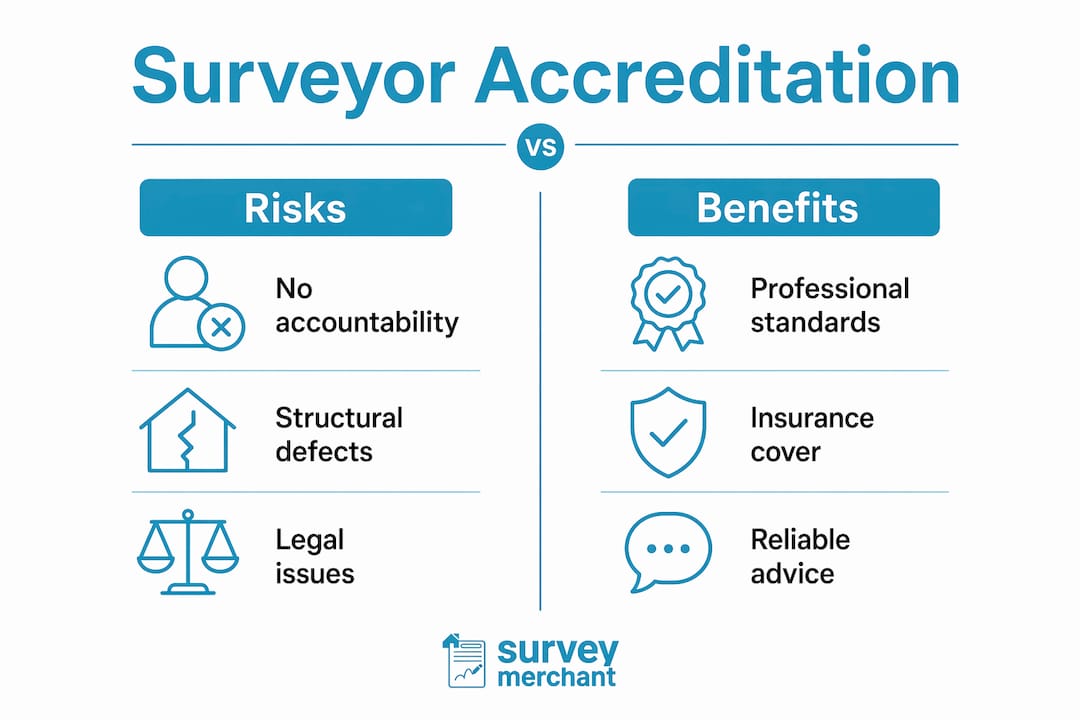
Hiring an unaccredited surveyor removes every protection described above. The risks are not theoretical. They are financial and legal.
The absence of accountability is the defining problem. A buyer who discovers structural defects after completion, having relied on an unaccredited report, bears the full cost alone. There is no professional body to complain to, no insurance to claim against, and no enforceable standard the surveyor breached.
The construction and property sector recognises this risk broadly. Professionals working across construction industry credibility consistently cite accreditation as the baseline for client trust, precisely because the absence of it leaves clients exposed.
Checking accreditation takes minutes and protects thousands of pounds. The process is straightforward when you know what to look for.
Pro Tip: Surveymerchant’s directory connects buyers directly with verified, accredited surveyors matched to their property type. Using a qualified surveyor finder removes the guesswork from the verification process entirely.
Knowing how to verify credentials in the UK is a practical skill every buyer should develop. The RICS register is free to search and takes under two minutes. There is no reason to skip this step.
Accreditation delivers value beyond basic consumer protection. For property investors in particular, the benefits extend into legal defensibility, financial credibility, and long-term risk management.
| Benefit | What it means in practice |
|---|---|
| Legal defensibility | Valuations and surveys from RICS-accredited surveyors carry weight in court and in mortgage applications. Lenders routinely require RICS-compliant reports. |
| Consumer confidence | Buyers and investors trust accredited reports more. That trust supports faster, smoother transactions. |
| Alignment with industry reforms | Accredited surveyors update their practice as RICS standards evolve, keeping clients compliant with current regulations. |
| Risk management | Accredited reports identify defects, liabilities, and risks that inform negotiation, pricing, and investment decisions. |
| Professional accountability | If advice proves wrong, accreditation creates a clear route to redress, reducing the investor’s exposure to unrecoverable losses. |
For investors managing multiple acquisitions, the cumulative value of reliable, defensible reports is substantial. A single missed structural defect or an inaccurate valuation can erode the return on an entire deal. Accreditation does not eliminate risk, but it creates a professional framework that identifies and quantifies it accurately.
The role of an RICS surveyor in a property purchase extends beyond the survey itself. Accredited surveyors advise on negotiation leverage, flag legal issues requiring solicitor attention, and provide context that shapes the buyer’s final decision. That advisory depth is only possible when the surveyor’s competence is verified and their accountability is enforceable.
I have worked in and around the UK property sector long enough to see the same mistake repeated. Buyers focus on price when choosing a surveyor and treat accreditation as a formality rather than a filter. That is the wrong order of priorities.
The price difference between an accredited and an unaccredited surveyor is rarely significant relative to the property value. A few hundred pounds saved on a survey fee is meaningless if the report misses a defect that costs tens of thousands to fix. I have seen buyers discover serious structural problems after completion that a thorough, accredited survey would have flagged at the offer stage. The negotiating leverage lost in those cases far exceeded the cost of a proper survey.
What surprises me most is how few buyers know that “surveyor” carries no legal protection in the UK. Most assume the title implies qualification. It does not. RICS accreditation is the only mechanism that makes the title meaningful. Buyers who understand this check the register before they instruct anyone. Those who do not are taking a risk they have not consciously chosen to take.
My honest advice: treat accreditation as a non-negotiable requirement, not a preference. Then assess experience, specialism, and report quality within that accredited pool.
— N
Surveymerchant connects property buyers and investors with RICS-accredited surveyors across the UK, matched to their specific property type and transaction needs.

Whether you need a commercial property survey, a residential building survey, RICS valuation services, or a party wall surveyor, Surveymerchant’s panel covers the full range of accredited surveying disciplines. The platform prioritises impartiality and quality assurance, so every surveyor in the network meets verified professional standards. For buyers and investors who want reliable advice without the risk of unregulated practitioners, Surveymerchant provides a direct route to qualified professionals who are accountable for their work.
Surveyor accreditation, particularly RICS regulation, is the only enforceable guarantee of competence, insurance, and accountability available to property buyers and investors in the UK.
| Point | Details |
|---|---|
| Accreditation is the only protection | “Surveyor” is not a legally protected title in the UK, so RICS regulation is the sole enforceable standard. |
| Insurance is mandatory for accredited firms | RICS firms must hold professional indemnity insurance; unregulated firms may carry none. |
| Independent redress exists for accredited surveyors | Buyers can escalate complaints through RICS’s formal process, an option unavailable with unregulated firms. |
| Accreditation is a baseline, not a guarantee of specialism | Verify niche experience separately, especially for listed buildings, party wall matters, or commercial assets. |
| Verification takes minutes | Search the RICS public register before instructing any surveyor to confirm current regulated status. |
Surveyor accreditation in the UK refers to recognition by a professional body such as RICS, confirming that a surveyor has met defined standards of competence, conduct, and insurance. Because “surveyor” is not a legally protected title, accreditation is the only enforceable proof of qualification.
RICS accreditation is not legally required, but it is the industry standard that lenders, solicitors, and informed buyers rely on. Without it, a surveyor operates outside any enforceable professional framework.
Search the RICS public register on the RICS website using the surveyor’s name or firm. The register is free to use and confirms current regulated status in under two minutes.
Yes. RICS-regulated firms must hold professional indemnity insurance, and disputes can be escalated through RICS’s independent redress process. Both routes provide financial recourse that unaccredited surveyors cannot offer.
Accreditation confirms baseline competence and professional standards, but specialist experience must be assessed separately. Always ask about relevant experience with your specific property type before instructing any surveyor.
Survey Merchant provides vetted RICS surveyors across 100+ UK locations at fixed fees:
→ Level 2 Home Survey (HomeBuyer Report)
→ Level 3 Building Survey (full structural survey)
→ RICS Red Book property valuations
→ Party wall surveyors — notices, awards & schedules of condition
→ Expert witness surveyors — CPR Part 35 reports for property disputes