Imagine you’ve had an offer accepted on your dream home, champagne is on ice, and then a structural defect discovered too late collapses the entire deal. This scenario plays out regularly across the UK, not because surveys weren’t available, but because buyers didn’t follow a clear workflow. A structured property survey process protects your investment, gives you legal standing to renegotiate, and prevents costly surprises from derailing your transaction. This guide walks you through every stage of the property survey workflow, from commissioning the right survey at the right moment to acting on the findings with confidence.
Table of Contents
Key Takeaways
| Point |
Details |
| Start surveys early |
Commission your RICS survey as soon as your offer is accepted to avoid delays and open room for renegotiation. |
| Prepare all documentation |
Gather property documents, access information, and contact details before booking your survey. |
| Understand condition ratings |
Survey reports use ratings to signal urgency and repairs, helping you prioritise next steps. |
| Work with trusted surveyors |
RICS-accredited professionals ensure clarity, compliance, and reliable outcomes for your transaction. |
Understanding the UK property survey workflow
The property survey workflow isn’t a single event. It’s a sequence of coordinated steps involving buyers, sellers, solicitors, and surveyors, each of which must happen in the right order to protect your position.
The timeline typically begins the moment your offer is accepted. Post-offer steps include appointing a solicitor and commissioning an RICS Home Survey, ideally within 24 hours. Waiting too long risks running survey findings too close to exchange of contracts, where renegotiation becomes far harder.
Here’s a simplified view of how the core stages align:
| Stage |
Who is involved |
Typical timing |
| Offer accepted |
Buyer, seller, estate agent |
Day 1 |
| Solicitor appointed |
Buyer, solicitor |
Day 1 to 2 |
| Survey commissioned |
Buyer, surveyor |
Day 1 to 3 |
| Site visit conducted |
Surveyor, seller/agent |
Week 1 to 2 |
| Report received |
Buyer, solicitor |
Week 2 to 3 |
| Renegotiation or exchange |
Buyer, seller, solicitors |
Week 3 onwards |
Understanding survey types comparison early helps you choose the right level of inspection for the property. A modern flat requires a very different approach to a Victorian terrace with original features and potential structural movement.
Several key parties play distinct roles throughout:
- Buyer: Commissions and pays for the survey, reviews findings, and decides next steps.
- Seller or agent: Coordinates access to the property for the surveyor.
- Surveyor: Conducts the physical inspection and produces the report.
- Solicitor: Uses survey findings to inform contract negotiations and legal due diligence.
A house surveys explained breakdown confirms what experienced buyers already know: skipping or delaying any of these steps creates gaps that often cost far more to resolve than the survey itself.
One missed step can turn a straightforward purchase into a months-long legal dispute. The workflow exists to protect everyone involved, not just the buyer.
Common pitfalls include commissioning a survey too close to exchange, choosing a surveyor based on price rather than qualifications, and failing to share findings promptly with your solicitor.
Steps to prepare for your property survey
Preparation before booking a survey is where many buyers lose unnecessary time and money. Getting your documents in order and selecting the right professional from the start makes everything run smoother.
You’ll need the following before instructing a surveyor:
- The property address and full postcode.
- Details of the property type, age, and construction (available from the estate agent or listing).
- Any information about known defects or previous works, disclosed by the seller.
- Your solicitor’s contact details for coordination purposes.
- Confirmation of the agreed purchase price.
Selecting a reputable surveyor is the most consequential decision in this stage. RICS-qualified surveyors deliver standardised, reliable reports and should be booked as early as possible after your offer is accepted to allow time for renegotiation if defects are found. Choosing based on cost alone is a false economy.

When it comes to finding RICS surveyors, you want someone with local knowledge of the area and experience with your specific property type. A surveyor who regularly works on period properties will spot deterioration patterns that a generalist might miss entirely.
Here’s a quick preparatory checklist to work through:
| Check |
Action required |
Contact |
| Survey type confirmed |
Review property age and condition |
Surveyor/your own research |
| RICS accreditation verified |
Check RICS register online |
RICS or surveyor directly |
| Access arranged |
Confirm with seller’s agent |
Estate agent |
| Solicitor informed |
Share survey booking details |
Your solicitor |
| Report delivery timeline agreed |
Confirm turnaround in writing |
Surveyor |
Arranging access is often overlooked. The seller doesn’t need to be present, but someone must let the surveyor in. Your estate agent usually handles this coordination, so notify them as soon as your booking is confirmed.
For RICS property advice specific to your location and property type, speaking directly with a chartered surveyor before booking can help you choose the right survey level and avoid paying for more than you need.
Pro Tip: Book your surveyor within 48 hours of offer acceptance. Popular RICS surveyors in busy areas can have availability windows of two weeks or more, and delays here push everything else back.
Executing the survey: site visit to final report
Once your preparation is complete, the survey itself follows a clear sequence. Knowing what to expect at each stage keeps you in control rather than waiting anxiously for news.
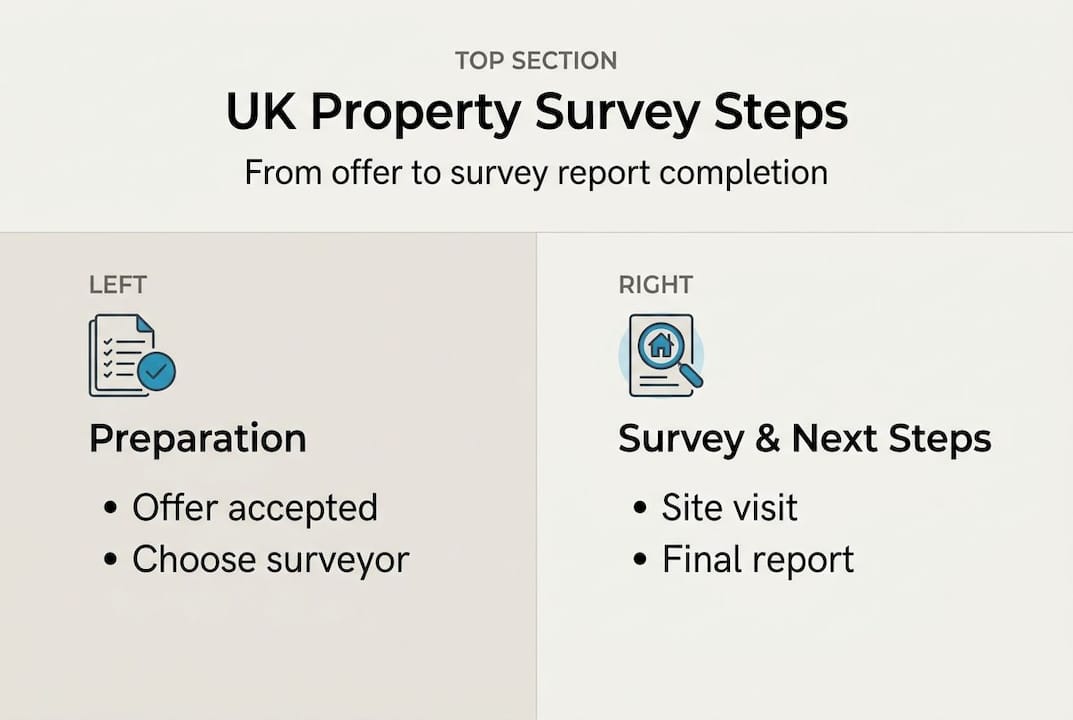
Here is the standard sequence from booking to report:
- Instruct the surveyor in writing, confirming the property address, survey level, and agreed fee.
- Arrange access through the estate agent or seller, with a confirmed date and point of contact.
- Site visit conducted, during which the surveyor carries out a thorough visual inspection of the property.
- Report compiled by the surveyor, applying condition ratings to all major elements.
- Report delivered to you electronically or in hard copy, within the agreed timeframe.
- Follow-up call or meeting with your surveyor to discuss findings before acting on them.
The on-site inspection typically lasts between 2 and 8 hours depending on the survey level chosen, with the written report arriving within 3 to 10 working days. A Level 2 Homebuyer Report on a standard semi-detached home will generally take 2 to 4 hours on site, while a Level 3 Building Survey on an older or larger property can take a full working day.
Report condition ratings work on a numbered scale. Condition rating 1 indicates no repair is currently needed. Rating 2 highlights defects requiring attention but not urgently. Rating 3 flags serious defects needing immediate action or further specialist investigation. Understanding this scale is what allows you to prioritise spending and negotiate effectively.
For buyers considering a Level 2 survey on their first purchase, this mid-range option covers most standard residential properties built after 1900 and provides enough detail to make informed decisions without the cost of a full structural assessment.
Pro Tip: Always request a follow-up call with your surveyor after receiving the report. A 20-minute conversation often reveals context that doesn’t make it into the written document, particularly around urgency and cost estimates for repairs.
After the survey: responding to findings and next steps
The report lands in your inbox and suddenly the property looks very different on paper. This is where a clear head and a structured response make the difference between a successful purchase and an expensive mistake.
Condition ratings 1 through 3 guide your immediate priorities. Rating 1 findings require no action before purchase. Rating 2 issues should be factored into your negotiation or budgeted for post-completion. Rating 3 findings demand specialist reports, cost estimates, and serious consideration before proceeding.
Here are the most common post-survey scenarios and how to respond:
- Minor defects only (rating 1 to 2): Proceed with purchase, adjusting your maintenance budget accordingly.
- Moderate defects (rating 2): Request a price reduction reflecting the cost of repairs, supported by contractor quotes.
- Major defects (rating 3): Commission a specialist survey (structural engineer, damp specialist, etc.) before making any decision.
- Significant non-disclosure: Raise with your solicitor immediately, as this may have legal implications.
- Recommendations for further investigation: Follow these up promptly to avoid delays to your exchange timeline.
If a rating 3 defect is discovered, do not panic and do not ignore it. Pause, commission the appropriate specialist report, and use the findings to renegotiate or make an informed decision to withdraw.
After reviewing ratings, here is a quick reference for your next actions:
| Condition rating |
Meaning |
Recommended action |
| 1 |
No repair needed |
Proceed as planned |
| 2 |
Repair needed, not urgent |
Negotiate or budget post-purchase |
| 3 |
Serious defect |
Specialist survey, renegotiate or withdraw |
For properties with structural concerns, expert construction advice from a qualified professional can help you interpret findings and quantify repair costs accurately.
A structured house buying checklist that incorporates your survey findings alongside legal and financial steps ensures nothing falls through the cracks at this critical stage.
Expert perspective: why a proactive workflow saves time and money
The most common mistake surveyors see is treating the survey as a formality rather than a decision-making tool. Buyers commission it because their mortgage lender requires a valuation, then barely read the full report. That’s an expensive habit.
A proactive workflow means the survey results directly shape your negotiation, your solicitor’s approach, and your post-completion spending plan. Buyers who act on findings early almost always negotiate better outcomes than those who read the report after exchange is imminent.
There’s a persistent myth that surveys slow transactions down. In reality, discovering a rating 3 defect three weeks before exchange gives you time to respond. Discovering it after completion gives you nothing but a repair bill. Chartered surveyor insights consistently reinforce this: the survey is the single most valuable document in any property transaction, and treating it as such from day one protects your money and your position.
A transparent survey process also builds trust between buyer and seller. When findings are handled professionally and promptly, deals are far more likely to reach completion.
Get trustworthy help with your UK property survey
Following the right workflow is only as effective as the surveyor you choose to carry it out. A qualified, impartial professional makes every difference to the quality of your report and the strength of your negotiating position.

Survey Merchant connects you with RICS-accredited surveyors across the UK, matched to your property type and location. Whether you’re purchasing in a city centre or a rural setting, we simplify the process of finding the right expert quickly. Our network covers residential and commercial properties nationwide, including specialist teams for Liverpool property surveyors and beyond. Take the first step today and get your survey booked with confidence.
Frequently asked questions
How long does a property survey take in the UK?
The site visit lasts between 2 and 8 hours depending on the survey level chosen, with the written report typically delivered within 3 to 10 working days.
When should I commission a property survey as a UK buyer?
Commission your survey immediately after offer acceptance. Within 24 hours is the recommended timeframe, giving you the best chance to act on findings before exchange.
Why use an RICS-accredited surveyor in the UK?
RICS-qualified surveyors produce standardised reports that are recognised in legal proceedings and mortgage applications, making them the most reliable choice for any UK property purchase.
Recommended