Expert Witness
Oct 8, 2026
Surveyor Negligence Claims: A UK Homeowner's Guide
Suspect your surveyor was negligent? Learn to identify surveyor negligence claims, gather evidence, and start legal action with our step-by-step UK guide.

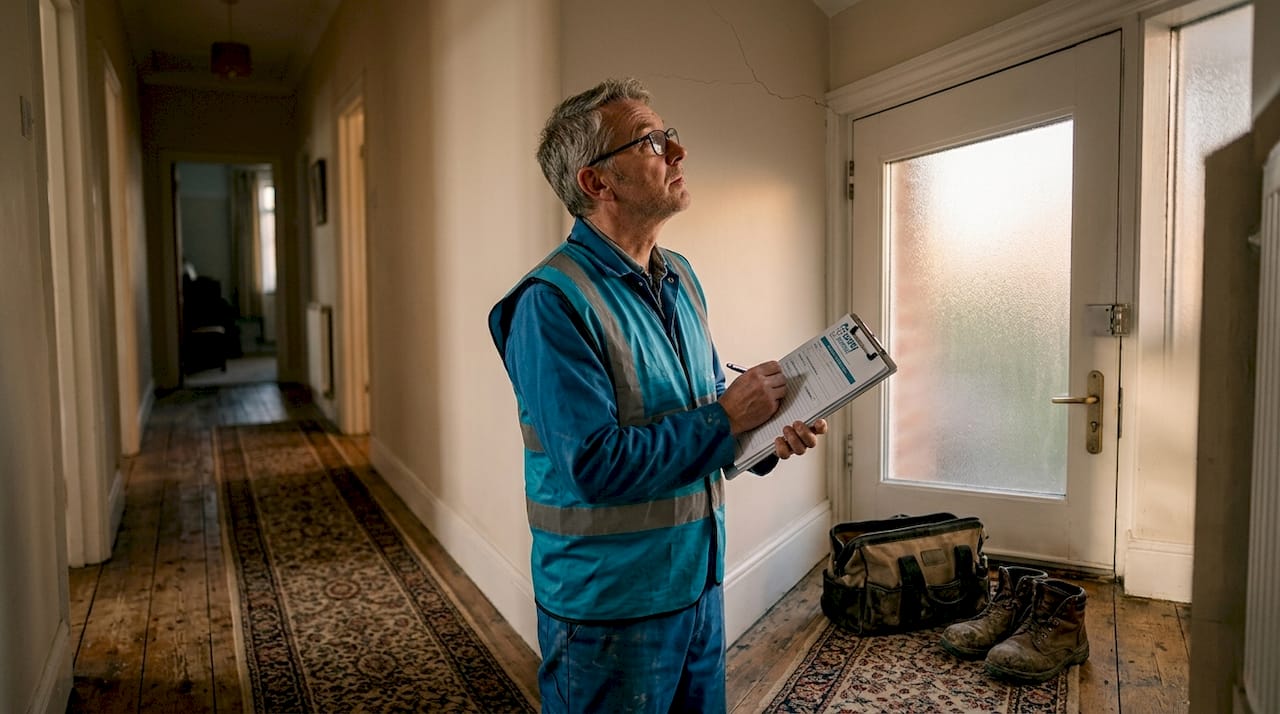
You open the survey report because something feels wrong. A patch of damp keeps spreading. A roofline looks uneven. Cracks that seemed cosmetic now look like movement. Then you read the report again and realise the survey gave you reassurance at the exact point you needed warning.
That's the moment clients typically begin. Not with a tidy legal question, but with a property problem, a financial headache, and a strong sense that a professional missed something serious.
Surveyor negligence claims turn on evidence much earlier than commonly anticipated. The legal arguments matter, but the outcome is often shaped by what you do in the first days after discovery. If you repair too soon, throw away paperwork, or rely on memory instead of records, you can weaken a claim before anyone sends a formal letter. A careful response gives you options. A rushed one usually narrows them.
Buying a property usually involves trust layered on trust. You trust the seller's replies, the lender's process, and the surveyor's professional judgement. When a major defect appears soon after completion, the actual shock isn't only the repair issue. It's the feeling that you paid for risk to be identified and still walked into it.
Some defects are obvious only in hindsight. Damp behind furniture. A roof defect that becomes clear after heavy rain. Structural cracking that looked historic but turns out to be active. Others are the sort of issues buyers assume a competent inspection should have flagged at once. That difference matters, because surveyor negligence claims don't succeed just because the property has problems. They succeed when the evidence shows the survey fell below the standard of reasonable skill and care, and that failure caused financial loss.
The practical response is rarely to argue first. It's to secure the factual record.
Practical rule: treat the property like evidence before you treat it like a project.
Clients often want to start repairs immediately, especially when the defect affects safety, weatherproofing, or daily living. Sometimes urgent mitigation is necessary. But wherever possible, preserve the condition first with photographs, video, paperwork, and a clear written timeline. If later you need to show what the surveyor saw, what was accessible, and what should have been reported, that first record becomes far more important than people realise.
A good claim starts with discipline. Keep the survey report. Keep the emails. Keep the estate agent particulars, the valuation, and any messages about condition. If a contractor has already visited, get their observations in writing. The people who recover best in these situations are usually the ones who stop, organise, and document before they complain.
The law doesn't require perfection. It requires reasonable skill and care. That sounds abstract until you break it into the issues that decide claims.

For a claim to succeed in England and Wales, you usually need to prove duty of care, breach of that duty, causation, and quantifiable loss. For valuation cases, you also need to show you relied on the valuation, with damages often measured by the difference between what you paid and what a reasonable buyer would have paid if the defects had been known, as set out in Carruthers Law's discussion of surveyor negligence claims and damages.
Those four elements work like a filter:
If one of those parts is missing, the claim becomes difficult quickly.
A survey can contain an error without being negligent. That distinction frustrates claimants, but it's real. Surveyors inspect within limits. Access may be restricted. Some defects are concealed. Some risks can only be flagged as needing further investigation, not fully diagnosed during a standard inspection.
Negligence is more likely where the missed issue was significant, visible, and within the scope of the survey. Think of major cracking, an evidently failing roof covering, obvious signs of longstanding water ingress, or a defect that other competent surveyors would ordinarily have reported from the same inspection opportunity.
A poor outcome doesn't prove negligence. A poor report, measured against what a competent surveyor should have done, might.
The report wording matters here. So do the terms of engagement. If the surveyor clearly excluded an element, warned that access was blocked, or recommended further specialist investigation that wasn't pursued, that changes the analysis. On the other hand, boilerplate caveats don't rescue a report that gave unwarranted reassurance in the face of obvious warning signs.
A useful way to test your position is to ask three blunt questions:
That last point is where many claims harden. If you would have renegotiated, commissioned further investigation, or walked away entirely, the survey report may have had direct financial consequences. That is the territory where a viable claim often begins.
The strongest files are usually built before the first angry email is sent. Evidence gathering is not admin. It's the foundation of the entire case.
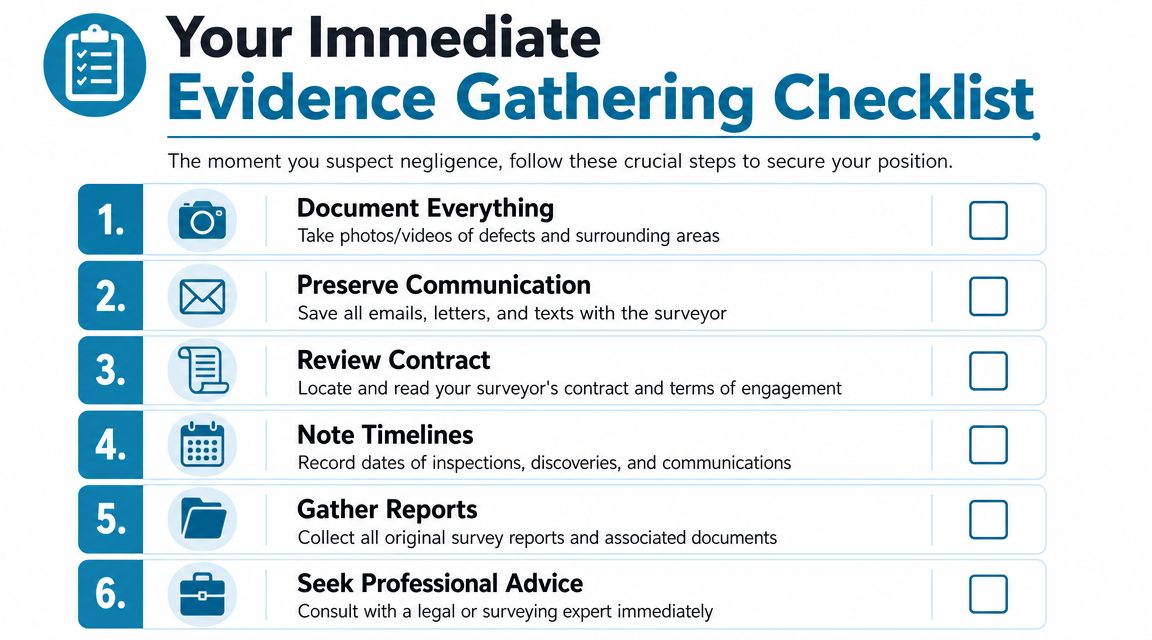
Start with the property itself.
Then gather the documents that establish the transaction history.
If you're unsure whether the professional was properly qualified or what designations they held out, check and save that material early. Publicly available records and professional profiles can be useful later, and it can help to verify UK surveyor credentials before positions harden.
A claim usually turns on a timeline, not just a defect list. Build one while the facts are fresh.
Write down dates in one document only, then update it. Competing versions of the timeline create avoidable problems.
Include the instruction date, survey date, report date, exchange, completion, first sign of the issue, first contractor attendance, and every complaint or discussion after discovery. If someone said, “that should have been picked up,” note who said it, when, and in what context. Don't embellish. Accuracy beats indignation every time.
The documents do different jobs later:
| Evidence | Why it matters downstream |
|---|---|
| Survey report | Shows exactly what was said, omitted, and recommended |
| Terms of engagement | Defines scope and limits of the duty |
| Photographs and video | Preserves condition before repairs or deterioration |
| Timeline | Supports causation and procedural steps |
| Contractor comments | May help identify whether the defect was longstanding |
| Proof of expenditure | Helps establish financial loss |
Don't send original documents around casually. Keep a master folder, then work from copies. Label files by date. If you eventually need a solicitor or expert surveyor to review the matter, a tidy evidence set saves time, cost, and confusion.
Court isn't always the first or best move. In many cases, the sensible starting point is a structured complaint that tests the other side's position and flushes out their explanation before legal costs escalate.
Send a formal written complaint to the surveyor or their firm. Keep it measured. Set out the property address, the date of the survey, the defects now identified, why you say they should have been reported, and what loss you believe has followed. Attach the key pages of the report, representative photographs, and any early supporting observations.
A good complaint does two jobs. It gives the firm a fair chance to respond, and it creates a paper trail showing you acted reasonably. Weak complaints tend to ramble, speculate about dishonesty, or demand figures before the evidence is mature. Strong complaints stay factual and ask for a substantive written response.
If the surveyor is a member of a professional body, check the complaints route attached to that membership. If you need background on what membership and standards can mean in practice, this short guide on RICS accreditation explained is a useful starting point.
Different routes do different things. Some focus on conduct and service. Others are better suited to compensation disputes. None should be chosen casually.
| Route | Best For | Potential Outcome | Typical Timescale |
|---|---|---|---|
| Internal complaint to the firm | Early resolution where facts are still being established | Explanation, apology, reinspection, settlement discussion, complaint rejection | Varies |
| Professional body complaint | Concerns about professional conduct or competence | Regulatory scrutiny, conduct findings, pressure on standards compliance | Varies |
| Ombudsman or redress scheme | Service complaints and lower-value disputes where a practical resolution is possible | Award, recommendation, complaint dismissal, negotiated outcome | Varies |
| Solicitor-led claim preparation | Cases with significant loss, disputed liability, or expert issues | Formal claim, negotiated settlement, ADR, litigation | Varies |
Some trade-offs are easy to underestimate:
Choose the route that matches the problem, not the route that feels most satisfying in the moment.
Where the issue is serious structural defect, substantial overvaluation, or a purchase you say you would never have proceeded with, complaints alone often won't finish the job. They can still be worth doing, but they should be handled with the larger claim strategy in mind.
When a complaint doesn't resolve matters, the dispute becomes more formal. At that stage, process matters almost as much as merits. A good claim can be weakened by poor preparation. An arguable defence can gain ground if the claimant's evidence is disorganised.
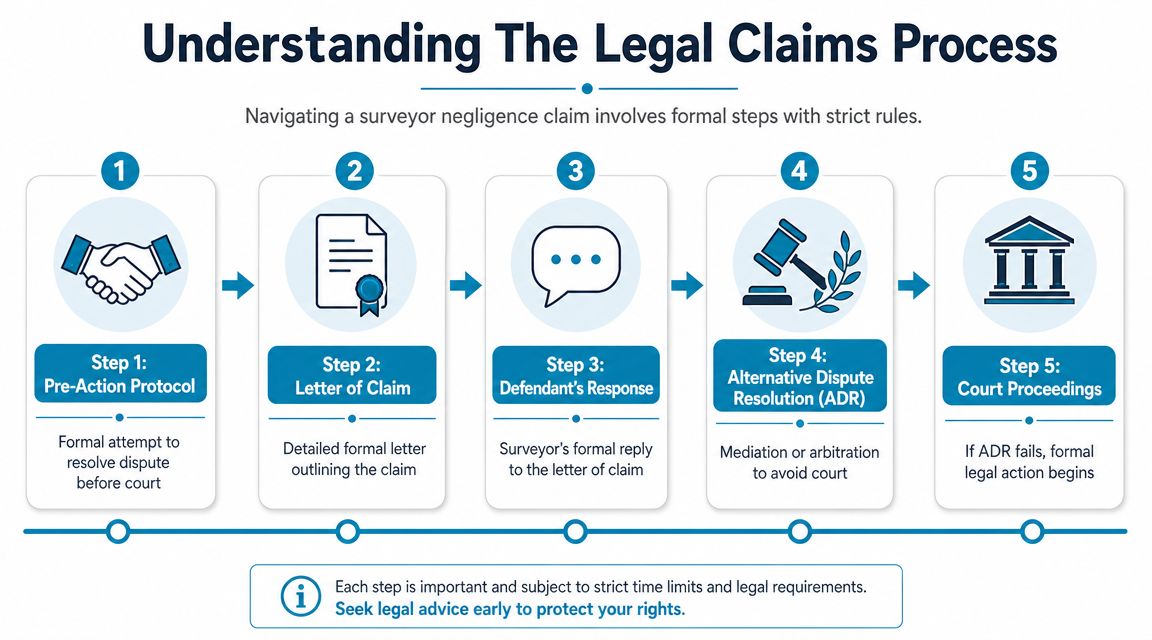
In England and Wales, surveyor negligence disputes are commonly handled under the professional negligence pre-action process. Practitioners note that the surveyor should acknowledge a Letter of Claim within 21 days and then has up to 3 months to investigate and provide a full response, with limitation generally 6 years from the negligent act, or 3 years from discovery in some cases, as outlined in Axis Lawyer's overview of professional negligence claims.
That timetable matters because many claimants spend too long “seeing how things develop” while the limitation position gradually worsens. Timing is often one of the first issues I look at, because a strong complaint doesn't help if the claim is already out of time or close to it.
A formal Letter of Claim isn't just a longer complaint. It should identify the duty said to be owed, the respects in which the surveyor is alleged to have fallen short, the causal link to the purchase decision or price, and the heads of loss. It usually needs support from an independent expert surveyor before it can be drafted properly.
The normal sequence looks like this:
One practical point clients often miss is insurance. Surveyor defendants commonly notify their professional indemnity insurers, and that changes the tone quickly. Responses become more formal, expert-led, and procedural. If you want to understand why that matters, Survey Merchant's PII guide gives helpful context.
Many claimants assume damages equal the repair bill. That's not always right. The default rule in negligent survey cases is usually diminution in value, meaning the difference between the price paid on the assumption of a sound property and its true defective value. That measure was established in Perry v Sidney Phillips & Son 1 WLR 1297, and later commentary notes it remains the standard approach, with cost of cure used where it better reflects the actual loss. Commentary also notes that Large v Hart marks an important boundary, because where negligent advice meant the transaction would not have proceeded at all, liability may extend to all losses flowing from the breach, as discussed in Harper James's article on professional negligence claims against surveyors.
That distinction has real consequences. A claimant may spend heavily on repairs but still recover on a different legal basis. Equally, a large repair estimate doesn't automatically mean the legal value loss is identical.
The question isn't only “what did it cost to fix?” It's “what loss did the negligent report cause in law?”
This is why independent expert evidence and valuation analysis are so important. A surveyor negligence claim can fail on liability, but it can also fail because the claimant measures the wrong loss or can't prove it cleanly. The legal route is not just about being right on the defect. It's about proving the right kind of financial consequence.
When liability is disputed, an independent surveyor often becomes the hinge point of the case. Homeowners usually know something has gone wrong. They rarely have the professional evidence needed to show what a competent surveyor would have reported at the time.

Survey Merchant connects clients with a nationwide panel of qualified surveyors across residential and commercial disciplines. In the negligence context, that matters because the right instruction is not just “inspect the defect”. It's usually to assess the property condition, review the original report, and give an impartial opinion on whether the issue should have been identified, described, or escalated.
That kind of report can help at several stages:
A common mistake is instructing a general contractor for a repair quote and assuming that will prove negligence. It won't. A builder can be useful on remedial scope, but the core professional question is what a competent surveyor should have done during the original instruction.
Survey Merchant's panel includes chartered professionals with experience in defects, valuations, roof and damp issues, and expert witness work. That breadth helps because surveyor negligence claims often involve more than one technical issue. There may be building pathology, access questions, valuation consequences, and reporting-standard issues all in the same file.
The practical advantage is matching. A dispute about structural movement needs a different reviewer from a complaint centred on valuation methodology or a leasehold issue. Getting the wrong expert early can waste time and increase cost without improving the evidence.
For claimants who need legal follow-through as well as technical input, a coordinated referral to specialist solicitors can also make the process more efficient. The expert evidence should drive the legal strategy, not the other way round.
A faulty survey leaves those affected feeling cornered. You've bought the property, the defect is now yours to manage, and the professional you trusted may already be defending their report. The way through is methodical, not dramatic.
Start with the evidence. Preserve the condition, organise the papers, and build one accurate timeline. Then make a measured complaint and choose the right route based on the seriousness of the issue, the likely value of the loss, and whether you'll need expert support. If you're trying to understand wider UK property risks, dispute patterns, and market context while you assess next steps, the UK commercial real estate blog is a useful broader read.
Don't assume the repair invoice tells you the legal value of the claim. Don't assume every bad survey is negligence. And don't wait too long to get the file reviewed if the sums are meaningful or the facts are deteriorating.
Handled properly, surveyor negligence claims are less about outrage and more about proof. The claim that succeeds is usually the one built carefully from the start.
If you need an independent surveyor to review a suspected bad survey, assess missed defects, or provide expert evidence support, Survey Merchant can help connect you with the right qualified professional for your case.
Survey Merchant provides vetted RICS surveyors across 100+ UK locations at fixed fees:
→ Level 2 Home Survey (HomeBuyer Report)
→ Level 3 Building Survey (full structural survey)
→ RICS Red Book property valuations
→ Party wall surveyors — notices, awards & schedules of condition
→ Expert witness surveyors — CPR Part 35 reports for property disputes