We use cookies to improve your experience on our site, analyze site traffic, and assist in our marketing efforts. By clicking "Accept all," you agree to the storing of cookies on your device. You can choose to "Reject all" non-essential cookies. For more information, please read our Cookie Policy.
Gazundering UK 2026: What It Is & How to Handle It
A complete 2026 UK guide to gazundering: definition, legality, the latest statistics, the government's binding-contract reforms, and practical steps for sellers and buyers backed by a professional survey.
Gazundering is back in the headlines in 2026. With more homes on the market than buyers, mortgage rates stubbornly high and the average purchase still taking around 120 days, more buyers are cutting their offer in the days before exchange and leaving sellers with an unwelcome choice: accept less or start again. This guide explains what gazundering is, whether it is legal, how common it really is, what the government’s home-buying reforms will change, and how a professional survey from a suitably qualified, accredited surveyor puts both buyers and sellers in a stronger position.
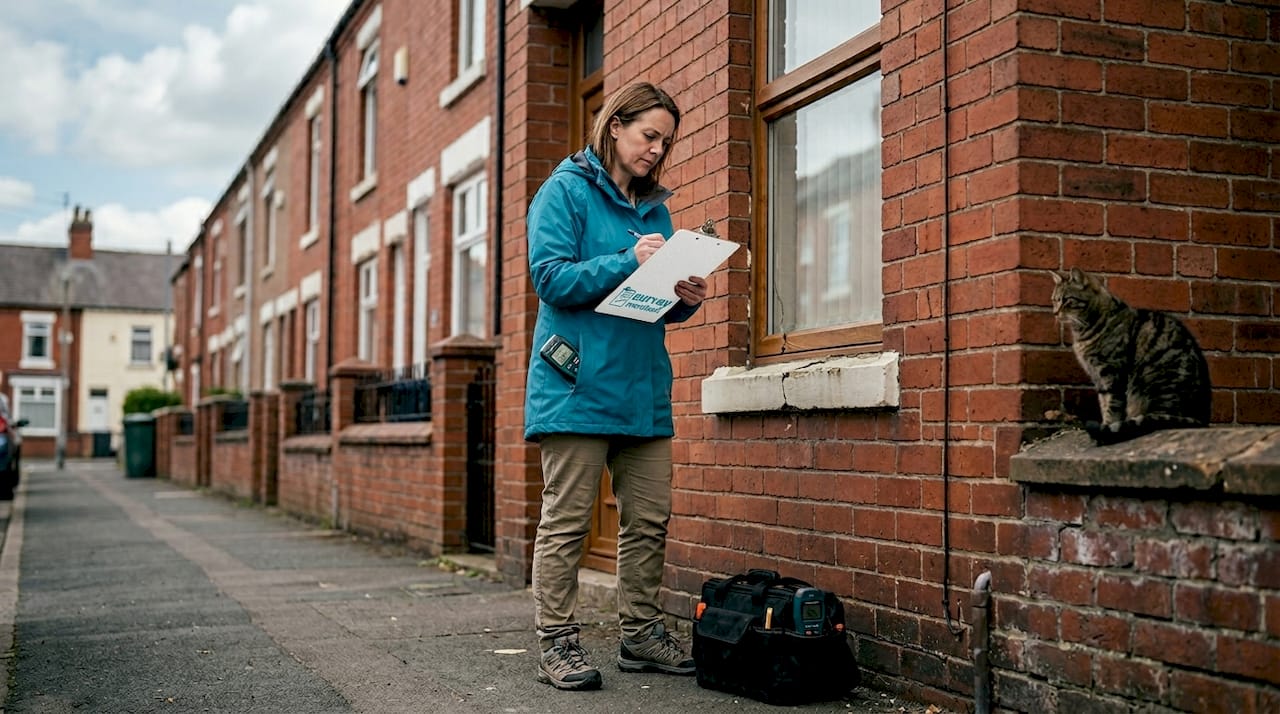
Gazundering happens in the window between “sold subject to contract” and exchange, when neither side is legally committed.
Key takeaways
Gazundering is when a buyer lowers an offer that the seller has already accepted, usually shortly before exchange of contracts, and threatens to walk away if the seller refuses.
It is legal in England, Wales and Northern Ireland because nothing is binding until contracts are exchanged. In Scotland, offers become binding once missives are concluded, so it is rare there.
Research by Quick Move Now (February 2025) found that 19% of agreed sales saw an attempted renegotiation; sellers agreed to the full reduction in 56% of those cases and only 6% collapsed outright.
In August 2026, eight out of ten estate agents polled by The Independent said they were seeing more gazundering than a year earlier, driven by a buyer’s market and higher mortgage costs.
The government’s June 2026 home-buying reforms promise binding conditional contracts at offer stage and upfront sales packs, but the legislation is not expected until the end of this Parliament.
A price cut backed by a Level 2 or Level 3 survey report is a legitimate renegotiation, not gazundering. For buyers it is the strongest evidence you can have; for sellers, a pre-sale survey removes the surprises that invite a last-minute cut.
What is gazundering?
Gazundering is when a property buyer reduces their offer after the seller has accepted it, typically just before exchange of contracts, and makes clear they will pull out unless the lower price is agreed. It exploits the fact that in England and Wales a sale is not legally binding until exchange, so the seller must choose between accepting less or re-marketing the home.
The word is a play on gazumping, its mirror image, where a seller accepts a higher offer from someone else after agreeing a sale. Both practices feed on the same weakness in the English and Welsh system: the long, uncommitted gap between an offer being accepted and the moment the parties are bound.
Not every price reduction is gazundering. If a building survey uncovers a £12,000 roof repair, a valuer reports a down valuation, or searches reveal a problem the seller did not disclose, a revised offer is a reasonable response to new information. Gazundering, in the sense most people use it, is an opportunistic cut with no new justification, timed to put maximum pressure on the seller.
Is gazundering legal in the UK?
Yes. In England and Wales, section 2 of the Law of Property (Miscellaneous Provisions) Act 1989 requires a contract for the sale of land to be made in writing and signed by both parties. Until that written contract is exchanged, an accepted offer is an agreement in principle only, and either side can change the terms or withdraw without penalty. Northern Ireland works in a similar way. The position is different in Scotland, where offers are made through solicitors and become legally binding once “missives” are concluded, which usually happens much earlier in the process. That is why gazundering and gazumping are far less common north of the border.
Legal does not mean cost-free, however. A buyer who gazunders risks losing the property, the survey fee, the mortgage valuation fee and any legal costs incurred so far. A seller who refuses risks losing a buyer in a slow market. Understanding where the leverage sits on each side is the key to handling it well.
How common is gazundering in 2026?
The most detailed recent data comes from a survey published by the property firm Quick Move Now in February 2025 and reported by The Intermediary on 13 February 2025. It found that 19% of agreed sales experienced an attempted renegotiation after the sale was agreed. Of those attempts:
56% ended with the seller agreeing to the full reduction requested and the sale completing (11% of all sales);
28% ended with the seller refusing and the sale completing at the original price (5% of all sales);
11% ended with a smaller discount being agreed (2% of all sales);
6% ended with the seller refusing and the sale falling through (1% of all sales).
Most gazundering attempts succeed, at least in part. Source: Quick Move Now research, reported February 2025.
The picture in 2026 appears to be worsening. A snapshot survey by The Independent, published on 24 August 2026, asked ten estate agencies whether they were seeing more gazundering than in the same period of 2025: eight said yes, including Jackson-Stops, JLL, Benham & Reeves and Yopa. Agents pointed to a buyer’s market with more stock than demand, especially for flats, and to mortgage rates that have left fewer buyers competing for each home. The same article cited Barclays research in which 11% of homeowners whose sale or purchase had fallen through in the previous three years said they had been gazundered.
Industry bodies are more cautious. In July 2026 the Conveyancing Association described gazundering as a fairly rare occurrence overall but a growing one, citing a BBC report of a seller whose buyers cut £15,000 from the agreed price the day before exchange. Whatever the exact figure, the trend is consistent with wider market data: more homes for sale than at any point in over a decade, longer selling times and sellers increasingly accepting below asking price.
Why is gazundering increasing?
Several factors combine to make 2026 a gazundering year:
A buyer’s market. Stock levels are high and sales are taking longer, which shifts bargaining power to buyers, particularly those with no chain and a mortgage offer in hand.
Mortgage costs. Higher rates squeeze affordability; a buyer whose fixed-rate offer has changed between agreeing a price and exchange may genuinely be unable to proceed at the original figure.
Slow conveyancing. The government puts the average purchase at around 120 days. The longer the gap, the more can change, from interest rates to the buyer’s own circumstances.
Information arriving late. Most buyers make an offer knowing almost nothing about the property’s condition. A HomeBuyer Report or building survey ordered weeks later can reveal defects that would have changed the offer from the outset.
Repair costs. Rising labour and materials costs mean the same defect costs more to fix than it did two years ago, so buyers are less willing to absorb it.
Gazundering vs gazumping vs legitimate renegotiation
Scenario
Who acts
When
Is it justified?
Typical outcome
Gazundering
Buyer cuts the agreed price
Days before exchange
Usually no new information; leverage-based
Seller accepts, counters or re-markets
Gazumping
Seller accepts a higher rival offer
Any time before exchange
Legal but widely seen as bad faith
Original buyer loses the home and sunk costs
Survey-led renegotiation
Buyer revises offer
After the survey report, well before exchange
Yes: evidence of defects and repair costs
Price cut, seller repairs, or retention agreed
Down valuation
Lender values below the price
After the mortgage valuation
Yes: lender will not lend on the agreed price
Price cut, larger deposit or new lender
Gazanging
Seller withdraws from the sale
Any time before exchange
No buyer fault; seller changes mind
Buyer loses fees and time
Gazundering from the seller’s side: what to do if it happens to you
Being gazundered is stressful, but a calm, evidence-based response gets the best result. Work through these steps:
Ask for the reason in writing. Is the buyer citing the survey, the valuation, searches or simply “market conditions”? A specific, documented defect deserves a different response from a vague one.
Check the evidence. If the buyer quotes a survey finding, ask for the relevant pages and any contractor quotes. A £15,000 reduction for a “roof problem” may turn out to be a few slipped slates.
Price the alternative. Re-marketing means another two to four months, more mortgage or bridging costs, and the risk your onward purchase collapses. Sometimes a modest reduction is cheaper than starting again.
Counter rather than capitulate. Quick Move Now’s data shows that sellers who refuse or counter very often still complete. Offer a smaller reduction, a contribution to a specific repair, or a faster exchange date in return for holding the price.
Commission your own evidence. An independent condition report or RICS Red Book valuation from an accredited surveyor gives you a credible figure to defend, rather than negotiating against the buyer’s numbers alone.
Keep the sale moving. Delay is the gazunderer’s friend. Answer enquiries within 48 hours and push for an exchange date.
How sellers can reduce the risk before listing
The most effective protection is to remove the surprises. A pre-sale survey identifies damp, roof, structural or electrical issues before a buyer’s surveyor does, so you can either fix them, price them in, or disclose them with quotes attached. Sellers who instruct a suitably qualified surveyor before marketing are far less exposed to a late cut, because the buyer has nothing new to discover. Preparing your legal pack early, choosing a buyer with a mortgage agreement in principle and a short chain, and agreeing a target exchange date all shorten the window in which gazundering can happen.
A survey report from a suitably qualified, accredited surveyor is the difference between an opportunistic cut and a justified renegotiation.
Gazundering from the buyer’s side: renegotiating fairly
If you are a buyer, the question is not whether you can lower your offer, but whether you should and how. Cutting the price without reason days before exchange may work in a soft market, but it also carries a real chance of losing the home along with every fee you have paid. A better approach is to build the renegotiation on evidence:
Order your survey as soon as the offer is accepted, not after the mortgage valuation. The earlier the report lands, the earlier and more reasonably you can revisit the price. Our guide to negotiating after a survey explains the process step by step.
Choose the right level of survey. A Level 2 HomeBuyer Report suits conventional homes in reasonable condition; a Level 3 building survey is the right tool for older, altered or visibly defective properties and gives you far more detail to negotiate with.
Get repair quotes. A surveyor’s condition ratings plus two contractor quotes are far more persuasive than a round-number demand.
Offer options, not ultimatums: a price reduction, a retention held by solicitors until works are done, or the seller completing repairs before exchange.
Be honest about affordability. If a mortgage rate change is the real reason, say so early. Sellers respond better to transparency than to a surprise on exchange day.
Will the 2026 home-buying reforms end gazundering?
On 19 June 2026 the Ministry of Housing, Communities and Local Government unveiled a package of reforms aimed at the one in three sales that fall through each year, which HM Land Registry research estimates costs sellers around £400 million annually across England and Wales. The headline measures are:
Sales packs at the point of listing, giving buyers key information on condition, leasehold costs and chain status before they offer.
Binding conditional contracts once an offer is accepted, with a financial penalty for any party that withdraws without a valid reason. Penalty levels, permitted exceptions and the dispute process are still being worked out with industry.
Digital property logbooks, digital ID checks and e-signatures to cut the average 120-day transaction by around four weeks.
A Code of Practice for property agents later in 2026, with a consultation on mandatory qualifications from 2027.
Under this model, cutting an agreed price without a legitimate reason would become a breach of contract rather than a legal tactic. The government has said that survey problems, mortgage failures and chain collapses are the kind of reasons likely to count as valid, which makes the quality and timing of the survey more important, not less. Crucially, though, the binding-contract requirement will not take effect until sales packs are embedded, and the legislation is only promised “by the end of this Parliament”. For anyone buying or selling in 2026 and 2027, the current rules still apply. You can read our analysis of the roadmap in what upfront property information means for surveys.
Gazundering and the survey: why timing matters
Quick Move Now’s managing director has described the survey stage as the most common moment for gazundering, and that is no coincidence. It is the first time most buyers learn anything substantive about the property. The practical lesson for both sides is the same: get the condition information on the table as early as possible.
Stage of the sale
Typical timing (England & Wales)
Gazundering risk
How a survey helps
Offer accepted (SSTC)
Week 0
Low
Seller’s pre-sale survey already disclosed; buyer offers with eyes open
Survey and valuation
Weeks 1–4
High
Buyer’s Level 2 or Level 3 report provides evidence for any fair renegotiation
Searches and enquiries
Weeks 3–10
Medium
Issues raised early can be resolved rather than used as leverage
Mortgage offer issued
Weeks 4–8
Medium
A down valuation is a lender matter; an independent valuation can challenge it
Run-up to exchange
Weeks 10–17
Highest
No surprises left to exploit if both sides relied on a professional report
Whether you are a seller commissioning a pre-sale report or a buyer gathering evidence, use a suitably qualified, accredited surveyor. In the UK that means a professional regulated or accredited by a recognised body such as the Royal Institution of Chartered Surveyors (RICS), the Chartered Institute of Building (CIOB) or the Residential Property Surveyors Association (RPSA), working to a recognised standard such as the RICS Home Survey Standard. Accreditation matters in a negotiation: a report from an accredited, insured professional carries weight with the other side, with lenders and, if it ever comes to it, with a court.
Why choose Survey Merchant for your pre-purchase or pre-sale survey?
Gazundering thrives on uncertainty, and a clear, independent survey is the quickest way to remove it. Survey Merchant helps buyers and sellers across the UK get that evidence quickly and at a fair price:
An accredited panel matched to the job. Our panel includes suitably qualified surveyors regulated or accredited by bodies such as RICS, CIOB and RPSA, so a Victorian terrace, a new-build flat or a non-standard construction home each gets the right specialist.
Nationwide UK coverage with local knowledge. Surveyors who know the housing stock, ground conditions and local market in your area, which matters when a price is being argued over.
Fast turnaround. Early inspection and prompt reporting shorten the window in which gazundering can happen.
Transparent, competitive fixed fees. Compare quotes for Level 2 HomeBuyer Reports, Level 3 building surveys and RICS Red Book valuations with no hidden extras.
Impartial advice. We do not sell the property or lend on it; our only interest is an accurate picture of its condition and value.
End-to-end support. From choosing the right survey level to understanding the report and using it in negotiation, our team is on hand throughout.
Gazundering is when a buyer lowers their offer after the seller has accepted it, usually just before exchange of contracts, and threatens to withdraw unless the seller agrees to the reduced price.
Is gazundering illegal in the UK?
No. In England, Wales and Northern Ireland a sale is not legally binding until contracts are exchanged, so either party can change the terms or walk away before then. In Scotland offers become binding once missives are concluded, so gazundering is rare there.
How common is gazundering?
Quick Move Now research published in February 2025 found 19% of agreed sales saw an attempted renegotiation, and in August 2026 eight out of ten estate agents polled by The Independent said gazundering had increased compared with 2025.
What should I do if I have been gazundered?
Ask for the reason in writing, check any survey or valuation evidence, price the cost of re-marketing, and counter with a smaller reduction or a repair contribution rather than simply accepting. An independent survey or valuation gives you a credible figure to defend.
Is lowering my offer after a survey gazundering?
Not if it is based on genuine new information. A revised offer backed by a Level 2 or Level 3 survey report and repair quotes is a legitimate renegotiation. Gazundering is a cut with no new justification, timed to pressure the seller.
Will the government ban gazundering?
The June 2026 reforms propose binding conditional contracts once an offer is accepted, with penalties for withdrawing without a valid reason. Legislation is promised by the end of this Parliament, so the current rules still apply in 2026 and 2027.