Valuation
Sep 29, 2026
Down valuation on your mortgage: what to do next
A down valuation on your mortgage can derail your plans. Discover essential steps to tackle this challenge and keep your purchase on track.

A down valuation means the lender’s surveyor has decided the property is worth less than the price you agreed with the seller. The lender will only lend against its own figure, not the price on your offer letter, and that gap is now your problem to solve.
You have five realistic routes: renegotiate the price with the seller, formally challenge the valuation with evidence, apply through a different lender, cover the shortfall with extra cash, or walk away. Which one makes sense depends on the size of the gap, how much chain pressure you’re under, and whether the low figure reflects a genuine market issue or something the valuer got wrong.
Do these things within the next 24 to 72 hours:
Pro Tip: Get the valuation report before you do anything else. Half the “should I challenge this?” panic disappears once you can actually see whether the valuer used two comparables from three years ago or genuinely can’t find recent sales nearby.
If the shortfall turns out to be a condition issue rather than a pricing one, a RICS survey through a marketplace like Survey Merchant can give you the independent evidence you need to negotiate from a position of strength rather than guesswork.
Resolving a down valuation quickly comes down to knowing your cash gap, gathering the right evidence, and choosing the fastest realistic route for your chain position.
| Point | Details |
|---|---|
| Calculate the cash gap first | Work out the LTV change and extra deposit needed before deciding on a strategy. |
| Renegotiation usually beats a challenge | Sellers often accept a price closer to the valuation faster than a formal appeal succeeds. |
| Gather three solid comparables | Use Land Registry sold-price data, not asking prices, to support any challenge. |
| Commission a RICS survey for condition issues | A Level 2 or 3 survey adds independent weight if the shortfall involves defects, not just price. |
| Survey Merchant speeds up credible evidence | Its nationwide RICS surveyor panel helps buyers get a survey booked and reported quickly to support a challenge or negotiation. |
A mortgage valuation is the lender checking its own security, not a report written for your benefit. It confirms the property is worth roughly what you’re borrowing against, so the bank isn’t lending £300,000 against a house that’s actually worth £270,000. Many lenders now do this using an automated valuation model (AVM), a desktop assessment, or a drive-by inspection rather than sending someone inside the property at all, according to Willow Private Finance.
That matters because none of those methods look at the boiler, the roof, or the damp patch in the cellar. A drive-by valuer might not even get out of the car. An AVM certainly won’t.
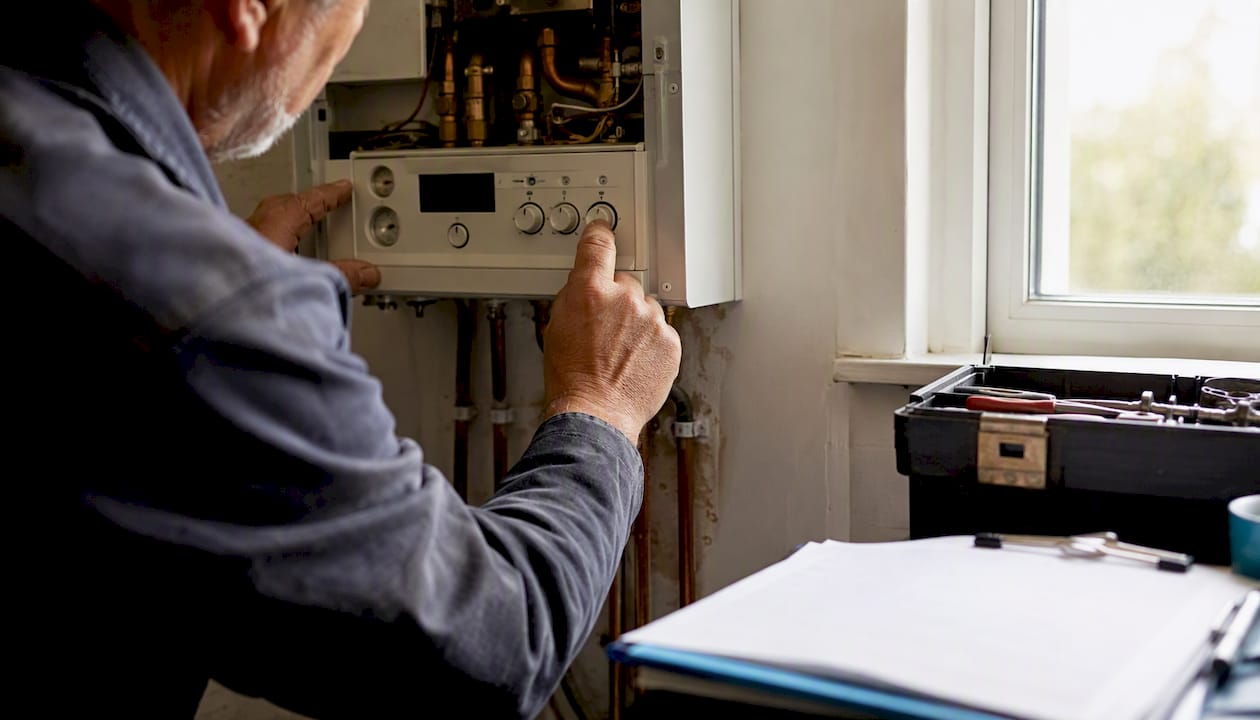
A RICS Home Survey is a different animal entirely, commissioned by you, for you. RICS explains that a Level 2 Home Survey includes a market valuation alongside a condition assessment, making it the natural next step if you want both a second opinion on price and a proper look at the building’s health. A Level 3 survey goes further still, suited to older, altered, or unusual properties where structural risk is a real possibility.
| Feature | Lender valuation | RICS Level 2/3 survey |
|---|---|---|
| Who commissions it | The lender | You, the buyer |
| Who it benefits | The lender’s security | You, the buyer |
| Typical method | AVM, desktop, or drive-by | Full or partial physical inspection |
| Influences mortgage amount | Yes, directly | No, but supports negotiation or a challenge |
| Typical cost | Often bundled into lender fees | £250 to £1,000 depending on level and property size |
Most down valuations aren’t the valuer being awkward. They usually come down to one of three things: the market, the property, or the lender’s own risk appetite.
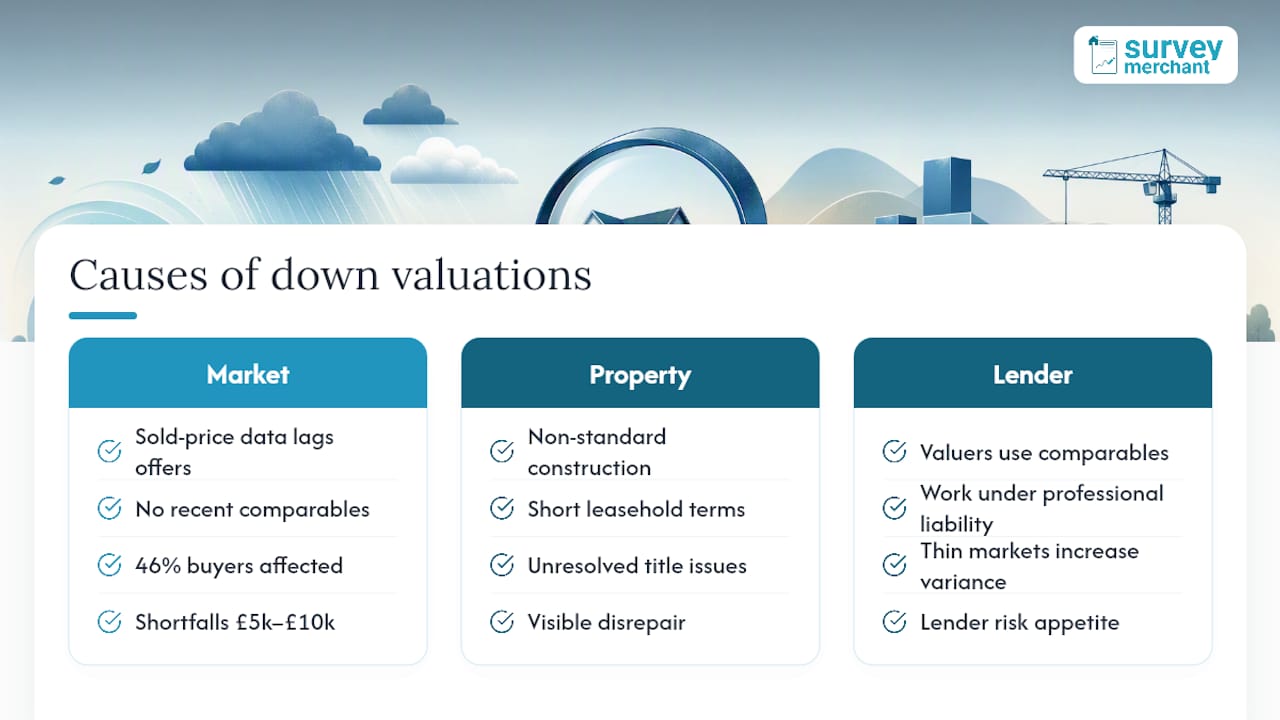
Market causes. In fast-rising markets, sold-price data lags behind what buyers are actually agreeing to pay. If three similar houses sold for £280,000 six months ago and you’ve agreed £310,000 in a bidding war, the valuer has no recent comparable evidence to support your figure, even if the market has genuinely moved. Which?'s research found around 46% of prospective buyers in one survey period had experienced a down valuation, with most shortfalls sitting between £5,000 and £10,000.
Property causes. Non-standard construction, short leasehold terms, unresolved title issues, or visible disrepair can all pull a valuation down regardless of what the local market is doing.
Valuer and lender causes. Valuers work under professional liability and lean on comparable evidence rather than asking prices or agent enthusiasm. The RICS journal notes that in thin markets, valuers must look further afield for comparables and apply adjustments, which increases variance between different surveyors’ opinions on the same property. Add in a lender’s general risk appetite, and a cautious AVM figure can land well under an agreed price even on a well-kept home, as Legal & General points out.
Pro Tip: Read the valuation report closely. If it references specific comparable addresses and dates, you’re dealing with a comparables issue you can challenge with better evidence. If it flags “disrepair” or “non-standard construction,” you’re dealing with a condition issue, and a survey will help more than an argument.
The valuation almost always lands after your offer is accepted and your mortgage application has gone in, which is exactly why it feels like such a gut punch. You’ve had the offer accepted, told friends and family, maybe even started measuring for curtains, and then the figure comes back lower than expected.
Three main methods, in order of how thorough they are:
Once the result lands, move quickly:
Not every low valuation means the same thing, and the right response depends on which of four buckets you’re in.
1. Pure price gap. The valuer agrees the property is sound but thinks it’s simply worth less than you’ve offered. Your mortgage offer will be revised to lend against the lower figure, leaving you to find the difference or renegotiate.
2. Condition or defect flagged. The report notes disrepair, damp, subsidence risk, or similar. This can trigger retention (the lender holding back part of the loan until repairs happen) or a request for a specialist report before funds release.
3. Lender appetite or property fit issue. Some lenders won’t lend on ex-local authority flats above a certain floor, properties with limited lease terms, or non-standard construction. Here the valuation figure might be fine, but the lender’s own criteria are the real obstacle.
4. Request for more evidence. Occasionally the valuer simply wants clarification, perhaps on tenure, boundaries, or a discrepancy between the floorplan and the listing. This one is often the quickest to resolve.
A quick example: if your report cites “insufficient comparable evidence in the immediate area,” you’re in bucket one and comparables will help. If it mentions “evidence of movement to the rear elevation,” you’re in bucket two, and you need a structural opinion before anything else happens.
Once you know which bucket you’re in, the decision becomes far more concrete. Ferro Financial sets out four primary routes: challenge the valuation, renegotiate the price, switch lender, or increase your deposit to cover the gap. Walking away is always the fifth, quieter option.
| Option | How it solves the gap | Time to resolve | Typical cost | Likelihood of success |
|---|---|---|---|---|
| Renegotiate with seller | Seller drops price to match valuation | 1 to 2 weeks | None directly | Often the most successful route |
| Challenge the valuation | Lender revises figure upward with new evidence | 2 to 3 weeks | Cost of any independent survey commissioned | Moderate, needs strong comparables |
| Switch lender | New lender’s valuer reaches a higher figure | 2 to 4 weeks | New arrangement/valuation fees | Uncertain, depends on the market |
| Add deposit / cash | You fund the shortfall yourself | Immediate once funds confirmed | Full cash gap amount | Guaranteed if funds available |
| Walk away | Removes the problem entirely | Immediate | Lost survey/legal fees to date | Always available |
Willow Private Finance makes an important point here: appealing a lender’s valuation is often less effective than simply renegotiating with the seller, because the lender usually backs its own instructed surveyor unless you bring genuinely objective new evidence or point to a factual error.
Negotiating with the seller works best when you lead with the report, not your frustration. Share the specific comparables the valuer used, note the shortfall in plain terms, and propose a split: perhaps you meet halfway, or the seller contributes towards a repair the valuer flagged rather than cutting the headline price. Sellers who’ve already committed emotionally to moving often prefer a modest reduction to restarting the whole process with a new buyer.
Worked example. Say you agreed £320,000 and the valuation comes back at £305,000, a £15,000 shortfall. Against the new valuation, the lender will only lend up to its LTV limit on £305,000.
A challenge only works with hard evidence, not a strongly worded email. Here’s the sequence that mortgage brokers recommend, drawing on guidance from WhatMortgage:
Set your expectations realistically. Lenders generally back their instructed valuer’s professional opinion, so a challenge succeeds most often when you can point to a specific factual error or comparables the original valuer clearly missed, not simply a difference of opinion on price. Expect roughly two to three weeks for a response once submitted.
Pro Tip: Match your comparables on the three things valuers actually adjust for: time (how recent the sale was), size (square footage, not bedroom count), and condition (renovated versus original). A four-bed detached that sold eighteen months ago for a higher price isn’t a strong comparable if it had a new kitchen and yours doesn’t.
Numbers make this far less abstract. Walk through it properly and the decision usually becomes obvious.
If you decide to proceed regardless, recheck three things before exchange: your monthly repayment at the new loan amount, any arrangement or product fees tied to a specific LTV band, and whether your solicitor needs to confirm the source of any additional cash for anti-money-laundering checks.
Cost and time pull in different directions depending on the route, and your chain position often decides which one you can actually afford to choose.
Roughly 46% of prospective buyers encounter a down valuation at some point according to Which?, and most shortfalls fall between £5,000 and £10,000, small enough that renegotiation resolves them faster than a formal challenge or a lender switch in most cases.
If your chain is tight, weigh the two to four extra weeks a lender switch adds against the risk of losing the property or the chain collapsing entirely. Sometimes the “guaranteed but painful” option, finding the cash, ends up cheaper than the theoretically free option that costs you the sale.
If the down valuation flags a condition issue, or you simply want stronger ammunition for a challenge or negotiation, a paid RICS survey earns its keep quickly. RICS explains that a Level 2 Home Survey combines a market valuation with a condition assessment, giving you two things a lender valuation never provides: an independent opinion on price, and a professional view on the building’s structural health.
A Level 3 survey goes further again, appropriate for period properties, homes with extensions or unusual construction, or anywhere the down valuation report hints at structural concern rather than pure pricing.
Booking through a marketplace like Survey Merchant means you’re matched to a RICS-qualified surveyor from a nationwide panel rather than searching independently and hoping you’ve found someone genuinely qualified for your property type. You’ll typically get a written report covering condition findings, an independent valuation opinion where relevant, and photographic evidence, exactly the kind of material a broker can use to support a formal challenge or a seller negotiation. You can read more on the difference between a mortgage valuation and a home survey and how each fits into your next move.
Pro Tip: A paid survey tends to be worth it when the shortfall is condition driven or exceeds a few thousand pounds, since the report can pay for itself in negotiating leverage. If the gap is small and purely a comparables issue, three solid sold-price examples might be all you need, no extra spend required.
Brokers see the same pattern again and again: buyers instinctively want to fight the valuation, when renegotiating with the seller usually gets there faster and cheaper. A formal challenge only really lands when you’ve spotted a factual error in the report or found comparables the valuer plainly missed. Absent that, you’re arguing opinion against a professional who the lender will back by default.
Your priorities shift depending on who you are. First-time buyers with no chain pressure have the most room to negotiate hard or top up their deposit, since there’s no onward sale riding on speed. Home movers stuck in a chain often can’t afford the two to four weeks a lender switch adds, so speed usually beats principle, even if that means accepting a slightly worse outcome to keep the chain intact. Buyers purchasing as an investment should be the quickest to walk if the numbers no longer work, since there’s no emotional attachment forcing a bad decision.
A few habits separate buyers who resolve this smoothly from those who drag it out for weeks:
If a down valuation has left you needing independent evidence fast, Survey Merchant connects you directly to RICS-qualified surveyors from a nationwide panel, without the delay of ringing round firms one by one to find someone available.

You tell us your property type and what triggered the shortfall, whether it’s a comparables dispute or a condition flag in the lender’s report, and we match you with a surveyor suited to that specific issue, whether that’s a Level 2 or Level 3 survey. Booking is straightforward through our building surveying services page, and if the property is older, extended, or structurally complex, our full Level 3 building survey service gives you the depth of report a formal challenge or a firm negotiation with the seller often needs. Every report comes with photographic evidence and clear condition findings your broker can put directly in front of the lender.
If you’d rather explore whether a fresh valuation opinion could help your negotiation, our RICS valuation services page sets out how that works and what it typically costs. Check availability in your area and get matched with a surveyor today.
Building a strong case rests on using primary data rather than agent-supplied asking prices or hearsay about “what houses on that street go for.”
This article provides general information and does not constitute financial or legal advice. Mortgage lending decisions depend on your individual circumstances, so confirm your options with a qualified mortgage broker or solicitor before acting.
Can I still get my mortgage if the valuation is lower than the price? Yes, but the lender will only lend against its own valuation figure, not the agreed price, so you’ll need to cover the shortfall in cash, renegotiate, or switch lender to proceed at the original figure.
How often do down valuations actually happen? Which? found that around 46% of prospective buyers in one survey period had experienced a property being valued below the agreed price, with most shortfalls between £5,000 and £10,000.
Is it worth challenging a mortgage valuation? It’s worth challenging when you can point to a factual error or genuinely strong comparables the valuer missed. Without that, renegotiating with the seller tends to succeed more often and faster than a formal appeal.
Does a down valuation affect my mortgage offer’s validity? It usually results in the lender revising your offer to the lower loan amount rather than withdrawing it outright, though condition-related issues can trigger additional conditions or a retention until repairs are addressed.
Should first-time buyers handle a down valuation differently to home movers? First-time buyers without a chain generally have more room to negotiate hard or top up their deposit, while movers under chain pressure often need to prioritise speed over contesting the figure.
This article is general information, not a substitute for advice from a qualified financial advisor. Consult a qualified financial professional about your own circumstances before acting on anything here.
Survey Merchant provides vetted RICS surveyors across 100+ UK locations at fixed fees:
→ Level 2 Home Survey (HomeBuyer Report)
→ Level 3 Building Survey (full structural survey)
→ RICS Red Book property valuations
→ Party wall surveyors — notices, awards & schedules of condition
→ Expert witness surveyors — CPR Part 35 reports for property disputes