Leasehold
Jul 16, 2026
HomeBuyer Report vs Building Survey: Which Do You Need?
Compare RICS Level 2 HomeBuyer Report and Level 3 Building Survey — what they cover, typical costs and which properties need

Buying a property? Choosing the right survey is key. For most modern homes in good condition, a HomeBuyer Report (Level 2) is sufficient. It highlights visible issues using a traffic-light system and costs about £455 on average. However, if you're considering an older, listed, or non-standard property - or planning renovations - a Building Survey (Level 3) is better. It provides a deeper inspection, detailed repair advice, and costs around £629 on average. Both options help you avoid unexpected expenses and negotiate effectively.
| Feature | HomeBuyer Report (Level 2) | Building Survey (Level 3) |
|---|---|---|
| Inspection Type | Visual, non-intrusive | Detailed, hands-on |
| Property Age | Modern (post-1900) | Older (pre-1880) |
| Condition | Good | Poor or modified |
| Cost | £400–£1,000 | £630–£1,500+ |
| Report Length | 25+ pages | 35+ pages |
| Repair Guidance | Basic | Detailed with estimates |
Choose based on your property's age, condition, and future plans.
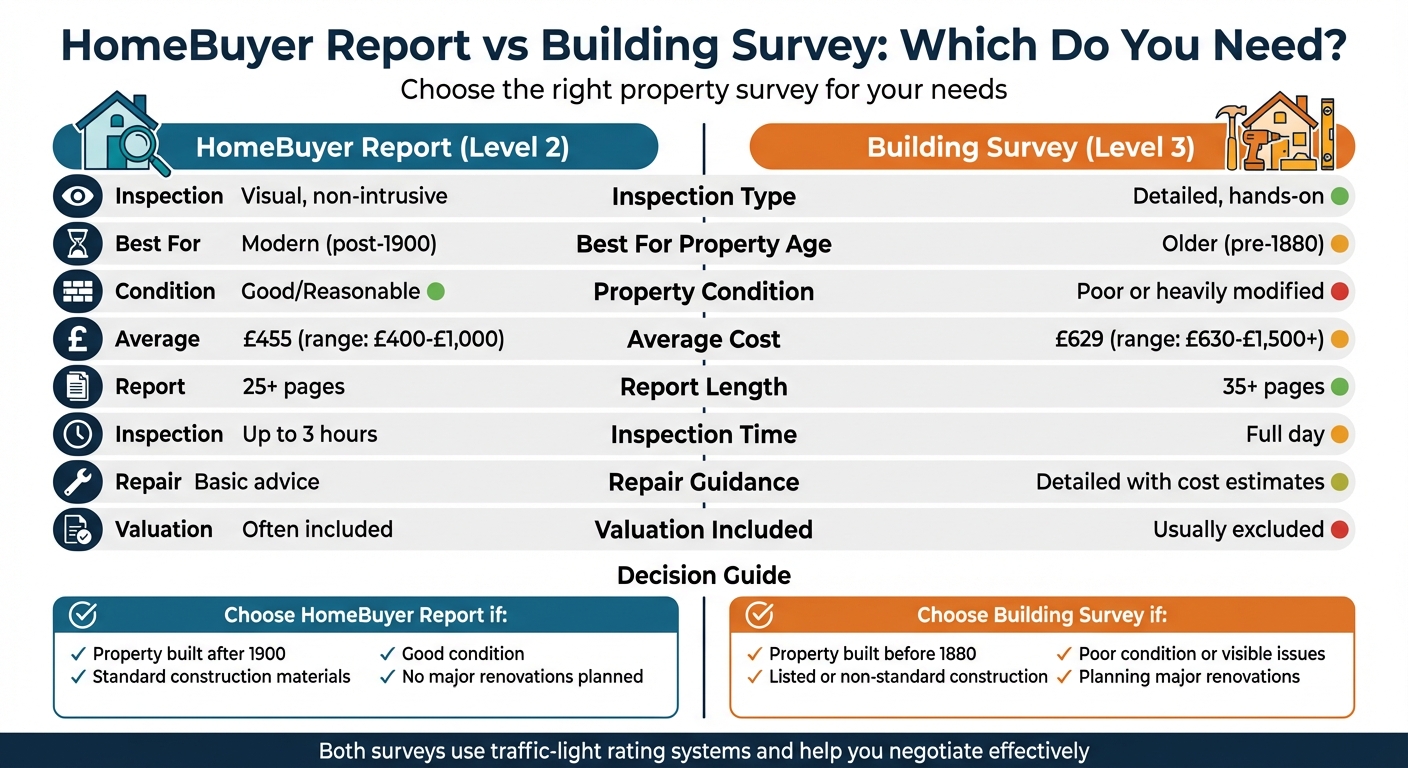
HomeBuyer Report vs Building Survey Comparison Chart

The HomeBuyer Report (RICS Level 2) is a mid-level property survey designed for conventional homes in good condition, typically constructed from standard building materials and with no major modifications [1][6]. It’s particularly suited to properties built within the last 80 to 100 years.
This report uses a traffic light rating system to evaluate the property’s condition:
"Choose an RICS Level 2 Home Survey if you would like more extensive information while buying or selling a conventional house, flat or bungalow, built from common building materials and in reasonable condition." – RICS [6]
The report provides professional advice on necessary repairs and future maintenance [2][6]. It’s typically at least 25 pages long and costs around £455 on average, though prices can range from £400 to £1,000, depending on the property’s size and location [1][3].
A HomeBuyer Report involves a visual inspection of the property’s main structural elements and systems. The surveyor doesn’t lift carpets, move furniture, or remove fixed panels and floorboards [3][7].
Indoor areas included in the inspection are ceilings, walls, bathrooms, and visible timbers (checked for signs of rot or woodworm) [3]. Outdoor features such as the roof, gutters, walls, and any permanent outbuildings are also assessed [3]. The surveyor examines windows, damp-proofing, insulation, and drainage chambers where accessible, although drains themselves are not tested [3][4][6].
The loft is inspected for leaks and structural issues [3]. A traffic light system is used to highlight potential problems, with common issues including damp, wall cracks, subsidence, Japanese Knotweed, and electrical faults [1].
The inspection typically takes 90 minutes to 4 hours, depending on the property size [3]. For an additional fee, you can opt for a "survey and valuation" version, which includes a market valuation and an insurance reinstatement figure (rebuild cost) [3][6].
This survey is ideal for standard houses, flats, or bungalows built from common materials since the late Victorian period (around 1880). However, it’s not suitable for listed buildings, properties with thatched roofs or timber frames, homes in poor condition, or those requiring significant renovations [3][4][6].
The findings from a HomeBuyer Report can also be a useful tool for negotiation. If defects are identified, they may help you negotiate a lower purchase price or prompt the seller to address major issues before the sale is finalised [1][3][7].
The Building Survey (RICS Level 3), previously called a "Full Structural Survey", is the most thorough property inspection you can get in the UK [1][4]. It provides a detailed evaluation of a property's condition, focusing on its structural soundness, the materials used in its construction, and how those materials have held up over time [1][2].
This isn’t just a surface-level check. Surveyors go deeper, inspecting areas such as the roof space, measuring the thickness of thermal insulation, and conducting a heel-drop test to check for floor deflection. They also examine under-floor spaces, open accessible windows, and lift inspection chamber covers to assess drainage systems [9].
The resulting report, often exceeding 35 pages, highlights visible and hidden defects, their causes, potential solutions, and the risks of leaving them unaddressed [4][1][8]. On average, the cost of this survey is around £629, though it can go beyond £1,000 for larger or more complex properties [1][6].
"Building Surveys are ideal for period properties, buildings that you want to renovate or convert, or those that have already been extensively altered." – Rightsurvey [4]
The Building Survey doesn’t stop at identifying issues - it also provides expert advice on how to address them. Surveyors thoroughly examine all accessible parts of the property, including structural elements like the roof framework, and look for signs of damp, rot, or woodworm. They trace potential problems across the property, offering practical solutions and even legal guidance for dealing with serious risks or unsafe conditions [1][2][4].
A Building Survey is particularly relevant for certain types of properties. If you’re buying a home built before 1880, a listed building, or one with non-standard construction (like timber-framed or thatched roofs), this survey is highly recommended [4]. It’s also suitable for larger homes with five or more bedrooms, houses in poor condition, or ones showing signs of structural issues, such as major cracks or sagging roofs [4].
Planning to renovate, extend, or convert the property? A Building Survey is the right choice. If the property has already undergone significant changes, this service can be tailored to address specific concerns. The detailed repair cost estimates included in the report can also strengthen your position during negotiations, whether that means adjusting the purchase price or requesting repairs before finalising the deal [4][2][6].
The key difference between a HomeBuyer Report (Level 2) and a Building Survey (Level 3) lies in the depth of inspection and the type of property they are suited for. A HomeBuyer Report is a non-intrusive survey focusing on visible aspects of the property. Surveyors won't lift carpets, move furniture, or inspect concealed areas. On the other hand, a Building Survey is far more detailed and involves a thorough, hands-on examination, including areas like the attic and accessible subfloor spaces [1][7].
The property’s age and condition play a critical role in deciding which survey to choose. A Level 2 survey is aimed at conventional properties built within the last 80 to 100 years that are in decent condition. Meanwhile, a Level 3 survey is recommended for older properties (pre-1880), non-standard constructions (such as timber-framed or thatched homes), or buildings requiring significant renovation [1][4].
The reports themselves also differ in structure and content. HomeBuyer Reports use a traffic light system to flag issues requiring attention, while Building Surveys provide an in-depth explanation of the property’s construction, pinpointing the causes of defects and recommending specific solutions. Typically, a HomeBuyer Report is at least 25 pages long, whereas a Building Survey stretches to 35 pages or more [1][4]. This added detail also impacts their cost.
On average, a HomeBuyer Report costs about 60% of what a Building Survey would [4]. Prices depend on the size and complexity of the property. Level 2 surveys often include a market valuation and insurance reinstatement costs, either as standard or optional add-ons. In contrast, a Level 3 survey typically excludes valuation unless specifically requested as an additional service [1][2].
"The main difference between a homebuyers report and a building survey is that the building survey provides a more thorough inspection of the property in question." – Adele MacGregor [1]
Here’s a quick breakdown of the key differences:
| Feature | HomeBuyer Report (Level 2) | Building Survey (Level 3) |
|---|---|---|
| Inspection Type | Visual and non-intrusive | Comprehensive and hands-on |
| Property Age | Modern/Conventional (<80–100 years) | Older (>80–100 years) or unique designs |
| Property Condition | Reasonable/Good | Poor, neglected, or heavily modified |
| Defect Analysis | Highlights visible issues | Explains causes and suggests solutions |
| Repair Guidance | Basic advice | Detailed recommendations with cost estimates |
| Market Valuation | Often included | Typically excluded unless requested |
| Traffic Light System | Yes | Yes |
| Report Length | At least 25 pages [4] | At least 35 pages [4] |
| Average Cost | £455 [1] | £629 [1] |
| Time Required | Up to 3 hours [7] | Full day [7] |
Deciding between a HomeBuyer Report and a Building Survey depends on a few key factors: the property’s age, construction materials, condition, and your plans for it. Generally, homes built in the last 80 to 100 years and in reasonable shape are suited to a Level 2 survey (HomeBuyer Report) [1]. For older properties or those showing visible issues, a Level 3 survey (Building Survey) is the safer choice. These considerations will help you pick the right survey for your situation.
The construction materials matter. If the property is a standard brick-and-tile build, a HomeBuyer Report should suffice. However, homes built with timber, thatch, or stone require the more thorough analysis provided by a Building Survey [1]. The same applies if the house has been extensively altered, extended, or converted - a Level 3 survey is better equipped to assess the quality of structural changes [1].
Your future plans for the property also play a role. Planning major renovations or structural changes? A Building Survey gives you a detailed understanding of the property’s condition and its ability to handle such work [6]. This upfront knowledge could save you from expensive surprises later.
"Given the varied nature of materials and construction techniques found in pre-1945 properties, we will only offer a building survey on such properties." – Andrews Eades Chartered Surveyors [15]
Before the survey, let your surveyor know about any specific concerns, like cracks or damp patches, so they can give those areas extra attention [6]. Keep in mind, once contracts are exchanged, you can’t back out or renegotiate, making it crucial to complete the survey beforehand [10].
A HomeBuyer Report works well for properties that are relatively modern and in good condition. For example, a 10-year-old semi-detached house built with standard materials or a well-maintained purpose-built flat might only need a Level 2 survey [11]. Properties built after 1900 using common construction techniques are typically good candidates. If the home shows no visible signs of cracks, damp, or structural movement, the non-intrusive inspection offered by a HomeBuyer Report is usually enough. It’s also a more budget-friendly way to spot visible issues without diving into a full structural analysis.
A Building Survey is essential for older or more complex properties. For instance, a 19th-century terraced house with visible cracks in the walls would need a Level 3 survey. Similarly, large Victorian homes with extensions, Grade II listed buildings, or semi-derelict properties require this in-depth approach [11][12]. If the property has known issues, such as subsidence, a Building Survey is a must [10].
Skipping a proper survey can be costly. On average, homeowners spend £5,750 on repairs after moving in when defects are discovered too late [14][16]. In one survey, 16% of buyers found issues post-purchase, with some spending over £5,000 on fixes. Meanwhile, around 7% were able to negotiate a lower price after problems were flagged [14].
"A survey can flag these issues before you buy, which allows you to negotiate a lower price and makes getting a survey worthwhile." – Andrew Boast, Co-founder, SAM Conveyancing [14]
For properties built with non-standard materials, like concrete frames, or those needing significant renovation, a Building Survey provides detailed repair advice and cost estimates. This information is invaluable for negotiating the purchase price or planning renovations [1][13]. Choosing the right survey not only helps you avoid surprises but also ensures you’re prepared for any necessary investment.
The cost of a HomeBuyer Report generally falls between £400 and £1,000, with the average being around £455. On the other hand, Building Surveys tend to range from £630 to £1,500, averaging about £629. For reference, Level 2 surveys typically cost about 60% of what a Level 3 survey would cost[1][4]. Several factors influence these prices, including the property's value, size, location, and age. For instance, larger homes with five or more bedrooms require more time and effort to inspect and report on. Similarly, older properties - those built before 1880 - listed buildings, or homes with unique features like thatched roofs or timber frames often demand specialised attention[5].
While the upfront cost may seem significant, these surveys can offer substantial value. If a report identifies repairs amounting to, say, £10,000, buyers can use this information to negotiate a price reduction or request that the repairs be completed before the contracts are finalised[5]. This makes choosing the right survey a critical decision, one that benefits from expert guidance.

When navigating these cost differences, having the right support can make all the difference, and that’s where Survey Merchant steps in. Survey Merchant connects homebuyers with RICS-registered surveyors who provide both HomeBuyer Reports and Building Surveys, tailored to the specific needs of the property. All surveyors in their network adhere to strict professional standards, carry professional indemnity insurance, and are committed to delivering impartial, high-quality reports.
With coverage across the UK, Survey Merchant offers personalised advice to help you choose the most suitable survey level based on your property’s unique features and risks. Whether you need a straightforward HomeBuyer Report for a modern semi-detached home or a detailed Building Survey for a Victorian terrace with visible structural issues, Survey Merchant can match you with the ideal surveyor. Most reports are delivered within two to five working days after the inspection[17], giving you the critical information you need to move forward confidently - or to renegotiate if necessary.
Deciding between a HomeBuyer Report and a Building Survey comes down to three key factors: the property's age, its condition, and how you plan to use it. For most conventional homes - typically those built within the last 80–100 years and in decent condition - a HomeBuyer Report (Level 2) is a solid choice. This type of survey provides a non-intrusive visual inspection with a traffic-light rating system, costing between £400 and £1,000[5].
On the other hand, a Building Survey (Level 3) is better suited for older, listed, or non-standard properties, as well as homes in poor condition or those earmarked for significant renovations. This more detailed inspection includes examining areas like attics and even under floorboards where possible. While it comes with a higher price tag - ranging from £630 to £1,500+[5][6] - it offers in-depth repair advice and can identify hidden issues that a Level 2 survey might overlook. Understanding these differences ensures you select the survey that best safeguards your investment.
"A house survey will give you information to decide about the property purchase, which can have far-reaching financial implications." – RICS[6]
No matter whether you opt for a Level 2 or Level 3 survey, having the right one in place shields you from unexpected costs and provides the evidence you need to negotiate effectively.
To simplify this important choice, Survey Merchant connects you with RICS-registered surveyors who tailor their expertise to your property's specific requirements. The right survey is not just a safeguard - it's a crucial tool for making informed and confident decisions.
When considering property surveys, there are two main options to choose from, depending on the type and condition of the property.
The HomeBuyer Report (RICS Level 2 Survey) is tailored for properties built within the last 80–100 years and in generally good condition. This survey focuses on visible issues like damp or structural movement, using a straightforward traffic-light system to indicate problem areas. It also includes advice on necessary repairs, making it a practical choice for modern homes needing a clear and concise overview.
On the other hand, the Building Survey (RICS Level 3 Survey) is far more detailed. It’s designed for older, period, or significantly altered properties, as well as homes that require extensive renovations. This survey delves into the structural integrity of the building, uncovers hidden defects, and estimates repair costs, providing a thorough evaluation of the property’s condition.
In essence, the HomeBuyer Report works well for a straightforward review of a newer property, while the Building Survey is the go-to option for an in-depth analysis of older or more complex homes.
When buying an older property - typically one that's over 80–100 years old - or a building that's been heavily modified, or if you're planning to renovate or convert it, a Building Survey is the smarter choice. It offers a detailed structural analysis, giving you a clear picture of the property's overall condition.
This survey is particularly helpful for spotting potential problems in more complicated or distinctive properties, ensuring you're well-prepared to handle repairs and manage future expenses.
A property survey provides an impartial evaluation of a property's condition, offering useful details that can be leveraged during negotiations. It identifies visible problems like damp, roof damage, or structural issues, often presented through a straightforward traffic-light system. These insights can help you negotiate repairs or justify a reduced offer.
Take the HomeBuyer Report (Level 2), for instance. This report focuses on significant, visible defects and can help estimate repair costs. For example, if roof repairs are estimated at £15,000, you could negotiate this amount off the asking price or request the seller to handle the repairs before the sale is finalised. On the other hand, a Building Survey (Level 3) goes further, uncovering more complex or hidden issues, such as drainage or structural concerns. This detailed analysis provides stronger grounds for renegotiation or, in some cases, might even lead you to reconsider the purchase if the necessary repairs prove too expensive.
Once you receive the survey report, you can review its findings with your solicitor or discuss them directly with the seller. This professional assessment helps safeguard your investment and ensures you’re paying a fair price for the property.
Survey Merchant provides vetted RICS surveyors across 100+ UK locations at fixed fees:
→ Level 2 Home Survey (HomeBuyer Report)
→ Level 3 Building Survey (full structural survey)
→ RICS Red Book property valuations
→ Party wall surveyors — notices, awards & schedules of condition
→ Expert witness surveyors — CPR Part 35 reports for property disputes