We use cookies to improve your experience on our site, analyze site traffic, and assist in our marketing efforts. By clicking "Accept all," you agree to the storing of cookies on your device. You can choose to "Reject all" non-essential cookies. For more information, please read our Cookie Policy.
A complete 2026 guide to exchange of contracts in England and Wales: how it works, the deposit, exchange-to-completion timings, pulling out, new builds, the government's reform roadmap and why your survey comes first.
Exchange of contracts is the moment a house sale in England and Wales stops being a gentleman’s agreement and becomes legally binding. Until that point either side can walk away without penalty; after it, the buyer’s deposit is on the line and the completion date is fixed. This 2026 guide explains exactly what exchange of contracts means, what has to happen before it, how long it takes to reach completion, what can go wrong in between, and why your survey must be finished (and acted on) before you sign.
Key takeaways
Exchange of contracts is when the buyer’s and seller’s solicitors swap signed contracts and the deal becomes legally binding on both parties.
The buyer normally pays a 10% deposit at exchange; pulling out afterwards usually means forfeiting it, while a seller who withdraws can be sued for the buyer’s losses.
Completion typically follows one to two weeks later, though same-day exchange and completion is possible and longer gaps are common with new builds.
Risk in the property generally passes to the buyer at exchange, so buildings insurance must start on exchange day, not completion.
The government’s June 2026 reform roadmap proposes binding conditional contracts much earlier in the process, so getting your survey done early matters more than ever.
Any survey findings, price renegotiation or mortgage retention must be resolved before exchange – afterwards it is too late.
What is exchange of contracts?
Exchange of contracts is the point in a property transaction in England and Wales when the buyer’s and seller’s solicitors formally swap identical signed contracts, the buyer pays the deposit, and the sale becomes legally binding. From exchange, neither party can withdraw without serious financial consequences, and the completion date written into the contract is fixed.
Before exchange, an accepted offer is only an informal agreement. The property is marked sold subject to contract (SSTC), the agent issues a memorandum of sale, and the solicitors get to work – but either side can still change their mind, which is why gazumping and gazundering remain possible right up until exchange. According to GOV.UK (June 2026), the average purchase in England currently takes around 120 days and roughly one in three agreed sales falls through before exchange, costing sellers about £400 million a year.
In Scotland the process is different: missives (a series of formal letters between solicitors) are “concluded” much earlier, often within a few weeks of an offer, so the binding point arrives sooner. This guide focuses on England and Wales.
At exchange of contracts the signed contracts are swapped, the deposit is paid and the sale becomes legally binding.
How does exchange of contracts actually work?
Despite the name, nobody physically swaps paper any more. Exchange is usually done by telephone between the two solicitors using Law Society formulae (most commonly “Formula B”). Each solicitor holds a contract signed by their own client; on the call they confirm the contracts are identical, agree the completion date, and declare the contracts exchanged. The buyer’s solicitor then sends the deposit to the seller’s solicitor, usually by same-day bank transfer.
In a chain, exchange has to happen on every linked transaction on the same day, which is why your solicitor will not exchange until every party in the chain is ready. One slow link holds everyone up – a key reason the government wants to reform the process.
A formal mortgage offer (not just an agreement in principle), with any conditions or retentions dealt with.
Searches returned – local authority, water and drainage, environmental and any location-specific searches such as mining or flood.
Enquiries answered, including the seller’s TA6 property information form and TA10 fittings and contents form.
Deposit funds cleared in your solicitor’s client account.
Buildings insurance arranged to start on the day of exchange.
Completion date agreed with everyone in the chain.
How much is the deposit at exchange of contracts?
Under the Law Society’s Standard Conditions of Sale (5th edition, 2018 revision), which govern most residential contracts, the buyer pays a deposit of 10% of the purchase price on exchange. In practice a 5% deposit is sometimes negotiated, particularly for first-time buyers with a 95% mortgage, but the contract will usually still entitle the seller to demand the balance up to 10% if the buyer fails to complete.
The exchange deposit is separate from your mortgage deposit in the everyday sense: it is simply the first slice of the money you are putting in, paid early as security for the seller. The rest of the purchase price, including the mortgage advance, is transferred on completion.
How long between exchange and completion?
There is no legal minimum or maximum gap. The typical interval is one to two weeks, giving everyone time to book removals, request mortgage funds and arrange utilities. Same-day exchange and completion is possible and is sometimes used in chain-free purchases or when parties are nervous about committing early, although it leaves no safety net if money arrives late. Gaps longer than a few weeks are common with new builds, where contracts are exchanged while the home is still being built, with completion triggered by a notice when the property is finished.
Data reported by TwentyCi in November 2026 (via The Intermediary) put the average time from sale agreed to exchange so far in 2026 at 127 days, four days longer than in 2025 – so the real bottleneck is getting to exchange, not the final stretch to completion.
Typical timeline from offer to keys (England and Wales, 2026)
Stage
Typical timing
What it involves
Offer accepted (SSTC)
Day 0
Memorandum of sale issued; solicitors instructed; survey booked
Survey and valuation
Weeks 1–3
Level 2 or Level 3 survey; lender’s mortgage valuation
Searches
Weeks 1–6
Local authority, drainage and water, environmental, mining/flood where relevant
Mortgage offer
Weeks 2–5
Formal offer issued after valuation and underwriting
Enquiries and report on title
Weeks 3–10
Solicitor raises enquiries, reviews TA6/TA10, reports to buyer
Exchange of contracts
Typically weeks 10–18
Deposit paid; completion date fixed; sale legally binding
Your survey must be completed, and any defects negotiated, before exchange of contracts – afterwards the price and the property are fixed.
Why your survey must be done before exchange of contracts
Once contracts are exchanged you buy the property as it is. The principle of caveat emptor (buyer beware) applies, and under the Standard Conditions the risk in the property generally passes to the buyer at exchange. If the survey later reveals a failed roof, subsidence or an unsafe electrical installation, you have no right to renegotiate or withdraw without losing your deposit.
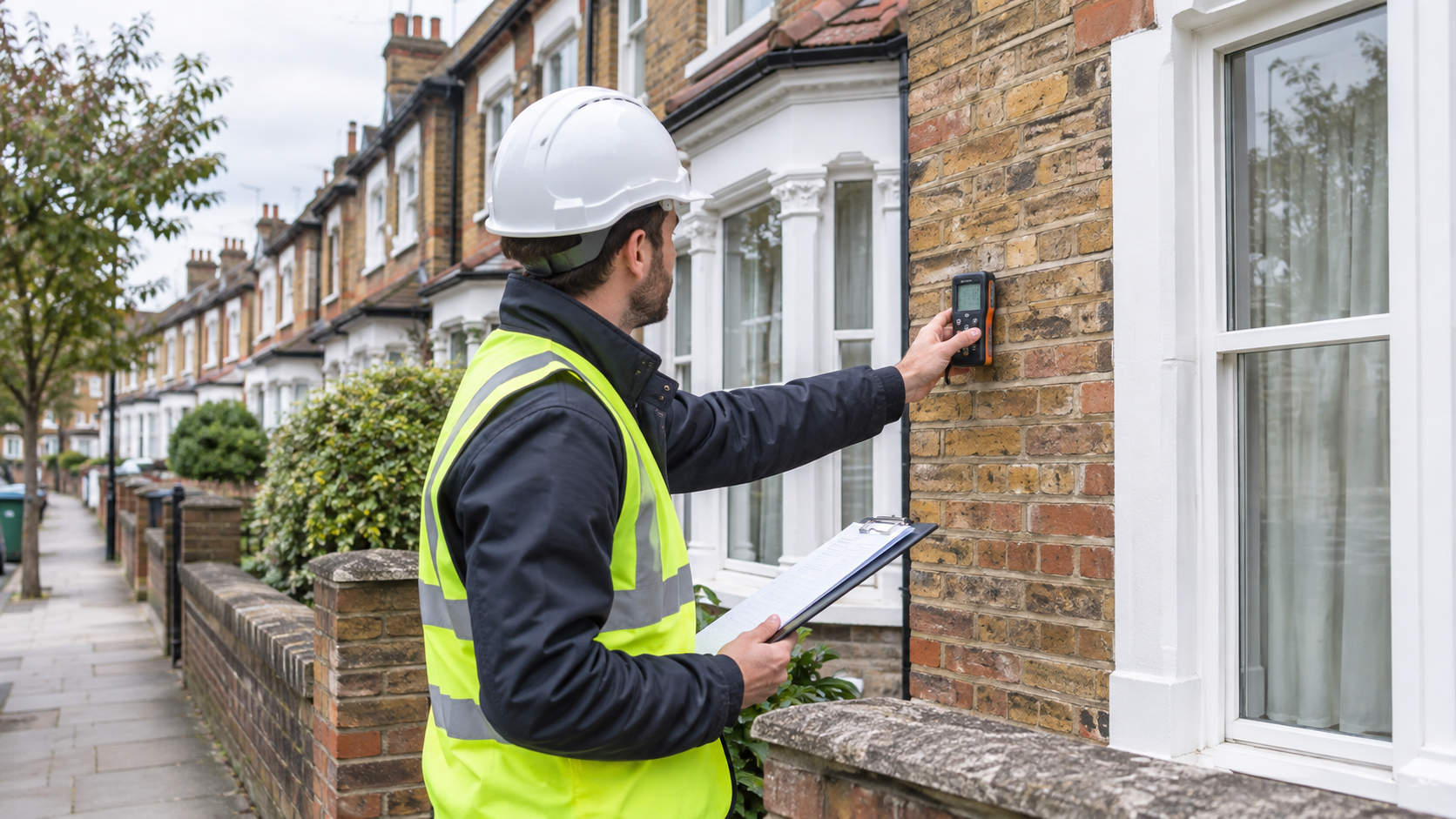
That is why a suitably qualified, accredited surveyor – regulated by a body such as RICS, CIOB or RPSA – should inspect the property as early as possible after your offer is accepted. Survey Merchant’s panel includes accredited surveyors across these bodies, matched to the age and type of property, so your report lands well before your solicitor is ready to exchange. If the report raises concerns, our guide to what to do when a survey finds problems walks through your options, from obtaining quotes to renegotiating or, in serious cases, walking away while you still can.
Survey issues remain a meaningful cause of collapsed sales. Quick Move Now’s Q3 2026 analysis, reported on 2 November 2026, found survey problems accounted for 12.5% of failed transactions, behind buyers changing their minds (37.5%) and mortgage or lending issues (18.75%). Every one of those fall-throughs happened before exchange – which is precisely the window in which a thorough survey protects you.
What happens after exchange of contracts?
Between exchange and completion the practical work takes over. Your solicitor requests the mortgage funds from your lender (usually three to five working days ahead), carries out pre-completion searches at HM Land Registry and a bankruptcy search, and prepares the transfer deed (TR1) for signature. You should confirm your removals, redirect post, notify utilities and the council, and make sure your buildings insurance is live.
On completion day the buyer’s solicitor sends the balance of the purchase money to the seller’s solicitor. Once it arrives, the seller’s solicitor confirms completion, the estate agent is authorised to release the keys, and the seller must have vacated and left the property in the condition agreed in the contract. GOV.UK notes that the seller’s solicitor then uses the proceeds to redeem the mortgage, settle agent fees and pay their own costs before releasing the balance to the seller.
After completion you must file a Stamp Duty Land Tax return and pay any tax due within 14 days of completion (GOV.UK, updated 30 September 2026), and your solicitor will register your ownership and any mortgage at HM Land Registry.
Can you pull out after exchange of contracts?
Technically yes, but it is a breach of a binding contract and the consequences are severe. The table below summarises the usual position under the Standard Conditions of Sale; the exact terms of your contract will govern.
Scenario
Likely consequence
Buyer fails to complete on the agreed date
Seller can serve a notice to complete giving 10 working days, making time of the essence; interest at the contract rate accrues daily on the outstanding balance
Buyer still fails to complete after the notice
Seller can rescind, keep the 10% deposit (and claim any shortfall to 10% if only 5% was paid), resell and sue for further losses
Seller fails to complete
Buyer can serve a notice to complete, then rescind and recover the deposit with interest, and sue for losses such as legal, survey and mortgage costs, or seek an order for specific performance
Property damaged between exchange and completion
Risk normally sits with the buyer, which is why buildings insurance must be in place from exchange
Mortgage offer withdrawn after exchange
Buyer remains bound; may need a bridging loan or face losing the deposit
If you are worried about a mortgage down valuation, a change in your circumstances or a chain that feels fragile, the time to pause is before exchange. Home buyers’ protection insurance can cover wasted legal and survey fees if a purchase collapses before exchange, but it will not rescue a forfeited deposit afterwards.
Exchange of contracts on a new build
New-build purchases work differently. Developers typically require exchange within 28 days of reservation, long before the home is finished, with the contract specifying an anticipated completion date and a “long-stop” date by which the developer must complete. Completion is triggered by a notice when the property is ready, often giving the buyer around ten working days to complete. Because you commit so early, make sure your mortgage offer will still be valid at the expected completion date, and book an independent snagging inspection for the period between notice and completion so defects are recorded before you move in.
Completion usually follows one to two weeks after exchange of contracts, when the balance is paid and keys are released.
2026 reforms: will exchange of contracts change?
Yes, potentially significantly. On 19 June 2026 the Ministry of Housing, Communities and Local Government published its Home Buying and Selling Reform Roadmap. Its central proposals are:
Sales packs before listing – sellers and agents would have to provide key information up front, including the home’s condition, searches, leasehold costs and chain status.
Binding conditional contracts earlier – once sales packs are embedded, legislation would require parties to enter binding conditional contracts far earlier, potentially once an offer is accepted, with financial penalties for withdrawing without a valid reason.
Voluntary reservation agreements now – during 2026 the government is promoting voluntary reservation agreements, with work on penalty levels and exceptions planned for 2027–28 and legislation targeted before the end of this Parliament.
Digital tools – digital property logbooks, digital ID checks and qualified electronic signatures to cut the roughly four weeks the government says reforms could save.
The practical implication for buyers is clear: if commitment moves to the point of offer, the survey can no longer be something you commission after your offer is accepted and before you exchange months later. Buyers will need condition information – either from the seller’s pack or their own independent survey – before they commit. Getting into the habit of booking an accredited surveyor immediately is good preparation for the new system and good protection under the current one.
Checklist: the week before you exchange
Read your survey report in full and confirm every recommended further investigation has been done or priced.
Check the mortgage offer expiry date covers your intended completion date, and that any retention has been released or budgeted for.
Confirm the deposit has cleared in your solicitor’s client account (allow for bank transfer limits and fraud checks).
Arrange buildings insurance to start on exchange day; your lender will require it.
Agree the completion date with the whole chain and provisionally book removals.
Re-read the contract, TA6 form and your solicitor’s report on title; ask about anything you do not understand.
Confirm the fixtures and fittings list reflects what you expect to be left in the property.
Why choose Survey Merchant for your pre-exchange survey?
Exchange of contracts is the point of no return, so the survey that comes before it has to be right. Survey Merchant helps buyers across the UK get that protection without the delays that so often hold up exchange:
Accredited panel matched to the job – suitably qualified surveyors regulated by bodies including RICS, CIOB and RPSA, selected for the property’s age, construction and location.
Nationwide coverage with local knowledge – surveyors who know the housing stock, ground conditions and common defects in your area.
Fast turnaround – prompt inspection dates and clear, plain-English reports so your solicitor is not waiting on you to exchange.
Transparent, competitive fixed fees – you know the cost before you book, with no hidden extras.
Impartial advice – we work for you, not the seller, agent or lender, and will tell you plainly whether findings justify renegotiation or further investigation.
End-to-end support – from choosing between a Level 2 and Level 3 survey to explaining the report and helping you act on it before exchange.
This article is general information, not legal advice. Conveyancing law differs in Scotland and Northern Ireland; always take advice from your solicitor or licensed conveyancer on your own transaction.
Related guides
No items found.
Book a RICS surveyor
Survey Merchant provides vetted RICS surveyors across 100+ UK locations at fixed fees:
Exchange of contracts is the point in a property purchase in England and Wales when the buyer's and seller's solicitors swap signed, identical contracts and the buyer pays the deposit. From that moment the sale is legally binding on both sides and the completion date is fixed. Before exchange, either party can still withdraw without penalty.
How long after exchange of contracts is completion?
Usually one to two weeks, although there is no legal minimum or maximum. Same-day exchange and completion is possible, and new-build purchases often have a much longer gap because contracts are exchanged while the home is still being built. The completion date is agreed between all parties in the chain and written into the contract.
Can I pull out after exchange of contracts?
Only by breaching a binding contract. A buyer who fails to complete can be served a notice to complete giving 10 working days, charged interest at the contract rate, and will normally forfeit the 10% deposit and be liable for the seller's losses. A seller who pulls out can be sued for the buyer's wasted costs or compelled to complete.
How much deposit do I pay on exchange of contracts?
The Standard Conditions of Sale provide for a 10% deposit paid on exchange. A 5% deposit is sometimes agreed, especially for buyers with a 95% mortgage, but the seller can usually demand the balance up to 10% if the buyer fails to complete. The remainder of the price, including the mortgage advance, is paid on completion.
Do I need buildings insurance from exchange or completion?
From exchange. Under the Standard Conditions of Sale the risk in the property generally passes to the buyer when contracts are exchanged, and most lenders require cover to be in place from that date. Arrange a policy that starts on exchange day, even if you will not move in until completion.
Should I get a survey before exchange of contracts?
Yes. Once you exchange you buy the property as it is and cannot renegotiate or withdraw without losing your deposit. A Level 2 or Level 3 survey from a suitably qualified, accredited surveyor (RICS, CIOB or RPSA regulated) should be completed and any findings resolved before your solicitor exchanges. Survey Merchant can arrange a fast, fixed-fee survey nationwide.