We use cookies to improve your experience on our site, analyze site traffic, and assist in our marketing efforts. By clicking "Accept all," you agree to the storing of cookies on your device. You can choose to "Reject all" non-essential cookies. For more information, please read our Cookie Policy.
Title Deeds Explained: 2026 UK Guide to Finding Yours
Everything UK homeowners and buyers need to know about title deeds in 2026, including Land Registry fees, reading the register, the general boundaries rule and the October 2026 consultations.
Title deeds are the documents that prove who owns a property and on what terms. In England and Wales most of that proof now lives in HM Land Registry’s digital register rather than in a bundle of paper, which is why so many homeowners are unsure what their title deeds actually are, where they are kept, and what they can and cannot tell you. This 2026 guide explains title deeds in plain English: how to get copies for £7, how to read the title register and title plan, what to do if deeds are lost or a property is unregistered, and why the red line on your title plan does not fix your legal boundary.
Key takeaways
For registered property, your “title deeds” are the title register and title plan held by HM Land Registry; the original paper deeds are mostly of historical interest once the title is registered.
You can download the title register and title plan online for £7 each; official copies (needed as proof in court or a transaction) cost £11 each and arrive in under a week.
The title register has three parts – A (property), B (proprietorship) and C (charges) – which together show the description, owners, restrictions, mortgages, covenants and rights of way.
The title plan shows “general boundaries” only. GOV.UK guidance updated in October 2026 confirms you should not scale measurements from it, and T marks are not conclusive.
Lost deeds are rarely fatal: a registered title can be re-proved from the register, and an unregistered property can be registered using a statement of truth and supporting evidence.
HM Land Registry opened two consultations on 27 October 2026 (closing 22 December 2026) on restructuring fees and widening free access to ownership data.
What are title deeds?
Title deeds are the legal documents that record who owns land or property and the rights and obligations attached to it. In England and Wales, for a registered property, the title deeds are effectively the HM Land Registry title register and title plan, plus any filed documents; older paper conveyances are supporting evidence rather than the primary proof of ownership.
The register is the master record. Since compulsory registration was rolled out, HM Land Registry holds records on most property sold in England or Wales since 1993, and the vast majority of homes are now registered. A property that has not changed hands or been mortgaged since 1990 may still be unregistered, in which case the paper deeds remain essential and are usually held by the owner, their solicitor or a former lender.
For most homes in England and Wales, the title register and title plan are the title deeds that matter day to day.
Title deeds and the Land Registry: what is actually held?
People searching for “title deeds and land registry” usually want to know what the Registry keeps and what it hands out. According to GOV.UK’s search-the-register guidance, three things are available for a registered title:
Title register – a PDF showing the title number, the owner, the price paid (where available), rights of way and whether a mortgage has been discharged.
Title plan – an Ordnance Survey-based map with the property edged in red, showing its location and general boundaries.
Title summary – a quick online view of the title number, owner, price paid, tenure (freehold or leasehold) and any lender.
Crucially, GOV.UK states that HM Land Registry does not store original paper deeds. If the register marks a deed as “filed”, the Registry holds a scanned copy which you can request; otherwise the original bundle sits wherever the last conveyancer or lender left it. If you want to confirm who owns a neighbouring plot or a piece of land you are interested in, our guide to an ownership search on a property walks through the process step by step.
How to get a copy of your title deeds (and what it costs)
Getting copies is quick and inexpensive. The table below summarises the current fees published on GOV.UK as of November 2026.
Document
How to get it
Fee
Can it prove ownership?
Typical timing
Title register (online copy)
Search the register on GOV.UK and download
£7
No – information only
Instant
Title plan (online copy)
Search the register on GOV.UK and download
£7
No – information only
Instant
Title register (official copy)
Form OC1 by post
£11
Yes – admissible as evidence
Less than a week
Title plan (official copy)
Form OC1 by post
£11
Yes – admissible as evidence
Less than a week
Copies of filed deeds and documents
Form OC2 using the title number
£11 per document
No – use official copies of the register
Not stated; usually days
Historical title register (post-1993)
Form HC1
£11 per date requested
No
Less than a week
The distinction between online and official copies matters. GOV.UK is explicit that downloaded online copies cannot be used as proof of ownership, for example in court. For anything evidential – a boundary dispute, a probate application or a lender’s request – order official copies. If you are buying, your conveyancer will obtain official copies as part of the standard searches; our explainer on what a property search is covers how title documents fit alongside local authority, drainage and environmental searches.
How to read a title register: the A, B and C registers
This describes the property, confirms whether it is freehold or leasehold, refers to the title plan and lists rights that benefit the land, such as a private right of way over a neighbour’s drive. For leasehold titles it records brief lease details: the date, the parties and the term. It may also note excepted land (mines and minerals, for example) or land removed from the title. Understanding the tenure line is essential; if you are weighing up the two, read our leasehold vs freehold guide.
B: Proprietorship register
This shows the class of title (absolute freehold and absolute leasehold are the best and most common), the current registered owners and their contact addresses, sometimes the price paid, and any restrictions that limit the owner’s power to deal with the property – a common example being a restriction requiring a lender’s consent to a sale.
C: Charges register
This records the “burdens” on the land: registered mortgages, restrictive covenants, rights of way that others enjoy over the property, and tenancies. The register will usually not show how much is owed under a mortgage. Not every title has a C register. Entries here can affect how you use and extend a home, which is why our guides to restrictive covenants on property and easements in property surveys are worth reading before you commit to works.
What does a title plan show (and what does it not)?
The title plan is where most misunderstandings about title deeds begin. HM Land Registry’s guidance on boundaries and boundary disputes, published on 24 September 2026 and updated on 7 October 2026, is unambiguous: title plans are based on Ordnance Survey mapping and usually show general boundaries, not exact legal boundaries. In almost all cases the red edging shows the general boundary only, and you should not rely on measurements taken from a title plan to find the exact legal line.
Three further points from that guidance surprise many owners:
There is no rule that a fence or hedge on the left or right of a property belongs to that owner.
“T” marks on a plan are not always conclusive about who must maintain a boundary feature.
HM Land Registry cannot decide, mediate or resolve boundary disputes between neighbours.
If a precise line matters – for an extension, a new fence or a sale – the guidance recommends getting advice from a legal professional or chartered surveyor, and notes that a determined boundary application “will almost always” need a plan produced by a chartered land surveyor. Fewer than 1% of registers have a determined boundary, largely because of cost, and a boundary agreement between neighbours is usually cheaper and can be noted on the register so it binds future owners. Our article on boundary dispute surveyor costs sets out what a measured boundary survey involves and what you should expect to pay.
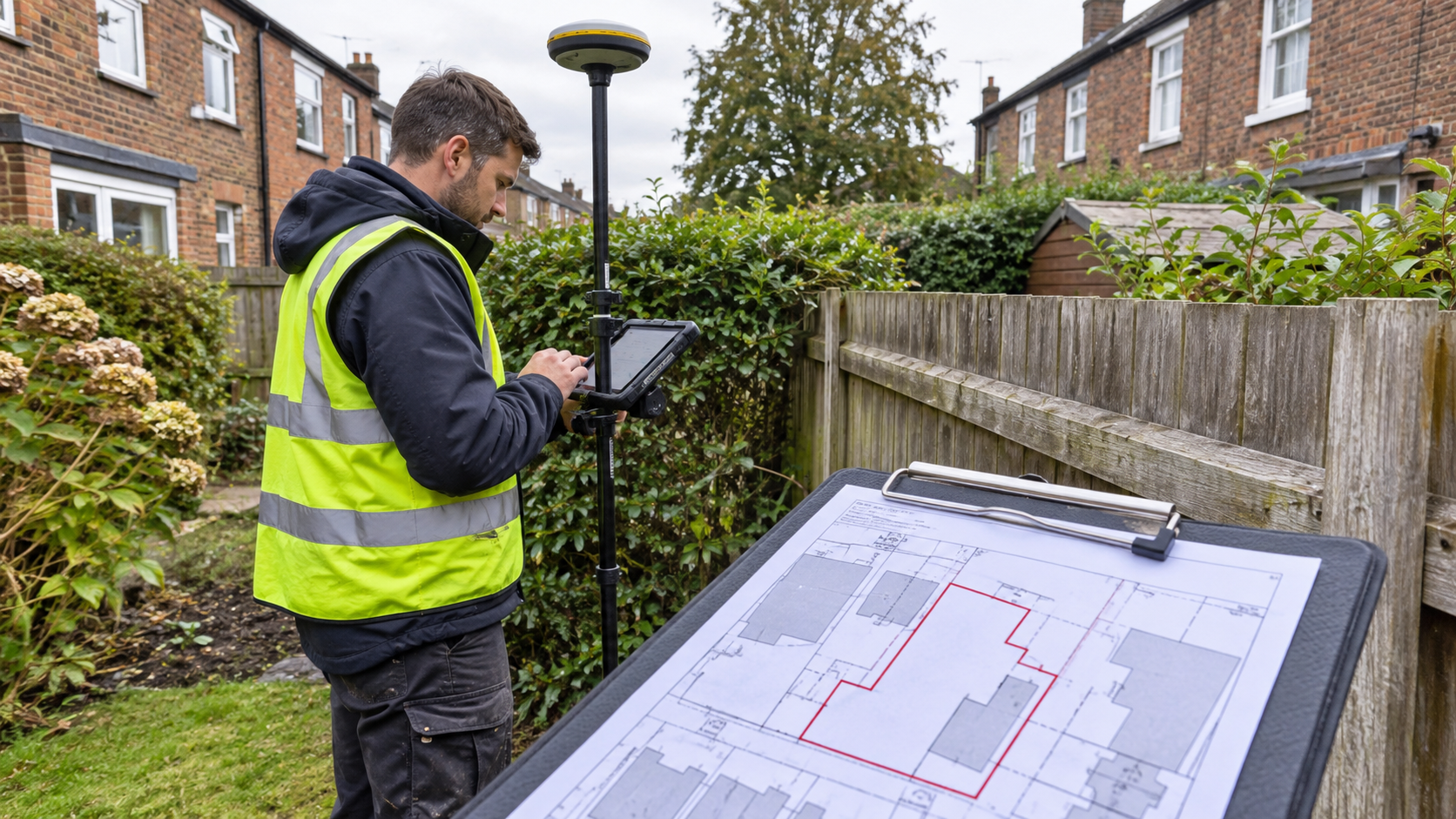
Where the exact line matters, a surveyor compares the title plan with physical features and historic deeds on site.
Lost title deeds and unregistered property: what to do
If the property is registered, lost paper deeds are rarely a problem: ownership is proved by the register, and you can simply order official copies. If the property is unregistered and the deeds are lost or destroyed, the route is first registration supported by evidence. HM Land Registry’s practice guide on first registration where deeds have been lost or destroyed explains that the applicant must account for the loss by statement of truth and provide whatever secondary evidence exists – old conveyancing files, mortgage records, council tax and insurance history. The Registry may grant a lesser class of title (such as possessory) which can later be upgraded under the Land Registration Act 2002. Where a gap in the paper trail cannot be closed, buyers and lenders often rely on cover; see our guide on when to use title indemnity insurance.
Registration is compulsory when you buy, inherit, are given or mortgage land, with a limited exception for leases of seven years or less. Voluntary first registration is also available and gives the owner a state-backed guarantee of title. According to HM Land Registry’s processing times page, last updated 30 October 2026 and reflecting September 2026 data, half of all first registrations are completed in about 8 months and almost all in about 11 months; an expedite request is free and the vast majority of expedited applications are processed within 10 working days.
Application type
HM Land Registry timing (Sept 2026 data)
Searches and official copies (Information Services)
91.8% completed within 1 day; 1–2 days if handled manually
Simple updates (e.g. removing a mortgage)
Just over 30% automated and completed within minutes
Changes to existing titles
35.9% in 1 day; 33.8% take longer than 3 months
First registrations
Half in about 8 months; almost all in about 11 months
New titles / transfers of part
Half in about 9 months; almost all in about 10–12 months
Expedited applications
Vast majority within 10 working days (free)
Historic conveyances and plans remain valuable evidence, especially for unregistered land and boundary questions.
Title deeds in Scotland and Northern Ireland
This guide focuses on England and Wales. In Scotland, ownership is recorded by Registers of Scotland in the Land Register as a title sheet, with older properties still on the Sasine Register; in Northern Ireland, Land & Property Services maintains the Land Registry and Registry of Deeds. The principles are similar – a public register, a plan and a set of burdens – but forms, fees and terminology differ, so check the relevant registry before ordering documents.
What is changing in 2026: fees, data access and automation
Two developments this year are worth knowing about. On 27 October 2026 HM Land Registry launched two public consultations – “Future of access to HM Land Registry information” and “Restructuring HM Land Registry fees” – both closing on 22 December 2026, as reported by Today’s Conveyancer (28 October 2026). The data proposals would give the public free access to searchable, mappable ownership datasets covering most land in England and Wales, mainly large and commercial holdings, with free access to residential titles limited to public bodies and approved researchers. Baroness Taylor, Minister for Housing and Local Government, said that “everyone would be able to access datasets showing ownership across the vast majority of land in England and Wales”. The fee proposals would replace value-based Scale 2 fees (transfers for no or below-market value, and mortgage registrations) with fixed fees to cut errors and requisitions; HM Land Registry has said the proposals make no change to official copy fees, so the £7 and £11 figures above stand for now.
Separately, HM Land Registry’s 2026/27 business plan committed to automating residential mortgage applications and piloting a digital remortgage, which should shorten the gap between a lending decision and registration. For buyers the practical lesson is unchanged: order title documents early, read the C register closely, and get a building survey booked as soon as an offer is accepted so that physical findings and title entries can be read together.
Why title deeds matter to surveyors (and when you need one)
Surveyors use title deeds constantly. A building surveyor will cross-check the title plan against what is on the ground, flag outbuildings or extensions that sit outside the red edging, and look for rights of way or covenants that affect proposed works. A valuer will read the register for restrictions, leases and charges that influence value; our RICS-standard valuation service relies on official copies for exactly this reason. In boundary and party wall matters, historic deeds and plans are often the decisive evidence – see our guide to adverse possession for how long-standing occupation can override the paper position.
Whoever you instruct, use a suitably qualified, accredited surveyor. Survey Merchant’s panel includes surveyors regulated or accredited by bodies such as RICS, CIOB and RPSA, matched to the task in hand, whether that is a measured boundary survey, a pre-purchase building survey or a formal valuation.
Why choose Survey Merchant for your title and boundary questions?
Accredited panel matched to the job – surveyors regulated or accredited by RICS, CIOB and RPSA, among others, so a boundary question goes to a boundary specialist and a valuation to a registered valuer.
Nationwide UK coverage – local surveyors who know the housing stock, planning history and typical title quirks in your area.
Fast turnaround – prompt booking and report delivery so title issues are identified while there is still time to renegotiate or seek indemnity cover.
Transparent, competitive fixed fees – you know the cost before you instruct.
Impartial advice – we work for you, not for the seller, agent or lender.
End-to-end support – from reading the register with you to liaising with your conveyancer on anything the survey uncovers.
For a registered property in England and Wales, title deeds are a title register (a short PDF split into A property, B proprietorship and C charges registers) and a title plan showing the property edged in red on an Ordnance Survey base map. Older paper deeds are typed or handwritten conveyances, often tied with ribbon.
How do I get a copy of my title deeds?
Search the register on GOV.UK and download the title register and title plan for £7 each. For official copies that can be used as evidence, send form OC1 with £11 per document; they arrive in less than a week. Copies of filed deeds are requested with form OC2 at £11 per document.
Where are my title deeds kept?
HM Land Registry does not store original paper deeds. For registered property, the register itself is the proof of ownership. Original paper bundles, where they still exist, are usually held by the owner, their solicitor or a former mortgage lender.
Do title deeds show exact boundaries?
No. GOV.UK guidance updated in October 2026 confirms the title plan shows general boundaries only and should not be scaled for measurements. T marks are not conclusive. For a precise line, a chartered surveyor can prepare a measured boundary survey or a determined boundary plan.
Can lost title deeds be replaced?
If the property is registered, order official copies from HM Land Registry. If it is unregistered, apply for first registration with a statement of truth and supporting evidence; the Registry may grant possessory title, which can be upgraded later under the Land Registration Act 2002.
Is HM Land Registry changing its fees in 2026?
Two consultations opened on 27 October 2026 and close on 22 December 2026, proposing fixed Scale 2 fees and wider free access to ownership datasets. HM Land Registry has said official copy fees are not being changed, so the £7 online and £11 official copy fees still apply.