Building Surveying
Jul 16, 2026
Your 2026 UK Home Buying Timeline: Guide to Success
Navigate the 2026 UK home buying timeline. Our guide covers the 18-week process, avoiding delays, and property survey tips.

Buying a home in the UK now takes around 18 weeks from offer to completion, and the most important part of that timeline is usually the stretch from offer accepted to exchange, which typically takes 8 to 12 weeks. If you're waiting for calls from the estate agent, your lender and your solicitor, that probably feels less like a plan and more like limbo.
That uncertainty is where buyers make avoidable mistakes. They treat the process as a series of boxes to tick, then get blindsided when a survey uncovers defects, a lender queries value, or a chain wobbles because someone else wasn’t ready. A better way to look at the home buying timeline is as a sequence of risk checks. Each step exists to protect your money, your negotiating position and your ability to complete without nasty surprises.
If your offer has just been accepted, you don’t need more jargon. You need to know what happens next, what can slow it down, and which actions effectively reduce risk instead of merely creating paperwork.
The moment your offer is accepted feels like the hard part is over. In reality, that’s when the serious work starts. Legal checks, lender requirements, property condition issues and chain management all sit between you and the keys.
The current benchmark matters because it resets expectations. In the UK, the average time from offer to completion has reached 18 weeks, up from 15 weeks in 2019, according to Rightmove’s housing market data. That increase isn’t just admin bloat. It reflects a more demanding conveyancing process, where searches, mortgage checks and survey findings can all affect whether the transaction stays intact.
Many buyers struggle because they expect steady progress every week. That isn’t how the process works. It tends to move in bursts. Documents go out, people wait, enquiries come back, and one issue can suddenly become the new priority.
Thinking about the home buying timeline in phases helps:
Practical rule: Don’t judge progress by silence alone. Judge it by whether the next risk has been identified and dealt with.
That mindset changes how you behave. Instead of asking, “Why is this taking so long?”, ask, “What is still unverified?”
It also helps to understand how buyers now search and shortlist homes before they ever get to conveyancing. If you’re still refining how you assess listings and compare property details, ListingBooster.ai's AI search guide is a useful read because it shows how search behaviour is changing and why better early filtering can save time later.
A smoother purchase usually starts before you’ve chosen the property. Buyers often focus on the asking price and forget that readiness is what strengthens their bargaining power. If you’re not organised before offering, the same gaps will slow you down later under much more pressure.

An agreement in principle matters because it shows a seller that a lender has already carried out an initial assessment. It doesn’t guarantee the loan, but it tells the seller you’re not guessing at your budget.
From a risk point of view, this is less about impressing the estate agent and more about reducing later disruption. If your lender starts querying income, deposits or documents after the offer is accepted, the whole chain can end up waiting on issues you could have dealt with earlier.
Have these ready before you view seriously:
Many buyers leave this until the offer is accepted. That sounds harmless, but it creates a dead period right at the start of the transaction. The memorandum of sale goes out, then everyone waits while you compare quotes and return onboarding forms.
A good conveyancer does more than process forms. They spot title issues, raise targeted enquiries and keep pressure on the other side when momentum starts to fade. Responsiveness matters. So does clarity. If you can’t get a straight answer before instruction, service usually won’t improve once the file is open.
A sensible pre-offer shortlist should compare:
| What to check | Why it matters |
|---|---|
| Communication style | You need clear updates, not generic chasing emails |
| Experience with your property type | Leasehold flats, older houses and new builds create different issues |
| Turnaround on onboarding | Slow opening can waste the first days after acceptance |
| Capacity | An overloaded fee earner can become your bottleneck |
Buyers often think the transaction starts with the accepted offer. In practice, it starts with the quality of your preparation.
If you’re still working out how to frame and present an offer, this guide on making an offer on a house is a helpful primer before you commit.
This is the longest stretch in the home buying timeline, and it’s where most of the risk sits. HomeOwners Alliance reports that the period from offer acceptance to exchange typically spans 8 to 12 weeks, and 18% of transactions fail during this phase, with 35% of those failures linked to defects revealed by a property survey in its home buying process guidance.
That tells you something important. The survey is not a nuisance inserted into the middle of an otherwise straightforward transaction. It’s one of the main points where buyers discover whether the deal still makes sense.
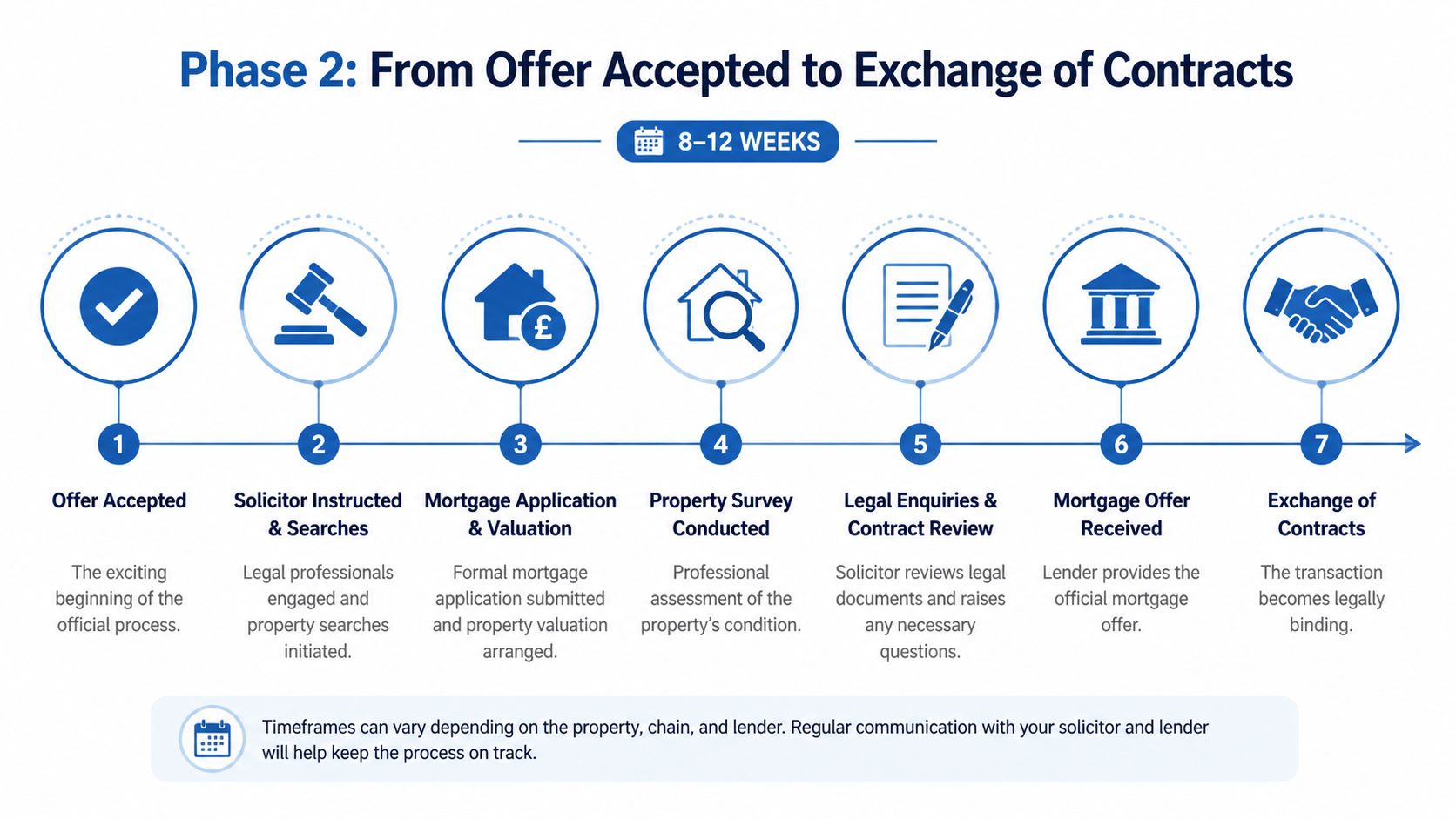
Once the offer is accepted, several professionals start assessing different kinds of risk at the same time:
Each of them is looking at a different question. Is the property legally sound? Is it worth the loan? Is it physically what it appears to be? Are there unresolved issues that should change the price or your willingness to proceed?
If one answer comes back poorly, the whole timeline changes.
The sequence below is what a well-managed file usually looks like.
Instruct your conveyancer immediately
This opens the legal file, starts ID checks and lets contract papers be requested straight away.
Submit your full mortgage application
An agreement in principle gets you to the starting line. The full application gets underwriters involved and starts the lender’s formal review.
Book your survey early
Buyers protect themselves at this stage. A mortgage valuation serves the lender. It doesn’t replace a buyer’s own inspection of condition. If you’re unclear on the difference, this explanation of what is a mortgage valuation clears up one of the most common misunderstandings in the process.
Let searches begin without delay
Local authority, drainage and other searches can expose planning, access or environmental issues. They also take time, so hesitation here rarely helps.
Review the survey before reacting emotionally
Many reports look alarming because surveyors must record risk carefully. The important question is not whether the report contains defects. Most do. The question is whether the defects are routine, manageable, expensive, urgent or negotiable.
Buyers usually lose momentum in one of three ways.
First, they wait too long to book the survey because they don’t want to “spend money too early”. That often backfires. If the property has significant issues, finding out later wastes more time and puts your negotiation in a weaker position.
Second, they treat every adverse comment as a reason to panic. Older housing stock often shows movement history, damp indicators, roof wear or outdated materials. Some findings are warning signs. Others are maintenance realities. You need context, not alarm.
Third, they go passive while professionals work. Good buyers don’t micromanage, but they do keep decisions moving. When your solicitor asks whether to raise an additional enquiry, whether to seek a retention, or whether to renegotiate after the survey, answer promptly.
The buyers who keep transactions moving aren’t the loudest. They’re the ones who return documents quickly, read reports properly and make decisions without drifting for days.
A few practical habits help here:
The biggest mistake in this phase is assuming delay and protection are opposites. They aren’t. A well-timed survey, careful legal enquiry and firm lender check may feel slower in the moment, but they’re often what stops a much bigger problem after completion.
Exchange is the point where a purchase stops being provisional and becomes binding. Buyers often spend weeks focused on surveys, searches and mortgage paperwork, then underestimate this final stretch because the hardest uncertainty feels behind them.

Zoopla’s 2024 analysis states that the average time from exchange to completion is 4 to 6 weeks, and that 95% of transactions complete successfully after exchange, while pre-exchange issues such as valuation gaps are where most deals fail. It also notes that valuation gaps affect 31% of buyers in its UK moving timeline analysis.
Before exchange, either side can still walk away. After exchange, there are legal and financial consequences if you do. That’s why your solicitor won’t exchange until key conditions are satisfied and you’ve signed the contract and transferred the deposit they require.
From a buyer’s point of view, this is the stage to stop thinking like a bidder and start thinking like an incoming owner.
A practical exchange checklist looks like this:
Completion day is mostly a funds-transfer day. Your solicitor sends the balance to the seller’s solicitor. Once received, the estate agent is authorised to release the keys. Buyers often imagine a ceremonial handover, but most of the drama happens in client accounts and phone calls.
Completion is exciting, but it’s administrative before it’s emotional. Keep your phone on, your ID handy and your expectations realistic until the funds land.
If you’re moving out of a rented property at the same time, planning that overlap matters. A practical end of tenancy cleaning guide can help you avoid a last-minute scramble on the property you’re leaving while you’re focused on the one you’re buying.
The usual advice is to be patient and let the professionals get on with it. Patience matters. Passivity doesn’t. A lot of delay in a home buying timeline comes from issues that were predictable, even if they weren’t avoidable.

RICS notes that 28% of buyers face survey-related renegotiations or chain collapses, and average survey turnaround is now 15 to 21 days because of surveyor shortages, which is why booking early matters in the first place, as outlined by RICS guidance on survey timing and shortages.
Survey timing catches buyers out because they assume they can wait until “everything else is moving”. In practice, the survey often determines whether everything else should keep moving.
If the report identifies significant movement, roof defects, damp patterns, poor alterations or safety concerns, you may need specialist quotes, further inspections or a revised negotiation. None of that is bad in itself. It’s exactly what due diligence is for. The trouble starts when the report arrives late and every decision becomes urgent.
Common delay points usually look like this:
What works is boring, disciplined and effective.
First, front-load decisions. Instruct your conveyancer fast, keep your broker supplied with documents and get the survey booked early enough that you still have room to act on it.
Second, ask better questions. Instead of “Has anything happened?”, ask “What is the current blocker, who owns it, and what is the next action?” That gets clearer answers from solicitors and brokers.
Third, know when extra investigation is sensible. If the first survey flags concerns, this guide on who organises a survey and how to handle Level 3 building survey problems is useful for understanding next steps rather than freezing at the first sign of a problem.
A financial detail can also hold things up if you leave it too late. If you’re trying to budget for purchase costs alongside mortgage and moving expenses, a UK property tax estimator is a practical way to sense-check your numbers before completion funds are due.
After the first burst of activity, it helps to pause and reset your approach. This short video is useful if you want a plain-English reminder of how buyer decisions affect the process in real time.
Don’t aim for a fast purchase at any cost. Aim for a purchase that stays intact because you found the risks while you could still act on them.
That’s the difference between a delayed transaction and a damaged one. Delay is inconvenient. Buying the wrong property, or buying the right property on the wrong assumptions, is much more expensive.
A realistic home buying timeline is not a countdown. It’s a controlled process of checking legal position, funding and property condition before you commit fully. If you treat it that way, the waiting becomes more manageable because each delay has context.
The buyers who cope best are usually the ones who prepare early, instruct quickly and make decisions promptly when information comes back. They don’t confuse momentum with rushing. They understand that a survey, a valuation question or a legal enquiry can feel like friction while protecting them from a poor purchase.
Keep this checklist in mind:
The biggest purchase of your life shouldn’t rely on guesswork. The strongest position is always an informed one.
If you want a clear view of a property’s condition before you commit, Survey Merchant can help you get quotes from a nationwide panel of qualified surveyors for Level 2 and Level 3 surveys, valuations and specialist inspections, so you can move forward with better information and less uncertainty.
Survey Merchant provides vetted RICS surveyors across 100+ UK locations at fixed fees:
→ Level 2 Home Survey (HomeBuyer Report)
→ Level 3 Building Survey (full structural survey)
→ RICS Red Book property valuations
→ Party wall surveyors — notices, awards & schedules of condition
→ Expert witness surveyors — CPR Part 35 reports for property disputes