Leasehold
Jul 16, 2026
What Is a Commercial Pre-Acquisition Survey?
Reveals true condition, compliance risks and 1–10 year capex for commercial properties so buyers can negotiate with confidence.

A commercial pre-acquisition survey, also called Technical Due Diligence (TDD), is a thorough property inspection conducted before buying or leasing a building. It identifies structural issues, regulatory risks, and future costs, helping buyers or tenants make informed decisions. This survey is especially useful for assessing repair liabilities, compliance with standards like fire safety and energy performance, and estimating capital expenditure over 1–10 years.
Key points:
This survey is crucial for understanding the true condition of a property and avoiding costly surprises.
Knowing the right time to commission a survey is crucial since it plays a key role in uncovering potential issues. One of the most common scenarios is during a freehold purchase. Similarly, when prospective tenants are considering long leases, a survey becomes vital to help them fully understand their repair obligations before signing. For property investors acquiring income-generating assets or portfolios, an independent survey provides a clear picture of the building's condition, helping validate financial models and forecast capital expenditure during the holding period [8][13].
In some instances, sellers take the proactive step of commissioning a vendor's survey. This approach identifies defects in advance, helping to avoid unexpected issues during buyer due diligence and speeding up the transaction process [11].
Beyond these triggers, certain property risks make commissioning a survey even more essential.
Some properties carry higher risks, making a thorough survey indispensable. While older or period buildings are the obvious candidates, even properties constructed between 2000 and 2018 require close scrutiny due to cladding or façade concerns, which have become a growing issue in commercial real estate [4].
Other red flags include:
The increasing emphasis on energy performance adds another layer of importance. By 2030, UK commercial buildings must achieve a minimum EPC rating of B, and identifying a potential "stranded asset" before purchase is far more cost-effective than addressing it post-acquisition [7]. Additionally, the growing presence of Reinforced Autoclaved Aerated Concrete (RAAC) in older commercial and industrial properties has made structural assessments a near-standard requirement [11][12].
Understanding these risks highlights how critical timing is when it comes to commissioning a survey.
The ideal time to instruct a survey is early in the due diligence phase, preferably before Heads of Terms are agreed. This allows any findings to influence the price or terms of the deal [4]. It’s essential to complete the survey before exchanging contracts; otherwise, you risk taking on liabilities without properly accounting for them [6][8].
The survey process typically runs alongside legal due diligence, planning searches, and valuations. For a straightforward, single-tenanted property, the process usually takes two to three weeks from instruction, with many reports delivered within 5–10 working days of the site visit [4][2]. However, more complex or multi-tenanted properties may require additional time, so factoring this into the transaction timeline from the beginning can prevent last-minute stress.
"The TDD should be commissioned as early as possible in the due diligence period... ideally before heads of terms are agreed." - Savas Bulduk, Director and Chartered Building Surveyor, Hampstead Surveyors
For leasehold acquisitions, it’s wise to wait until your legal team has clarified the specific repairing obligations under the proposed lease. This ensures the surveyor’s evaluation aligns directly with your contractual responsibilities [7].
When commissioning a commercial pre-acquisition survey, the goal is to thoroughly evaluate the property’s physical condition and ensure it meets legal requirements. These surveys delve into every aspect of the building, offering a detailed snapshot of its current state.
The structural elements – foundations, floors, walls, and external features like cladding and insulation – are assessed for any signs of movement, cracks, or general wear and tear. Roofing is a key area of focus, with surveyors checking drainage systems, flashings, and rainwater management. Drones often come into play here, helping to inspect hard-to-reach areas safely.
Internally, the surveyor examines issues like dampness, condensation risks, and the state of interior finishes. Externally, the property’s grounds are inspected, including fences, paved areas, outbuildings, and drainage systems. Mechanical and electrical (M&E) systems, such as heating, ventilation, plumbing, and lifts, are given a high-level review to estimate their condition, age, and remaining lifespan.
Another critical part of the survey is identifying hazardous materials like asbestos or RAAC. For properties built between 2000 and 2018, cladding and façade safety are often flagged as common concerns during technical due diligence [4].
Beyond the physical inspection, the survey also reviews key legal and compliance aspects.
The legal and compliance review is a vital part of the survey, addressing areas that could lead to significant financial or legal liabilities.
Fire safety takes centre stage, with checks on compartmentation, alarm systems, and cladding risks in line with the Building Safety Act. Surveyors also assess whether the property meets accessibility standards under the Equality Act, which replaced the Disability Discrimination Act. They inspect asbestos registers to ensure they comply with the Control of Asbestos Regulations 2012 (CAR 2012) and identify any missing or incomplete Operation & Maintenance (O&M) documentation [2][15].
Energy performance is becoming increasingly important in these reviews. Since 1st April 2023, properties must have an EPC rating of at least E to qualify for new rental agreements [16].
"A well-executed TDD survey empowers clients to negotiate with confidence, understand the true condition of the asset, and plan effectively for future use, funding, or redevelopment." - Allan Williams-Jones, Director, HFWJ Surveyors
If the survey uncovers potential issues, follow-up investigations may be recommended. These could include CCTV drainage surveys, land contamination checks, or structural engineering assessments, all of which should ideally occur before contracts are finalised [1][14].
Once the inspections and compliance checks are complete, the surveyor compiles the findings into a clear, actionable report. This document is designed to support decision-making, starting with an executive summary – often referred to as a red-flag memo – which highlights the most pressing concerns. This summary is particularly helpful in fast-moving transactions where quick insights are needed [5].
The main body of the report provides a detailed narrative of the property’s condition, backed by annotated visuals to illustrate specific defects. Findings are categorised by urgency and linked to a Capital Expenditure (Capex) forecast, typically spanning a 1–10 year period:
Priority
Timeframe
Typical Findings
0–12 months
Safety hazards, water ingress, fire safety breaches, structural instability
1–3 years
Roof renewals, M&E replacements, fabric repairs
4–10 years
Routine upkeep, cyclical decorations, long-term improvements
This prioritisation not only highlights what needs attention but also provides cost estimates and timelines. As LEM Building Surveying explains:
"A commercial survey is not simply a list of defects. Its commercial value comes from translating observed condition into decision-grade insight."
Modern reports may also include advanced techniques such as drone imagery, thermographic scans for moisture detection, or 3D photogrammetry, particularly for complex properties [5][9].
Now that you know what a pre-acquisition survey covers, let’s dive into how to commission one and make the most of its findings.
Start by preparing a detailed briefing. Include essential details like whether the property is freehold or leasehold, the context of the transaction, and your timeline for making decisions. Ensure the surveyor you choose has the right credentials, such as RICS or CABE accreditation. Agree on the scope of work, any exclusions, and optional extras (like drone surveys or thermal imaging) in writing.
It’s best to commission the survey as early as possible during the due diligence phase - ideally before finalising heads of terms [4]. For more complex properties, you may need input from specialists like M&E engineers, structural engineers, or environmental consultants [9]. Planning for this early can prevent delays. Some firms even offer a quick red-flag memo within 48 hours of the inspection for time-sensitive deals [4][5]. To avoid hiccups, ensure the property is accessible and have key documents ready, such as asbestos registers, O&M manuals, and EPC records.
Survey Phase
Key Activities
Deliverable
Briefing, scope definition, fee agreement
Confirmed scope of work
Visual assessment, optional drone/thermal checks
Raw evidence and photographs
Risk assessment, capex modelling, compliance review
Draft findings
Defect schedules and priority ratings
Red-flag memo and full TDD report
Review with legal and commercial teams
Price adjustments or lease clauses
Once you receive the report, start with the executive summary. This section highlights the main issues that could impact your decision. Pay close attention to the priority bands, which categorise risks into immediate, medium, and long-term concerns.
The capex (capital expenditure) forecast is another critical section. These forecasts often span a 5–10 year period [4]. For instance, in April 2026, Strut Building Surveyors conducted a survey on an 855 m² Victorian commercial property in North Yorkshire. The report identified £310,000 in capex requirements, including £85,000 for a roof replacement within five years and £60,000 for M&E upgrades. This allowed the investor to project a post-refurbishment yield of 8.3% on a £650,000 purchase [13].
If the report suggests additional investigations - like CCTV drainage surveys, structural assessments, or M&E testing - treat these as priorities to address before exchanging contracts.
After thoroughly reviewing the report, the next step is to use its findings strategically during negotiations.
The survey report isn’t just a technical document - it’s also a powerful negotiation tool. As Savas Bulduk, Director and Chartered Building Surveyor, puts it:
"The TDD findings feed directly into the commercial negotiation. Identified defects and capital expenditure requirements can be reflected in price adjustments, warranty provisions, retention funds or conditions precedent to completion."
For instance, if the report highlights immediate or high-risk issues, you can use these to negotiate a price reduction or ask the seller to carry out repairs before completion. Medium-term capex items, like a roof renewal needed within three years, could justify requesting a retention fund - where part of the purchase price is held back until the work is done.
For tenants, survey findings play a slightly different role. A Schedule of Condition - a detailed record of the property’s state at the start of a lease - can be attached to the lease to limit your liability for dilapidations [3]. Without this, you could end up footing the bill for pre-existing defects.
"A survey rarely stops a transaction. It informs it. The purpose is to identify risks so parties can renegotiate terms, plan costs or proceed with confidence." - Bressummer A.R.K.
Make sure to share the report with your legal team as soon as it’s ready. This ensures that any technical findings can be translated into contractual protections before the exchange. Ideally, the survey process and legal work should happen side by side rather than one after the other.
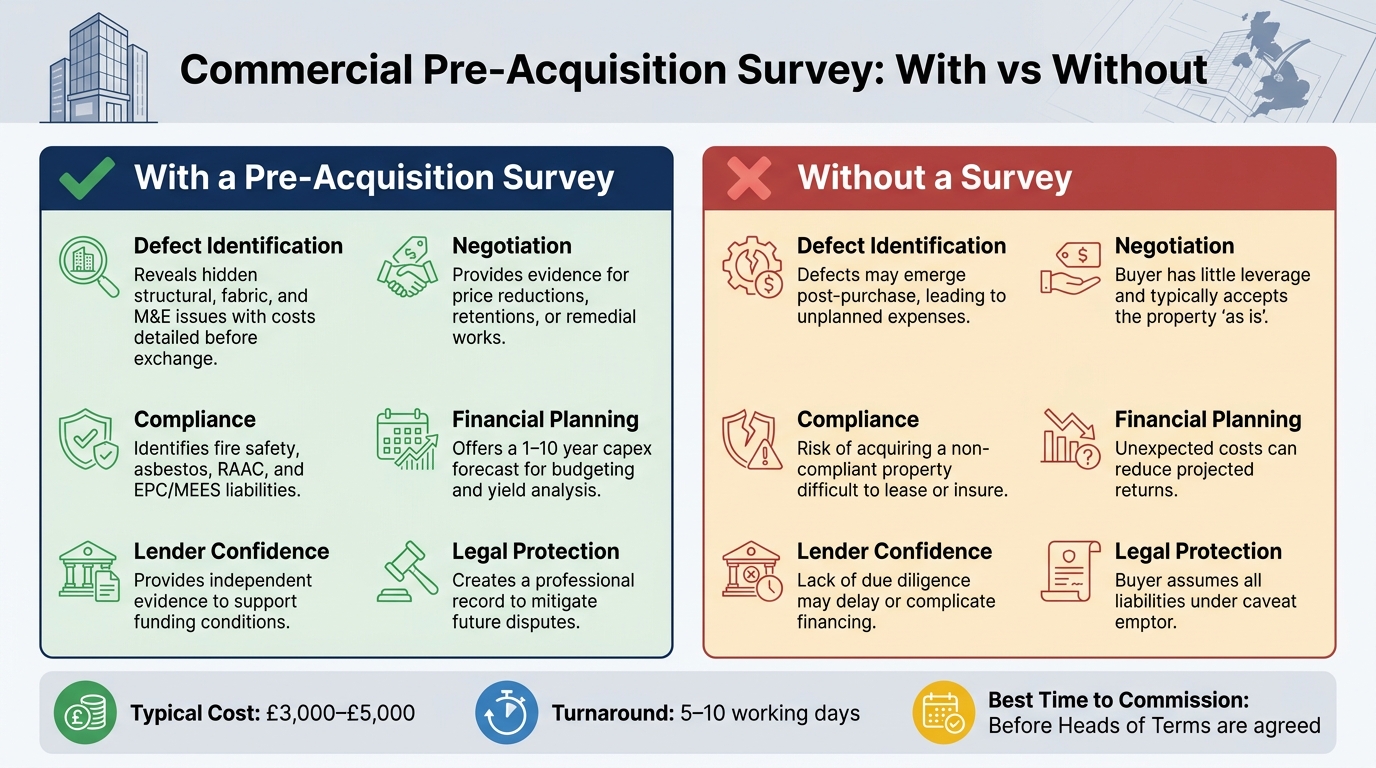
Commissioning a pre-acquisition survey offers more than just a detailed report; it provides crucial insights that can save buyers from unexpected surprises. The survey helps uncover hidden issues such as roof problems, structural defects, outdated mechanical and electrical systems, asbestos, or RAAC (Reinforced Autoclaved Aerated Concrete), which may not be visible during a routine property viewing. Additionally, a 1–10 year capital expenditure forecast aids in creating an accurate budget.
Another key advantage is ensuring the property complies with current regulations. This not only helps buyers avoid legal troubles but also prevents them from acquiring a property that could be difficult to lease or insure.
"In many cases, the cost of a pre-acquisition survey is recovered several times over through successful negotiation or risk mitigation." - SJM Surveyors
These insights often shape financial planning and provide a strong foundation for price negotiations.
The cost and timing of a survey are practical considerations that highlight its value. For a straightforward, single-tenanted commercial property, technical due diligence usually costs between £3,000 and £5,000 [4]. For larger or more complex properties, the price varies based on factors like the building's size, construction type, and the need for specialist assessments.
Turnaround times for standard properties are typically 5–10 working days after the site inspection. For multi-tenanted buildings or larger portfolios, this timeline extends to 2–3 weeks [2][4]. If you're working under tight deadlines, some surveyors offer red-flag memos within 48 hours [5].
The scope of the survey directly impacts cost and duration. Optional extras, such as drone surveys, mechanical and electrical testing, or intrusive investigations, may increase the price but are often necessary for older or more complex properties.
"A commercial survey is not simply a list of defects. Its commercial value comes from translating observed condition into decision-grade insight."
For lease agreements rather than outright purchases, a lighter option like a Schedule of Condition may be more suitable and cost-effective [10].
The decision to commission a survey significantly impacts areas such as defect identification, financial planning, and compliance. Here's how a pre-acquisition survey stacks up against skipping the process:
Area
With a Pre-Acquisition Survey
Without a Survey
Reveals hidden structural, fabric, and M&E issues, with costs detailed before exchange
Defects may emerge post-purchase, leading to unplanned expenses
Provides evidence for price reductions, retentions, or remedial works
Buyer has little leverage and typically accepts the property 'as is'
Identifies liabilities like fire safety, asbestos, RAAC, and EPC/MEES requirements
Risk of acquiring a non-compliant property that may be difficult to lease or insure
Offers a 1–10 year capex forecast for budgeting and yield analysis
Unexpected costs can reduce projected returns
Provides independent evidence to support funding conditions
Lack of due diligence may delay or complicate financing
Creates a professional record to mitigate future disputes
Buyer assumes all liabilities under
"The best commercial property acquisitions are rarely the cheapest - they're the ones where the buyer knew exactly what they were getting and priced accordingly." - Anyaa Coutts, TSP
These comparisons underscore why a pre-acquisition survey is a smart move for securing a well-informed investment.
If you're ready to work with experienced commercial surveyors, Survey Merchant connects you with RICS-accredited professionals across the UK, offering services from pre-acquisition surveys to project management and expert witness reports.
A commercial pre-acquisition survey is an invaluable tool for any property buyer or investor. It takes the guesswork out of the process by uncovering the true cost of owning a property - not just the purchase price. Whether it’s identifying structural defects, compliance issues, or estimating long-term capital expenditure, this survey equips you with the facts you need to make confident decisions. As Strut Building Surveyors aptly describe it:
"A Commercial Pre-Acquisition Survey turns unknowns into an action plan."
By commissioning a RICS-accredited surveyor early - ideally before finalising heads of terms - you can maximise the benefits of the survey’s findings. Even newer buildings often hide issues like poor workmanship or missing O&M documentation, making the survey a worthwhile investment. With costs typically ranging from £3,000 to £5,000 for a single commercial unit [4], it’s a small price to pay compared to the potential risks of skipping it. Without this step, buyers remain exposed to liabilities under caveat emptor.
For expert guidance and access to a nationwide network of RICS-accredited surveyors, visit Survey Merchant to ensure your pre-acquisition process is as informed and secure as possible.
A professional pre-acquisition survey is essential for uncovering potential risks in commercial properties. Expert surveyors evaluate properties for hazardous materials such as asbestos and reinforced autoclaved aerated concrete (RAAC). They also examine external walls, cladding, and the overall building structure, identifying defects, compliance concerns, and potential remediation costs. Survey Merchant links you with experienced surveyors to help address these critical issues before you make a purchase.
Choosing between a technical due diligence (TDD) report and a Schedule of Condition comes down to your specific goals. A TDD report offers an in-depth analysis of the building's condition, systems, and compliance status, often accompanied by a forecast of capital expenditure. On the other hand, a Schedule of Condition serves as a photographic and descriptive record that captures the property's state at the beginning of a lease, helping to limit liability for dilapidations.
When conducting an initial survey, you might uncover aspects that warrant closer examination. Depending on what’s found, additional specialist reports could be necessary. These might include drainage surveys, land contamination assessments, or mechanical and electrical inspections. Surveyors may also suggest specific tests to address potential concerns such as environmental risks, structural movement, or concealed issues like moisture ingress. These extra checks are essential for identifying any potential liabilities, giving you a clearer picture before finalising your purchase.
Survey Merchant provides vetted RICS surveyors across 100+ UK locations at fixed fees:
→ Level 2 Home Survey (HomeBuyer Report)
→ Level 3 Building Survey (full structural survey)
→ RICS Red Book property valuations
→ Party wall surveyors — notices, awards & schedules of condition
→ Expert witness surveyors — CPR Part 35 reports for property disputes