Leasehold
Jul 16, 2026
How Survey Results Impact Property Decisions
How property surveys reveal defects, influence negotiations and sales outcomes. RICS-accredited independent reports help buy

Survey results often decide whether property transactions succeed or fail. In 2025, 26% of residential sales in the UK fell through, with 18% linked to survey findings. These reports highlight property defects, influencing buyers to renegotiate or pull out entirely.
Key takeaways:
For buyers, surveys serve as negotiation tools and help estimate repair costs. Sellers can use them to set realistic prices and avoid surprises during negotiations. Whether you choose a platform like Survey Merchant or work directly with a RICS-accredited surveyor, understanding survey types and their findings is crucial for informed decisions.
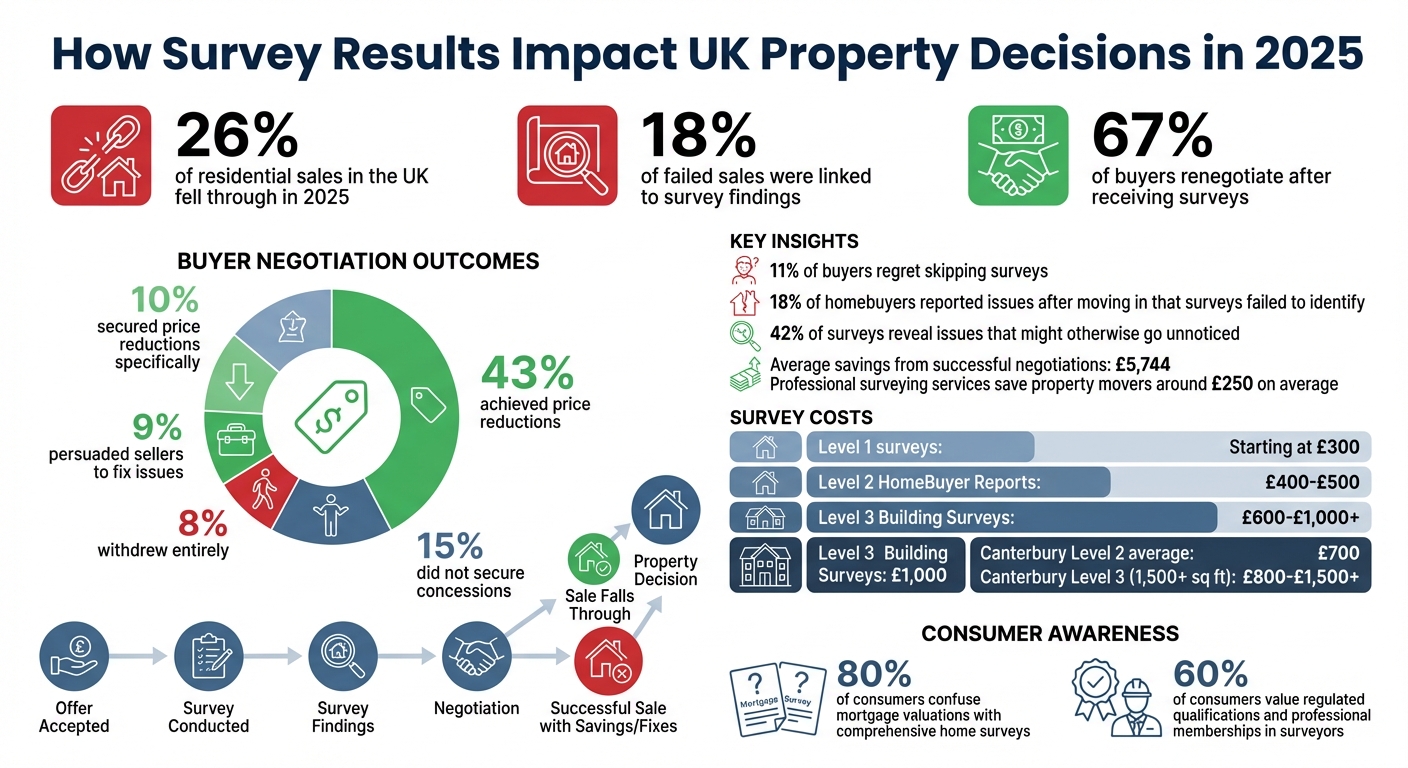
UK Property Survey Statistics: Impact on Buyer Decisions and Negotiations 2025

Survey Merchant connects property owners and buyers with a network of skilled surveyors from across the UK. These professionals strictly adhere to the RICS Home Survey Standard, which has been in effect since 1 March 2021. This standard outlines mandatory requirements for residential surveys, ensuring reports are independent and focused solely on the property's condition - not influenced by lenders or sellers [2]. Surveyors are typically affiliated with respected organisations like RICS or the RPSA, both of which enforce stringent codes of conduct [2]. A 2025 study revealed that 60% of consumers value regulated qualifications and professional memberships as key traits in surveyors [5]. Additionally, firms regulated by these bodies must carry professional indemnity insurance, adding another layer of accountability for their advice [2]. Beyond impartiality, Survey Merchant provides an extensive range of services tailored to meet diverse property needs.
Survey Merchant offers a variety of options, including Level 2 HomeBuyer Reports starting at £400, Level 3 Building Surveys from £600, and Red Book valuations. They also handle party wall agreements, dilapidations, lease extensions, project management, and expert witness reports [2]. Specialised inspections are available for issues like damp, structural movement, timber decay, and even Japanese Knotweed identification [7]. Survey results are typically delivered within 3–7 working days, while property purchases often wrap up in about six weeks [7]. This broad service range not only addresses specific property concerns but also strengthens the negotiating power of buyers and sellers alike.
Clear and unbiased survey results can significantly influence property negotiations. As highlighted by RICS:
"A thorough, accurate and impartial survey undertaken by a regulated professional is a quality service that is worth paying for" [2].
Sarah Bent, Head of Residential Property at Hegarty, emphasises:
"Knowing the exact condition of the property gives buyers confidence and peace of mind, reducing the risk of unexpected problems after purchase" [8].
These detailed reports allow buyers to estimate repair costs independently, which can lead to renegotiated prices or requests for remedial work before finalising a deal. For sellers, transparent surveys help establish realistic asking prices and foster smoother negotiations [9]. On average, professional surveying services can save property movers around £250 [7]. By providing reliable, evidence-based insights, these services play a crucial role in enabling more informed decisions during property transactions.
Compared to the more thorough approach offered by Survey Merchant, traditional surveying methods come with notable limitations.
Conventional surveys rely on RICS regulation to uphold professional standards. Surveyors with AssocRICS, MRICS, or FRICS credentials must adhere to strict codes of conduct [2]. However, mortgage valuations are primarily designed to protect the lender’s interests, often overlooking hidden defects [6][10]. Moreover, these surveys typically only assess "reasonably accessible" areas, leaving issues behind walls or under floorboards undetected [10]. This limitation can make it harder to clearly communicate survey findings and their implications.
The introduction of the RICS Home Survey Standard has improved clarity by offering a three-level system for surveys [2]. Yet, 18% of homebuyers still reported issues after moving in that their survey failed to identify [3]. Non-invasive methods mean that secured panels, hidden spaces, or electrical fittings cannot be fully inspected. When access is restricted or specific expertise is required, reports often recommend "further investigations." This can lead to delays and confusion, as buyers must arrange for additional specialists to assess issues like damp, timber rot, or asbestos. David Blake, a Mortgage Adviser at Which?, explains:
"Surveys will either give you peace of mind about the condition of the building or, if there are problems, provide you with a powerful bargaining chip for negotiating or asking the seller to fix any problems" [3].
Traditional surveys also vary in scope and cost.
Despite these options, a 2022 poll revealed that 80% of consumers still confuse a mortgage valuation with a comprehensive home survey, underscoring the need for better communication about what each service entails [11].
The limitations of conventional surveys can significantly affect property decisions. In 2025, 18% of failed property transactions occurred because buyers either withdrew or couldn’t renegotiate the price after a survey [1]. While 67% of buyers successfully renegotiated - 43% achieving a price reduction - 8% chose to withdraw entirely [3]. To strengthen their position, buyers are advised to obtain at least two independent quotes for any defects identified [2].
When deciding between Survey Merchant's platform model and traditional RICS-regulated methods, it’s important to weigh their respective strengths and weaknesses to determine which suits your needs best.
Survey Merchant connects users with a nationwide panel of surveyors offering services like Level 2 and Level 3 reports, valuations, party wall agreements, and specialist consultations. This platform simplifies the process by providing easy access to tailored property insights. On the other hand, traditional surveying relies on individual RICS-accredited professionals. With over 100,000 members worldwide, RICS surveyors must carry professional indemnity insurance and follow strict ethical standards, as highlighted by Smart Home Surveyors:
"RICS-accredited surveyors must adhere to a strict code of ethics and must pass a comprehensive exam." [12]
Both approaches share some common ground, but they also differ in key areas. Let’s explore these to help you make an informed decision.
Both methods involve non-invasive inspections, which means certain issues may go undetected. This explains why 18% of homebuyers report uncovering problems after completing their purchase [3]. These limitations can weaken a buyer's ability to negotiate effectively. If hidden defects are found later, additional specialist checks may be required, potentially delaying decisions and increasing costs [2].
Another ongoing issue is the confusion between mortgage valuations and detailed property surveys. Many buyers are unaware of the distinction, so whether you use Survey Merchant or hire a RICS surveyor directly, it’s crucial to confirm the exact service being provided.
Survey costs vary depending on the property and the survey type. For example, in Canterbury, Level 2 reports average around £700, while Level 3 surveys for larger properties (over 1,500 sq ft) range between £800 and £1,500 or more [13].
Here’s a quick breakdown of how the two approaches compare:
| Aspect | Survey Merchant | Conventional RICS Surveying |
|---|---|---|
| Impartiality | Nationwide panel with verified professional indemnity insurance | RICS code of ethics binding over 100,000 members globally |
| Service Range | Multi-disciplinary services, including surveys, valuations, and agreements | Typically individual surveyors; specialist services may require separate arrangements |
| Clarity | Platform-coordinated approach tailored to client needs | RICS Home Survey Standard (effective 1 March 2021) ensures consistency |
| Inspection Boundaries | Non-invasive visual assessment (Levels 1–2) | Non-invasive visual assessment (Levels 1–2) |
| Decision Impact | Dependent on survey level and follow-up actions | 67% of buyers renegotiate successfully, though 15% may not secure concessions |
One key takeaway is that 67% of buyers manage to renegotiate successfully after receiving their survey results, often securing price reductions or repairs [3]. Regardless of the method chosen, obtaining at least two independent contractor quotes for any identified issues can significantly strengthen your negotiating position [2].
Survey results play a key role in property decisions. Research shows that 67% of homebuyers manage to negotiate lower prices or secure repairs after reviewing survey findings - saving an average of £5,744. Additionally, 42% of surveys reveal issues that might otherwise go unnoticed, highlighting their importance [3][14].
For buyers, choosing the right survey is essential. A Level 2 report is ideal for standard homes, while a Level 3 survey suits older properties or those needing a closer inspection. The traffic light system used in these reports clearly highlights defects, and obtaining at least two repair quotes can strengthen your negotiation position.
Sellers, on the other hand, benefit from addressing potential issues early. In Scotland, where Home Reports are required before listing a property, arranging a survey in advance can help identify and resolve problems, reducing the risk of unexpected setbacks during the sale process.
For property investors, detailed financial insights are crucial. A Level 3 report that includes repair costs and timelines enables accurate budgeting and helps forecast rental income. Specialist buy-to-let surveys can also provide advice on tenant suitability and long-term maintenance, adding an extra layer of security to your investment.
When selecting a survey service, focus on the expertise and reliability of the provider. Opt for accredited surveyors from recognised organisations like RICS or RPSA, and prioritise actionable report formats that meet your needs. Survey Merchant offers a nationwide panel of professionals, delivering services such as HomeBuyer Reports, valuations, and party wall agreements. Backed by verified professional indemnity insurance, they provide the tools you need to make confident property decisions.
An independent property survey provides a much deeper look into a property's condition compared to a basic mortgage valuation, which mainly serves the lender's interests. Mortgage valuations are quick checks aimed at confirming the property's value as security for the loan, but they often miss critical issues like structural problems or damp.
On the other hand, independent surveys - such as a Level 2 HomeBuyer Report or a Level 3 Building Survey - dive into the details. They can reveal issues like faulty wiring, subsidence, or hidden damage, giving buyers the information they need to make smarter decisions. These insights can even be used to renegotiate the purchase price or request necessary repairs, potentially saving money and preventing unexpected expenses down the line.
By opting for an independent survey, you gain a clearer picture of the property's actual condition, helping to minimise risks and offering peace of mind before committing to such a significant investment.
A property survey can be a game-changer during negotiations by uncovering potential problems like damp, structural weaknesses, or necessary repairs. These discoveries often give buyers leverage to renegotiate the price, request that repairs are made before completing the sale, or, in severe cases, rethink the purchase altogether.
The survey results act as an objective basis for discussions. For buyers, this means they’re less likely to overpay for a property hiding costly issues. For sellers, addressing any flagged concerns early can make the property more appealing and help avoid delays in the selling process. In the end, surveys equip both sides with the facts they need, paving the way for clearer and fairer negotiations.
Property surveys often reveal structural problems like subsidence, cracks, or movement, which could compromise a building's safety and stability. Common issues such as damp, roof damage, and electrical faults are also frequently identified and might require immediate repairs.
Surveys can also uncover problems with drainage, timber decay, or heating and ventilation systems, which could result in hefty repair bills. These findings are essential as they can directly impact a property's valuation, strengthen a buyer's position during negotiations, and even influence the decision to go ahead with the purchase. A detailed survey provides the clarity needed to make confident property decisions.
Survey Merchant provides vetted RICS surveyors across 100+ UK locations at fixed fees:
→ Level 2 Home Survey (HomeBuyer Report)
→ Level 3 Building Survey (full structural survey)
→ RICS Red Book property valuations
→ Party wall surveyors — notices, awards & schedules of condition
→ Expert witness surveyors — CPR Part 35 reports for property disputes