Leasehold
Sep 4, 2026
Commercial Lease Break Clause: UK Guide 2026
Navigate your commercial lease break clause in 2026. Our UK guide covers notice, conditions, common traps, and negotiation for early termination. Essential for

A break clause usually becomes important at the worst possible moment. Your business has outgrown the unit, trading has shifted, a merger means duplicate space, or the board has decided the office footprint needs to shrink. On paper, the lease offers a route out. In practice, that right can be lost by a missed notice date, an unpaid balancing charge, or a room left full of furniture on handover day.
That's why a commercial lease break clause is never just a legal provision. It's an operational project with a legal deadline. The wording in the lease matters, but so do the keys, the final rent payment, the removal contractor, the condition of the premises, and the person serving notice. If those moving parts aren't coordinated, the clause that looked like a safety valve can turn into a trap.
Break clauses are also far from unusual. In UK commercial property, a landmark survey discussed in a University of Reading paper on break clauses found that over 35% of landlords granted break clauses in more than 50% of new or renewed leases, while 8% said they never granted them. The same paper reported simulation analysis estimating that including a break clause could reduce lease value by 2.12%. That tells you something commercially important. Flexibility has a price, and both sides know it.
For tenants, the mistake is treating the break as a letter-writing exercise. For landlords, the mistake is treating it as purely adversarial. In reality, success or failure usually turns on preparation, timing, and whether the property is physically handed back in the way the lease requires.
A business owner signs a lease in good faith, expecting stability. Two or three years later, the same premises may be too small, too expensive, badly configured, or in the wrong location for how the business now operates. That's when the break clause moves from background drafting to front-page priority.
The attraction is obvious. A commercial lease break clause gives one or both parties a contractual right to end the lease early on stated terms. If the market changes or the business plan changes, there's at least a route out before expiry.
The risk is less obvious until it's too late. Break rights in commercial leases are technical. They aren't governed by what seems fair. They're governed by what the lease says, and the lease often expects exact compliance on notice, timing, payment, occupation, and handover.
Practical rule: If your lease says the break works only if certain steps are completed, assume each of those steps is mandatory unless your solicitor tells you otherwise in writing.
I've seen occupiers focus on the strategic decision to exit and leave the mechanics until late. That's the wrong way round. The right question isn't just, “Do we want to break?” It's, “Can we prove, on the required date, that every condition has been met?”
Many businesses frequently encounter a specific challenge. The directors may have approved relocation. The removal company may be booked. Heads of terms for a new site may even be signed. But if notice was served incorrectly, or the premises aren't fully yielded up, the old lease may still continue.
That can leave a tenant paying for space it no longer wants and a landlord dealing with a dispute instead of a clean handover. The clause intended to create certainty then produces the opposite.
A break clause gives a tenant, a landlord, or both parties a contractual right to end a lease before the stated expiry date. That right exists only because the lease creates it, and it works only if the party using it does exactly what the clause requires.
For a business owner, that is the first point to get clear. A break clause is not merely a legal definition sitting in the lease. It is a timed project with legal, financial, and physical tasks that all have to line up on one date. The notice has to be valid. The rent position has to be checked. The premises may need to be cleared, repaired, and handed back in the condition the lease requires.
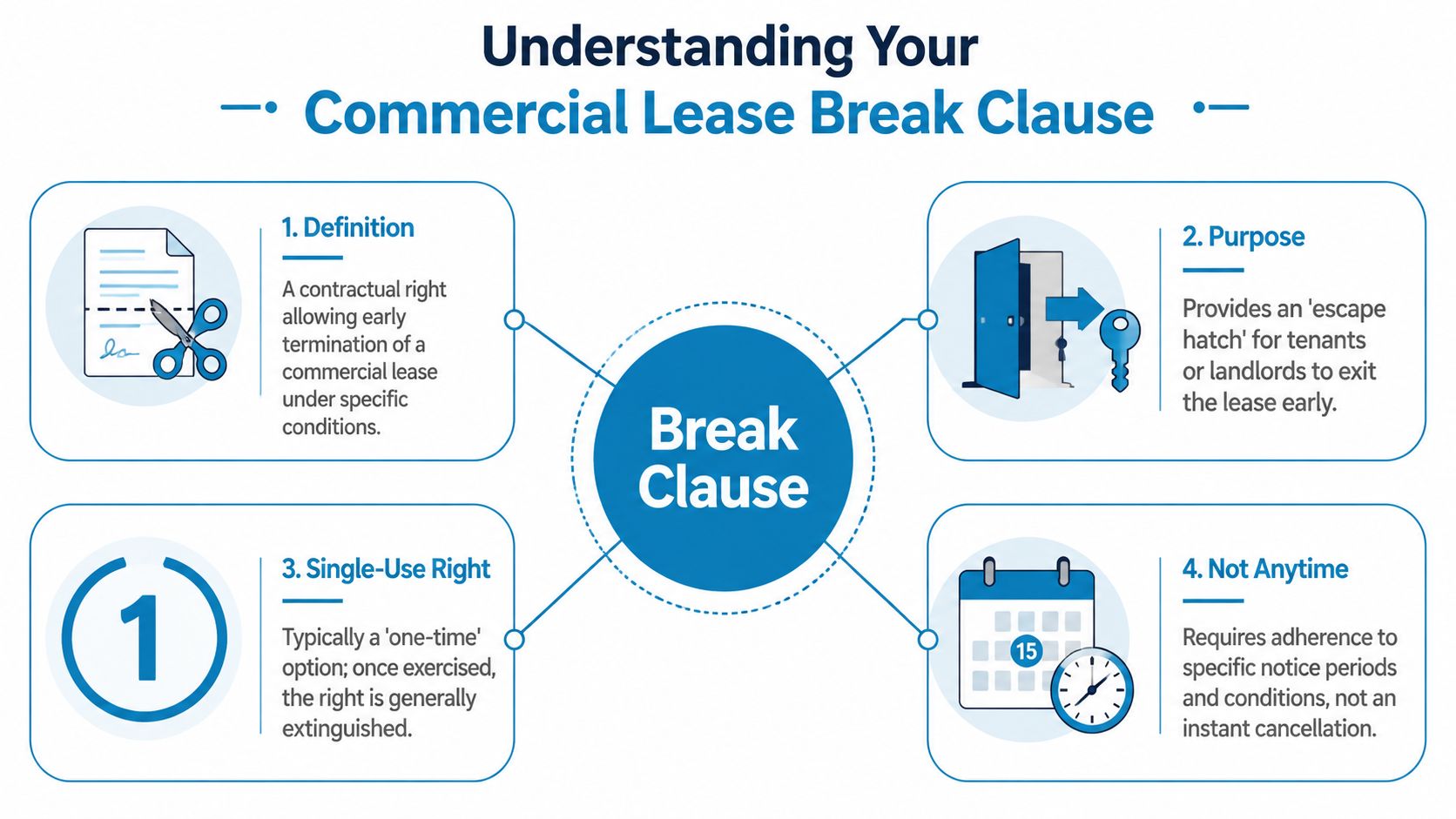
A tenant in a fixed term lease cannot usually walk away because trading has changed, the business has relocated, or the space no longer suits operational needs. The lease has to contain an express break right. If it does, the wording decides who can use it, when they can use it, how notice must be served, and what has to be done before the lease ends.
A properly drafted clause will usually cover:
The practical point is simple. The break date on paper is only part of the job. The critical question is whether the business can carry out every step in time, including the property work on the ground.
A short explainer can help if you're discussing the basics internally:
Break clauses are usually structured in one of four ways.
A tenant-only break gives the occupier the option to leave early. This is often the most valuable form from a tenant's perspective because it gives flexibility if the business contracts, relocates, or restructures.
A landlord's break gives the owner a right to terminate early. Tenants often resist this unless the trigger is narrow and commercially understandable, such as redevelopment or owner occupation.
A mutual break allows either party to end the lease. That can look balanced in heads of terms, but it also creates uncertainty if either side needs long-term security.
There is also a separate distinction between a fixed-date break and a rolling break. A fixed-date break can be used only on a stated date. A rolling break can usually be exercised at any time after a stated date, provided the correct notice is served.
Two clauses can both be called a tenant break and have very different levels of risk. One may require only valid notice and payment of basic rent. Another may require vacant possession, full compliance with covenants, and complete yielding up. The second clause is far harder to deliver because it depends on what the property looks like and what remains in it on the break date.
That is why break advice should never stop at reading the wording. The legal requirements have to be tested against the physical state of the unit, office, or warehouse. Are there alterations that need landlord consent or removal? Are there outstanding repair items? Will furniture, stock, signage, cabling, or partitioning prevent vacant possession? If the lease requires yielding up, has anyone checked what that means for this building in practice?
At this point, survey input stops being optional and starts affecting the outcome. A solicitor can explain what the clause requires. A surveyor can inspect the premises and identify what may stop the tenant from complying with that requirement. Businesses that leave that exercise until the final weeks often discover that the legal right to break depends on repair works, removals, reinstatement, and handover arrangements that take longer than expected. Survey Merchant's dilapidations services are typically used at this stage to assess condition, reinstatement exposure, and what must be done before handback.
The label on the clause matters less than whether the clause can be carried out in practice. That is the commercial test. If the answer depends on last-minute decisions about repairs, clearance, or occupation, the break right is already at risk.
Most failed breaks don't fail because the tenant changed its mind. They fail because the lease attached conditions to the break and those conditions were mishandled. The clause looked straightforward when signed. It looked much less straightforward when someone had to perform it.
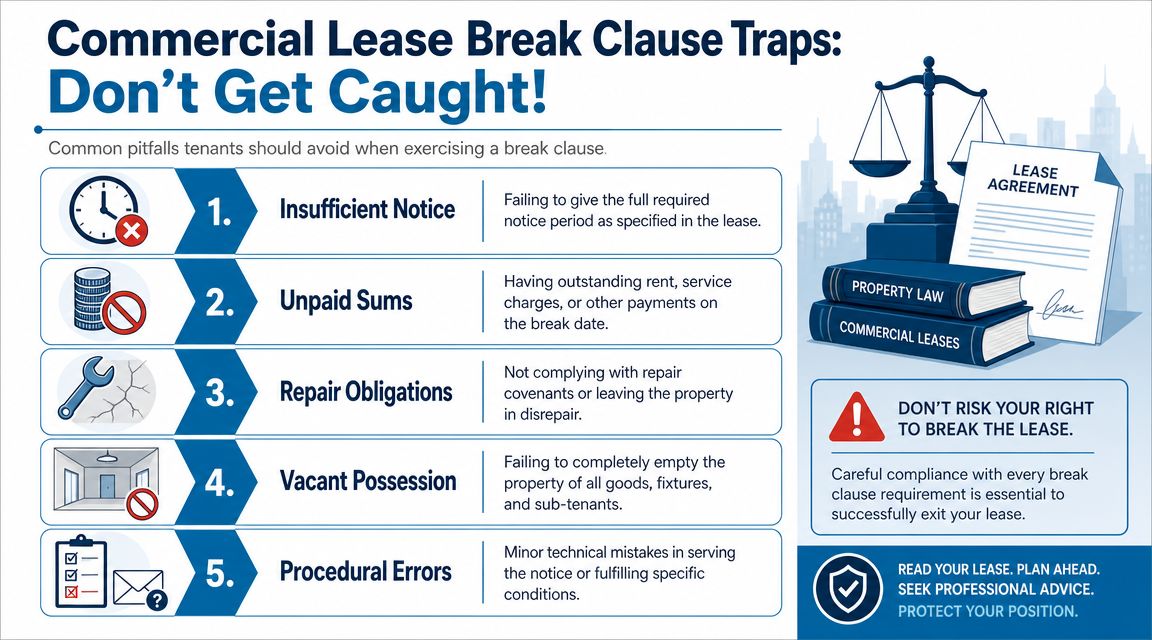
The hardest clauses are usually the ones that require more than notice. The Code for Leasing Business Premises strongly advises that tenant break clauses should only be conditional on giving up occupation and paying basic rent, because broader requirements such as compliance with all covenants create a high risk that even a minor repair issue could invalidate the break. That guidance is discussed in this overview of commercial lease break clause risks and the Code for Leasing Business Premises.
That distinction matters. A condition requiring payment of basic rent is narrower and easier to manage than a condition requiring payment of all sums due. A clause requiring the tenant to give up occupation is usually clearer than one requiring full compliance with every covenant in the lease.
Watch for phrases such as:
Each of those phrases can become a dispute if the parties leave them until the final weeks.
Vacant possession is where legal wording meets physical reality. It usually means the tenant must return the premises free from people, chattels, and anything else that substantially prevents the landlord from enjoying immediate possession.
Businesses often underestimate this. They assume staff have moved out, so the property is empty enough. It may not be. Server racks, archived files, old shelving, furniture, rubbish, marketing materials, sample stock, and contractors still on site can all create problems.
A clean break day usually requires:
If the tenant leaves the premises in a state that stops the landlord taking immediate control, the legal argument will focus on possession, but the practical cause is usually poor project management.
Repair obligations are where survey work becomes decisive. If the break clause is tied to compliance with covenants, then disrepair, unauthorised alterations, incomplete reinstatement, or poor decorative condition may all be relevant. Even where the break itself doesn't require full repair compliance, the condition of the premises still affects the tenant's financial exposure.
This is why the best break preparations involve legal review and building review together. A solicitor can interpret the clause. A surveyor can test what the premises look like against the lease obligations.
If the lease contains any broad compliance wording, early input on dilapidations is sensible. A tenant that waits for the final month often loses the chance to prioritise works, challenge scope, or negotiate from a position of control. For occupiers needing that technical assessment, Survey Merchant's dilapidations services are the kind of specialist support that helps turn lease wording into a practical action list.
Six months before a break date, the legal work can look under control. The notice deadline is diarised. The board has approved the exit. Then the practical problems start to appear. A mezzanine installed years ago was never documented properly. Archived stock is still in a back room. The rent statement does not match the lease. On break day, success turns on whether those issues were found early and dealt with in the right order.
A tenant should treat a break clause as a timed exit project. The lease sets the conditions, but the outcome depends on people, payments, condition, removals, and handover. If one part slips, the whole exercise can become expensive.
Begin by stripping the lease down to the points that control the exit. Focus on the break clause, notice provisions, rent and other payment obligations, yielding-up wording, alterations, reinstatement, repair, and any side letters or licences that changed the original position.
As noted earlier, break rights are usually tied to fixed dates and strict notice periods. The practical point is simple. Work backwards from the break date and build a programme with internal deadlines that are earlier than the lease requires. Leaving service of the notice until the final days creates unnecessary risk. So does leaving the building review until the final month.
A useful plan looks like this:
| Phase | Timescale | Key Actions | Critical Pitfall to Avoid |
|---|---|---|---|
| Lease review | As early as possible | Identify break date, notice period, service provisions, payment conditions, yielding-up terms, repair and reinstatement obligations | Treating a short clause as a simple clause |
| Notice preparation | Before the notice deadline | Draft notice from the lease wording, verify parties and addresses, check permitted service methods, line up proof of service | Serving at the wrong address or outside the permitted method |
| Financial review | After notice is served | Reconcile rent, insurance, service charge, VAT, and any default interest position | Assuming the landlord's statement is correct without checking the lease |
| Property review | Well before the break date | Inspect condition, alterations, removals, reinstatement items, occupiers, storage, and access arrangements | Discovering too late that works need contractor lead-in time |
| Handover execution | Final run-up and break day | Clear the premises, finish agreed works, return keys, close out codes and access, record handover | Leaving behind goods, waste, fittings, or informal occupation |
Break notices fail on detail. Wrong party name, wrong address, wrong method, late service, poor proof. None of those errors is unusual.
Use the lease wording, not an old precedent taken from another transaction. Check whether the landlord has changed, whether notice details were updated by licence or transfer, and whether the lease requires service on more than one party. If personal service, recorded delivery, or another specific method is prescribed, follow it exactly. If several methods are allowed, use the combination your solicitor considers safest and keep the evidence in one file.
Good practice is straightforward:
If the lease has been varied, assigned several times, or includes awkward conditions, get expert leasehold advice before the notice is served. That check is usually far cheaper than arguing over a failed break.
If the break is conditional on payment, review the account as a separate task. Do not assume finance, estates, and legal teams are all working from the same figures.
Check annual rent, service charge, insurance rent, VAT, interest, balancing charges, and any sums demanded under side agreements. Then compare those figures against what the lease requires by the break date. Some tenants end up paying sums they dispute to protect the break, then argue recovery later. That is a commercial judgement, not just a legal one, and it should be made deliberately.
A missed small sum can do more damage than a large dilapidations claim. The claim can be argued afterwards. A failed break can leave the tenant liable for the rest of the term.
Tenants often lose control at this juncture. The legal question may be whether vacant possession or covenant compliance has been achieved. The practical question is whether the building can be handed back cleanly, safely, and without argument.
Inspect the premises early enough to act on what you find. Look at repair, decorations, alterations, reinstatement items, external areas, plant, roof access if relevant, storage, signage, data cabling, and anything left by contractors, concession operators, or shared users. A surveyor's review helps translate broad lease wording into a list of physical tasks with costs and timings.
That matters because reinstatement and clearance nearly always take longer than expected.
A disciplined tenant keeps one live schedule showing each break condition, each property issue, who is responsible, when it must be completed, and what evidence will prove it was done. Photographs, contractor invoices, clearance notes, key records, and handover correspondence all belong in that file.
The last few days should be managed like a possession handback, not an office move. Confirm that all occupiers are out, all goods are removed, all rubbish is cleared, all agreed works are finished, and no one is left using the premises informally. Deal with alarms, fobs, access cards, and security codes. Return keys in the way the lease or agreed protocol requires, and record exactly when and how that happened.
Do not rely on a casual conversation with the managing agent.
If the landlord later challenges the break, the tenant's best protection is usually a combination of strict legal compliance and a clear factual record of what the property looked like and how control was returned on the day.
When a landlord receives a break notice, the first job isn't to react emotionally or strategically. It's to verify whether the notice is valid and what the lease requires next. Some notices are effective. Some are defective. Some are unclear enough to require careful advice before any response is sent.
Start with the mechanics. Was the notice served by the right party? Was it sent to the correct address? Was it served within the required period? Did it comply with any formal requirements in the lease?
Landlords should gather the lease, any licences, side letters, rent schedules, and title or management information immediately. If the property has changed hands or the management arrangements have changed, check whether the lease was updated correctly for service purposes.
A simple internal review should answer:
Don't acknowledge a notice as valid unless you mean to. Equally, don't reject it casually. A poorly chosen response can create arguments later.
If the break is conditional, the landlord should monitor the tenant's compliance in a disciplined way. That means reviewing the rent account, identifying any service charge or insurance issues, arranging inspections where appropriate, and checking whether third-party occupation or storage remains on site.
The aim should be evidence, not gamesmanship. If a landlord intends to rely on non-compliance, it helps to know precisely what the alleged failure is and how it connects to the break wording.
A practical inspection process often works better than a stream of confrontational correspondence. A sensible property manager will want to know what the tenant is removing, what is being reinstated, what is staying behind, and whether the premises can be marketed quickly if the break takes effect. For that operational angle, articles like Survey Merchant for landlord insights can be useful background reading.
A landlord who understands the building, the lease file, and the payment history is in a far stronger position than one who relies on broad assertions after the event.
If the break is likely to succeed, the landlord should move early on the commercial consequences. That may mean repair scoping, marketing, viewings, compliance checks, insurance review, or planning a refurbishment before re-letting.
If the break is doubtful, there may still be room for a commercial discussion. Some disputes are better resolved by agreement than by turning every technical issue into litigation. The best landlords stay alive to both positions. Protect the legal right, but keep sight of the asset strategy.
The cheapest break dispute is the one prevented at drafting stage. By the time a tenant wants to leave, both parties are stuck with the wording they accepted at the start. If that wording is vague, overloaded, or commercially unrealistic, trouble is already built in.

From a tenant's perspective, the ideal break clause is narrow in its conditions and clear in its mechanics. The best result is usually a break conditional only on valid notice, payment of basic rent to the break date, and giving up occupation.
That approach reflects market guidance discussed earlier. The broader the conditions, the easier it becomes for small issues to threaten a major business decision.
Tenants should try to secure:
If the lease is being agreed remotely, it also helps to keep execution clean and documented. For businesses reviewing process and validity questions around modern transaction workflows, this guide to electronic lease signing is a useful companion to the drafting stage.
Landlords are entitled to protect rental income and the value of the asset. A break right introduces uncertainty. It can affect valuation, lending, reletting strategy, and the timing of capital works. That is why landlords often seek conditions.
A sensible landlord position is usually to insist on conditions the tenant can control and prove. Vacant possession is often commercially justifiable. Payment of basic rent is also understandable. But drafting that requires absolute compliance with every covenant can create so much technical risk that it becomes a flashpoint later.
Good landlord drafting tends to avoid two extremes. It should not be so soft that the break is effectively unconditional if the deal does not justify that outcome. It should not be so aggressive that the clause becomes unworkable in practice and invites dispute.
Break rights are not free. In uncertain conditions, flexibility becomes a commodity that parties trade against other lease terms. Current UK commentary has pointed to hybrid working, office rationalisation, and wider volatility as reasons why the question is no longer solely whether a break clause exists, but how it should be priced and negotiated. That commercial framing is captured in this UK market discussion on flexibility and break clause negotiation.
For tenants, that may mean accepting a different rent profile, a shorter incentive package, or tighter drafting elsewhere in the lease in return for a usable break. For landlords, it may mean recognising that a cleaner, more predictable clause can be preferable to a heavily conditioned one that stores up conflict.
A well-negotiated clause does two things at once. It gives the tenant a real option and gives the landlord a result that can be administered without argument. That is the balance worth aiming for.
A break date is not just the day a legal right is exercised. It is the day a building, unit, or suite has to be handed back in the state the lease requires. That is why property obligations sit at the centre of break strategy, not at the edges.
The lease may require the tenant to yield up, remove alterations, make good damage, redecorate, or return the premises in a specified condition. Even where those obligations do not determine whether the break itself is valid, they still determine the cost of exit.
The paperwork signed years earlier is important. If there was a detailed schedule of condition at the start of the term, it may help cap arguments about the standard of repair. If there were alterations during the term, the licences and reinstatement wording need to be checked early, not in the final week.
Tenants often focus on notice. Surveyors focus on what the landlord will physically receive back. Both viewpoints are necessary.
A chartered surveyor brings discipline to the practical side of the break. They can inspect the premises, compare the state of the property with the lease obligations, identify reinstatement and repair issues, and help distinguish what must be done before the break date from what may become a post-termination dilapidations claim.
For landlords, survey evidence supports planning, budgeting, and any terminal schedule that may follow. For tenants, it can prevent overreaction, under-preparation, or expensive last-minute works that don't solve the underlying issue.
The break clause may sit in the lease, but its success often turns on the floors, ceilings, partitions, services, signage, fixtures, and condition on site.
That is why professional due diligence is not an optional extra. It is often the difference between a controlled exit and a dispute about whether the lease ever ended at all.
If you're dealing with a break clause, dilapidations exposure, or the condition of premises on handover, Survey Merchant can connect you with suitably qualified surveyors across the UK for practical, impartial advice. That support can help you understand the property obligations behind the lease wording, quantify likely issues early, and approach notice, repairs, reinstatement, and handover with a proper plan rather than guesswork.
Survey Merchant provides vetted RICS surveyors across 100+ UK locations at fixed fees:
→ Level 2 Home Survey (HomeBuyer Report)
→ Level 3 Building Survey (full structural survey)
→ RICS Red Book property valuations
→ Party wall surveyors — notices, awards & schedules of condition
→ Expert witness surveyors — CPR Part 35 reports for property disputes