Building Surveying
Aug 2, 2026
What is asbestos surveying? A guide for property owners
Learn what is asbestos surveying and why it's crucial for property owners. Protect occupants and meet legal obligations effectively.

Asbestos surveying is defined as the systematic identification and assessment of asbestos-containing materials (ACMs) within a building, carried out to protect occupants and meet legal obligations. In the UK, the Control of Asbestos Regulations 2012 and the HSE’s guidance document HSG264 set the legal framework that governs how surveys must be planned, conducted, and reported. If you own, manage, or are buying a property built before the year 2000, understanding what is asbestos surveying and what it means for your legal duties is not optional. Asbestos remains the single largest cause of work-related deaths in the UK, and a proper survey is the first line of defence.
Asbestos surveying is the formal process of locating, recording, and assessing ACMs in a building so that risks can be managed or eliminated. The duty to manage asbestos under Regulation 4 of the Control of Asbestos Regulations 2012 places direct responsibility on building owners and managers to hold accurate asbestos information. Without a survey, you cannot know what ACMs are present, where they sit, or what condition they are in. That gap in knowledge puts occupants, contractors, and future buyers at risk.
The asbestos inspection process also carries significant weight in property transactions. Buyers and investors routinely request survey results before exchanging contracts. A missing or inadequate survey can delay a sale, reduce a property’s value, or expose a seller to legal liability. Getting the right survey done at the right time is not just a health measure. It is sound property management.

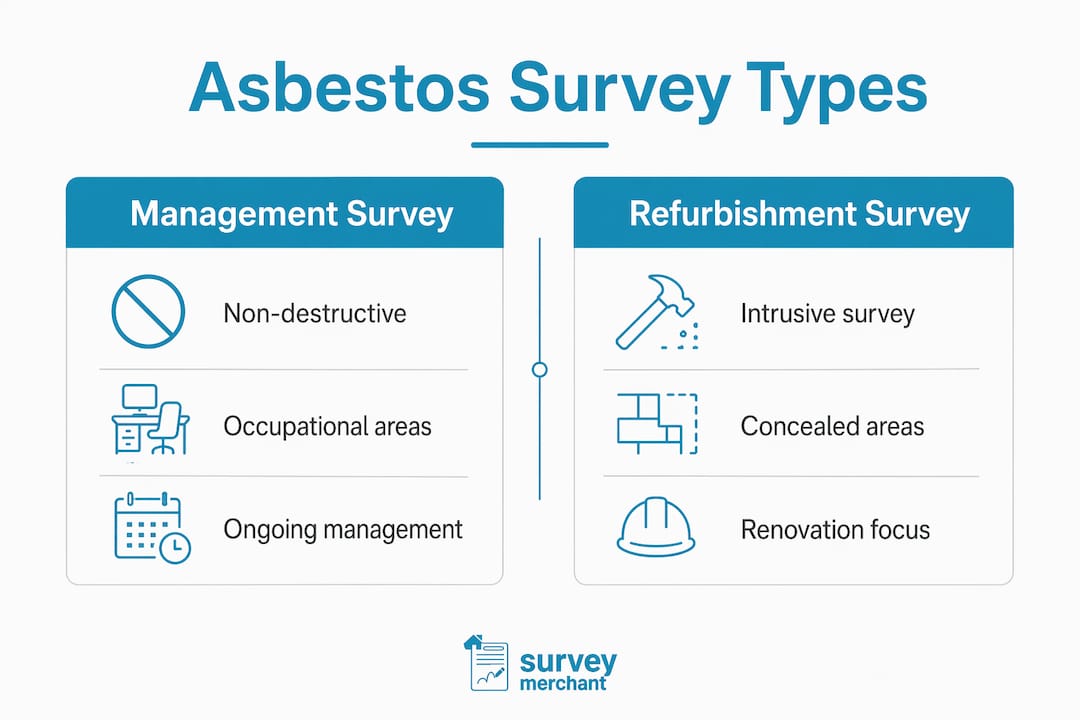
Two primary survey types exist under UK law: the Management Survey and the Refurbishment and Demolition Survey. Each serves a distinct purpose, and the two are not interchangeable.
A Management Survey is non-destructive. The surveyor inspects accessible areas of a building during normal occupation, locating ACMs that could be disturbed by everyday activities such as maintenance or minor repairs. This survey type fulfils the Regulation 4 duty to manage and is the standard starting point for any occupied building. It does not require the building to be vacated.
A Refurbishment and Demolition Survey is fully intrusive. Surveyors open walls, lift floors, and access concealed voids to find all ACMs before construction, refurbishment, or demolition work begins. This survey type fulfils Regulation 5, which requires identification of asbestos before any work that could disturb it. The area being surveyed must be vacated, and some localised damage to the building fabric is expected.
Using a Management Survey when a Refurbishment and Demolition Survey is required is one of the most common compliance failures in the UK. The consequences include hidden ACMs being disturbed during works, exposing workers to asbestos fibres and triggering enforcement action from the HSE.
Pro Tip: If you are planning any renovation, extension, or demolition, commission a Refurbishment and Demolition Survey before work starts. A Management Survey alone will not satisfy Regulation 5 and will not protect your contractors.
The table below summarises the key differences between the two survey types.
| Feature | Management survey | Refurbishment and demolition survey |
|---|---|---|
| Purpose | Ongoing management during occupation | Before refurbishment or demolition |
| Intrusion level | Non-destructive | Fully intrusive |
| Building occupancy | Occupied | Must be vacated |
| Legal trigger | Regulation 4 | Regulation 5 |
| Typical output | Asbestos register and management plan | Full ACM schedule for removal planning |
The asbestos inspection process follows a structured sequence from initial planning through to a written report. Each stage builds on the last, and skipping any step undermines the reliability of the final findings.
Survey planning. The client and surveyor agree the scope, including which areas to inspect and what access is available. Clients must instruct surveyors clearly, specifying areas and any restrictions, because surveyors do not automatically know all client requirements. Clear instructions at this stage prevent gaps in coverage.
Site inspection. For a Management Survey, the surveyor walks the building systematically, checking all accessible areas including roof spaces, service ducts, and plant rooms. For a Refurbishment and Demolition Survey, the surveyor uses intrusive techniques such as opening wall cavities and lifting floor coverings to expose hidden materials.
Sampling. Where a material is suspected to contain asbestos, the surveyor takes a small physical sample. Sampling follows strict protocols to prevent fibre release. Samples are sealed, labelled, and sent to an accredited laboratory for analysis.
Laboratory analysis. The laboratory identifies the type of asbestos present, such as chrysotile, amosite, or crocidolite, using polarised light microscopy or electron microscopy. The results confirm whether a material is an ACM and inform the risk assessment.
Report production. The surveyor compiles a written report containing a full schedule of ACMs, their locations, conditions, and risk scores. For Management Surveys, this report forms the basis of the asbestos register, which the dutyholder must maintain and keep accessible to contractors.
The table below shows what each report stage delivers.
| Stage | Output |
|---|---|
| Site inspection | Photographic record and material schedule |
| Sampling and analysis | Laboratory confirmation of ACM type |
| Risk assessment | Priority score for each ACM |
| Final report | Register, maps, and management recommendations |
An asbestos survey report typically includes the location, type, quantity, and condition of each ACM, combined with a risk assessment that prioritises management actions. Understanding what that report tells you determines what you do next.
The risk assessment within the report combines two factors: the type of material and the likelihood of it being disturbed. Friable materials such as sprayed coatings score higher than encapsulated materials such as asbestos cement sheets. A high score does not always mean immediate removal. It means the material needs closer monitoring or management.
The asbestos register created from the report is a legal document. You must make it available to any contractor working on the building before they start. Failure to do so breaches the Control of Asbestos Regulations 2012 and can result in prosecution. For property buyers, reviewing the existing register before exchange gives a clear picture of what management obligations transfer with the building.
Key elements to check in any survey report include:
For more detail on what to do when ACMs are found, the Surveymerchant guide on asbestos in a building survey covers the practical next steps clearly.
Surveyor quality determines the reliability of everything that follows. A poorly conducted survey produces a flawed register, which in turn creates legal and safety risks for everyone connected to the property.
HSE recommends using surveyors accredited by UKAS to BS EN ISO/IEC 17020. UKAS accreditation confirms that the surveyor’s systems, competence, and impartiality have been independently assessed. There is no legal requirement for accreditation, but it is the clearest indicator of quality available to clients. UKAS accreditation ensures surveyors meet consistent standards of independence and technical ability.
Surveyors without UKAS accreditation can still be competent. In those cases, verify their qualifications, check references from recent comparable projects, and confirm their familiarity with HSG264. The HSE guidance on sourcing surveyors makes clear that client due diligence does not end at hiring. You remain responsible for the quality of the survey you commission.
Key checks before appointing a surveyor:
Pro Tip: Always define the survey scope in writing before work begins. A verbal agreement leaves gaps that can invalidate your compliance position if the HSE investigates.
For a broader view of health and safety compliance obligations for survey providers, Surveymerchant’s guidance covers what responsible commissioning looks like in practice.
Asbestos surveying is a legal requirement for most pre-2000 buildings in the UK, and choosing the wrong survey type or an unqualified surveyor creates liability that falls directly on the property owner.
| Point | Details |
|---|---|
| Two distinct survey types | Management Surveys cover occupied buildings; Refurbishment and Demolition Surveys are required before any intrusive works. |
| Legal framework | The Control of Asbestos Regulations 2012 and HSG264 define duties for both survey types. |
| Report as legal document | The asbestos register must be maintained and shared with contractors before any work begins. |
| UKAS accreditation matters | HSE recommends UKAS-accredited surveyors to BS EN ISO/IEC 17020 as the clearest quality standard. |
| Scope must be agreed in writing | Clear client instructions to the surveyor prevent coverage gaps and compliance failures. |
The question property owners get wrong most often is not whether to commission a survey. It is which survey to commission. A Management Survey is the right tool for understanding what is in a building during normal use. The moment you plan to open a wall, lift a floor, or strip out a ceiling, that survey becomes inadequate. The Refurbishment and Demolition Survey exists precisely because hidden ACMs sit in places a non-intrusive inspection cannot reach.
Projects have been delayed by weeks because a contractor arrived on site, asked for the asbestos register, and found it was based on a Management Survey for a building about to be gutted. The contractor stopped work. The client faced the cost of commissioning a new survey, vacating the area, and rescheduling trades. That outcome is entirely avoidable.
The other misunderstanding that comes up regularly is treating the survey report as a one-time document. An asbestos register is a living record. Every time work is done, every time a material is removed or disturbed, the register needs updating. Property investors who buy buildings with existing registers should treat those documents as a starting point, not a final answer. Commission a fresh survey if the existing one is more than a few years old or if the building has changed significantly.
Clear communication between you and your surveyor before the inspection starts is the single most effective thing you can do to get a reliable result. Define the scope, confirm the access arrangements, and ask to see a sample report before you sign anything.
— N
Buying or managing a property without a current asbestos survey is a risk no informed owner should accept. Surveymerchant connects property owners, investors, and buyers with qualified, experienced surveyors across the UK who understand both the technical and legal requirements of asbestos inspection.

Whether you need a Management Survey for an occupied building or a full Refurbishment and Demolition Survey ahead of renovation works, Surveymerchant’s panel includes surveyors with the credentials and experience to deliver clear, compliant reports. For commercial properties, the commercial property survey service covers asbestos alongside the full range of building condition assessments. For residential and mixed-use properties, the building surveying services page sets out the options available. Contact Surveymerchant to discuss your specific requirements and get matched with the right surveyor for your building.
An asbestos survey is a formal inspection of a building to locate, identify, and assess asbestos-containing materials. It produces a written report and register used to manage health risks and meet legal duties under the Control of Asbestos Regulations 2012.
A Management Survey is required for any non-domestic building built before 2000 where a duty to manage applies under Regulation 4. A Refurbishment and Demolition Survey is required before any intrusive work under Regulation 5.
A Management Survey is non-destructive and covers accessible areas during normal occupation. A Refurbishment and Demolition Survey is fully intrusive, requires the area to be vacated, and is used before renovation or demolition work begins.
Buyers of pre-2000 properties should request any existing asbestos register and consider commissioning a fresh survey if none exists or if the existing one is outdated. The register transfers legal management obligations to the new owner.
HSE recommends using surveyors accredited by UKAS to BS EN ISO/IEC 17020. Where accreditation is not available, verify qualifications, request references, and confirm experience with your building type before appointing.
Survey Merchant provides vetted RICS surveyors across 100+ UK locations at fixed fees:
→ Level 2 Home Survey (HomeBuyer Report)
→ Level 3 Building Survey (full structural survey)
→ RICS Red Book property valuations
→ Party wall surveyors — notices, awards & schedules of condition
→ Expert witness surveyors — CPR Part 35 reports for property disputes