Leasehold
Jul 16, 2026
Ultimate Guide to Pre-Lease Surveys
Pre-lease surveys identify defects, estimate repair costs and clarify liabilities to support lease negotiations.

When signing a commercial lease, understanding the property's condition is vital to avoid unexpected costs. A pre-lease survey identifies potential issues, estimates repair costs, and ensures you know your responsibilities under the lease. This is especially important for Full Repairing and Insuring (FRI) leases, where tenants are responsible for the entire building's upkeep, even for pre-existing defects. Here's what you need to know:
Skipping this step risks financial and legal complications. A pre-lease survey ensures both tenants and landlords start with a clear understanding of the property's condition, reducing disputes and unexpected expenses.
A pre-lease survey is all about identifying existing defects and estimating the costs to fix them before committing to a lease.
The main goal? Assessing risk and liability. For tenants entering a Full Repairing and Insuring (FRI) lease, this is crucial. Without a proper survey, you could unknowingly take on responsibility for pre-existing issues the moment you sign the lease, potentially leading to hefty repair bills [4][6].
But that's not all. A pre-lease survey can also give you leverage in negotiations. Whether it's asking for repairs, a rent reduction, or even a rent-free period, the findings can help you secure better terms. Plus, it provides a clear picture of the short- and long-term maintenance costs, helping you plan your budget more accurately [4][3][5].
"The pre-lease survey guides whether to take the lease and on what terms, while the schedule of condition protects the tenant's interests during and at the end of the lease." - Fourth Wall [4]
To get the most out of the survey, involve your surveyor early - during the Heads of Terms stage. Share the draft lease and maintenance records so they can tailor the inspection to the specific repairing obligations you'll be agreeing to [2][9].
Next, let's dive into the areas that a pre-lease survey typically covers.
A pre-lease survey takes a close look at all aspects of the property, pinpointing defects that could affect negotiations and financial planning. Here's a breakdown of the key areas it examines:
| Area Inspected | Elements Inspected |
|---|---|
| External Envelope | Roof coverings, flashings, gutters, downpipes, external walls, and glazing [2][4][7] |
| Internal Fabric | Floor slabs and finishes, suspended ceilings, internal walls, and doors [2][4] |
| MEP Services | Electrical distribution, HVAC systems, plumbing, and drainage [4][3][7] |
| Statutory Compliance | Asbestos presence, fire safety measures, and accessibility under the Equality Act [4][3] |
| Legal and Documentation | Draft lease, title, warranties, and existing maintenance records [4][3] |
Energy performance is also reviewed, as the building's EPC rating impacts running costs and its suitability for your intended use [4][3]. The type of lease you're signing will influence the survey's focus. For instance, under an IRI (Internal Repairing and Insuring) lease, the survey will prioritise internal finishes and mechanical and electrical systems. On the other hand, an FRI lease demands a more detailed inspection of the entire property [5].
It’s easy to confuse a pre-lease survey with other types of property assessments, but each serves a unique purpose and is conducted at specific stages.
| Survey Type | Primary Purpose | Timing | Key Focus |
|---|---|---|---|
| Pre-Lease Survey | Assessing liability and aiding tenant negotiations [4][3] | Before signing the lease | Compliance and future maintenance costs [4] |
| Schedule of Condition | Providing a factual record to limit future repair liability [2][9] | At lease commencement | Photographic and narrative evidence of current state [2] |
| Pre-Acquisition Survey | Due diligence for property buyers [9] | Before contract exchange | Capital expenditure and asset value [9] |
| Dilapidations Survey | Evaluating terminal lease liabilities [9] | Near or at lease expiry | Repairing covenant breaches and remedial costs [9] |
The most common mix-up is between a pre-lease survey and a Schedule of Condition (SoC). Think of them as complementary tools. The pre-lease survey helps you decide if and how to proceed with the lease, while the SoC documents the property's current state - usually with photos - and becomes an official part of the lease. This record helps protect you from being held liable for pre-existing issues [4][3].
"The schedule is appended to the lease and referenced in repair, decoration and reinstatement clauses. This narrows future disputes by setting the baseline." - AMS Surveys [2]
A pre-acquisition survey, on the other hand, is aimed at buyers rather than tenants. Its focus is on how defects affect the property's value, which is less relevant when you're leasing instead of purchasing [9].
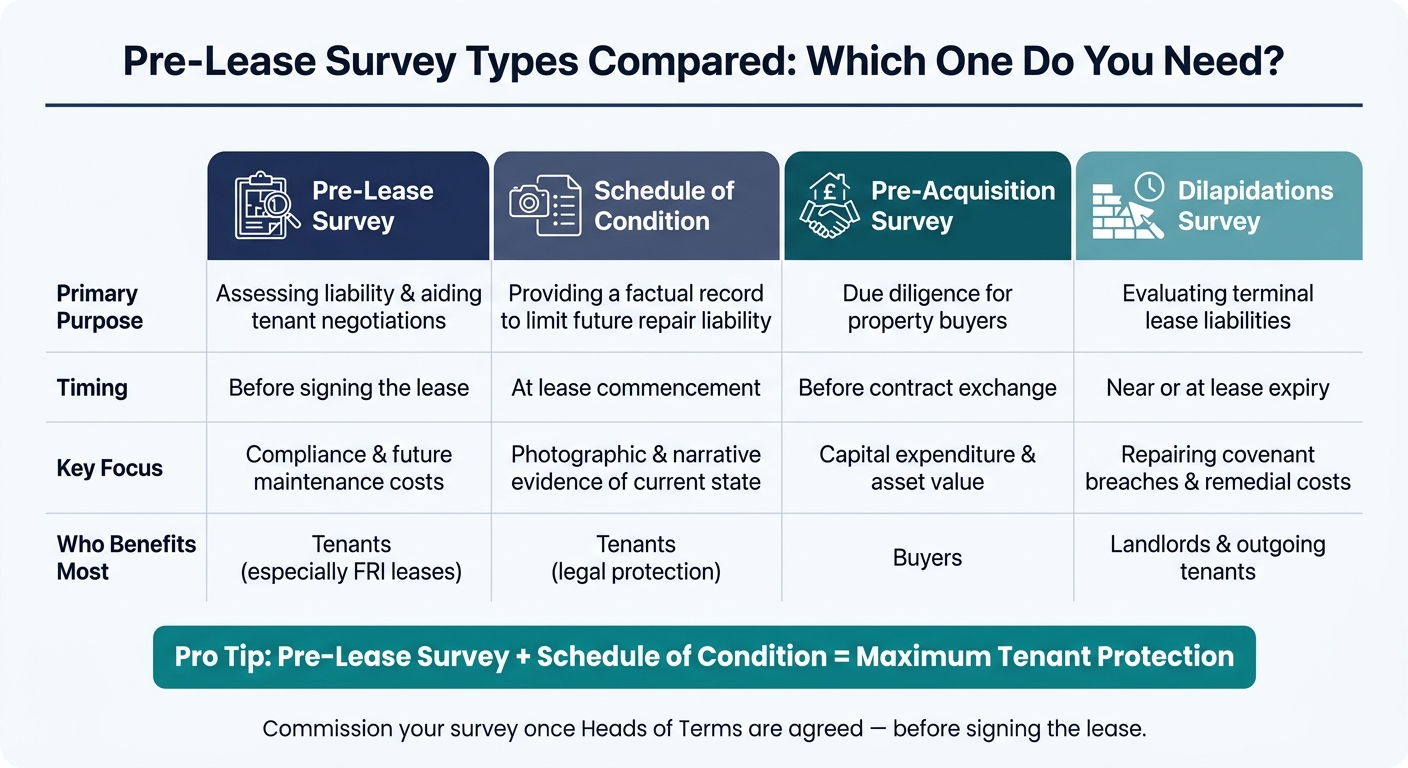
Pre-Lease Survey Types Compared: Which One Do You Need?
The main reason to commission a pre-lease survey is when signing a Full Repairing and Insuring (FRI) lease. With this type of lease, you take on responsibility for the entire building - including the roof, external walls, structure, and services - from the moment you sign. Any existing problems with the property become your responsibility [5][6]. A pre-lease survey gives you the opportunity to identify these issues, allowing you to negotiate repairs or even reconsider the lease entirely.
Older properties, especially those built before the 1980s, can hide significant issues such as asbestos, non-compliant fire doors, or structural weaknesses [4][10]. The cost of addressing these problems can be substantial, and without a survey, you may not realise the extent of your liability until it's too late.
If you're leasing space in a multi-let building, service charge contributions also need careful consideration [4][8]. These charges cover shared maintenance and capital costs determined by the landlord. A survey can help you understand what these contributions are likely to involve over the course of your lease.
The best time to instruct a surveyor is once Heads of Terms are agreed, but before signing the lease. This ensures you retain negotiating power while the legal terms are still being finalised. This aligns with earlier advice to engage a surveyor at the Heads of Terms stage [6][12].
The type of property you're leasing greatly influences what the survey should focus on. The risks involved in a warehouse differ significantly from those in a retail unit or a multi-storey office.
| Property Type | Key Survey Focus |
|---|---|
| Industrial / Warehouse | Roof condition, floor load capacity, weatherproofing of external walls, and loading bays [4][5] |
| Office | HVAC systems, suspended ceilings, electrical compliance, and energy performance (MEES) [5][3] |
| Retail | Accessibility under the Equality Act, shopfront condition, and suitability for intended use (e.g., ventilation for a restaurant) [7][3] |
| Listed Buildings | Heritage restrictions, specialist materials, and long-term structural stability [4][8] |
For industrial properties, the roof often presents the greatest financial risk. A damaged roof on a large warehouse can lead to significant repair costs, which, under an FRI lease, would fall to the tenant. In office spaces, the focus shifts to building services like HVAC systems. A poorly maintained system isn't just expensive to repair but can also disrupt daily operations. For retail or leisure properties, it's crucial to check whether the space can support your intended use, including verifying planning permissions and utilities [7].
Listed buildings require extra attention. Heritage restrictions can limit repair options and necessitate the use of specialist contractors, driving up costs. If you're considering a listed property, it's essential to work with a surveyor experienced in heritage properties [4][8].
With these property-specific risks in mind, the next section will walk you through the pre-lease survey process itself.
The pre-lease survey process starts with the appointment of a surveyor. At this stage, it’s important to share the Heads of Terms and draft lease documents. These documents help the surveyor customise the inspection to focus on your lease obligations, especially under a Full Repairing and Insuring (FRI) lease.
When conducting the on-site inspection, the surveyor thoroughly examines the building’s fabric, structural elements, and MEP (Mechanical, Electrical, and Plumbing) systems. High-resolution, time-stamped photographs are taken to create the Schedule of Condition. To ensure an effective inspection, make sure all areas are accessible and free from obstructions, as blocked areas could hide potential issues.
Once the inspection is complete, the surveyor prepares a detailed report. A well-organised report usually includes:
"The report should support the solicitor's drafting rather than sit outside it as a general commentary document." - LEM Building Surveying [9]
After receiving the report, your solicitor uses the findings to adjust lease clauses. For the Schedule of Condition to carry legal weight, both parties must agree on its content and formally attach it to the lease.
This structured approach ensures the survey findings directly inform lease negotiations, helping to manage risks and avoid future disputes.
Timing is crucial to align the survey process with the lease finalisation. For smaller commercial units, the on-site inspection typically takes 2–4 hours, while larger or multi-floor properties may require a full day. Preparing the report usually takes 5–10 working days.
| Stage | Typical Duration |
|---|---|
| On-site inspection (small unit) | 2–4 hours |
| On-site inspection (large/multi-floor) | Full day |
| Report preparation | 5–10 working days |
| Landlord review and agreement | Variable - allow extra time |
"For commercial tenants, we recommend allowing a minimum of two to three weeks between instructing the survey and the anticipated lease completion date." - ALD Surveying [13]
This two-to-three-week window accounts for the inspection, report preparation, and the time required for the landlord’s surveyor to review and approve the Schedule of Condition. Delaying the instruction until the lease is nearly signed significantly limits your ability to incorporate the findings into the lease.
"For lease-related Schedules, it is critical that the inspection takes place before the lease is completed, not after." - ALD Surveying [1]
In terms of cost, surveyor day rates in the UK generally range from £800 to £2,000 [14]. For an average SME property, the total cost of a pre-lease survey typically falls between £1,800 and £3,000 + VAT [14]. However, properties in London or other high-cost areas may incur an additional premium of 10–30% [14].
Pre-lease surveys are essential for identifying risks that could leave tenants burdened with unexpected liabilities. Among the most common structural problems are movement-induced cracking, deteriorated roof coverings like slipped tiles or failed flashings, and defects in the building’s envelope that allow water ingress. These issues can lead to hefty repair bills, often amounting to 15–30% of the property's value [18].
Additional findings often include roof leaks, failed window seals, and blocked drainage systems. Under Awaab's Law, landlords in the UK must investigate damp and mould concerns within 10 days, making it critical to address these issues during the survey phase [17].
"The difference between a £2 million investment and a £2.3 million liability often lies in the thoroughness of the structural inspection. Hidden defects don't negotiate." - Senior Chartered Surveyor, RICS [18]
Beyond structural concerns, mechanical, electrical, and plumbing (MEP) systems often present their own challenges.
Ageing MEP systems can hide costly risks. The table below highlights typical lifespans and replacement costs for key components:
| System Component | Typical Lifespan | Replacement Cost |
|---|---|---|
| Boiler Systems | 15–20 years | £15,000 – £80,000 |
| Electrical Distribution | 25–30 years | £30,000 – £150,000 |
| Air Conditioning | 15–20 years | £20,000 – £200,000 |
| Fire Alarm Systems | 10–15 years | £10,000 – £50,000 |
| Lifts | 20–25 years | £40,000 – £100,000 per unit |
Compliance issues can further complicate matters. Surveys often uncover expired Electrical Installation Condition Reports (EICRs), missing Gas Safety certificates, and non-compliant fire doors. Another critical factor is Energy Performance Certificates (EPCs). By law, commercial properties must meet at least an EPC rating of E to be let, with the minimum expected to rise to C by 2027 [19]. Non-compliance can lead to fines ranging from £5,000 to £150,000, depending on the rateable value and the length of the breach [19].
"Building services risks may be less visible during a static inspection but can dominate business continuity outcomes." - LEM Building Surveying [11]
Equally important is the accuracy and completeness of lease documentation, as oversights here can lead to costly disputes.
Poorly prepared lease documentation is another major source of financial risk. Without a Schedule of Condition, tenants may unknowingly accept responsibility for pre-existing disrepair and be required to return the property in better condition than when the lease began.
Disputes over dilapidations can cost between £20,000 and £100,000 [16]. However, tenants who obtain a pre-lease survey and include a well-documented Schedule of Condition in the lease can reduce their liability by 30–50% [16]. For instance, AMS Surveys shared a case where a tech company moving into a Manchester property documented water staining and minor cracking before signing the lease. When the landlord later claimed for a full ceiling replacement, the photographic evidence limited the tenant’s liability to only the tiles damaged during their tenancy [2].
"The investment in a professional Schedule of Condition is almost always a fraction of the potential liability it protects against." - ALD Surveying [1]
To ensure its legal validity, the Schedule of Condition must be formally signed, dated, and annexed directly to the lease. If it’s merely filed separately, it holds little weight in the event of a dispute.
Pre-lease surveys play a crucial role in safeguarding both tenants and landlords as they enter lease agreements. Below, we explore the specific advantages for each party.
For tenants under a Full Repairing and Insuring (FRI) lease, the responsibility for the building's condition - including pre-existing defects - falls squarely on their shoulders. A Schedule of Condition provides a photographic and documented baseline, helping tenants avoid being held liable for issues that existed before their tenancy began. This record can also serve as a powerful negotiation tool, enabling tenants to request landlord-funded repairs, rent-free periods, or even contributions towards fit-out expenses. Without such a document, repair costs over a relatively short lease of five years could easily escalate into five- or six-figure sums [15].
Another advantage lies in financial planning. A well-structured survey categorises repair costs into immediate, medium-term, and lease-end priorities, giving tenants a clearer understanding of their financial commitments.
Surveys can also uncover potential future costs, such as major works like roof replacements or façade repairs, which might lead to increased service charges. Additionally, with regulations requiring commercial buildings to meet an EPC rating of B by 2030 [20], tenants could face unexpected cost surges if energy efficiency upgrades occur during their lease term.
"A Schedule of Condition is one of the most powerful tools a tenant can use to manage risk in a commercial lease." - Bressummer A.R.K. [12]
Landlords also stand to gain from pre-lease surveys, whether they commission one themselves or support a tenant’s efforts to do so. This approach signals transparency, which can streamline negotiations and foster trust. More importantly, it establishes a clear, defensible record of the building's condition at the start of the lease, reducing the likelihood of disputes over pre-existing damage at the lease's end.
Surveys are also instrumental in protecting the value of the property. Identifying issues such as roof wear or structural movement early on can prevent minor concerns from escalating into significant, costly problems. This proactive approach not only preserves the building's insurability and market value but also allows landlords to implement a Planned Preventative Maintenance (PPM) schedule, offering a clear roadmap for maintenance and reducing the need for reactive repairs.
"By clearly documenting the building's condition and explaining obligations in practical terms, a surveyor helps align expectations between parties. This reduces the likelihood of disputes and unexpected expenditure during occupation or at lease expiry." - Bressummer A.R.K. [12]
The table below outlines the primary benefits for both tenants and landlords:
| Benefit | Tenants | Landlords |
|---|---|---|
| Liability protection | Limits exposure to historic defects via Schedule of Condition | Provides defensible record against end-of-lease disputes |
| Financial clarity | Breaks down repair costs by timeframe for accurate budgeting | Supports PPM planning and avoids reactive expenditure |
| Negotiation support | Findings justify rent reductions or landlord-funded repairs | Ensures lease terms are technically accurate and enforceable |
| Compliance awareness | Flags EPC, fire safety, and accessibility risks before signing | Identifies statutory risks that could create legal liability |
| Asset confidence | Confirms the property's suitability for business | Protects long-term property value and insurability |
Navigating the complexities and risks of property leasing requires the expertise of a qualified surveyor. While understanding the importance of a pre-lease survey is a good start, finding the right professional to carry it out is just as critical.
Pre-lease surveys play a key role in managing risks, which makes choosing the right surveyor an essential step. Surveyors regulated by RICS (Royal Institution of Chartered Surveyors) or CABE (Chartered Association of Building Engineers) follow strict professional standards. They carry professional indemnity insurance and provide unbiased advice. Look for designations like AssocRICS, MRICS, or FRICS, as well as CABE membership, as these signify technical expertise [21][22].
"Surveyors regulated by RICS or CABE are bound by strict standards of professionalism, technical competence, and impartiality." - SJM Surveyors [21]
Experience is just as important as credentials. Ask for evidence of work on similar properties and request sample reports to assess their clarity and thoroughness [21][22].
Equally, impartiality cannot be overlooked. Ensure your surveyor has no financial interests that might influence their recommendations [21][22].
"A thorough, impartial survey by a regulated professional is invaluable." - RICS [22]
It's best to instruct your surveyor as soon as heads of terms are agreed. This ensures there’s enough time to identify potential risks before you’re legally committed [12]. To make the process easier, you can use platforms that carefully vet surveyors to match you with the right expert.

Survey Merchant simplifies the process by connecting you with accredited, highly qualified surveyors across the UK. Their platform matches property professionals with a nationwide panel of RICS-accredited surveyors specialising in various property types [23].
They offer services like Commercial Building Surveys, Schedules of Condition, and tailored dilapidations reports, all designed to be clear and easy to understand. This supports proactive risk management and ensures clarity during lease negotiations.
Skipping a professional survey can be costly. On average, buyers who forgo surveys face £6,000 in repair costs, with 17% encountering bills exceeding £12,000 [23]. For commercial tenants with FRI (Full Repairing and Insuring) obligations, the financial risks are even greater.
Conducting a pre-lease survey is an essential step before signing a commercial lease. It highlights compliance issues and provides solid evidence to negotiate better terms - whether that's securing landlord-funded repairs, a rent-free period, or adjustments to repairing obligations. By identifying key issues early, the survey plays a direct role in shaping lease terms and negotiation strategies.
"A building surveyor helps uncover those risks before the transaction completes, when there is still an opportunity to renegotiate, budget or walk away." - Bressummer A.R.K. [12]
For landlords, the survey also helps avoid costly disputes at the lease's end by creating a shared understanding of the property's condition from the outset.
In fact, survey-backed negotiations often cut dilapidations claims to 30–60% of their original figure [24]. Considering survey costs range from around £800 for smaller units to over £6,000 for larger or more complex properties [24], the potential financial savings far outweigh the initial investment.
To make the most of this process, commission your survey once the Heads of Terms are agreed. Share the draft lease with your surveyor and ensure the Schedule of Condition is formally attached to the lease. This step can protect you from unexpected repair costs down the line [24].
When it comes to securing a commercial lease, these services often complement each other to ensure a smoother and more secure process. A pre-lease survey helps identify structural risks and potential maintenance costs, offering crucial insights to strengthen your lease negotiations. Meanwhile, a Schedule of Condition - a detailed document often including photographs and written descriptions - provides a legal record of the property's state. This can be invaluable in limiting your liability for dilapidations at the end of the lease.
For unbiased, professional guidance, Survey Merchant connects you with specialists who offer these essential services, tailored to meet your specific requirements.
If a pre-lease survey reveals serious issues, it opens the door for renegotiation. You could ask for a price reduction, insist the landlord addresses the repairs before finalising the contract, or, if the problems are too extensive, decide to withdraw entirely. To back up your requests, it’s a good idea to get independent quotes from experts outlining the repair costs. Most sellers are likely to negotiate rather than start over with a new buyer, so don’t hesitate to make your case.
Booking a pre-lease survey should be a top priority as soon as your offer is accepted. This ensures there’s enough time to complete the inspection, prepare the report, and allow the landlord’s surveyor to review the Schedule of Condition. Rushing this process by leaving it too late can lead to unnecessary stress and potential delays. Both parties must review and agree on the survey before it’s formally added to the lease.
Survey Merchant provides vetted RICS surveyors across 100+ UK locations at fixed fees:
→ Level 2 Home Survey (HomeBuyer Report)
→ Level 3 Building Survey (full structural survey)
→ RICS Red Book property valuations
→ Party wall surveyors — notices, awards & schedules of condition
→ Expert witness surveyors — CPR Part 35 reports for property disputes