Leasehold
Jul 16, 2026
Top Legal Disputes Avoided by Pre-Lease Surveys
Pre-lease surveys record a property's condition to prevent repair, dilapidations, compliance and boundary disputes, reducing

Avoid costly legal disputes before signing a commercial lease with a pre-lease survey. These inspections document a property's condition, helping tenants and landlords negotiate lease terms and responsibilities while minimising future conflicts. Here's why they're crucial:
Pre-lease surveys cost between £500 and £3,000+, depending on property size and complexity, but they save tenants from expensive repairs and litigation. Platforms like Survey Merchant connect you with RICS-certified surveyors for thorough assessments. Don't sign a lease without one.
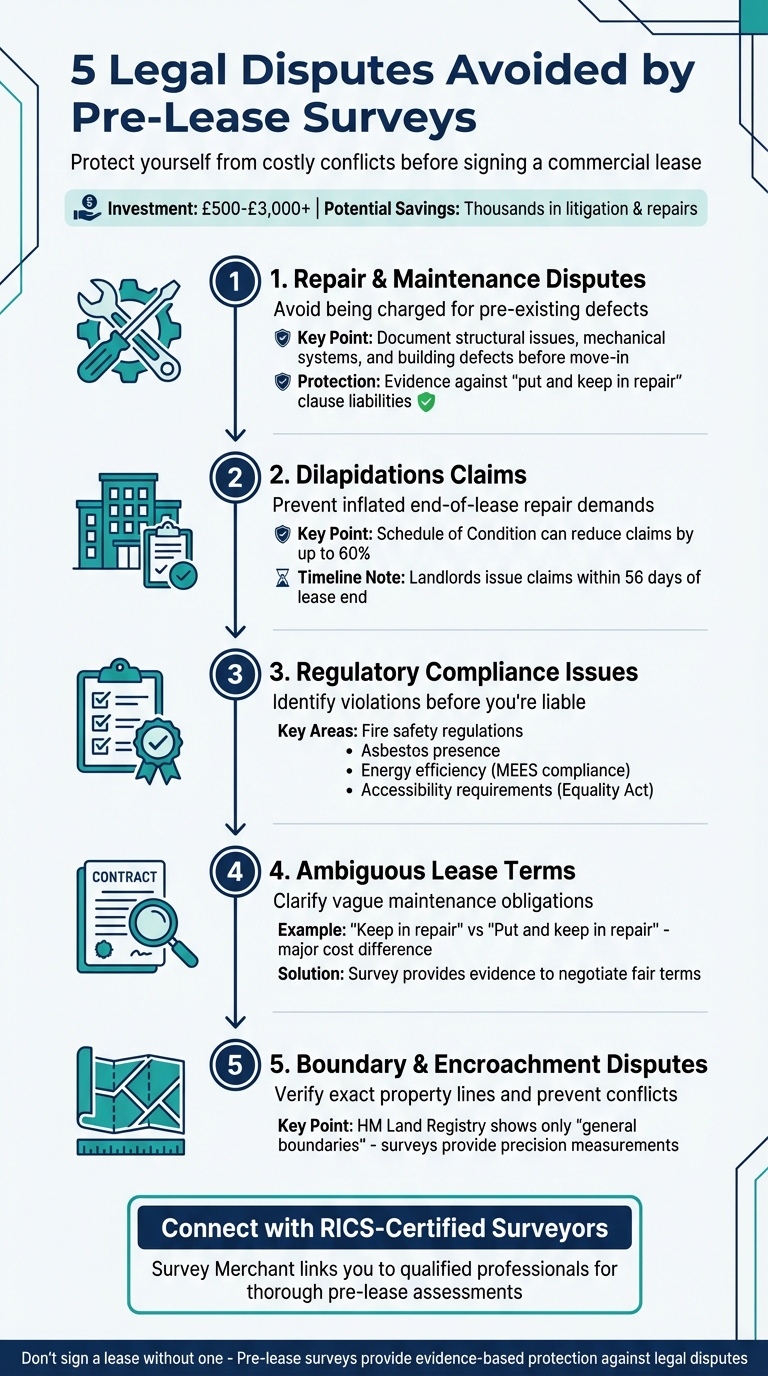
5 Legal Disputes Prevented by Pre-Lease Surveys

Pre-lease surveys act as a safeguard against potential legal disputes in commercial property leasing. By documenting the property's condition before signing the lease, these surveys establish a clear baseline, protecting both landlords and tenants from misunderstandings or exaggerated claims. Let’s delve into how they help prevent specific types of legal conflicts.
One common area of conflict involves repair responsibilities. Without a pre-lease survey, tenants may find themselves unfairly held accountable for defects that existed before they moved in. These surveys thoroughly examine key aspects of the property, including the building's structure (roofs, walls, finishes) and essential systems such as mechanical, electrical, and plumbing components. By documenting these conditions, tenants can avoid being wrongly blamed for repairs.
This is particularly important for leases with clauses like "put and keep in repair", which could obligate tenants to restore a property to good condition, even if it was already in poor shape when they took possession. A pre-lease survey provides written and photographic evidence, clarifying what qualifies as normal wear and tear versus a breach of lease obligations.
The case of Twinmar Holdings Ltd v Klarius UK Ltd & Anor highlights the importance of such documentation. Here, the court ruled that soiled rooflights in a warehouse were not in "good condition" because artificial lighting was necessary during the day for routine tasks [6].
Disputes over dilapidations - failure to meet maintenance and repair obligations - are another costly challenge in commercial leasing. A pre-lease survey, especially when paired with a Schedule of Condition, ensures tenants are not unfairly required to return a property in better condition than it was at the start of their lease [8].
"The intention of a dilapidation survey is to ensure that the commercial property is returned to the landlord at lease expiry in a condition which is compliant with the relevant lease terms or that a financial settlement is agreed." - Toby Smith, Commercial Building Surveyors [8]
Such surveys help prevent disagreements by identifying issues early and providing a strong defence against inflated claims. According to the Dilapidations Protocol for England and Wales, landlords typically issue a schedule of dilapidations within 56 days of a lease ending, with tenants given a similar timeframe to respond [4].
Additionally, it’s worth noting that landlords who are VAT-registered and can reclaim the tax cannot legally include VAT in dilapidations settlements [6].
Pre-lease surveys also play a critical role in identifying regulatory shortcomings. They can uncover non-compliance with fire safety regulations, accessibility requirements under the Equality Act, or the presence of hazardous materials like asbestos or non-compliant fire doors [1].
Energy efficiency is another crucial consideration. Surveys assess whether a property meets Minimum Energy Efficiency Standards (MEES), which are a legal requirement for occupation. If upgrades are needed to meet these standards, landlords may face restrictions on recovering repair costs, particularly when VAT is recoverable [6]. Surveyors also check for statutory test certificates for systems like fire alarms, electrical installations, gas systems, and lifts, ensuring everything is up to code [6].
Identifying these issues early not only allows tenants to renegotiate lease terms but also provides an opportunity to walk away before committing. The initial condition report can even be used as leverage to negotiate exclusions in the lease for pre-existing defects or regulatory failures [9].
Lease agreements often include vague terms that can lead to misunderstandings - and those misunderstandings can get expensive. Pre-lease surveys help bridge the gap between the legal language of the lease and the actual condition of the property. This ensures that both landlords and tenants are on the same page about their responsibilities, reducing the risk of disputes down the line.
The wording in maintenance clauses can have a big impact on financial obligations. For instance, the difference between "keep in repair" and "put and keep in repair" might seem small, but it’s not. "Put and keep in repair" means tenants might have to improve the property’s condition beyond what it was when the lease began [2][3]. As Gail Morris, Partner at Cripps, explains:
"An obligation to keep a premises in repair includes an obligation to put the premises into repair if it is in disrepair at the start of the lease" [3].
A pre-lease survey can document the property’s condition, making these clauses clearer and fairer [1][2]. It also helps with "yield up" clauses, which define the property's required condition at the end of the lease. For example, in one case involving a major distribution warehouse, a Schedule of Condition with over 1,000 images reduced a landlord’s dilapidations claim by roughly 60% [13].
To protect tenants, the survey should be formally referenced in the lease agreement and attached to it. Without this, tenants could end up responsible for repairing pre-existing damage [2][13]. In most commercial leases - especially Full Repairing and Insuring (FRI) leases - tenants are responsible for all repairs, including major structural elements like roofs and foundations [10]. By documenting the property's condition at the start, tenants can avoid being unfairly charged for issues like structural movement or dampness that existed before they moved in [2].
Clear boundary definitions are another area where pre-lease surveys are crucial. Using precision instruments, surveyors can establish exact measurements, resolving ambiguities in outdated legal descriptions [11]. This is especially important because HM Land Registry typically records only "general boundaries" based on Ordnance Survey maps, which lack the detail needed for commercial projects [12].
Surveyors compare the actual physical features of the property to the HM Land Registry title plans, identifying discrepancies and encroachments. This information can be critical during lease negotiations [11][12]. For tenants planning fit-outs or extensions, topographic surveys are invaluable. These surveys identify features like tree canopies, surface infrastructure, and neighbouring property details, which are essential for addressing rights of light or party wall concerns [12]. Since scaled Land Registry plans often lack detail, topographic surveys provide the clarity tenants and landlords need [12].
A pre-lease survey doesn’t just clarify lease obligations - it can also save you money and shield you from legal headaches. For a cost ranging from £500 to £3,000 or more, this survey helps uncover existing issues and potential liabilities, reducing the risk of disputes and expensive legal battles.
Pre-lease surveys thoroughly examine a property’s condition, including its roofing, walls, and mechanical and electrical systems. This detailed assessment highlights both current defects and potential future problems [1]. Armed with this information, tenants can negotiate better lease terms, demand that landlords handle necessary repairs, or even secure rent concessions before signing the lease [1][2]. Without this documentation, tenants might find themselves footing the bill for pre-existing issues, especially under “put and keep in repair” clauses.
Take the example of a tenant in Nottingham who, in January 2026, considered leasing an industrial warehouse. INform Surveying conducted a pre-lease survey using drone technology to inspect the roof. The survey revealed that a previous "Licence to Alter" for a concrete slab overlay had only been partially completed and was already cracking. This discovery highlighted significant potential repair and reinstatement costs. Thanks to the survey, the tenant renegotiated the lease to include a specific Schedule of Condition, protecting them from inheriting these liabilities [14].
Pre-lease surveys can also spot compliance issues, such as fire safety concerns, accessibility shortcomings, or energy inefficiencies, which could otherwise lead to mandatory and costly upgrades [1][14]. As Liam Piercy, BSc (Hons) MRICS, Director at Fourth Wall, puts it:
"A pre-lease condition survey is essential for any tenant considering a commercial lease. It provides a comprehensive understanding of the property's condition, helping to identify potential liabilities and maintenance obligations before commitments are made" [1].
This initial documentation not only saves money but also reduces the likelihood of future legal complications.
Beyond repair costs, a pre-lease survey can also help avoid legal disputes. The detailed reports produced by these surveys act as evidence-based documentation, which can quickly resolve conflicts and prevent the exaggerated claims that sometimes arise in dilapidations disputes [5].
Although a pre-lease survey might cost a few thousand pounds upfront, it can save tenants from the much higher costs of litigation or disrepair counterclaims. Legal battles often involve expert fees, court proceedings, and the risk of covering the opposing party’s legal costs if the case is unsuccessful [1][7]. By documenting the property’s condition with detailed photographs and written records, a pre-lease survey limits end-of-lease liabilities and helps disputes from spiralling into costly legal battles [1][10].
When arranging a pre-lease survey, it's important to ensure your surveyor holds the MRICS (Member) or FRICS (Fellow) designations and that the firm is regulated by RICS. This ensures they follow strict ethical and professional standards [6][15].
Qualified surveyors bring expertise in areas like client care, ethics, and legal compliance [6]. For commercial leases, look for professionals experienced in dilapidations, diagnosing building defects, and preparing schedules of condition. Many modern surveyors also use advanced equipment, such as LiDAR scanners for 3D modelling, light meters to assess warehouse rooflights, and 360° virtual tour technology [6]. Christopher Sullivan MRICS, Director at Hollis, highlights the importance of professionalism in survey work:
"A coherent claim demonstrates a surveyor's professionalism and expertise, helping to build trust with the client and ensuring a smooth and efficient resolution of any disputes relating to a property's condition" [6].
Before hiring, ask for sample reports to check for clarity and thoroughness. Additionally, confirm that the surveyor can arrange specialist testing if needed - like CCTV drainage surveys or electrical system inspections [6]. RICS-regulated firms also provide verified professional indemnity insurance, offering added peace of mind [15].
Taking these steps ensures you're well-prepared to connect with skilled professionals through trusted platforms.

Survey Merchant is a platform that connects property owners and tenants with a national network of RICS-certified surveyors. They focus on essential services like pre-lease surveys, dilapidations assessments, and schedules of condition - key to avoiding the legal disputes discussed here.
The platform ensures all surveyors adhere to established industry standards, such as the RICS Home Survey Standard and the RICS Code for Leasing Business Premises [15][16]. Their reports are legally robust and evidence-based, capable of holding up in court if disputes arise. Surveyors also use state-of-the-art diagnostic tools and provide detailed photographic documentation, helping to limit repair responsibilities and avoid costly dilapidations claims at the end of a lease.
Pre-lease surveys play a critical role in documenting a property's condition, providing a solid foundation for dispute prevention and lease negotiation. These surveys are invaluable in helping tenants and landlords avoid unexpected costs and disagreements. By clearly outlining repair responsibilities, reducing the risk of dilapidations claims, and identifying compliance issues, they minimise the chances of legal conflicts while also offering considerable financial advantages.
The financial upside is clear. With evidence-based documentation, tenants can negotiate improved lease terms, secure rent reductions, and avoid being unfairly charged for pre-existing defects.
To make this process straightforward, Survey Merchant connects you with trusted, RICS-certified surveyors who specialise in delivering thorough pre-lease assessments. Whether you're dealing with a modest retail space or a large industrial facility, these professionals offer detailed reports tailored to your property, ensuring your interests are protected and lease agreements proceed smoothly.
Choose Survey Merchant for your pre-lease survey needs and safeguard yourself against costly disputes and financial risks.
A pre-lease survey plays a key role in assessing the condition of a commercial property, pinpointing any existing issues or necessary repairs. This allows tenants to steer clear of unanticipated repair costs and ensures they fully understand their responsibilities before committing to a lease.
The insights from the survey can also be leveraged during lease discussions to negotiate repairs, modify maintenance duties, or achieve more favourable terms. By identifying potential liabilities upfront and preparing accordingly, tenants can safeguard their long-term interests and reduce the likelihood of conflicts throughout the lease period.
A pre-lease survey plays a crucial role in preventing disputes by offering a thorough record of the property's condition at the start of a lease. It carefully documents any existing damage, defects, or general wear and tear, providing a clear and unbiased reference point for both landlords and tenants.
When both parties agree on the property's condition from the outset, it becomes easier to define who is responsible for repairs or any dilapidations. This clarity helps minimise disagreements when the lease ends, as tenants are only accountable for any issues that occur during their tenancy. Moreover, a detailed Schedule of Condition can limit repair responsibilities to the property's documented state, ensuring transparency and fairness for everyone involved.
Choosing RICS-certified surveyors for a pre-lease survey is a smart move because they adhere to the strict professional standards set by the Royal Institution of Chartered Surveyors (RICS). Their specialised knowledge ensures unbiased and detailed evaluations, helping to uncover potential issues like unclear lease terms or repair obligations that could otherwise lead to expensive disputes.
These professionals are trained to offer dependable advice on leasehold matters and property conditions, protecting the interests of both landlords and tenants. Their comprehensive reports clearly outline responsibilities from the start, reducing the chances of misunderstandings or legal troubles. In the UK property market, turning to RICS-accredited surveyors is considered a reliable choice, offering reassurance and a recognised level of quality.
Survey Merchant provides vetted RICS surveyors across 100+ UK locations at fixed fees:
→ Level 2 Home Survey (HomeBuyer Report)
→ Level 3 Building Survey (full structural survey)
→ RICS Red Book property valuations
→ Party wall surveyors — notices, awards & schedules of condition
→ Expert witness surveyors — CPR Part 35 reports for property disputes