Building Surveying
Aug 2, 2026
Step by step home survey guide for UK buyers
Navigate your property purchase smoothly with our step by step home survey guide, ensuring you make informed decisions and avoid costly pitfalls.

A home survey is a formal assessment of a property’s condition, carried out by a qualified professional before purchase or renovation. Following a clear step by step home survey guide protects you from costly surprises, gives you negotiating power, and confirms whether a property is structurally sound. In the UK, surveys are classified by the Royal Institution of Chartered Surveyors (RICS) into three levels: the Condition Report (Level 1), the Homebuyer Report (Level 2), and the Building Survey (Level 3). Each serves a different purpose, and choosing the wrong one is one of the most common mistakes first-time buyers make.
Preparation determines how useful your survey will be. Arriving unprepared, or booking the wrong surveyor, wastes time and money.
Start by gathering the following documents and information before the survey date:
| Item | Why You Need It |
|---|---|
| Floor plans or layout drawings | Help the surveyor map rooms and identify structural changes |
| Title deeds | Confirm boundaries and flag any legal restrictions |
| Previous survey reports | Highlight recurring defects or unresolved issues |
| Planning permission records | Verify that extensions or alterations were approved |
| Energy Performance Certificate (EPC) | Provides context on insulation, heating, and efficiency |
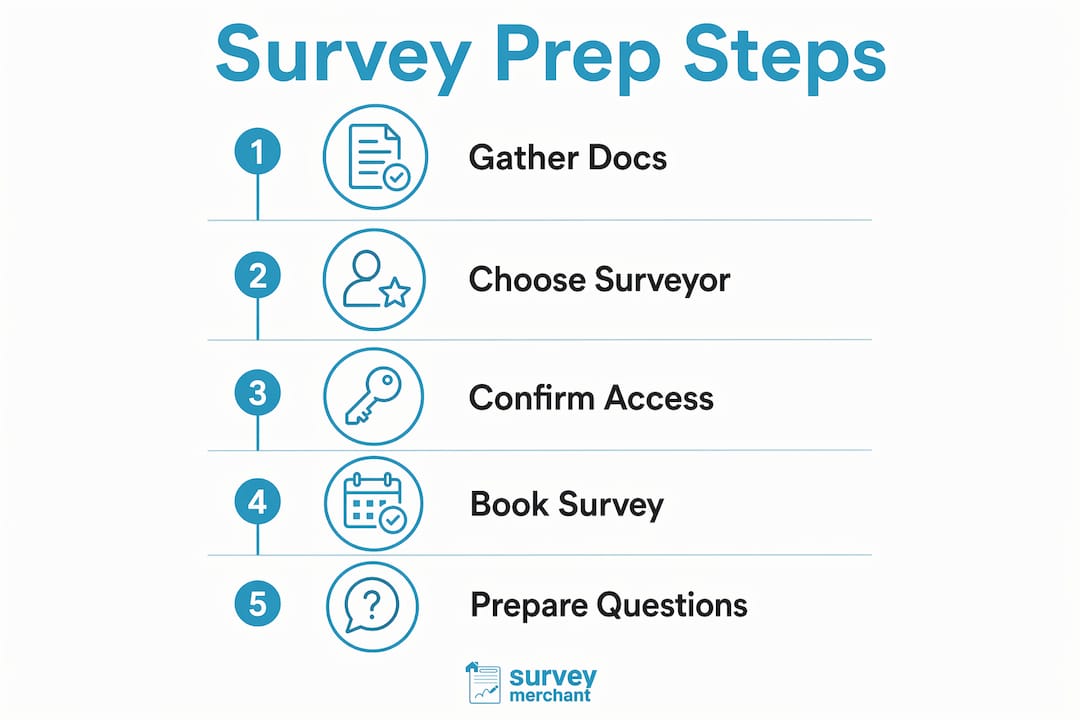
Selecting the right surveyor matters as much as gathering the right documents. RICS-accredited surveyors follow regulated professional standards, which means their reports carry legal weight and are defensible if disputes arise. Always verify a surveyor’s RICS membership on the official RICS register before booking.
Coordinating access is the step most buyers overlook. The seller or letting agent must confirm that all rooms, the loft, the cellar, and any outbuildings are accessible on the day. Clear access to all areas prevents incomplete inspections and avoids costly return visits. Read Surveymerchant’s guide on preparing your home for a practical pre-survey checklist.
Pro Tip: Book your surveyor the moment your offer is accepted. Survey slots fill quickly in busy markets, and delays can push back your entire completion timeline.
The step-by-step survey process follows a logical sequence from booking through to receiving your written report. Here is what to expect at each stage.
Book the survey immediately after offer acceptance. Booking promptly after acceptance maintains momentum and reduces the risk of delays caused by surveyor availability or market demand.
Confirm the survey level with your surveyor. Discuss the property’s age, size, and condition. Older or larger properties almost always warrant a Level 3 Building Survey.
Arrange access with the seller or estate agent. Confirm the date, time, and which areas must be unlocked. Loft hatches, meter cupboards, and underfloor access points are frequently missed.
Exterior inspection (approximately 30–60 minutes). The surveyor examines the roof covering, chimney stacks, guttering, external walls, windows, and drainage. They look for cracks, damp staining, and signs of subsidence.
Interior inspection (approximately 1–4 hours depending on survey level). Rooms are assessed for damp, structural movement, ceiling condition, floor integrity, and the state of services such as electrics and plumbing. A comprehensive property inspection covers building materials, quality, condition, and red flags such as water damage or structural cracks.
Roof space and subfloor inspection. The surveyor accesses the loft to check rafters, insulation, and signs of water ingress. Subfloor voids are inspected where accessible.
Documentation and photography. Every defect is recorded with notes and photographs. This forms the evidence base for the written report.
Report delivery. Timelines vary by survey level. A Level 1 survey takes roughly one hour on-site and suits newer properties in good condition. A Level 2 Homebuyer Report takes 2–4 hours on-site, with the report delivered within 3–5 working days. A Level 3 Building Survey takes 4–8 hours on-site, with a report turnaround of up to 8 working days.
Pro Tip: Ask your surveyor in advance which areas they cannot access due to fitted furniture or fixed coverings. This prevents gaps in the report that could mask serious defects.
A survey report is only useful if you know what to look for. Most RICS-formatted reports use a traffic light condition rating system: Condition 1 (no repair needed), Condition 2 (repairs or maintenance required), and Condition 3 (serious defects requiring urgent attention).
A typical valuation report contains a property description, market analysis, comparable sales data, and a final market value conclusion. Survey reports follow a similar structure but focus on physical condition rather than price.
Key red flags to watch for in any survey report:
Once you have identified Condition 3 items, obtain at least two independent repair quotes before proceeding. Use those quotes to renegotiate the purchase price or request that the seller completes repairs before exchange. For renovation planning, the survey report becomes your priority list. Surveymerchant’s guide on reading a building survey report explains how to translate technical findings into practical decisions.
Most survey problems are avoidable. The mistakes below account for the majority of incomplete or misleading reports.
Pro Tip: If your surveyor flags a Condition 3 defect but cannot fully assess it due to access limitations, commission a specialist report before exchanging contracts. A structural engineer’s report typically costs £300–£600 and can save tens of thousands.
Choosing the correct survey level is the single most consequential decision in the home survey process. The table below compares all three RICS-defined levels.
| Survey Level | On-Site Time | Report Turnaround | Best For | Typical Cost Range |
|---|---|---|---|---|
| Level 1 Condition Report | ~1 hour | 1–2 working days | New builds, modern properties in good condition | £300–£500 |
| Level 2 Homebuyer Report | 2–4 hours | 3–5 working days | Standard properties built post-1900 in reasonable condition | £400–£800 |
| Level 3 Building Survey | 4–8 hours | Up to 8 working days | Older, larger, or non-standard properties; renovation projects | £600–£1,500+ |
A Level 3 Building Survey is the most thorough option and is strongly recommended for any property built before 1930, any property with visible defects, or any home you plan to renovate significantly. Surveymerchant’s Level 3 Building Survey service connects you with RICS-accredited surveyors who provide detailed, defensible reports.
Beyond the three standard levels, specialist surveys address specific risks. A damp and timber survey is worth commissioning if the Level 2 or Level 3 report flags moisture issues. A drainage survey (CCTV) is advisable for older properties where root ingress or collapsed pipes are plausible. For renovation projects, a pre-renovation inspection helps you scope works accurately before instructing contractors.
Valuation methods include the market (sales comparison), income, and cost approaches. Understanding which method your mortgage lender’s valuer uses helps you interpret any gap between the surveyor’s condition findings and the lender’s mortgage valuation figure.
A thorough home survey, conducted by a RICS-accredited professional at the correct level, is the most reliable way to protect your investment and plan any renovation with confidence.
| Point | Details |
|---|---|
| Choose the right survey level | Match the survey level to the property’s age, size, and condition to avoid missed defects. |
| Prepare thoroughly before the visit | Gather title deeds, floor plans, and prior reports, and confirm full access to all areas. |
| Book immediately after offer acceptance | Early booking prevents delays caused by surveyor availability in competitive markets. |
| Act on Condition 3 findings | Obtain repair quotes and use them to renegotiate price or request seller remediation. |
| Commission specialist surveys when flagged | Damp, drainage, and structural specialist reports resolve gaps a standard survey cannot cover. |
The survey is the one part of the buying process where first-time buyers consistently cut corners, and it is the decision they most often regret. I have seen buyers choose a Level 1 Condition Report on a 1960s semi-detached because it was £200 cheaper than a Homebuyer Report. Three months after completion, they discovered failing cavity wall insulation, a defective flue, and rising damp in the rear extension. The repair bill exceeded £18,000.
The fear is understandable. By the time you reach the survey stage, you have already spent money on solicitors and mortgage applications. The survey feels like another cost on top of costs. But the survey is not a cost. It is the only independent, professional assessment of what you are actually buying.
There is also a misunderstanding about what a mortgage valuation does. A mortgage valuation tells your lender whether the property is worth the loan they are about to issue. It does not tell you whether the roof is failing or whether the drains are blocked. Those are two entirely different documents serving two entirely different purposes. Conflating them is the most expensive mistake a first-time buyer can make.
My advice: always commission a Level 2 at minimum, regardless of how new or tidy the property looks. And if the surveyor recommends a specialist follow-up, take it seriously. That recommendation is not upselling. It is professional caution, and it is there to protect you.
— Surveymerchant
Surveymerchant connects UK buyers and homeowners with RICS-accredited surveyors across the country, matching you to the right professional for your property type and budget.

Whether you need a Level 2 Homebuyer Report for a modern flat or a full Level 3 Building Survey for an older property, Surveymerchant’s panel covers residential and commercial properties nationwide. If you also need a formal property valuation for mortgage or probate purposes, Surveymerchant’s RICS valuation services provide certified reports accepted by major UK lenders. Get in touch today to find a qualified surveyor and move forward with confidence.
A home survey is a professional assessment of a property’s physical condition, carried out by a qualified surveyor. It is not a legal requirement in the UK, but it is strongly recommended before any purchase or major renovation.
Survey duration depends on the level chosen. A Level 1 survey takes approximately one hour, a Level 2 takes 2–4 hours, and a Level 3 Building Survey takes 4–8 hours on-site.
No. A mortgage valuation confirms the property’s value for the lender and does not assess structural condition or identify defects. A separate survey is always needed for buyer protection.
Obtain at least two independent repair quotes for any Condition 3 items. Use those quotes to renegotiate the purchase price, request seller repairs before exchange, or withdraw from the purchase if costs are prohibitive.
Use the RICS official register to verify accreditation, or use a platform like Surveymerchant to be matched with a vetted, RICS-accredited surveyor suited to your property type and location.
Survey Merchant provides vetted RICS surveyors across 100+ UK locations at fixed fees:
→ Level 2 Home Survey (HomeBuyer Report)
→ Level 3 Building Survey (full structural survey)
→ RICS Red Book property valuations
→ Party wall surveyors — notices, awards & schedules of condition
→ Expert witness surveyors — CPR Part 35 reports for property disputes