Building Surveying
Jul 22, 2026
Demystifying property survey terminology for UK buyers
Confused by property survey terminology? Our guide simplifies the jargon, helping UK buyers read reports confidently and avoid costly surprises.

Misunderstood survey language is one of the most overlooked causes of stress, delay, and costly surprises in UK property transactions. Buyers often receive a detailed report full of technical phrases and grading systems, assume everything is straightforward, and then find themselves blindsided after completion. Understanding exactly what your surveyor means when they write “not inspected,” “condition rating 3,” or “further investigation recommended” is not optional. It is essential. This guide explains the terminology clearly so that you can read any survey report with confidence and act on it wisely.
| Point | Details |
|---|---|
| Survey terms matter | Knowing what the language in your survey report means is crucial to making safe, informed property decisions. |
| Three survey levels | Level 1, 2, and 3 surveys each use specific terms to signal what is—and isn’t—covered. |
| Inspection limits exist | Surveys are visual only and cannot guarantee against hidden problems without further specialist tests. |
| Updates underway | Survey terminology is evolving to better serve modern and complex property types. |
| Benchmarks help context | Understanding UK housing stock issues like damp gives essential perspective to what your survey reveals. |
A property survey is one of the most significant documents you will encounter when buying or owning a home. Yet most people spend less time reading it than they do browsing property listings. The language inside can be dense, qualified, and at times frustratingly vague. That vagueness is not accidental. It reflects the genuine limits of what a surveyor can inspect without dismantling walls or testing hidden systems.
Confusion most commonly arises around a handful of recurring issues:
These misunderstandings create real risk. A buyer who ignores a “further investigation recommended” note regarding roof timbers may complete a purchase without appreciating that full structural repairs could cost tens of thousands of pounds. For a thorough grounding in what surveys involve, the property surveys explained guide on our site covers the full scope.
“Survey reports are visual inspections only and may include items marked as ‘not inspected’ when access is unavailable. They cannot replace specialist testing for certain issues such as hidden defects, asbestos, or gas safety.”
Pro Tip: Always read the limitations section of your survey report before the findings. It tells you precisely what the surveyor could not see, and that shapes everything else you read.
The stakes are high for both buyers and sellers. A buyer armed with clear terminology can negotiate, seek specialist advice, or walk away. A buyer who misreads the report may proceed unaware.
One of the most important terms you will encounter is the Home Survey Standard. This is the framework developed by RICS (the Royal Institution of Chartered Surveyors) that governs how residential surveys in England, Wales, Scotland, and Northern Ireland are structured and reported. RICS survey levels are described using three tiers, and knowing the difference between them changes how you interpret every word in the report.
Here is what each level covers at a glance:
| Survey level | Common name | Best suited for | Depth of inspection |
|---|---|---|---|
| Level 1 | Condition Report | New builds, straightforward homes | Basic visual overview |
| Level 2 | HomeBuyer Report | Standard construction homes | More detailed, some testing |
| Level 3 | Building Survey | Older, unusual, or complex homes | Thorough, with advice on defects |
The three levels work as follows:
Level 1 (Condition Report): This is the lightest option. It flags obvious issues using a traffic light system but offers little narrative or context. It will not tell you why a problem exists or what it will cost to fix. It is appropriate for newer homes in clearly good condition, but not for anything with age or complexity.
Level 2 (HomeBuyer Report): This is the most popular choice for standard UK homes. It includes a more detailed written assessment, moisture readings, and some commentary on defects. It still excludes hidden areas and specialist systems, but gives you a practical picture of the property’s condition at the time of inspection.
Level 3 (Building Survey): This is the most detailed residential survey available. The surveyor investigates accessible roof spaces, subfloor voids, and structural elements. The report provides advice on repair options and likely costs. For any pre-1930s home, a converted building, or a property with visible defects, this is the level you should choose.
For more detailed guidance on selecting the right option, our article on choosing the right survey lays out the decision clearly. If you are specifically considering a Level 3, the dedicated building surveys explained resource covers the process in full.
Pro Tip: If a seller or estate agent says “a survey has already been done,” always ask which level it was. A Level 1 report on a Victorian terrace tells you almost nothing about its structural integrity.
Once you understand the survey tiers, the next step is reading the actual language inside a report. Certain phrases appear in almost every survey and carry specific meanings that are easy to misinterpret.
Here is a reference table for the most commonly encountered terms:
| Term | What it actually means |
|---|---|
| Condition rating 1 | No repair needed at this time |
| Condition rating 2 | Repair or maintenance needed, not urgent |
| Condition rating 3 | Serious defect requiring urgent attention |
| Not inspected | The area was inaccessible at time of inspection |
| Further investigation recommended | A specialist should assess this before you proceed |
| Visual inspection only | The surveyor did not open, probe, or test the element |
| Significant defect | A fault that could affect the property’s value or safety |
| Exposure to weather | Risk of water ingress or deterioration without intervention |
The phrase “not inspected” is perhaps the most misread term in any survey report. It does not mean the area is fine. It means the surveyor could not see it. As inspection limitations make clear, surveys are visual inspections and areas without access are simply excluded from findings. This means a sealed roof void, a locked cellar, or a built-in wardrobe covering a section of external wall may all contain undisclosed problems.
Condition ratings work like a traffic light system:
The new RICS Home Survey Standard has helped standardise how these ratings are applied, but interpretation can still vary slightly between surveyors. The Level 2 survey detail article explains exactly how a Level 2 report presents these ratings in practice.
One more phrase that deserves attention is “legal issues noted.” This appears when the surveyor observes something that may have planning, building regulations, or legal implications, such as an extension without visible consent documentation. It is not a legal opinion, but it is a signal to involve your solicitor immediately.

Survey terminology is not static. The language used in RICS reports has been changing, and understanding why matters particularly if you are buying an older, listed, or energy-retrofitted property.
The Home Survey Standard has been undergoing significant review. As RICS has noted, the survey standard terminology and scope of the tiers have been under active revision, with a second edition work programme aimed at clearer delineation and better coverage of special property types. This means the language you see in a report produced in 2025 or 2026 may differ slightly from one produced in 2020.
Some of the key areas receiving greater attention include:
“The second edition work programme within the Home Survey Standard is designed to address the growing complexity of the UK housing stock, particularly where retrofitting and heritage constraints intersect.”
The practical impact for buyers is real. If you are purchasing a 1960s prefab bungalow or a grade II listed farmhouse, you need a surveyor who not only understands the technical language of the new standard but who also has hands-on experience with that construction type. For further reading on how the standard is developing, our RICS survey standard updates article covers the changes in plain English.
Survey language does not exist in isolation. It connects to real-world conditions that affect millions of UK properties. Understanding the benchmarks behind the terminology gives you much better context when you read a report’s findings.
Damp is one of the most frequently cited issues in UK surveys. English Housing Survey findings confirm that damp prevalence is a meaningful and growing concern across England’s housing stock, affecting a significant proportion of the existing dwelling base. When your survey flags moisture readings above recommended levels, this is not a rare finding. It is one of the most common defects in the country, and one that ranges from superficial condensation to serious penetrating or rising damp requiring structural treatment.
Common pitfalls that buyers fall into when misreading survey terminology include:
Category 1 hazards, a term from the Housing Health and Safety Rating System (HHSRS), may appear in survey reports and mortgage valuations. These represent the most serious risks to occupants, including structural collapse, carbon monoxide exposure, and excess cold. If you see this term in any document relating to a property, take it seriously and seek specialist advice before proceeding. For first-time buyers particularly, the Level 2 survey for first-time buyers resource explains what to look for and how to respond to common findings.
“A property survey is not a guarantee. It is a professional opinion based on accessible evidence at a specific point in time.”
Pro Tip: If your survey recommends any specialist investigation, get it done before exchange of contracts, not after. Post-exchange, you have almost no negotiating power and any surprises become your problem.
Making sound property decisions relies on more than just the survey itself. Location, infrastructure, and the wider condition of similar homes in the area all feed into how you should weigh what the report tells you.
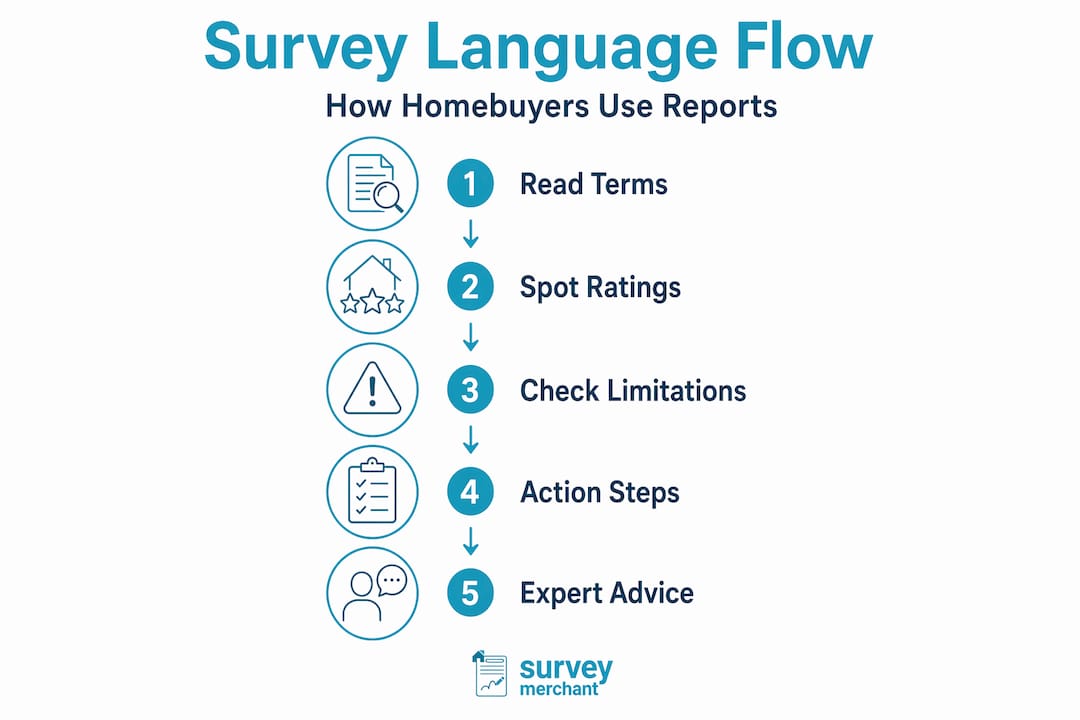
Across thousands of property transactions, one consistent pattern emerges. Buyers misread surveys not because they are uninformed, but because they expect surveys to do something they were never designed to do.
A Level 1 or Level 2 survey will not catch every fault in a property. It was not designed to. It is a structured visual inspection with defined scope and explicit limitations. The moment you expect it to be a comprehensive audit of everything that could possibly be wrong, you will be disappointed.
The most damaging mistake surveyors see is buyers who read a Level 2 report with no condition rating 3 items and conclude the property is essentially problem-free. What they have actually learned is that nothing seriously wrong was visible on the day of inspection, in the accessible areas, under the conditions present at the time. That is a very different statement.
Precision in reading survey language also protects you commercially. When a report says “further investigation recommended” for roof timbers, that note is the surveyor giving you a legitimate basis to request a structural engineer’s report before exchange. If the investigation reveals a problem, you can renegotiate or withdraw. Ignoring the note removes that option entirely.
Our practical advice is this: focus your attention on limitation language and action recommendations, not just the condition ratings. The ratings summarise visible findings. The limitations tell you where the report’s authority ends. Both are equally important.
For guidance on making the right survey choice from the outset, our choosing the right survey type article walks you through the decision step by step.
Understanding survey terminology is only half the equation. Acting on it with the right professional support is what protects your investment.

At Survey Merchant, we connect you with qualified, experienced surveyors across the UK who can carry out the appropriate level of inspection for your property and explain their findings in plain language. Whether you need a thorough Level 3 survey service for an older or complex home, or want to explore the full range of building surveying services we offer, our panel of specialists is ready to help. Getting the right survey, interpreted correctly, is the single most effective step you can take before committing to a property purchase.
‘Condition rating’ summarises how urgent a repair or issue is, using a colour-coded scale: green (no repair needed), amber (attention needed but not urgent), and red (serious attention required). The RICS Home Survey Standard uses this three-tier system across Level 1, 2, and 3 reports to help buyers prioritise findings.
These terms mean the surveyor either could not access that area or has identified a potential concern requiring specialist assessment. As survey inspection limitations confirm, you should commission appropriate specialist investigations before exchanging contracts.
No. Standard RICS surveys are visual only and explicitly exclude hidden defects that require destructive investigation or specialist testing. Standard RICS surveys cannot confirm the absence of asbestos, gas leaks, or other concealed hazards without separate specialist certification.
RICS is updating the Home Survey Standard to make language clearer and more consistent, particularly for non-standard and heritage properties. The second edition review focuses on better delineation between survey tiers and improved coverage of specialist property types.
Yes. 1.4 million dwellings in England had a problem with damp in 2024, representing around 5% of the housing stock and an increase from previous years. Damp remains one of the most frequently flagged issues in residential survey reports across the country.
Survey Merchant provides vetted RICS surveyors across 100+ UK locations at fixed fees:
→ Level 2 Home Survey (HomeBuyer Report)
→ Level 3 Building Survey (full structural survey)
→ RICS Red Book property valuations
→ Party wall surveyors — notices, awards & schedules of condition
→ Expert witness surveyors — CPR Part 35 reports for property disputes