Building Surveying
Jul 22, 2026
Understanding building surveys: essential guide for UK buyers
Discover what a building survey is and why it's crucial for UK buyers. Protect your investment with insights from our essential guide.

Buying property is one of the most significant financial commitments most people ever make, yet a surprising number of UK buyers treat surveys as an afterthought. Many assume a mortgage valuation offers meaningful protection, or that all surveys are essentially the same document under different names. That misunderstanding costs buyers thousands of pounds every year in unforeseen repair bills, failed sales, and legal complications. This guide cuts through the confusion, explaining exactly what a building survey is, what it covers, and how to use it as a powerful tool rather than a formality.
| Point | Details |
|---|---|
| Full property assessment | A building survey provides an in-depth review of a property’s condition, including hidden risks. |
| Informed buying decisions | Survey insights help you negotiate better terms or avoid costly mistakes. |
| Legal and financial protection | Surveys support legal compliance and help prevent expensive surprises post-purchase. |
| Choosing the right survey | Level 2 and Level 3 surveys suit different properties and buyer needs—know the difference before commissioning. |
A building survey is an in-depth, professional assessment of a property’s condition, carried out by a qualified surveyor. Unlike a mortgage valuation, which exists purely to reassure a lender that the property is worth what you are paying, a building survey works for you. It examines the fabric of the building, identifies defects, flags potential risks, and gives you a clear picture of what you are actually buying.
The scope of building surveying services goes well beyond a quick visual check. A surveyor will inspect the roof structure, walls, floors, windows, drainage, and outbuildings. They assess materials, construction methods, and signs of deterioration that an untrained eye would simply miss.
Building surveys are particularly important for:
| Survey feature | Mortgage valuation | Building survey |
|---|---|---|
| Purpose | Protects the lender | Protects the buyer |
| Depth of inspection | Very limited | Full structural and condition review |
| Report detail | Minimal | Detailed with recommendations |
| Identifies hidden defects | Rarely | Yes, where accessible |
| Cost to buyer | £150 to £300 approx | £500 to £1,500+ |
Understanding building surveyor roles helps clarify why this level of scrutiny adds real value. A chartered building surveyor brings training in construction, materials science, and defect analysis that makes their findings genuinely actionable.
Pro Tip: Always verify your surveyor holds RICS (Royal Institution of Chartered Surveyors) membership before instructing them. RICS members follow strict professional standards and carry professional indemnity insurance, which protects you if something is missed.
With a clear definition in mind, you might wonder how a building survey stacks up against other surveys. The UK market currently offers surveys across three levels, but the most relevant choice for most buyers is between Level 2 and Level 3.
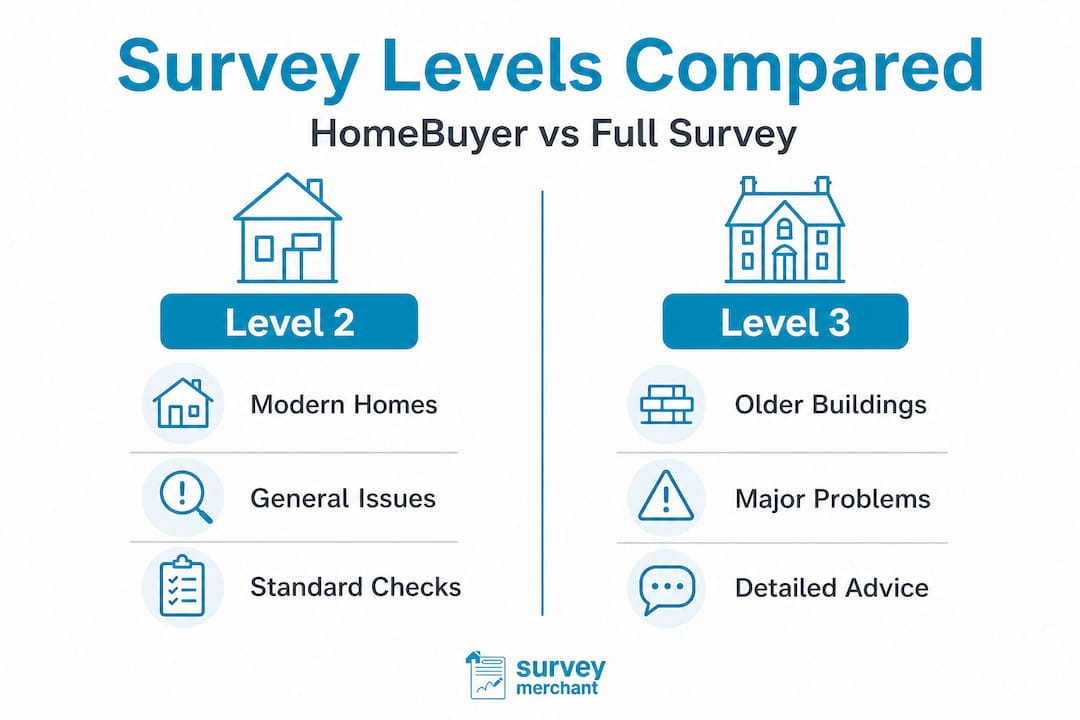
Different property surveys suit different property types and buyer needs, and picking the wrong one is a common and costly mistake. Here is how the two main options compare:
| Feature | Level 2 (HomeBuyer report) | Level 3 (Full building survey) |
|---|---|---|
| Scope | Standard modern properties | Older, unusual, or altered properties |
| Detail level | Condition ratings with commentary | Full narrative with repair guidance |
| Includes property valuation | Optional add-on | Not standard |
| Typical cost | £400 to £900 | £700 to £1,500+ |
| Best for | Post-1930s homes in good condition | Pre-1930s, non-standard, or extended |
| Highlights defects | Yes, visible ones | Yes, plus investigation recommendations |
Choosing the right level is not just about cost. A Level 2 survey on a Victorian terraced house with a converted loft and rear extension may simply not go far enough, leaving serious structural problems undetected.
How to choose the right survey in four steps:
Exploring survey examples from real purchase scenarios can help make this decision clearer. If you are still uncertain about whether a condition survey or structural survey better fits your situation, reviewing the condition vs structural surveys breakdown gives useful additional context.
Understanding the types of surveys, let’s take a closer look at exactly what you get with a building survey. The report is thorough and examines the property element by element, giving each a condition rating and explaining what action, if any, is required.
A typical Level 3 building survey covers:
Frequent issues found during building surveys include damp, subsidence, and poor alterations, and these are precisely the findings that save buyers from financial disaster. Damp alone can cost between £500 and £15,000 to remedy depending on cause and extent. Subsidence remediation regularly exceeds £20,000. These are not theoretical risks; they are documented findings in thousands of UK surveys each year.
Understanding construction concepts explained through accessible resources can also help you interpret your surveyor’s language when the report lands.
“A building survey is more than a report. It is peace of mind for buyers, clarity on condition, and the foundation for smarter decisions at every stage of the purchase.”
The most valuable findings are often the ones that are invisible on a viewing day. A beautifully decorated kitchen can hide wall ties that have corroded. A fresh coat of paint may be concealing rising damp. A surveyor’s thermal imaging equipment and moisture meter reveal what the eye simply cannot.

Now that you know what a building survey covers, it is critical to see why it is such a vital part of the UK property buying process. The financial logic alone is compelling.
Consider this: a Level 3 survey costs, on average, between £700 and £1,200 for a standard residential property. The average cost of remedying a significant defect missed at purchase is approximately £8,000 to £30,000. The return on that initial investment is obvious once you frame it that way.
Five reasons why skipping a survey is a false economy:
There is no legal requirement in England and Wales for buyers to commission a survey, but there is a strong practical one. Scotland operates under a different system, where sellers provide a Home Report including a survey before marketing. Even so, buyers in Scotland can and do commission independent surveys for added assurance.
Pro Tip: If your survey uncovers significant issues, do not walk away automatically. Use the findings to renegotiate the purchase price or ask the seller to carry out repairs before exchange. Understanding how to choose a surveyor effectively will also help you find a professional who can advise you on how best to respond to their findings.
Having established the value of a building survey, let’s turn to making its insights work for you as a buyer.
Before the survey, ask your surveyor these questions:
That last point is particularly valuable. A verbal briefing on survey day means you hear the critical issues first, in plain language, before the written report arrives. This gives you time to think before committing to a course of action.
On survey day, ensure the following are accessible:
Once the report arrives, read it in full, including the small print on limitations. Pay particular attention to items flagged as Category 3 (requiring urgent attention) and any recommendations for specialist investigations. How to select the right building surveyor for property purchases gives detailed guidance on finding a professional who will explain these findings clearly, not bury them in technical language.
Pro Tip: Get repair cost estimates from contractors before going back to the seller. Armed with real quotes, your renegotiation position is far stronger than simply saying “the survey found problems.” Figures talk.
For buyers in London or other high-value markets, hiring a chartered building surveyor with specific local knowledge of period properties and planning complexities can make a substantial difference to the quality and usefulness of the report you receive.
Most buyers treat the building survey as a box to tick on the solicitor’s checklist. They instruct a surveyor, wait for the report, skim the summary, and move on. That approach wastes one of the most powerful tools available in any property negotiation.
Here is the reality: the survey report is a legally grounded, professionally produced analysis of the property’s weaknesses. It is also a price renegotiation document, a future maintenance schedule, and an insurance planning tool, all in one. Buyers who treat it as such consistently get better outcomes than those who do not.
Buyers have saved between £5,000 and £40,000 off agreed purchase prices by using specific survey findings as the basis for revised offers. Buyers have also avoided catastrophic purchases entirely, where the survey revealed structural movement so serious that no remediation figure could make the deal viable. Both outcomes represent the survey doing its job.
What surprises most people is that minor findings often carry the biggest long-term risk. A damp reading in a basement that is dismissed as “minor” can indicate a failed tanking system that will cost £8,000 to £12,000 to resolve. A small crack in a gable end wall that “might” be historic movement will need a structural engineer’s opinion before any lender will proceed. These are not dramatic discoveries. They are the quiet ones that spiral.
The value building surveyors bring goes well beyond the day of inspection. The best surveyors are willing to answer follow-up questions, signpost appropriate specialists, and help you interpret what their findings mean for your specific situation. If yours is not doing that, you have the wrong surveyor.
Knowing what to look for is one thing. Having the right professional in your corner is another entirely. Survey Merchant connects UK property buyers with RICS-qualified surveyors who deliver thorough, clear, and actionable building survey reports across residential and commercial property types.

Whether you need a full building survey for a Victorian townhouse, a rural farmhouse, or a converted commercial space, Survey Merchant’s panel of specialists is matched to your property type and location. Every instruction goes through a quality assurance process, ensuring you receive the level of scrutiny your purchase deserves. Explore the full range of surveying solutions and request your survey today. Informed buyers make better decisions, and better decisions start with the right survey.
A building survey is not lawfully required but is strongly advised, especially for older, extended, or non-standard properties where hidden defects are far more likely.
A full Level 3 building survey typically takes between two and five hours on site, with the written report delivered within five to seven working days.
A building survey is thorough but cannot inspect concealed or fully inaccessible areas. Surveyors identify and flag common problems found and recommend specialist investigations where further access is needed.
You can use the findings to renegotiate the purchase price, request that the seller carries out repairs before exchange, or withdraw from the purchase entirely, often without financial penalty at the pre-exchange stage.
A building survey reviews the overall condition and all identified risks across the entire property, while a structural survey is more targeted and focuses specifically on structural elements such as foundations, load-bearing walls, and frames.
Survey Merchant provides vetted RICS surveyors across 100+ UK locations at fixed fees:
→ Level 2 Home Survey (HomeBuyer Report)
→ Level 3 Building Survey (full structural survey)
→ RICS Red Book property valuations
→ Party wall surveyors — notices, awards & schedules of condition
→ Expert witness surveyors — CPR Part 35 reports for property disputes